Summer 2026 issue now online
-Who Will Pay for Electricity Infrastructure
-The Permitting Trap
-Lessons from the Plaza Accord
-Apple's Reckoning with China
-Financing Reindustrialization
-Modernizing EXIM
-The Politics of Protected Assets
-A Dynamic Elite?
https://t.co/b6EaPz8KKZ
“Imperative: Forge a Western Hemisphere Energy Alliance” — @EconAtState Assistant Secretary Caleb Orr discusses the administration’s regional energy objectives with @AmericanAffrs executive editor Daniel Bring at the Energy Imperatives Summit on June 10.
“Imperative: Forge a Western Hemisphere Energy Alliance” — @EconAtState Assistant Secretary Caleb Orr discusses the administration’s regional energy objectives with @AmericanAffrs executive editor Daniel Bring at the Energy Imperatives Summit on June 10.
Through @NRCgov and Chairman Nieh’s leadership, I’m confident that a positive cultural shift towards harnessing the full breadth of nuclear power is upon us.
Thank you, @AmericanAffrs, for hosting such timely discussions on American energy dominance at this pivotal moment for the industry.
“Even if Apple under Ternus successfully navigates the political pressures on both sides, satisfying [DC] and Beijing enough to retain market access, it may find that the market it spent so much political capital protecting has already moved against it,” writes @isaacstonefish.
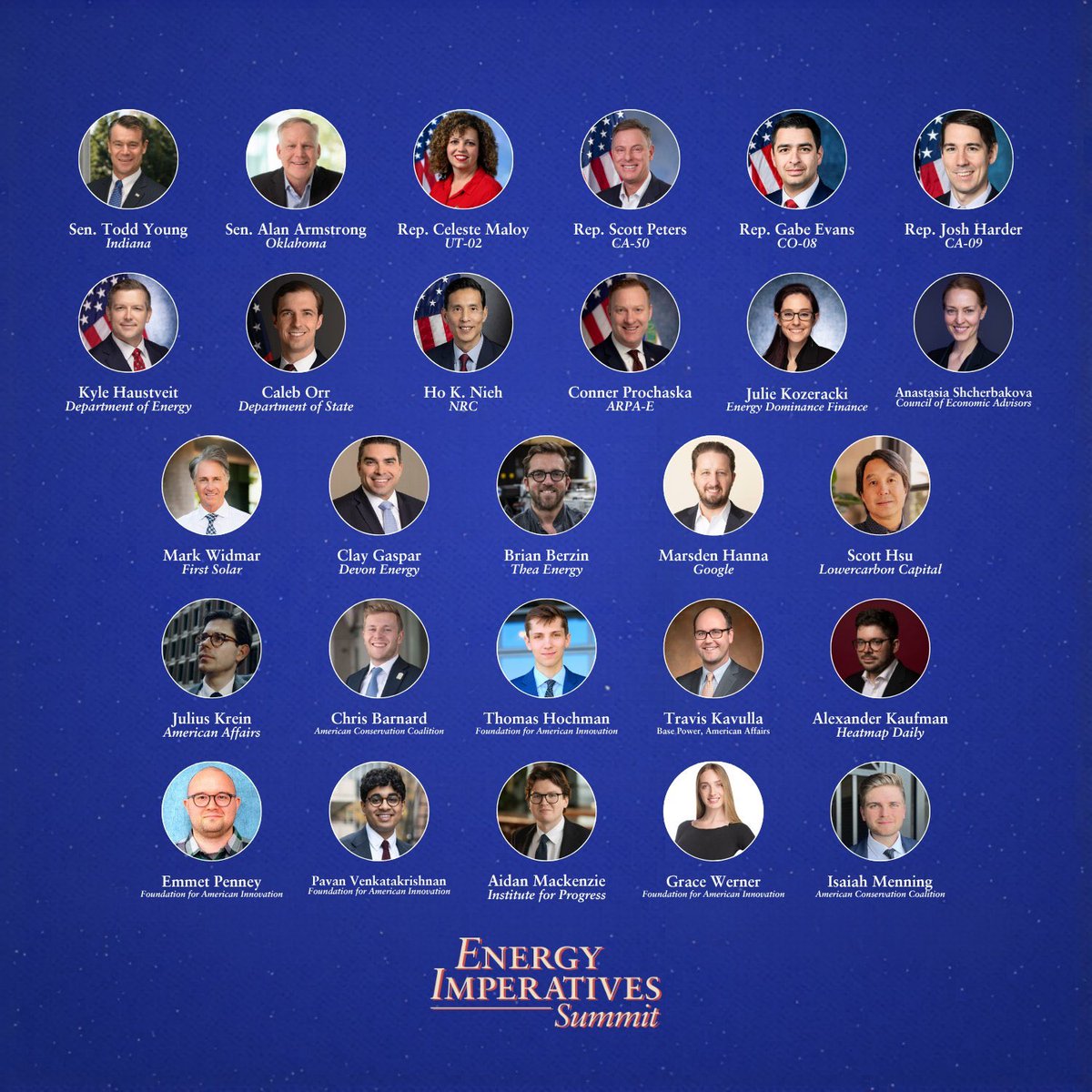
Our speaker line up is stacked ⚡️
The Energy Imperatives Summit kicks off June 9–10 at the Capital Hilton in Washington, D.C.
Register now to hear from the leaders shaping the future of American energy.
“The Plaza Accord of 1985 and the diplomatic campaign that surrounded it succeeded in rapidly reversing the trade deficit. But the success did not last,” writes Michael Starr.
“Our nation has built a political environment in which every form of generation and load can be stalled, canceled, or delegitimized, and in which even approvals often fail to deliver finality,” writes @ppavnr.
“Our permitting laws cut off the president’s ability to succeed by delivering new projects, but they offer him readymade authority to block projects. This creates a political incentive to prefer abuse,” writes @AidanRMackenzie.
“The common thread underlying each element is the infrastructure—generators, wires, transformers, and other gear—that keep the lights on… while everyone agrees that an electricity buildout is needed, everybody thinks somebody else should pay for it,” writes Tim Fitzgerald.
“The rising power demand of the data center industry almost appears like an industry running within the integrated grid but outside the usual paradigm of the traditional electric utility sector. Indeed, it should be treated as such,” writes @TKavulla. https://t.co/hQLnOeUhuc
“The rising power demand of the data center industry almost appears like an industry running within the integrated grid but outside the usual paradigm of the traditional electric utility sector. Indeed, it should be treated as such,” writes @TKavulla. https://t.co/hQLnOeUhuc





![AmericanAffrs's tweet photo. “Even if Apple under Ternus successfully navigates the political pressures on both sides, satisfying [DC] and Beijing enough to retain market access, it may find that the market it spent so much political capital protecting has already moved against it,” writes @isaacstonefish. https://t.co/uRoDd5VTaD](https://pbs.twimg.com/media/HJ6kFz0W8AAtAj9.jpg)