Three weeks ago, @JaneAFlegal and I wrote a piece for the WSJ outlining the reforms that should be in a permitting deal and the urgency of passage this Congress, especially for Dems. The Bipartisan American Affordability and Jobs Act of 2026 meets the moment.
Thanks, @ChronOpinion. BAAJA may not be perfect, but this is the best opportunity we've had in years to take meaningful action on energy costs and to build the infrastructure we need. We should not miss it.
👀 Heinrich on key Dems opposing permitting: “But the majority of people said we're going to govern for the American people. That's a lesson for the party as a whole-Are we actually going to govern for the American people, or are we going to be led around by the internet fringe?"
Gotta believe BAAJA resets the CW regarding big bipartisan dealmaking generally. Anything is possible when members of stature are committed to the exercise, the substance is good, and key players recognize urgency (whether as a matter of politics, policy, or procedure)
I know smart scientists who work at NRDC. While I still respect the work of those individuals, this makes it hard to trust the organisation and the research that comes out of there.
How can one be the face of “the science” with such bad epistemics? Just disagree on the facts.
NEPA is more like “look before you leap…wait, look some more…okay, now you can leap…hold on, someone says we need to look again…okay, now you can leap…wait, another group says we didn't look hard enough…okay, look some more… now you can leap.”
The Senate passing permitting is absolutely historic! Let's take a second to remember how long folks have been trying to get major permitting & transmission reforms: 🧵
For 50 years presidents have been frustrated by slow permitting and wanted to expand the grid. But for decades environmental and utility opposition made reform impossible
– 1971: Nixon asked Congress to reform transmission. But Congress never voted on the proposal (environmental and state's rights concerns blocked it)
– 1979: President Carter tried to get reforms to speed up energy approvals and judicial review to fix "endless roadblocks." Environmentalists opposed and the bill died in the House in 1980
– 2001: President Bush sought reforms for transmission developers to acquire land (Congress delayed until 2005)
– 2005: Following a massive blackout in 2003, Congress finally acted to boost grid development In the Energy Policy Act of 2005. However, the bill was change to add language that undercut the federal backstop for transmission (the process never built any lines)
– 2009: Obama asked Congress to facilitate building out the grid but Congress's proposal to give FERC siting authority never passed (utilities and environmental groups opposed)
– 2011: After permitting slowed economic recovery projects Obama said "Shovel-ready was not as shovel-ready as we expected"
– 2011-2024: FERC attempted to act to facilitate new interregional lines. However, FERC Order 1000 has failed to produce even a single line
– 2015: Congress passed the FAST Act, which created FAST-41. But Congress declined to add major reforms to judicial review or touch the underlying permitting laws
– 2018: Trump's request to limit reviews to 2 years was never taken up by Congress
– 2022: Despite ongoing delays to infrastructure and climate projects, the Senate voted down the Manchin-Biden-Schumer permitting reform & transmission proposal (Opposition from environmentalists and transmission opponents)
– 2023: Congress declined to include major reforms in the Fiscal Responsibility Act (added only very minor changes)
– 2024: The Manchin-Barrasso bipartisan permitting & transmission bill never got a floor vote
The reforms in BAAJA are transformative and historic. This Congress is on the cusp of reform that has been impassive for over 50 years
https://t.co/3Din3iDIRh
An interesting subplot of this unlikely buddy comedy is that the'll each move on from their posts heading energy/environment oriented BAAJA committees of jurisdiction and onto a shared dais leading the Judiciary committee.
Tapping the sign in light of the fact that 15 Democratic Senators, soon to be followed by several dozen of their colleagues in the House, voted for a bill that would have been unthinkable just two years ago in spite of a great many incentives pointing toward a nay.
15 Dem ayes or nearly a third of the 47-member Senate Democratic Caucus. An impressive feat under any circumstances but especially so given the scale of the legislation & the fact that its passage came on the heels of a once in a generation Dem wave.
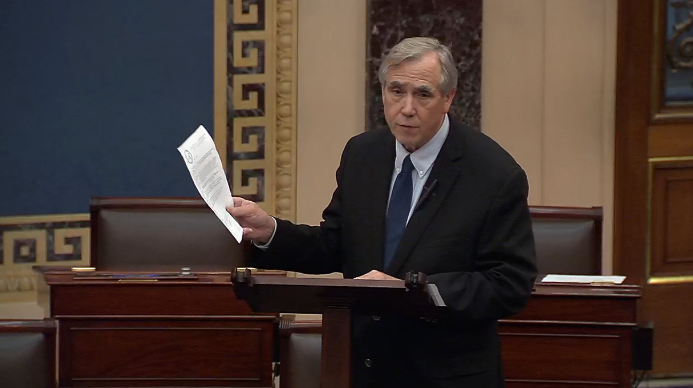
Earlier on Thursday, Sen. Jeff Merkley D-OR was part of a news conference calling for rules changes to make it easier to get bipartisan bills to the Senate floor.
Now he's standing solo on the Senate floor - blocking bipartisan amendments to the permitting reform bill.