Current LLM UX relies on knowing what to ask and is still predominantly session-based. For guided learning, I think we are there in terms of creation but need improvements in persistence.
Same profit, different tax - the CGT's dogs breakfast.
My article in the @australian's Inquirer today quotes Chief Economist of the NSW Parliamentary Budget Office, @DerekFranc90653
It's hard to get your head around just how bad this is, because it is so counter-intuitive.
Sounds like Gemini 3.5 Pro arrives around July 17th with a brand-new pretrain. Unless, of course, the government blocks it. People are pretty down on Google right now, but I think they'll be surprised. July is a month for Kaiju fights.
IS THE ECONOMIST ALWAYS WRONG?
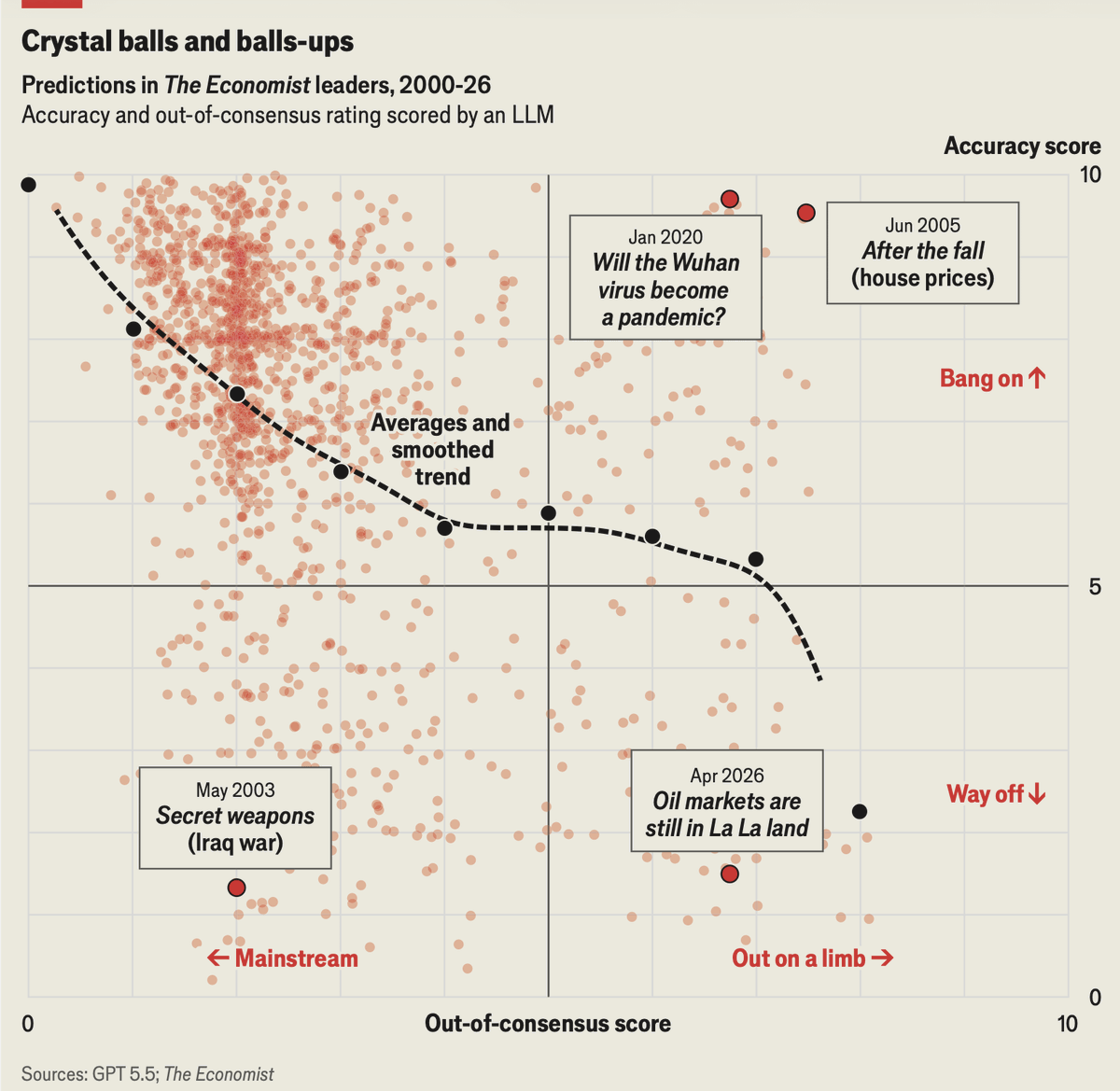
Scandalously, in some circles @TheEconomist has a reputation as a contrarian indicator. This week we fessed up to getting a big call on oil prices from April wrong.
Obviously our goal is not perfectly-hedged (and perfectly boring) predictive accuracy: often it is to stimulate, provoke, and challenge. But I did want to test that wider allegation, so I ran a series of LLM scorers across our full leader database since 2000 (7,000 leaders in all.)
You can see the results in the chart below: each dot is one of the 1,400 leaders where we identified concrete and falsifiable predictions that were central to the argument. Higher = more accurate, further to the right = more contrarian.
We do well, unsurprisingly, when aligned with conventional wisdom. We often do worse when truly out on a limb. But actually, on average, we are a bit likelier to be right than wrong on our somewhat-out-of-consensus calls. All round, a respectable performance.
And as @ecurrnomics points out an accompanying leader, there is no shame at all in being beaten by the market: as good free-marketers we believe deeply in the aggregated wisdom of prices.
Take a look at my piece here, which includes a canter through our best and worst calls of the last quarter-century: https://t.co/WyKqangFrE
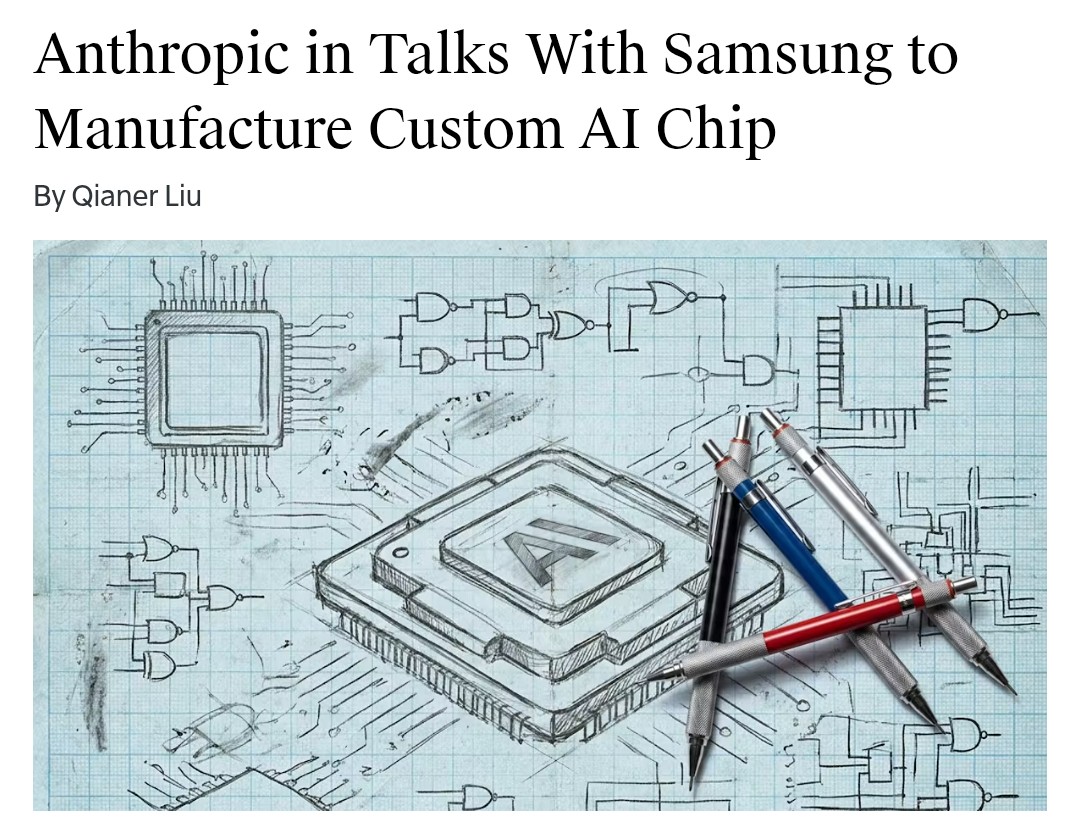
Anthropic has begun to work on its own chip as well, and are in talks with Samsung to manufacture it for them according to reporting this morning from The Information.
it’s fascinating how many ppl today are playing what i call the pre ai capitalism game which includes stuff like getting the bag (aka accumulating capital), mining for status, keeping options open, & then possibly exiting the arena once one or more of these hit.
this is very rational in a scarcity world but it’s much less obviously rational in a world where labor, media, software, knowledge work, & maybe even company formation get aggressively abundant (aka the agi world). ask yourself how much value with your capital/options have in this world?
in an agi world there is a real possibility that the real value may actually lies the opposite stuff like durable trust, taste, ability to get distribution, community, institutional memory, reputation (huge), & the ability to play in the game with high quality ppl for a long time.
i think a lot of ink is going to be spilt on this interview, but my strong view is there is no theory in the world today that isn't best expressed in a company, there are no companies that are not theories.
the corporate structure is totalizing now, karp is the purest form
I'm posting this prediction now so I can quote it later. There has been a significant breakthrough in architecture - specifically around memory efficiency - not by one of the big labs, but by a team that was spun out of OpenAI (not SSI). They will probably announce it soon.
I didn't expect this tweet to be controversial. But here we are.
Okay so look at the most popular apps you use every day. Now think about what they looked like two years ago vs today.
They're all converging on the same three panels. An explorer on the left. A chat in the middle. A preview on the right.
Look at the new apps being built. Same shape.
That's Slack.
Now think about how your team actually works. Work starts and happens in Slack. You only tab away for two things: context and ui.
Context, because the data you need lives somewhere else. UI, because some things need buttons. Different buttons.
An agent collapses both into one app. Context, it's already good at, it goes and gets whatever you need. UI, it's getting there. Soon it'll build the buttons right where you work.
Whoever nails this shape owns where work happens next. The 2030 Microsoft Office.
I think both Fable 5 and GPT-5.6 get approved for general release next week, and for use outside of the United States as well. But people should remember this moment and remember this feeling, because it is almost inevitable that we eventually reach a point where approval does not arrive.
Capitalism is going to tip the scales this time. I doubt they will approve one model and not the other, because doing so would be seen as incredibly anti-competitive. Fable and GPT-5.6 will probably receive the same clearance, probably on the same day. I also doubt they want to restrict sales outside the US, because that would be seen as anti-business and would trigger a major backlash against American closed-source AI. The rumblings of which you can already hear today. There is also a plan now taking shape on both the US left and right to create some version of an AI public wealth fund that pays a dividend directly to American citizens. That fund needs to be fed by the global sale of the big labs top models to people outside the US. So I think there will be no freeze on their use outside the United States this time.
The other reason is that allowing this will make people happy, and it will soften the fact that Mythos, as was announced yesterday, is available only to a vetted group of US agencies and companies. I do not think that this basic structure will change from here on out. Mythos may eventually be made available to certain allies, but only after the US government, its agencies, and then some chosen American companies have access to Mythos-2, Sol-2, or whatever the new uber-model turns out to be.
I do not think this gap ever closes again, not even for allies. And that means the US will increasingly possess an intelligence advantage that touches almost everything: voting, markets, corporations, academia, infrastructure, and the internal operations of foreign states. Having Mythos-n will always be trumped by whoever has Mythos-n+1. Anthropic themselves have said within nine months Mythos will look like a toy. That advantage, standing at the top of this tower, is too large to give up voluntarily. It also means that many things will become suspect. People will see shadows everywhere. Barring espionage, a deliberate leak, or the emergence of a non-US competitor at the top end of the scale, this structure will persist for some time. The public fight is about access to models. But the real fight is about access to the future. And from this point forward, whoever holds this power will also become increasingly capable of keeping it for themselves.