Though I've heard about it, I've never fully grasped how the night sky is littered with galaxies. https://t.co/QmVFFL6ETT is an amazing interactive viewer. Turn on the "Siena Galaxy Atlas" overlay. Thank you @desisurvey !
@ESYudkowsky Some supporting evidence that probability can be used with quantifiers - I was able to make sense of David Chapman's examples (@Meaningness) by using correct probability notation: https://t.co/0ZEbFghjM8
@ESYudkowsky Some supporting evidence that probability can be used with quantifiers - I was able to make sense of David Chapman's examples (@Meaningness) by using correct probability notation: https://t.co/0ZEbFghjM8
@shlevy Mark was helping me understand quantum field theory last year. I'm currently self-studying topics in AI and epistemology. I'd love to share notes on the process of going from "ignorance to grokking."
@Meaningness regarding your post on probability and logic (https://t.co/dExPITtwAV), are you saying that your examples involving 1st order logic and probability can be made well formed, but there is no unique or natural way to do so?
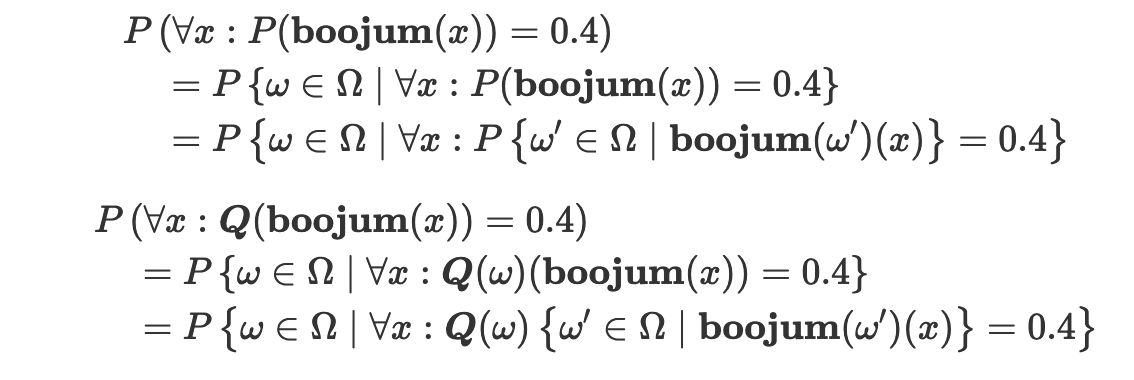
@Meaningness Here's how I interpreted your (simplified) example. I went a bit wild with random variables. Q is a measure-valued RV, and boojum is a predicate-valued RV. I have a long form post about this in the works if you are interested.
@Meaningness Does this problem arise when the same measure P is nested inside P (like in your example), or is nesting any measure inside a different measure restricted?
@Meaningness Yes. Does the standard formalization of mathematics (e.g. set theory or type theory) and measure-theoretic probability not work? Using random variable notation, P(f(X)) = P({ω∈Ω | f(X(ω)}) where f is any predicate and could include quantifiers.