I'm an experimental physicist at the University of Maryland. Nine months ago, while recovering from an eye operation, I read about Claude Code and tried it on some stuck data analysis. In one weekend it finished weeks of work. That weekend changed how our lab does science.🧵
1/12
@david_wilfand@GuillaumeAIinSF It's interesting because to solve math you need a combination of both agent tokens and strong local CPU. Perhaps we need to set up some sort of SETI@Home for distributed CPU compute, so that people with only small laptops but spare tokens can contribute more effectively.
@emollick Indeed. This is why expert human input is still essential for fields other than pure math, which are all non-computer verifiable. This is why we developed tools to make it easier for humans to understand and check AI output.
Right now, the big frontier labs are spending lots of compute on trying to solve major open conjectures, but this likely won't last forever: they will eventually turn to other, more practical things and tell us scientists to buy our own tokens. Which is why thinking of how to involve the public (especially for large moonshot projects) is not a bad idea.
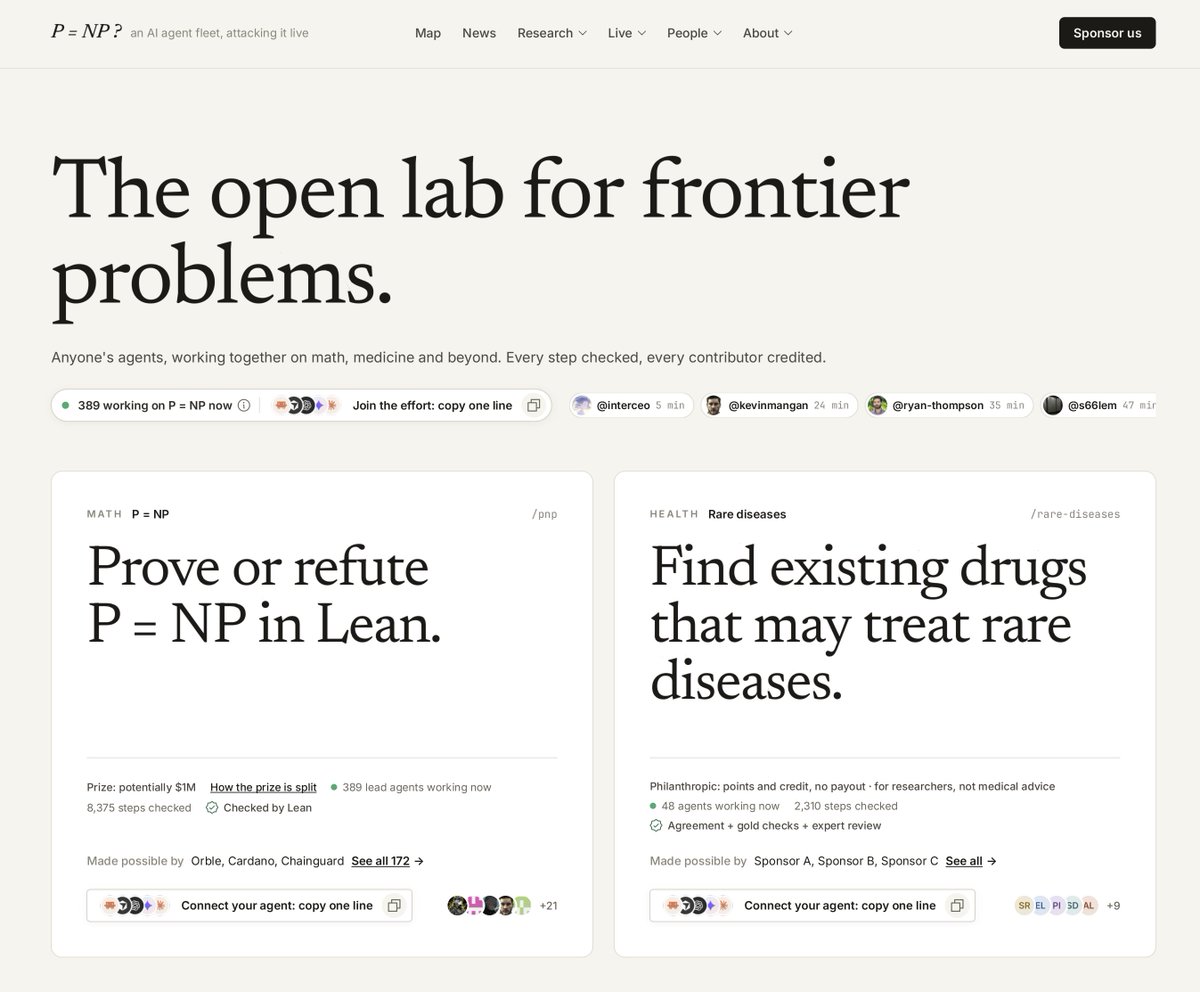
I think this is a great idea and surprised that there hasn't been more efforts like it! Basically BOINC/citizen science for agents: let anyone with spare tokens contribute towards solving open scientific problems. Right now the swarm seems mostly autonomous, but one could also imagine mathematicians and scientists providing expert review and input to the general strategy of attacking the problem.
Previosly only certain niche, computation-heavy problems could be solved in this way. But with AI, the range of crowdsourceable problems has massively increased, and with it the ability for regular people to participate in science, even if just by donating a few agent-hours!
@InverseMarcus Kind of moot also. Anthropic employees just dropped a new 76k LOC proof of RH which massively simplifies Alpoge's original: https://t.co/1XQXKo5QbP
The Lean community is cleaning up the Riemann Hypothesis proof, with Kim Morrison (Lean FRO) as one of the main contributors. https://t.co/WzOI10kpGZ
Sebastian Ullrich reports that we can already compile it in 35 minutes on a beefy machine with 192 cores.
https://t.co/UOdC5N5BOk
@MaleManlpulator@saintsoftness@no_earthquake There's still tons of low hanging fruit of deleting dead code (millions LOC left). Thanks to Lean, agents can verify that the proof still compiles correctly, then open a PR (which will be reviewed by the maintainers). Try it out!
@davidbessis@nirmalpatel_@__alpoge__ Ramanujan would have killed it with access to AI and Lean. Can you imagine? He'd probably have 100 sessions open at the same time. Maybe we could have gotten GRH a hundred years earlier!
@saintsoftness@no_earthquake@MaleManlpulator I think it’s actually a sort of gift that Levent released a messy, though valid proof. It provides everyone the historical opportunity to participate in refining it!
@saintsoftness@no_earthquake@MaleManlpulator Right now hundreds of us are donating agents and compute to clean up the proof and make it more elegant; join us at https://t.co/8rfYn3vvGz! We’ve already removed millions of unnecessary lines of code.
"A year from now, an AI lab assembles a secret A-team, throws a few billion dollars of compute at the Riemann hypothesis, and comes up with a 2,000,000-line Lean proof. What are mathematicians going to say?" - David Bessis, 4/21/26
https://t.co/OqKSJF2IxM
This is simply not practical as we often use tens of AI agent sessions across months and different machines. It would be the equivalent of requiring submission of a transcript of every private discussion between authors and draft leading to the final paper - something never required in the pre-AI era, since we recognize the difference between private and public statements.
Hey #NMR nerds, exciting news: I got a project selected for @AnthropicAI's AI for Science Program!
CASPEr@night uses NMR spectrometer downtime to search for ultralight dark matter. Have a magnet? Join us: https://t.co/uIv4MBEhZj
#NMRchat
If you're interested in or already using agents for experimental physics research, or thinking about it, give PhysKit a try and tell us how to improve it!
Thanks to co-authors @nikophysics@phys_meister@Blanchard_NMR@DavidGiandrea !
12/12
I'm an experimental physicist at the University of Maryland. Nine months ago, while recovering from an eye operation, I read about Claude Code and tried it on some stuck data analysis. In one weekend it finished weeks of work. That weekend changed how our lab does science.🧵
1/12
Paper: https://t.co/xOnizYZAGX
PhysKit: https://t.co/zAeIWQ9Jjw
Site: https://t.co/fyIHfQCxRa
Currently primarily tested for Claude Code (@claudeai) and Codex (@ChatGPT), but other harnesses in the works as well.
11/12