since you guys loved the exploding tesla..
I used GPT-6 Astra to create a 3D website that pulls apart the male anatomy into 2,234 modeled pieces!
we are in a renaissance of learning
Amazing support so far for my free Barriers app on iPadOS / MacOS. Over 10,000 downloads in less than a month.
I got some feedback to create a walk through video to help people understand how the app works.
🎥 https://t.co/5JBzNaO2yM
📱 https://t.co/PMKgORFsyg
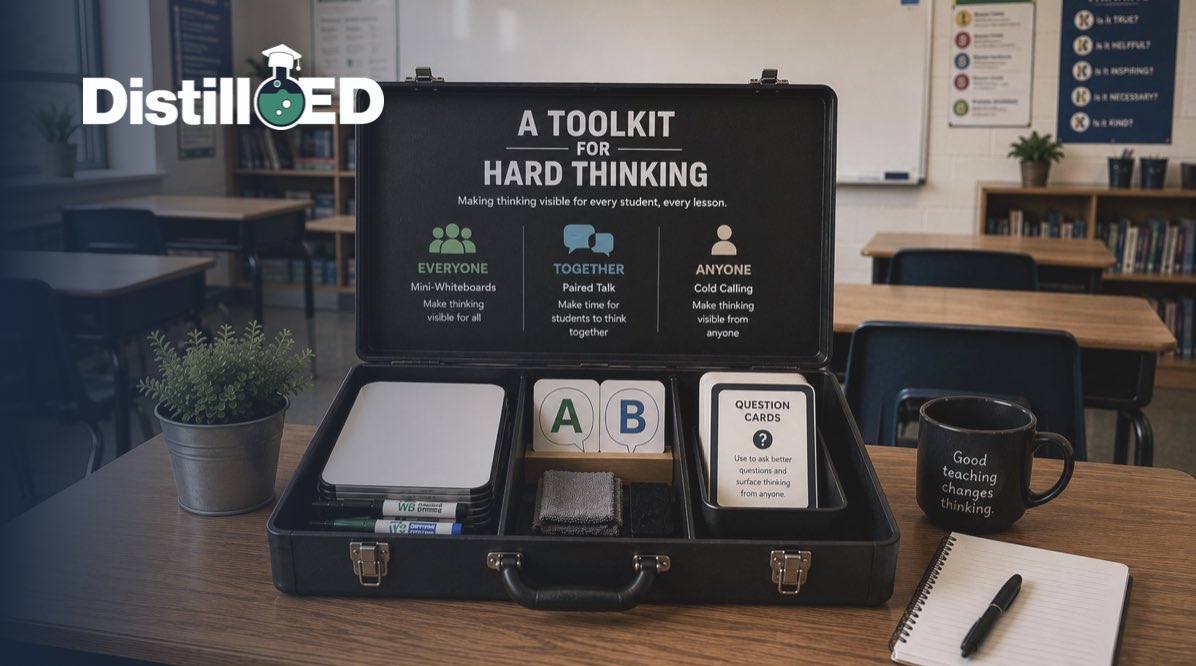
📣 Good news — I'm running a FREE, 45-minute online PD session: Hard Thinking for Everyone.
If, as Daniel Willingham reminds us, "memory is the residue of thought," the real question in any lesson is whether all students are attentive and cognitively engaged — or whether we're relying on poor proxies that just look like learning.
What is it about?
I'll walk through poor proxies, the principles, and the strategies of hard thinking, and outline the ETA framework — Everyone, Together, Anyone — three deliberate ways to sample student thinking. The talk will be about 45 minutes, followed by 15 minutes of Q&A.
When is it?
📅 Saturday 15th August
🇦🇺 8:00–9:00pm AWST (Perth) / 10:00–11:00pm AEST (Sydney/Melbourne)
🇬🇧 1:00–2:00pm (BST)
👉 Register here: https://t.co/9K4dpe3kOk
Can't attend live? A recording of the webinar will be available afterwards in the DistillED+ Hub for DistillED+ members. If you're not yet a member, you can explore the upgrade options here: https://t.co/zG1kuFY80D
Sign up and see you on Zoom!
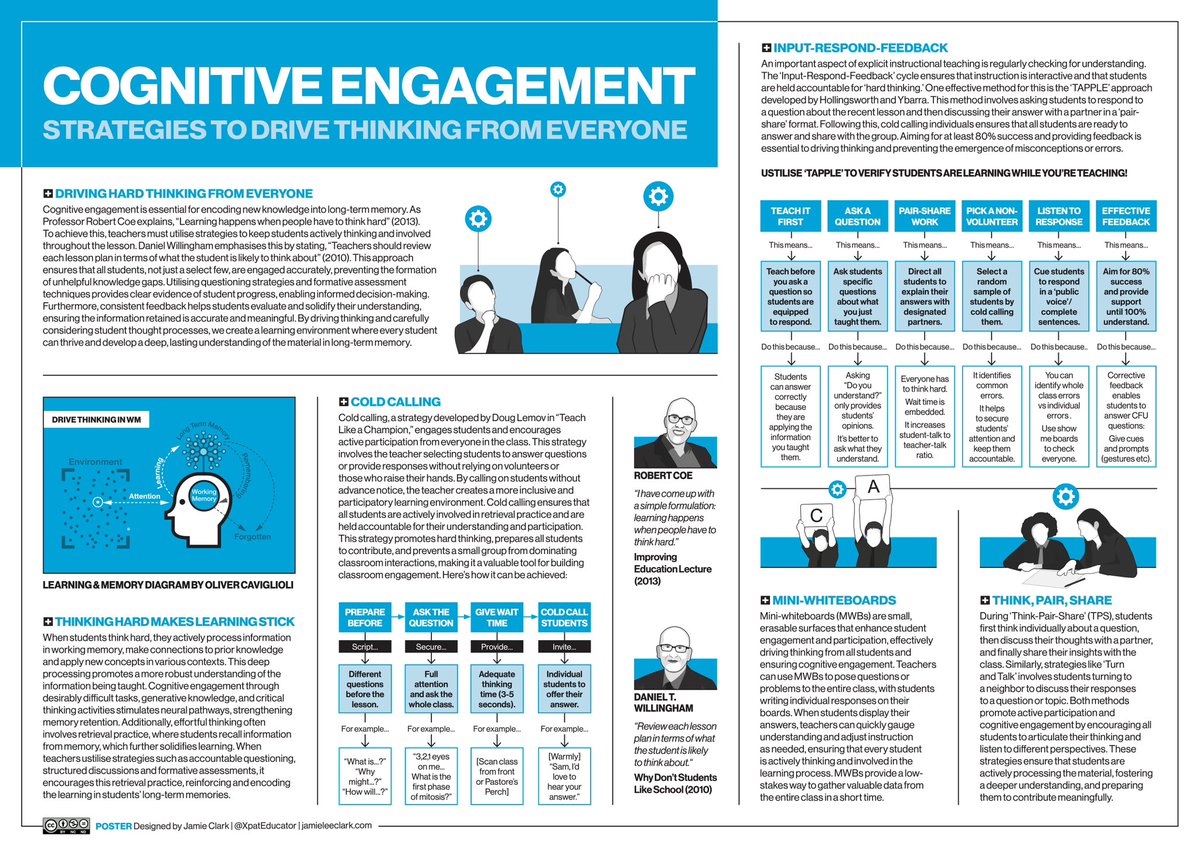
📣 COGNITIVE ENGAGEMENT! For new knowledge to be encoded in long-term memory, we must DRIVE THINKING and ensure that students are cognitively engaged. This one-page guide summarises how you can push ALL students to think hard.
👊 REPOST and get a FREE high-quality copy: https://t.co/Xj2XpPGvnu
Barriers is free on the App Store
It helps teachers reflect on the unintentional obstacles sitting between a student and the work - before the thinking even begins.
No accounts. No data issues. Just honest reflection.
👉 https://t.co/M0jo3w6REW
Some of the hardest barriers to learning aren't the learning at all - they're the ones we build into our own practice without meaning to. I made a free iPad app to help teachers spot them - https://t.co/QZucjloiJU
Built on Universal Design for Learning. No waffle, just the thinking. 🧵👇
❤️🥺 A Mexican fan at the Estadio Azteca gifted a young England fan his Merlín duck plush, and his reaction was PRICELESS.
Nothing brings people from different countries together like football does, and Mexico was the best host nation at the World Cup. 🏆
◽️MINI-WHITEBOARDS! This week in ⚗️DistillED, I’m revisiting one of the highest-leverage tools… MWBs push participation to 100%, turn every check into a retrieval event, and give you a whole-class snapshot of understanding in seconds.
https://t.co/GLskT8D1Aa
"Cross-curricular learning" is one of the most over-promised ideas in education.
We stick a coding lesson next to a math lesson and call it integration. The Transfer Illusion (Kirschner, Hendrick & Heal) is exactly this ... assuming students will spot the bridge between two domains just because we put them in the same room.
They won't. Not without us.
In my Geometry Playground, my students write Swift code that draws polygons. The turn angle in the code is the exterior angle of the shape. Same idea, two languages. But that connection is invisible until I stand at the front and model it - narrating my thinking, drawing the link out loud, showing where one becomes the other.
Transfer isn't a hope. It's a teaching move - https://t.co/GcSiBYPQ6y
The "cross curricular" label is cheap. The modelling that makes it real is not.
#Pedagogy #Mathematics #ComputerScience @XpatEducator@dylanwiliam
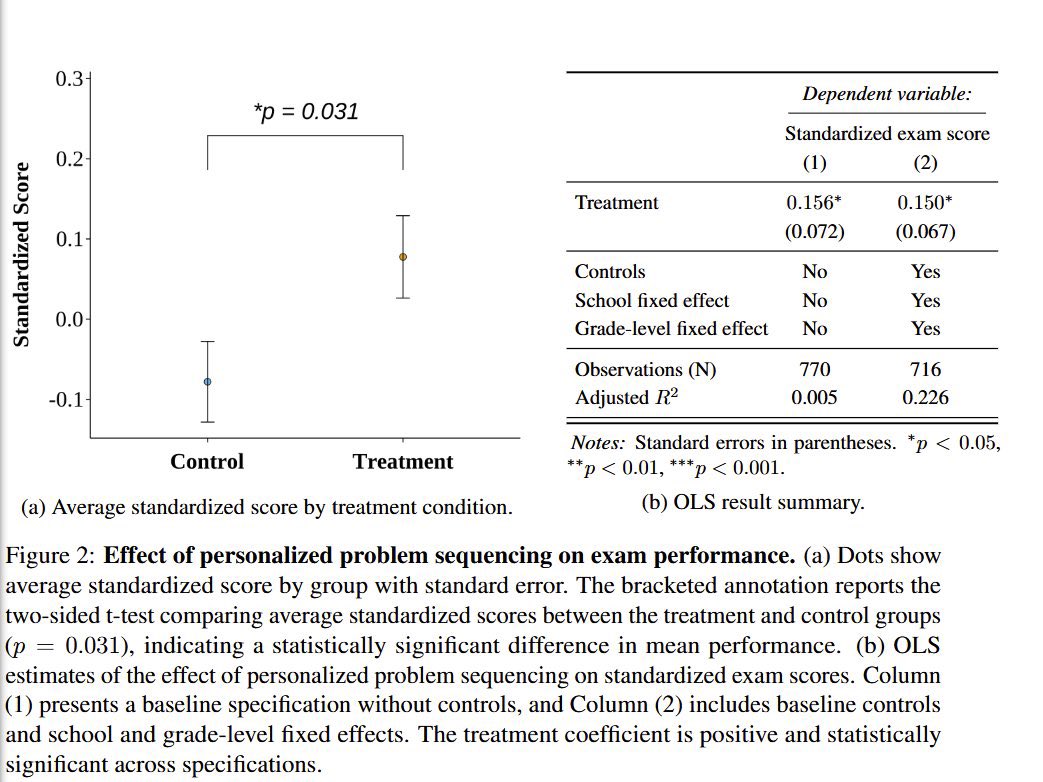
Yes, just having students “use AI to study” hurts learning (a helpful assistant is not a tutor), but using AI prompted to act like a tutor, especially with teacher support, seems to have large positive effects on learning in randomized trials. https://t.co/0HtjGC8eU0
@daniquanti@MushtaqBilalPhD Evidence so far suggests yes … recent EEG (electroencephalography) work on digital pens shows similar patterns to ink pens, both distinct from keyboards. The mechanism appears to be the handwriting motion itself, not the paper.
@MushtaqBilalPhD@Mrs_Afraoui Mueller & Oppenheimer (2014) found similar effects in adults; Morehead et al. (2019) failed to replicate; Fiorella & Mayer (2017) found laptop note-takers did better after review; Urry et al. (2021) found the opposite. There’s no consensus.
"Cross-curricular learning" is one of the most over-promised ideas in education.
We stick a coding lesson next to a math lesson and call it integration. The Transfer Illusion (Kirschner, Hendrick & Heal) is exactly this ... assuming students will spot the bridge between two domains just because we put them in the same room.
They won't. Not without us.
In my Geometry Playground, my students write Swift code that draws polygons. The turn angle in the code is the exterior angle of the shape. Same idea, two languages. But that connection is invisible until I stand at the front and model it - narrating my thinking, drawing the link out loud, showing where one becomes the other.
Transfer isn't a hope. It's a teaching move - https://t.co/GcSiBYPQ6y
The "cross curricular" label is cheap. The modelling that makes it real is not.
#Pedagogy #Mathematics #ComputerScience @XpatEducator@dylanwiliam
@FarzaTV@FarzaTV really loving this from an Education point of view (thinking of a teacher assistant). Have you played with Apple Foundation models or newly released Gemma 4 to reduce overhead costs?
Thought it would ask before I play myself