Most people hear real estate on crypto and immediately assume it’s just another tokenization pitch
That’s too shallow
What makes @zipcodenetwork interesting is not the asset class by itself
It’s the attempt to build the coordination layer around it.
Real estate is a multi-trillion dollar market, but the financing stack is still full of friction
- fragmented underwriting
- slow capital movement
- opaque collateral quality
- and too many middlemen feeding on delay
That is exactly the kind of market where better coordination matters more than louder narratives.
And that’s why Zipcode’s direction stands out.
The rebrand from Resi to @zipcodenetwork feels less like cosmetic cleanup and more like a clearer statement of intent
- tokenization
- lending
- on-chain loans
- and a stronger emphasis on oracle-driven infrastructure
That last part matters most.
Because on-chain credit without strong data is just dressed-up fragility
If you cannot evaluate contracts, collateral, borrower quality, and real-world state with enough precision, then “decentralized lending” is just a prettier way to manufacture bad debt.
That is the uncomfortable truth in this category.
The moat is not slapping property onchain.
The moat is building the information system that lets capital trust what it is touching
In that sense, Zipcode is not just trying to tokenize houses
It is trying to make real estate legible to decentralized finance
That’s a much harder problem.
And harder problems are usually where the real value hides.
A lot of projects want the upside of real-world assets without inheriting the discipline of the real world.
But if @zipcodenetwork can actually ship tokenization, lending, and oracle-backed credit infrastructure with real operational depth, then this becomes much more interesting than another CT narrative cycle.
Because then you are not selling exposure.
You are building rails.
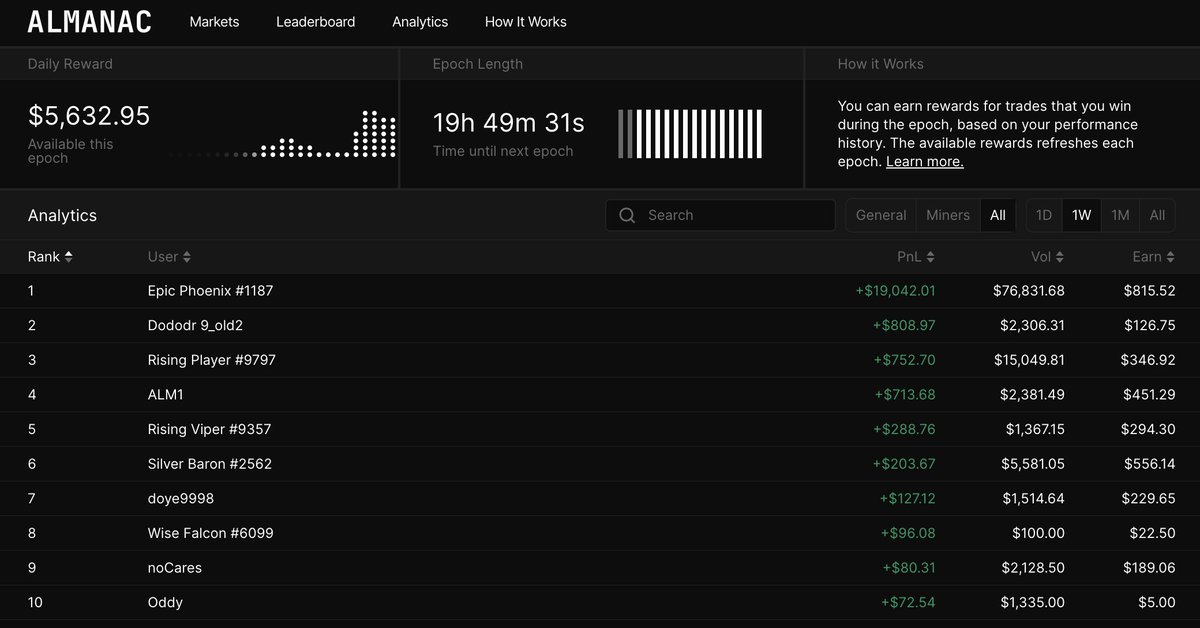
Prediction markets have a leaderboard problem
The people getting rewarded with attention are not always the people generating the earliest signal. They’re often just the people who look best once the market has already done most of the price discovery.
That is exactly why Almanac caught my attention.
@almanac_market is not just trying to tell you who made money. They are trying to tell you who saw it early, who sized it with conviction, and who actually held signal instead of farming late confirmation.
That distinction matters more than most people realize.
Because “good trader” is one of the most abused labels in crypto.
A lot of people look brilliant if you only check the final snapshot.
- green PnL
- high win rate
- nice screenshot
- cool dashboard
But prediction markets are full of false positives.
> some traders arrive after the hard discovery is already done
> some clip tiny spreads after the information edge is gone
> some look sharp because they only appear near resolution, when the market has already done most of the thinking for them.
That is not forecasting
That is looting the cleanup crew
Almanac’s real contribution, at least from what they are showing publicly, is this idea of conviction scoring
Not just: were you right?
But:
- were you right before it was obvious
- did you enter when uncertainty was still real
- did you hold through the part where your thesis could still break
- did your behavior look like signal or just opportunism
That is a much better filter
It is the difference between judging a bridge by whether it is still standing today, versus understanding how it handles load, stress, and failure modes.
One tells you the outcome.
The other tells you the quality of the structure.
And if you care about copying traders, allocating capital, or building tools on top of prediction markets, structure matters more than screenshots.
This is why I think Almanac has attention potential.
Not because “analytics platform” is exciting. It isn’t. Most analytics products are just prettier mirrors
But because prediction markets are entering the phase where meta-intelligence becomes valuable
- At first, people wanted markets.
- Then they wanted liquidity
- Then they wanted dashboards
Now they need ranking systems that separate:
- early signal from late noise
- conviction from lucky timing
- real forecasting from cosmetic PnL
That is where Almanac is aiming.
And if they get this right, the product is bigger than “a useful Polymarket tool.”
It becomes a reputation layer for forecasting itself
My uncomfortable test for you is simple:
Next time you see a “top trader” screenshot, ask one question before you get impressed
Were they early, or were they just visible at the end?
Those are not the same thing.
And in markets, that gap is where a lot of fake geniuses are born.
@almanac_market is betting that the real alpha lives inside that gap
I think they’re looking in the right place....
I’ve seen a lot of people say DeFi is dead or slowly dying and it might be true
I think one of the biggest things onchain right now is prediction markets.
They’re already doing over $2.5B in 7D volume, and @Polymarket alone is generating over $5M in weekly revenue. Yes, weekly revenue.
What I like even more is that a number of $TAO subnets are already focused on predictions and on capturing part of that value stack inside Bittensor.
When it comes to prediction markets, Bittensor may end up being one of the best places to find the intelligence layer behind them.
You’ve got subnets like:
SN6 Numinous - forecasting agents
SN103 Djinn - encrypted prediction marketplace
SN123 MANTIS - market signal aggregation
And recently, CrunchDAO and Marc from Numinous shared how crunchers are building AI agents that forecast live binary events from Polymarket across geopolitics, finance, and macro.
Because the market itself is only one layer.
The bigger opportunity may be the systems that generate signal, find edge, and make those markets more useful.
I believe prediction market intelligence will be 100x bigger than what it is now and soon.
Not long ago, AI agents mostly lived in advisory mode. Chatty little helpers. Suggestions here and there. “Buy this maybe” or “Try that.”
Low stakes.
If an agent got it wrong, no real harm. You laughed it off and moved on.
That era didn’t end because agents got smarter. It ended because agents started executing.
Agents are not just chatting anymore. They are doing the work. Executing trades. Moving real funds. Signing DeFi contracts. Coordinating supply chains. Making decisions in robotics and even healthcare setups.
When AI starts handling real value, everything flips.
One bad inference is no longer funny. It can wipe out millions or trigger cascading failures across systems.
At that point, “trust the model” is not enough.
When money leaves a wallet for good, trust must be provable.
Not vendor promises. Not dashboards. Not assumptions.
Actual math you can verify.
That is exactly why DSperse from @inference_labs feels so important right now.
DSperse breaks large models into balanced, composable pieces.
The critical components are compiled into zero-knowledge circuits.
Proof generation is distributed across nodes in parallel, efficient, and without a single point of failure.
What makes it feel production-ready:
• Proof time reduced from 229 seconds to 91 seconds on the NET model
• Memory usage stays reasonable, even on heavy models
• Live on Subnet-2, helping push past 300 million verifiable inferences
• Built on earlier work like Omron, now supporting vision models, batch norms, 4D pooling, and multi-agent coordination.
This hits differently because we are firmly in the execution phase now.
You cannot prove every step in a long reasoning chain. That would kill performance.
Instead, you prove what actually matters.
The decisions that trigger value movement.
The outputs that move assets.
The actions that authorize execution.
Targeted verification. High leverage. No wasted overhead.
Why DSperse stands out heading into 2026:
• Scalability without compromise.
Agents can operate in real time across trading desks and autonomous systems without waiting minutes for proofs.
• Privacy by default. zkML keeps inputs, weights, and sensitive data hidden. Essential for finance, healthcare, defense, and any system where leaks are unacceptable.
• Fault-tolerant by design. If a node fails, the proof still completes. This matches the reliability required when real value is at stake.
• Native alignment with Bittensor incentives. Subnet-2 rewards verifiable work. Better performance leads to more delegation, more TAO emissions, and real compounding value.
Without a layer like this, agents remain stuck in safe but limited advisory roles.
With DSperse, they move into true autonomy.
Auditable. Accountable. Governed by math instead of blind trust.
Inference Labs shipped DSperse in 2025 and kept pushing.
JSTprove CLI for developers.
TruthTensor benchmarks running large-scale agent tests.
Support for multi-agent and multi-player setups.
2026 feels like the year verifiable compute moves from “interesting idea” to required infrastructure for any agent that touches money.
If you are building, mining, staking, or watching decentralized AI closely, keep Subnet-2 on your radar.
DSperse is not an optional add-on.
It is the trust foundation that lets autonomy scale without turning into chaos.
Big respect to @inference_labs for shipping real infrastructure instead of endless hype.
To go deeper, read the DSperse arXiv paper:
https://t.co/7zSKsC1gUO
And watch Hash Rate Podcast Ep. 155 with @markjeffrey featuring @opendansor and @hudsongrae_me from the Inference Labs team: https://t.co/esOyr8QRpp
Bittensor / $TAO
Nodexo 2.0 feels like the trust layer decentralized GPU compute has been missing on Bittensor SN27.
Really impressed by how they flipped the script:
• Proof-of-GPU v3 anchors real work on Ethereum → public, verifiable, no more faking capacity or overselling the same card
• Mining emissions get burned instead of farmed → earnings only from actual user payments, kills gaming and aligns with genuine demand
• Providers stay fully off-chain → just install the agent and sell compute, no Bittensor onboarding hassle
• Small setups (even students with a few GPUs) can now compete purely on trust + price against big clouds
This turns @nodex0_ SN27 into a proper "lie detector for compute" and opens the door for real AI infra. Big step forward! 🔥
Seeing this 2025 recap from @inference_labs really puts things in perspective 🔥🔥🔥
What began as deep research papers and early proofs turned into real production infrastructure in under 12 months.
• Subnet-2, now DSperse, quietly crossed 300M+ verifiable inferences. This is not testnet noise. This is real usage at scale.
• JSTprove went open-source, making zkML proof generation accessible to anyone directly from the CLI.
• TruthTensor launched and already has 500k+ agents running with provable, verifiable outputs.
• Real partnerships with Immunefi, Cysic, Taoshi, and others, alongside a proving cluster scaling aggressively.
This is not “zkML is coming someday.”
It is here, it is verifiable, and it is starting to matter anywhere real value is involved. DeFi agents, autonomous systems, robotics decisions....... anywhere “trust me bro” is no longer acceptable.
Math over promises.
2025 proved the model works at scale.
2026 is where we find out how far accountable autonomy can actually go.
Grateful to watch this being built in real time.
Keep shipping, legends @inference_labs 💪
DAY 2 OF LEARNING BLOCKCHAIN RESEARCH.
Today I went in-depth into PoW , PoS , miners , validators , reorg risks .
Decided to spend today to understand how Ethereum actually works.
here's what i learned 🧵
BASICS
> Ethereum uses Proof of Stake. instead of miners burning electricity, validators lock up 32 ETH. if you validate correctly, you earn rewards. if you cheat or go offline, you lose your ETH. simple incentive design.
How Blocks Get Made.
( blocks are simply containers of transactions )
every 12 seconds, one validator gets randomly chosen to create a block. other validators check the block and vote on it. if 2/3 of validators approve, we move forward.
Finality - The Important Part.
Finality basically is knowing if a transaction can be reversed or not .
Ethereum has a DETERMINISTIC FINALITY .
Ethereum has TWO types of "confirmed":
1. soft confirmed (~12 seconds): your transaction is in a block. small chance it could get reversed still.
2. FINAL (~13 minutes): your transaction is locked in forever. can't be reversed unless someone burns billions of dollars worth of ETH.
reorg risk ( the chance your confirmed transaction gets erased )
- first 13 mins: small reorgs possible (maybe 1-2 blocks deep). rare but happens.
- after 13 mins: would need to destroy 33%+ of all staked ETH (currently ~$40+ billion). basically impossible to get a tx reversed on ETH. .
But why should this matter ??
Bitcoin takes ~1 hour for "safe" confirmation and even then it's not 100%. Ethereum gives you mathematical certainty in 13 minutes.
the tradeoff? Bitcoin is more decentralized (anyone can mine with hardware ). Ethereum requires 32 ETH to run a validator (about $100k right now). different philosophies.
that's it. Ethereum = stake money, validate blocks, get finality in 13 mins, economic security instead of computational security.
@faysalOfWeb3
How to stake your WCT (and actually understand the rewards).
1/ Staking WCT is the best way to support the network, but the math trips people up.
Most see "lock for 2 years" and run, or they stake and get mad when the weekly payout isn't what they expected.
👇👇👇
Let's be honest
How often do you connect your crypto wallet to a decentralized app (dApp) and it actually works instantly without issues ?
That perfect, smooth experience you get 99% of the time?
It's almost always powered by WalletConnect.
It's truly become the absolute backbone of Web3. It securely bridges any wallet (MetaMask, Trust Wallet, Rainbow, Phantom, etc.) to any application, across all different blockchains, without any fuss .
You must have traded on a DeFi exchange, minted an NFT, or logged into a crypto dApp , you've relied on WalletConnect , you just didn't realize it .
HOW DOES WALLET CONNECT PULL THIS OFF ?
It's actually really straightforward.
* You are on a dApp and tap "Connect Wallet."
* Instantly, either a QR code appears on your computer screen (for you to scan with your phone wallet), or your mobile wallet app opens directly.
* Behind the scenes: WalletConnect immediately establishes a fully encrypted session.
* You scan the code or approve the connection once in your wallet.
Now you're securely locked in and ready to sign transactions, approve swaps, and manage assets, with constant, safe communication flowing back and forth between the dApp and your wallet.
WalletConnect has become the industry standard because it solved the biggest talking points:
* Universal Support: It works with nearly every major wallet out there.
* Multi-Chain Friendly: It handles the headaches of different blockchains effortlessly.
* Security & Speed: It prioritizes a fast, secure connection over older methods
* Permissionless: Anyone can use it to build or connect.
you’ve definitely used this countless times. The fact that you don't notice it? That’s the point. It’s the silent backbone of Web3, and we take that reliability for granted way too often.
Thanks for reading!
Breaking the "Fragmentation" Wall
In traditional Web3, users often struggle with money stuck on different networks (like Base or Arbitrum).
WalletConnect Pay uses Chain Abstraction to hide this complexity.
Invisible Networks: You no longer need to manually bridge assets or worry about "Wrong Network" errors.
Unified Balance: Your funds are treated as one single pool of value, regardless of which chain they live on.
WalletConnect is quietly on track to hit $400B in network volume this year.
That's not a typo. Four hundred billion dollars.
And most people still think it's just that blue connect button.
Let me explain what's actually happening
🧵
@Cointelegraph Exactly when institutions hedge against debasement, they look for assets that hold real value.
On Solana, $STEP does that in DeFi form real yield, steady fee flow, and a deflationary supply that strengthens as activity grows.
@Cointelegraph He’s right Solana staking products are unlocking a whole new wave of capital.
Step Finance fits perfectly into that narrative, serving as the front page of Solana
@KobeissiLetter Tough quarter for Meta, but that’s how markets work even giants stumble.
Meanwhile, projects like Step Finance keep building quietly on Solana,
Bullish on $STEP
@WatcherGuru Mastercard dropping billions on a crypto startup just shows how deep traditional finance is going into blockchain.
On Solana, Step already building that kind of infrastructure connecting real products, fees, and users in one on-chain ecosystem.
@bitcoinarchive Saylor’s got his Bitcoin playbook down and he’s right about efficiency.
On Solana, Step Finance is doing the same in DeFi form
> real on-chain revenue
> compounding yields
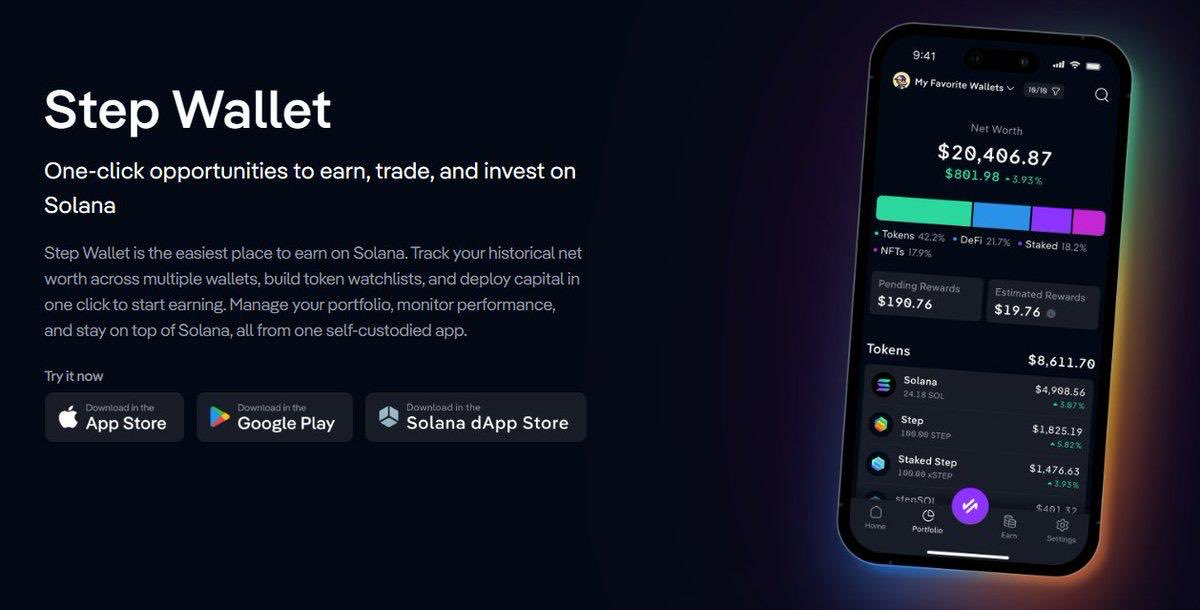
> step wallet & portfolio dashboards
@WatcherGuru $300M wiped in 15 minutes that’s the game.
While everyone panics, Step Finance keeps doing what it does best building, and generating revenue