Managing the Conflict Is No Longer a Strategy
The worst possible strategy for Israel is to continue “managing” the conflict while gradually eroding the possibility of eventually separating from the Palestinians.
No serious person is suggesting that a Palestinian state can or should be established tomorrow. The real question is what Israel does in the meantime. If the answer is simply to do nothing, preserve the status quo, and hope that somehow the problem will resolve itself, that is not a strategy, it is an avoidance of the fundamental decision Israel faces.
This is where Gadi Eisenkot’s approach deserves scrutiny. Like Netanyahu, he appears reluctant to confront the strategic choices required on the Palestinian issue. Yet Israel’s ability to repair its international standing and secure its future as a Jewish and democratic state is inseparable from this question.
Israel should therefore begin actively creating the conditions that preserve the possibility of future separation. That does not require the immediate establishment of a Palestinian state. It does require concrete measures: preventing further territorial fragmentation, strengthening the limited settlement blocs Israel expects to retain under a future agreement, and beginning the process of evacuating isolated settlements that undermine the possibility of separation.
The problem becomes even more serious when Eisenkot’s potential political partners advocate steps such as annexation in the E1 area or policies that could further weaken, or even contribute to the collapse of, the Palestinian Authority. Such measures would make future separation considerably more difficult.
The choice facing Israel is therefore not simply between “two states tomorrow” and “no Palestinian state.” The more consequential choice is between actively preserving the possibility of a future two-state arrangement and continuing down a path toward an irreversible one-state reality, with potentially severe diplomatic, economic, and international consequences for Israel.
Israel does not need to create a Palestinian state tomorrow. But an Israeli government does need a strategy for ensuring that separation remains possible tomorrow. Pretending that the status quo can be maintained indefinitely only postpones the decision while steadily narrowing Israel’s options.
If this is indeed the policy Eisenkot intends to pursue should he become prime minister, the potential costs could outweigh the benefits. Continuing to “manage the conflict” would not preserve the status quo; it would allow the deeply damaging trends unfolding every day in the West Bank to continue and become increasingly difficult to reverse.
The fundamental problem with conflict management is that the conflict is not static. Every additional settlement expansion, every step that weakens the Palestinian Authority, and every measure that makes territorial separation more difficult gradually changes the reality on the ground. What is presented as a cautious policy of avoiding premature decisions can therefore become a decision in itself, one that steadily closes the door on future separation.
Israel does not have the luxury of simply waiting. A government that genuinely wants to preserve Israel’s ability to separate from the Palestinians will eventually have to take politically difficult steps to keep that option alive.
The U.S. Embassy Jerusalem has been informed that checkpoints will be closed from September 27, 2026, to October 3, 2026, across the entire West Bank region. This means that there is no regular entry into Israel except for strictly medical and humanitarian reasons.
Jerusalem ID holders can still commute and travel freely. However, Arbel permit holders cannot cross checkpoints even by the shuttle. Exceptions can be considered only for medical and humanitarian reasons. More information will be shared if there are any significant changes to this policy. This is provided for your information as you make your own security plans.
Read the full message here: https://t.co/zq5d7S9pvf
Israel's Central Elections Committee voted Wednesday to disqualify Mansour Abbas' United Arab List slate from running in the election, as well as the Joint List, which consists of the parties Hadash, Ta'al and Balad. In its decisions, the committee claimed some members of the parties "reject Israel as a Jewish and democratic state."
The decisions may be reversed by appeal to the High Court of Justice, which struck down similar rulings in previous election cycles | Michael Hauser Tov, Chen Maanit, Noa Shpigel and Jack Khoury
🔗: https://t.co/RnMQ93j8Eq
Wow. Head of the most staunchly pro-Israel think tank in DC warns 🇮🇱 to brace for Iran-style sanctions from 🇺🇸 as soon as 2029.
“If the current coalition returns to power w/o changing its policies, defending Israel against financial warfare will become far more difficult.”
1/2
״אנחנו נתקן״, מבטיח חבר מפלגתו של נפתלי בנט. אבל לפני שמתקנים, כדאי לשאול שאלה פשוטה: מה בדיוק אתם מציעים לשנות?
כי כשמקשיבים לעמדות המדיניות והביטחוניות שמציגים בנט ואנשי מפלגתו, קשה לעיתים לזהות את השינוי הגדול שהם מבטיחים.
לא מדינה פלסטינית. לא שינוי יסודי בגישה כלפי הפלסטינים. המשך מדיניות ביטחונית ישראלית ברצועת עזה. קו תקיף עוד יותר מול קטר, עימות עם תורכיה והמשך המערכה שמטרתה להחליש ואף להביא לקריסת המשטר האיראני.
״אנחנו נתקן״?
כדאי גם לזכור את ממשלת בנט עצמה. בתקופתה אפילו לא התקיים דיאלוג מדיני משמעותי עם אבו מאזן, ולא הוצגה תפיסה מדינית חדשה לסכסוך הישראלי־פלסטיני. במובנים מרכזיים, מדיניות ניהול הסכסוך נמשכה.
ולכן השאלה איננה אם ממשלה בראשות בנט תהיה מנוהלת טוב יותר מממשלת נתניהו. ייתכן בהחלט שיהיו הבדלים גדולים בניהול המדינה, בגיוס חרדים, במוסדות השלטון, ביוקר המחיה וביחס למערכת הממלכתית.
השאלה שאני שואל היא אחרת:
מהי האלטרנטיבה המדינית?
אם אתם מתנגדים למדינה פלסטינית, ממשיכים למעשה לנהל את הסכסוך, מבקשים להמשיך את השליטה הביטחונית בעזה ומציעים מדיניות אזורית המבוססת במידה רבה על המשך הפעלת כוח — במה שונה החזון המדיני שאתם מציעים מהכיוון שבו ישראל צועדת כיום?
״אנחנו נתקן״ היא סיסמה מצוינת.
אבל מי שמבקש להחליף את הממשלה צריך להסביר לאזרחי ישראל לא רק מי ינהל את המדינה טוב יותר, אלא גם לאן הוא מתכוון להוביל אותה אחרת.
מספיק עם הסיסמאות של ״אנחנו נתקן״. תגידו במה בדיוק אתם מתכוונים להתנהל אחרת במדיניות.
כי כבר הייתה כאן ״ממשלת שינוי״. נתניהו אמנם לא ישב פיזית בלשכת ראש הממשלה, אבל בכל הנוגע למדיניות החוץ והסוגיה הפלסטינית, חלקים מרכזיים מהתפיסה שהוביל במשך שנים נמשכו גם בלעדיו: לא יוזמה מדינית משמעותית מול הפלסטינים, לא שינוי אסטרטגי ביחס לעזה, ובעיקר המשך האמונה שאפשר לנהל את הסכסוך במקום לקבל החלטות קשות לגבי עתידו.
ולכן השאלה לבנט ולאנשיו פשוטה: מה הפעם יהיה שונה?
אם אתם מתנגדים למדינה פלסטינית, מתכוונים להמשיך את המדיניות הישראלית הנוכחית בעזה, מדברים על עימותים נוספים באזור ומציעים למעשה להמשיך לנהל את הסכסוך, אז איפה בדיוק השינוי?
ויש כאן נקודה עמוקה אפילו יותר שאתם חייבים להבין:
אם תחליפו את נתניהו אבל תמשיכו את מדיניותו, העולם עלול להגיע למסקנה שהבעיה מבחינתו איננה נתניהו. הבעיה היא המדיניות של ישראל עצמה. אי אפשר לטעון במשך שנים שנתניהו הוא הבעיה, להחליף אותו, ואז להמשיך כמעט באותו כיוון מדיני.
אם אתם רוצים להיות אלטרנטיבה, תציגו אלטרנטיבה.
לא רק לנתניהו האיש.
למדיניות שלו.
The decision to once again prevent PA officials from attending the UN General Assembly opening is not helpful to the pursuit of stability in the Middle East, nonetheless in the corner of the region that Israelis and Palestinians inhabit.
But it seems even more nonsensical a time when the Trump team ostensibly wants to make progress on the President's 20-point plan for Gaza; Sec. Rubio said only days ago that the US does not want to see further instability in the West Bank; and USG officials around the region are meeting with unsavory actors like Hamas, Hezbollah, and now the Houthis.
A new poll by Israel’s Institute for National Security Studies finds that only 4% of Palestinians in the West Bank would vote for Hamas in upcoming elections.
Is this really the solution being offered by those who aspire to lead Israel?
There is no realistic scenario in which the Palestinians are granted limited autonomy over roughly 40 percent of the West Bank, while Israel retains ultimate control over the rest, and the international community accepts this as a sustainable political arrangement. Such a model would institutionalize a reality in which millions of people living between the Jordan River and the Mediterranean Sea have fundamentally different political rights and status, with no credible pathway toward resolving that disparity.
Israel has already learned the devastating limits of “managing the conflict.” October 7 should have ended the illusion that an unresolved Palestinian arena can simply be contained indefinitely. Repackaging conflict management as “autonomy” does not solve the underlying strategic problem.
Nor is this simply about international legitimacy. A Palestinian Authority confined permanently to fragmented territory, without a political horizon, defined borders, or meaningful sovereignty would become increasingly difficult to sustain. Its eventual collapse could leave Israel responsible once again for governing major Palestinian population centers. That is precisely the outcome Israel should be trying to prevent.
The Palestinian Authority was always an interim construct, created as part of a process that was supposed to lead somewhere. Turning the interim arrangement into the permanent solution is not a strategy. It is a prescription for eventually sliding toward a one-state reality, something that would fundamentally challenge Israel’s ability to remain both Jewish and democratic.
There are alternatives. One possible framework would begin with a very different objective: preserving and strengthening political and geographic separation between Israelis and Palestinians.
Israel could consolidate its presence around the major settlement blocs while beginning a gradual process of evacuating isolated settlements that have little strategic value and make future separation increasingly difficult. The major blocs could eventually be incorporated into Israel as part of a negotiated territorial arrangement, while a contiguous corridor and territorial framework would enable the emergence of a viable Palestinian political entity.
That entity would not necessarily have to resemble a conventional sovereign state with a military. Creative arrangements involving Jordan, including some form of federation or confederation, could also be explored, provided they are acceptable to the parties involved and offer Palestinians genuine political agency rather than permanent autonomy under Israeli control.
This is only one possible model among many. The important point is the strategic objective.
Israel needs a political architecture that preserves its future as a Jewish and democratic state, maintains its security, and remains compatible with its international relationships. Permanent limited Palestinian autonomy does none of those things. It risks creating an unsustainable hybrid reality that ultimately leaves Israel with two terrible choices: governing millions of Palestinians indefinitely or drifting into a single state.
Neither is a strategy for Israel’s future.
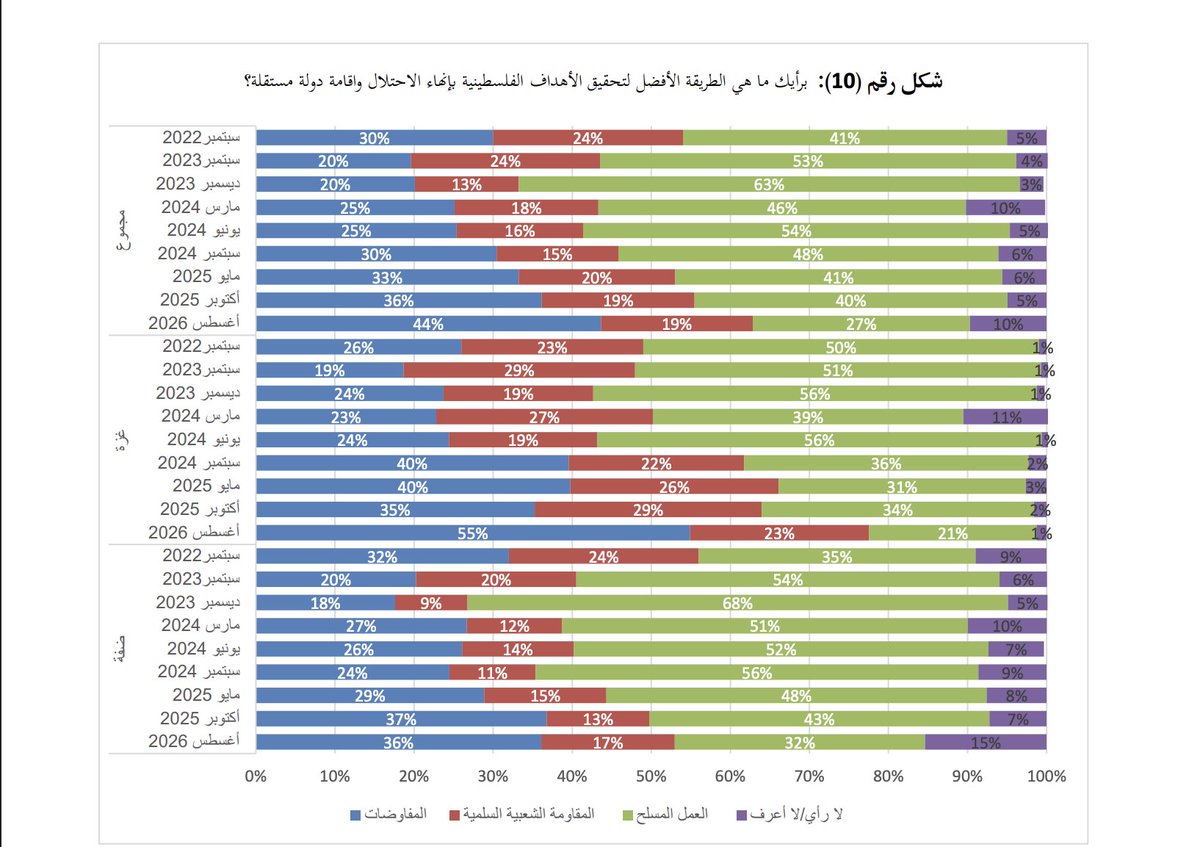
According to the latest PCPSR poll, just 27% of Palestinians support armed struggle—the lowest level of support recorded in the past four years.
Meanwhile, 44% support negotiations with Israel, while another 19% support nonviolent resistance.
In my first article for @ForeignPolicy, I argue that Turkey's peace process with the #PKK is not primarily about Erdogan's domestic political calculations. It is a response to a rapidly changing Middle East following Oct. 7, the fall of Assad, and the war with Iran. https://t.co/GSWYvjtobu
This reflects a remarkable misunderstanding of how much the Gulf has changed from someone who aspires to once again become Israel’s prime minister.
Saudi Arabia and Qatar are no longer living in the era of the Qatar blockade. They have moved well beyond that confrontation and today maintain a significant strategic relationship. The UAE remains more suspicious of Doha, but Bennett might want to remember who was among the first regional leaders to travel to Qatar after the Israeli strike in Doha: Mohammed bin Zayed.
Bennett seems to be analyzing today’s Gulf through the lens of the 2017–2021 Qatar crisis. A lot has changed since then.
There is another fundamental problem with his approach: Qatar is a major strategic partner of the United States. The idea that Israel can simply mobilize Washington behind a campaign to isolate Doha ignores both current Gulf geopolitics and U.S. strategic interests.
And with all due respect to Qatar’s influence operations in Washington, they are not the primary reason Israel’s standing in the United States has deteriorated. The greatest damage is being done by Israel’s own policies—above all, its approach to the Palestinians.
If Mr. Bennett genuinely wants to reverse the erosion of support for Israel in the United States, he would be better served by investing his energy in developing a realistic political strategy for the millions of Palestinians living between the Jordan River and the Mediterranean Sea.
Israel cannot find a technological solution to what is fundamentally a strategic and political problem.
אפקט סגלוביץ' - מחקר חדש של אקורד על ההשפעה הצפוייה של הצטרפות סגלוביץ' על תמיכת מצביעי האופוזיצייה בשותפות עם רע"מ. שורה תחתונה: ההצטרפות הצפוייה להגביר את התמיכה של מצביעי האופוזיצייה בשותפות עם רע"ם, באופן משמעותי. כולל בקרב מצביעי ביחד וישראל ביתנו.
לכל הממצאים: https://t.co/gg0Q2b9KHr
"75% of the opposition voters in Israel support a regional diplomatic security deal that includes a path to a Palestinian state."
@RonGerlitz1, CEO of aChord, shares striking findings from research conducted into Israeli public opinion.
Full interview: https://t.co/da8ITEqPnh
This is not really about whether Netanyahu could serve as a minister in a future government. Given the criminal charges against him, that scenario is highly problematic in any case, making talk of a political rotation largely beside the point.
The much more consequential issue is what would actually change if Netanyahu were replaced.
Listening to the leading candidate to head Israel’s next government, whether on the establishment of farms in Area C, his criticism of Yair Golan’s approach, or the broader Palestinian question, it is increasingly difficult to identify a meaningful alternative diplomatic vision. Most importantly, there appears to be very little willingness to seriously engage with the Palestinian issue at all.
He has not even clearly condemned statements by the leader of a new Israeli political party presenting the “voluntary migration” of Palestinians from Gaza as a political solution.
And that gets to the heart of the problem. For those leading Israel’s political opposition, the most important question should not be whether they will sit with Netanyahu in the next coalition. The question should be whether replacing Netanyahu would actually produce a different Israeli foreign policy.
At the moment, there is reason for serious doubt And I am not even addressing another deeply troubling issue: the categorical exclusion of roughly 20 percent of Israel’s citizens, its Arab citizens, from the possibility of serving their own country as members of the Israeli government.
Israel could replace Netanyahu without replacing Netanyahu’s policies. And if the next government continues essentially the same approach toward the Palestinians, Israel should not expect a fundamental improvement in its relations with Europe, the Arab world, or even, over time, with Washington.
Replacing the prime minister is not a foreign-policy strategy. The real test is whether Israel’s next leadership can offer a credible political vision for the day after Netanyahu. At the moment, this appears to be the most likely reality in Israel even if Netanyahu’s tenure as prime minister comes to an end.
Netanyahu may leave office, but Netanyahu’s core policie, particularly toward the Palestinians, could remain largely intact. And without a genuine change in those policies, a change of prime minister alone is unlikely to fundamentally alter Israel’s international trajectory.
The problem is not simply Netanyahu. The deeper problem is that no major political force in Israel currently offers a genuine ideological and strategic alternative to Netanyahuism.
That is why Israel could wake up the day after Netanyahu leaves office with a new prime minister, but without a fundamentally different vision for the country’s future.
Instead of offering Israelis a sense of hope, a political horizon, or a credible vision for the country’s future, the political debate has increasingly become a competition over who can sound tougher and more militaristic.
22 מדינות ערב הציעו לישראל שלום מלא. אנחנו אמרנו לא.
ב-2002 אימצו כל 22 חברות הליגה הערבית את יוזמת השלום הערבית: הסדר אזורי כולל, סיום הסכסוך ונורמליזציה מלאה בין ישראל לעולם הערבי, בתמורה להסכם קבע ולהקמת מדינה פלסטינית לצד ישראל.
כמעט רבע מאה שההצעה הזאת מונחת על השולחן.
אלו 22 המדינות:
אלג'יריה, בחריין, קומורו, ג'יבוטי, מצרים, עיראק, ירדן, כווית, לבנון, לוב, מאוריטניה, מרוקו, עומאן, פלסטין, קטר, ערב הסעודית, סומליה, סודאן, סוריה, תוניסיה, איחוד האמירויות ותימן.
הימין המתנחלי מנסה לשכנע את הציבור שאפשר להגיע לשלום עם העולם הערבי תוך התעלמות מהפלסטינים. כמה מדינות אכן כוננו יחסים עם ישראל, אבל פריצת הדרך האזורית נעצרה בדיוק שם. העולם הערבי אומר מאז 2002 את ההפך: הדרך להסכם אזורי עוברת בסיום הסכסוך הישראלי-פלסטיני.
הסכם כזה ישנה את מצבה האסטרטגי של ישראל: גבולות מוכרים, הכרה אזורית, שיתוף פעולה ביטחוני וכלכלי ועתיד שבו ישראל נשארת מדינה יהודית ודמוקרטית.
מדינה פלסטינית מפורזת לצד ישראל אינה פרס ואינה טובה שאנחנו עושים למישהו אחר. היא המפתח להסכם אזורי עם 22 מדינות.
לא צריך להמציא את הפתרון מחדש. הפרמטרים להסכם ידועים, ובסוגיות הליבה כבר גובשו פתרונות ששומרים על האינטרסים החיוניים של ישראל. אש"ף מכיר בישראל והרשות הפלסטינית תומכת רשמית בפתרון שתי המדינות.
זו בדיוק הסיבה שממשלת "חמאס הוא נכס והרשות הפלסטינית היא נטל" עשתה ועושה הכול כדי לחזק את חמאס, להחליש את הרשות ולחסל כל סיכוי לפתרון מדיני.
אם ישראל תמשיך במדיניות "ניהול הסכסוך", בסיפוח ובהתנחלויות, התוצאה תהיה קריסה ביטחונית, כלכלית ובינלאומית והפיכתה של ישראל למדינה מבודדת, נחשלת ומצורעת. כך ישלים הימין המתנחלי-משיחי את משימתו: הקמת "מדינת יהודה" על חורבנה של מדינת ישראל.
פתרון מדיני יגיע כך או אחרת. השאלה היא מי יעצב אותו: ישראל, שתוביל את המהלך ותשמור על האינטרסים שלה, או העולם, שיעשה זאת במקומה אחרי שנשלם מחיר כבד ונאבד את היכולת להשפיע.
זה לא פתרון שתי מדינות.
זה פתרון 22 המדינות.
אינטרס ישראלי!
Retired IDF Colonel Doron Meinrath was arrested today by the IDF for protecting a Palestinian community in Khirbet a-Tawil in the occupied West Bank from settler violence. The IDF arrested him after declaring the area of a water cistern he was protecting a "closed military zone".
Doron is one of several thousands of Israeli activists risking their health and freedom to serve as "protective presence" against settler terrorists.
https://t.co/pAc8EzTvkq
There will be no meaningful expansion of Arab-Israeli normalization without progress on the Palestinian issue. Israeli leaders should stop selling their public the illusion that the region can simply move on.
Egypt is not going to assume responsibility for governing Gaza. Saudi Arabia is unlikely to move toward full normalization with Israel without a credible political pathway for the Palestinians. And the regional map itself has changed: Saudi Arabia, Qatar and Turkey have significantly improved their relations, while Egypt and Turkey have undergone their own rapprochement.
So what regional reality is this strategy actually based on?
For years, Israeli policy has increasingly embraced the idea that the Palestinian question could be bypassed — that Israel could deepen its integration into the Middle East, expand the Abraham Accords and eventually normalize relations with Saudi Arabia without making consequential political choices on the Palestinian front. That assumption looks increasingly detached from reality.
The Abraham Accords were an important diplomatic achievement, but they should not be mistaken for proof that the Palestinian issue has become irrelevant. Saudi Arabia is not the UAE, and the political environment after the Gaza war is not the Middle East of 2020.
This matters for Washington as well. An American strategy built around a grand Israeli-Saudi bargain cannot succeed simply by offering Riyadh enough bilateral incentives while treating the Palestinian component as an obstacle to be managed. Saudi leaders have their own domestic, regional and Islamic considerations, and those cannot simply be wished away.
If this is also the foreign-policy doctrine of Israel's next government, then a change of leadership will produce remarkably little change in policy.
Israel needs a genuine foreign-policy reset. That means abandoning strategies based on assumptions that no longer correspond to the region as it exists today. It means recognizing that Israel cannot indefinitely separate regional integration from the Palestinian question.
A serious strategy begins with the region Israel actually lives in — not the region Israeli politicians would prefer to imagine.
In my latest Substack post, I argue that the only way to get Hamas to disarm, which is essential for Gaza's future, is in exchange for Israel's withdrawal from Gaza, and that this can only be a gradual, reciprocal, synchronized & verified process, as demonstrated by how the successful peace process in N.Ireland dealt with the decommissioning of the IRA's weapons: https://t.co/CJ1M2cfaS0