@zezzme33266@DrMcFillin Yeah, definitely avoid deifying anybody, and instead see for yourself in your own honest experience what can be realized. This is open source tech, reproducible, and surprisingly straightforward once you stop looking elsewhere, such as to others
Can Sufi and mystical islamic meditation help us understand consciousness?
Modern science has only recently begun to investigate advanced meditation and related altered states of consciousness. Most of this research has focused on Buddhist traditions and related meditations, especially from Theravāda and Tibetan sources. Sufism, despite its rich contemplative heritage and sophisticated models of self-transformation, remains absent from contemporary neuroscience and consciousness research.
As contemplative science increasingly turns toward advanced meditation, we need to develop a more comprehensive, cross-tradition understanding capable of integrating diverse contemplative perspectives on selfhood and awareness.
In our new manuscript, “Extending the Scientific Study of Advanced Meditation Across Contemplative Traditions to Sufism within Islam: A Comparison Case of Self-Attenuation including Theravāda Buddhism and Tibetan Dzogchen,” we explore how Sufi contemplative practice can contribute to the scientific study of consciousness and meditative development, and particularly to our understanding of selfhood and the attenuation and reorganization thereof.
Drawing on classical Sufi concepts including ‘nafs’ (self-centered or egoic processing), ‘qalb’ (‘heart’ as a center of awareness and affective transformation), and ‘rūḥ’ (a deeper non-egoic mode of awareness), we develop a neurophenomenological framework for understanding how Sufi contemplative practice reorganizes the ordinary sense of self while preserving vivid consciousness. Through this lens, we further present and examine ‘fanāʾ,’ a temporary dissolution of egoic selfhood, ‘baqāʾ,’ a reintegrated and stabilized mode of awareness following self-transformation, and ‘dhikr,’ a rhythmic devotional remembrance involving repeated phrases, breath, sound, and focused attention.
We present our new framework, theorizing that Sufi contemplative practice involves:
— Neural entrainment through rhythmic repetition
— Reduced dominance of narrative self-focus
— Reweighting of affective salience and motivational relevance
— Changes in agency, ownership, and self-boundaries
— Preserved awareness rather than loss of consciousness
Integrating Sufism into contemplative science is not simply about broadening comparative scope. It promises to deepen current scientific models of meditation by foregrounding dimensions often underexplored in modern contemplative science: devotion, affective salience, meaning, and the transformative role of rhythmic practice. Future research may thus advance a more integrative science of consciousness capable of linking phenomenology, large-scale brain dynamics, and the lived transformation of self-experience across contemplative traditions.
I’m so grateful to first author Asiya Gul, our collaborators Sebastian Ehmann, Catherine Prueitt @CatPrueitt, Terje Sparby @terjesparby, and the contemplative practitioners and traditions that continue to inspire this work.
Preprint below ⤵️
May this work benefit many 🙏
@Aella_Girl Perhaps scroll about 1/3 of the way down to the section labeled “Ontological Certainty, Agnosticism, and Neutrality” and see what you think of this take on these questions: https://t.co/j4l4nTOBUD
Kidney stones, the really big bad ones, when passing them, can be astoundingly, overwhelmingly, brutally physically painful, realization or no, and be so for many hours and days, in a way that just blows out far past ideals and dreams of what practice might be able to realistically stop.
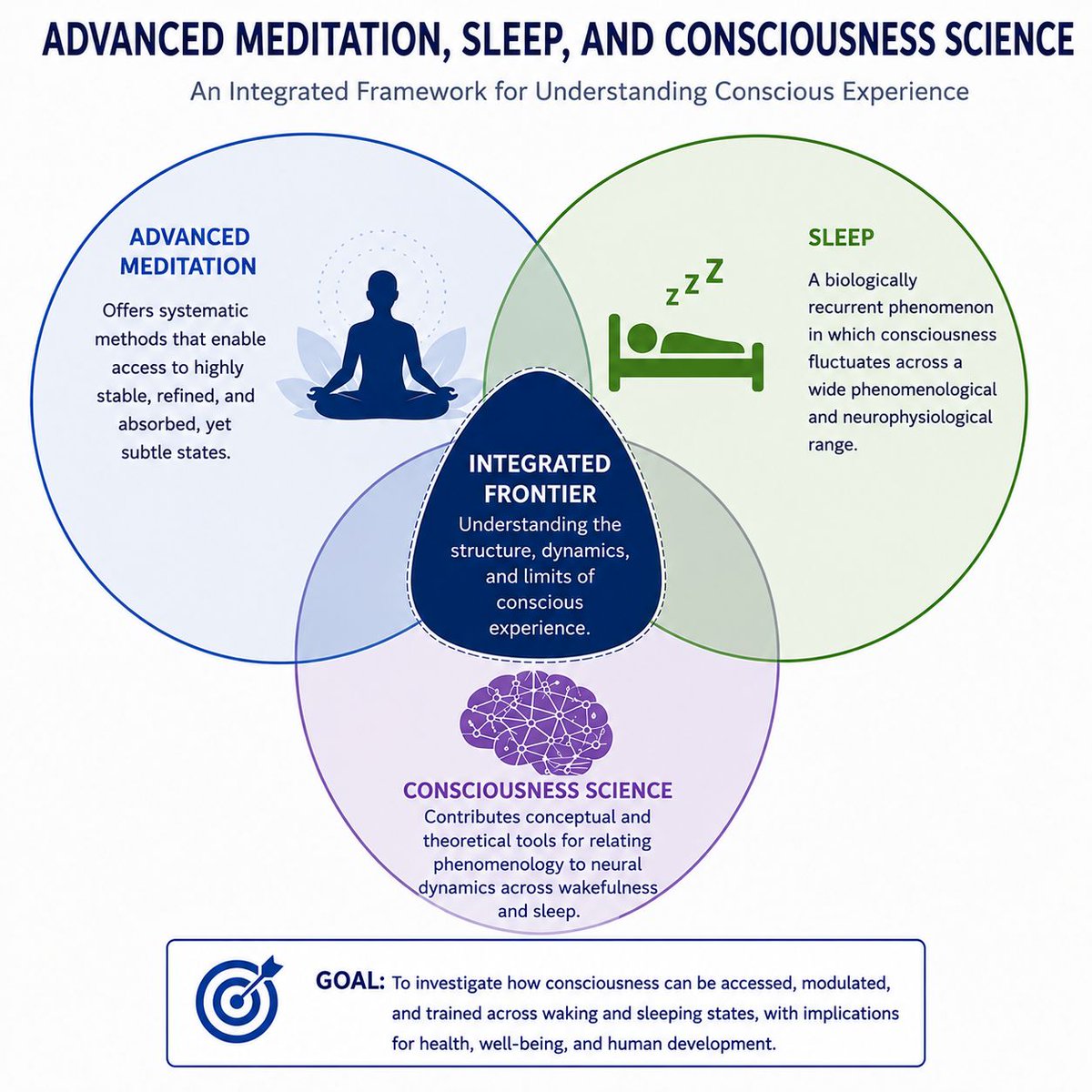
What can the interface of sleep, consciousness, and advanced meditation teach us?
Announcing the publication of “Advanced Meditation, Sleep, and Consciousness Science: An Emerging Frontier,” in Neuroscience & Biobehavioral Reviews.
Across many contemplative traditions, sleep has long been viewed not as unconscious downtime, but as a powerful domain for mind training. Modern science is only beginning to explore this possibility.
In our new article, we argue that uniting advanced meditation, sleep, and consciousness science opens a new frontier for understanding the mind across the full arc of both waking and sleeping life. In this view, consciousness is not simply “on” or “off,” but dynamic, trainable, and transformable across many states of experience.
The broader implications of this integrated perspective are profound. If awareness can be systematically cultivated not only during waking practice, but also across sleep states –for example through lucid dreaming, clear light sleep, and sleep-wake transitions – then this may represent a largely untapped dimension of human development, one that at least in some cases ancient traditions described in detail and that now science is only beginning to investigate.
I extend my deep gratitude to first author Clarita Bonamino @BonaminoClarita and our collaborator Clara Hausen, as well as to the contemplative practitioners and traditions who continue to inspire this work.
The full manuscript PDF is included in the comments below ⤵️
May this work benefit many 🙏
Hey, thanks for bringing more awareness to this much needed field and for all your work and support of it and getting your take on this out there.
Two things:
1) As you say you like the models I gravitate towards, the models of "nirodha" (which just means "cessation" in Pali) I am familiar with and most prefer have two types of "nirodha", as you explain, the more common one: Cessation/Fruition as you describe, and the very rare one: "nirodha samapatti", the Cessation of Perception and Feeling, but they are *not* differentiated by duration, as both can be quite quick to external time, and both can last a long time in some talented practitioners sometimes (in theory up to many hours for the first, perhaps rarely days for the second, might be outliers), but they have distinctly different setups, entrances, exits, and afterglows and after-effects, and I realize there is a recent, unfortunate trend, to differentiate these purely based on duration, but I don't think this is helpful, as they are so different. Again, since "my" models were mentioned, here they are: https://t.co/SSvdXfRdfQ and the next chapter on the Three Doors
vs
https://t.co/rUOfq56HO3
2) The @the_emergent EPRC, which @kathryndevaney is an OG co-founder of, is the world's largest research consortium dedicated to promoting this field which is so needed in the world. Please help support our work to make these dreams a reality! https://t.co/TaVO34FS4Y
Invisible Warfare
Headline: The MIT Study that Finally Visualizes the Brain-on-COVID
Have you ever had a medical scan come back "clear" while your brain felt like it was made of inflamed concrete? You aren't crazy. Standard medicine just wasn't looking small enough.
A major 2026 paper from MIT and Harvard just changed the game. They didn't just look at brain tissue; they physically expanded it 15-20x its size—like using a molecular magnifying glass—to achieve 20-nanometer resolution.
What they found changes everything:
Standard imaging looks for damage. This paper visualized defense.
Deep inside the brains of people who had SC2, they found periodic Amyloid Nanoclusters co-localizing directly with the virus.
What does that mean?
The Cargo: Your body is running on infected, hyper-activated platelets (the 'weaponized platelets' of LC). They carry viral debris and proteins into the brain's capillaries.
The Body's Defense: When the brain detects these viral invaders, it doesn't wait. Its immune system (microglia/astrocytes) triggers a protective, antimicrobial "foam" called amyloid-beta.
The Trap: This amyloid foam physically traps, cages, and neutralizes the viral proteins to stop them from causing further harm.
The Price: The paper found a 2-fold increase in activated astrocytes, the cells that manage the brain's environment. These dense, sticky amyloid traps and swollen astrocytes create a state of permanent, local, architectural neuroinflammation.
This isn't a "chemical imbalance." This is structural warfare. The brain is filled with tiny, persistent defensive knots that it cannot clear, causing the profound fatigue, cognitive impairment, and severe inflammation so common in LC.
#LongCOVID #Neuroinflammation #Microbiome #VigilanceLab
A comic showing this! Hope this helps my friends and fellow humans.
Wall of text warning.
I understand that on a surface level, the story they sell you is a good thing. Protecting kids, keeping them off websites they shouldn't be on, stopping predators - I don't think anyone is against all these things. But the fallacy here is that the implementation of all this monitoring means ANYONE could be implicated for ANYTHING the government deems a threat, now or later.
It's akin to installing a camera and microphone in every room of your house that records everything 24/7 and is easily accessible by law enforcement at any time. Not just live feeds, but all the archives going back years as well. And on top of that there are intelligence agencies deploying AI tools to scan all the footage to detect any "problematic" behavior. Even if you're not breaking any laws, they are more than free to flag you for this stuff and start building a profile, false positives included. This is the system they are setting up on the internet.
Let me give you an example: You want to log into Instagram but they require you to do an ID and face scan. So you do it. Now your friend is a bit of an edgy person and sends you a funny meme criticizing Israel. You find it silly, like the post. Instagram recognizes that and serves you some more edgy memes of this nature. Instagram's algorithm is constantly building a profile on you and flags that you like "Israel critic" content. Not illegal. Nothing to hide. Yet. Legislation is later passed that considers even memes of this nature to be racist and antisemitic, punishable by law with fines or worse. Law enforcement queries Meta for a list of all profiles deemed to fall into this category, Meta hands over your real name proven by your "age-verification check". Now you're on an intelligence agency watchlist. They have probable cause to monitor all your online activity and punish you for one misstep. Say the wrong thing, criticize or make fun of the wrong person, look at the wrong website - all fair game to them.
Going back to the cameras in your home, it's like owning a firearm completely legally for years, the AI system flags this to the government. And then firearms are outlawed. You were already flagged so you are now monitored as someone who could pose a risk to the public because you followed all laws in the past.
Stuff like this is already happening around the world. And don't kid yourself by thinking the government doesn't drool over the prospect of implementing the same kind of systems that Iran has where they imprison people for using the internet during a nation-wide shutdown.
Governments want more control, all of them, for all of history.
We have now mapped the most robust whole-brain characterization of meditation to date.
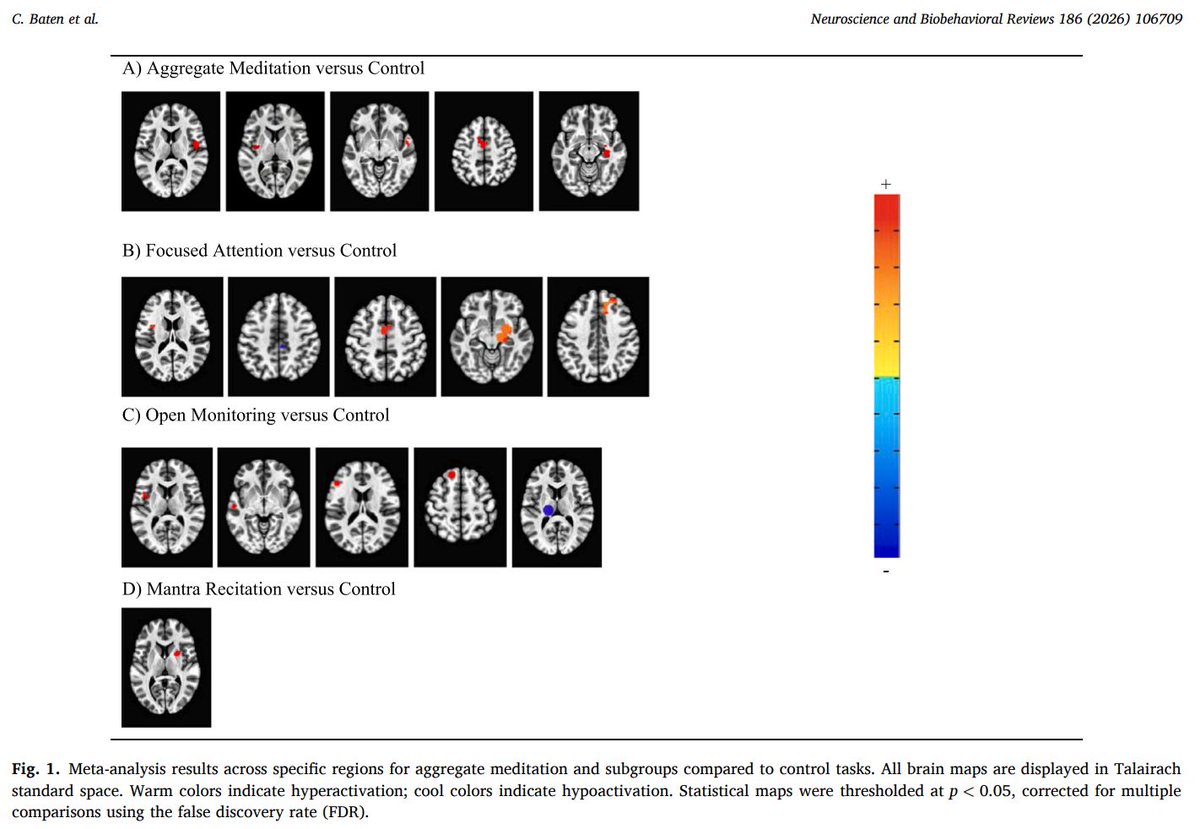
Our new paper in Neuroscience and Biobehavioral Reviews, “The Functional Neuroimaging of Meditation: A Quantitative Whole-Brain Meta-Analysis and Systematic Review,” provides a systematic and rigorous whole-brain characterization of meditation and establishes a foundational reference for future research in this domain.
Using quantitative whole-brain meta-analytic methods, we synthesized findings across the growing neuroimaging literature to move beyond individual experiments and identify the most reliable and reproducible brain activity common across meditation techniques as well as activity specific to different meditation techniques.
From 34 studies and over 700 individuals, we assessed neuroimaging data during focused attention, open monitoring, mantra recitation, and loving-kindness meditation. We found that:
– Across practices, meditation consistently recruits brain regions including the rolandic operculum, insula, superior temporal gyrus, supplementary motor area (SMA), and hippocampus.
– Functional decoding further linked whole-brain activation patterns to self-monitoring, reappraisal, motivation, experience, and awareness states., highlighting meditation’s role in engaging domain-general cognitive processes that may develop through intentional training.
Also, different meditation practices demonstrated dissociable neural signatures:
– Focused attention meditation recruited brain regions implicated in attentional control and monitoring, including the insula, SMA, superior frontal gyrus, and hippocampus.
– Open monitoring meditation engaged brain regions associated with salience, attentional awareness, and present-moment monitoring, including the insula, inferior frontal gyrus, middle temporal gyrus, and superior frontal gyrus.
– Mantra recitation was linked to distinct activation in the putamen/insula, regions associated with sustained attentional and psychomotor integration.
– Loving-kindness meditation activated aspects of prefrontal, cingulate, and affect-related brain systems associated with compassion and socioemotional processing.
Together, these findings provide robust evidence that meditation is not a single, unitary brain state, but rather a family of practices that engage overlapping yet distinct neural systems, which highlights the need for greater specificity in how meditation is studied and interpreted.
Our new research informs the personalization of clinical applications that seek to use meditation as an intervention to promote psychological well-being. In addition, it establishes a baseline for future research studying meditative development and advanced meditation. It also identifies promising neural targets for targeted clinical neuromodulation protocols.
Congratulations and gratitude to first author Caitlin Baten and our co-authors Arielle Keller @ArielleKeller and Chris Miller!
The full preprint is included below ⤵️
May our work benefit many 🙏