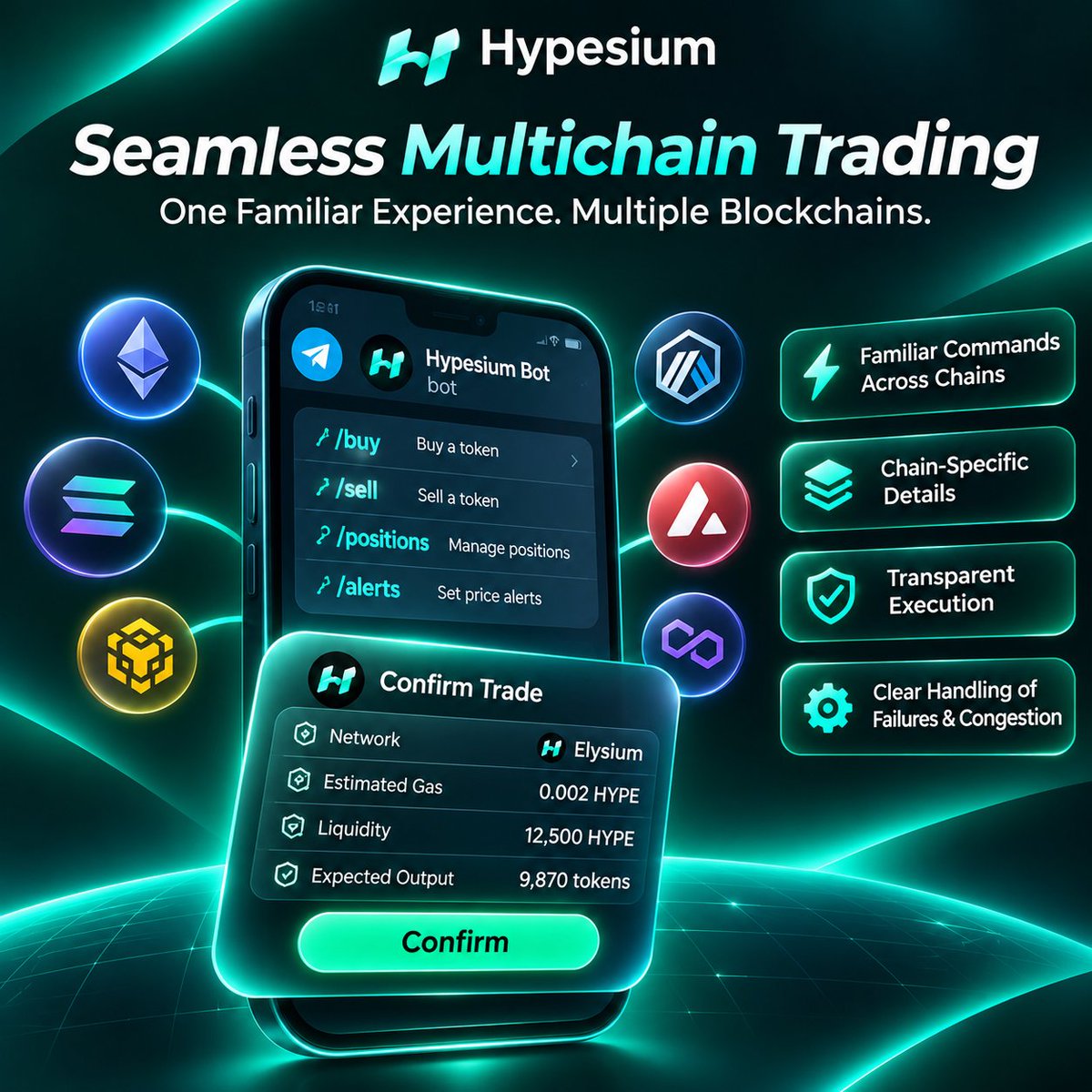
As @Hypesium expands to more chains, here's what I want to see: one familiar experience that still respects what makes each network different.
Changing blockchains usually means relearning the interface, the commands and the transaction flow. That friction makes managing positions across ecosystems harder than it should be.
Hypesium's Telegram model offers a way through. The same commands could buy, sell, monitor tokens and manage positions, with no hopping between platforms.
But a consistent interface doesn't mean every chain behaves the same. Gas costs, liquidity depth, confirmation times and execution conditions all vary. A trade that fills cleanly on one network can slip badly on another where liquidity is thin.
That's where transparency matters most. Before confirming, a trader should see:
➠ Which network the trade is on
➠ Estimated gas cost
➠ Available liquidity
➠ Expected execution details
I'd also want to know how failed transactions, congestion and surprise costs are handled. Convenience means little if users can't tell what happened when a trade goes wrong.
My takeaway: keep the commands the same on every chain, but make the transaction details specific to each one.
That's what would make Hypesium's multichain move valuable to traders.
@Hypesium@starlisting
Always DYOR.
My husband had a strange habit that I never understood.
Whenever his relatives asked how much money I contributed to our household, he would tell them I only paid $500 a month.
The truth was, I contributed $2,000 every month.
I never thought much about it until his mother called me one afternoon.
She said, “I hope you don't mind helping your husband with his younger brother's school fees. We know you don't earn much, but anything you can contribute will help.”
I was confused.
I asked her why she thought I didn't earn much.
Good night legends.
What changes when a blockchain does not expose a public mempool?
On networks with a public mempool, observers can inspect pending transactions before they are included in a block.
This information can influence how traders and automated systems respond to market activity.
Elysium operates without a public mempool, so trading systems need to approach transaction detection differently.
@Hypesium uses pool creation logs as an important trigger for its sniper execution process.
Rather than depending on publicly visible pending transactions, it prepares the necessary transaction information before the pool creation event arrives.
This changes the execution approach.
However, the absence of a public mempool does not remove competition between traders or guarantee favourable transaction ordering.
Understanding the network's transaction visibility is an important part of understanding how automated trading works on Elysium.
Multichain trading should make moving between ecosystems easier, not force users to relearn the entire process every time they switch networks.
That's an important area to watch as @Hypesium expands its trading experience across more chains.
Using Telegram as a familiar command layer could reduce the friction of buying, selling, tracking tokens and managing positions. Instead of jumping between different platforms, users can work through a more consistent interface.
But there's a technical distinction that shouldn't be overlooked: one interface does not mean identical trading conditions across every blockchain.
Each network comes with its own gas costs, liquidity depth, confirmation times and execution behavior. A route that works well on one chain may produce higher slippage or unexpected costs somewhere else.
That's why I believe chain-specific transaction information should remain visible, even when the commands stay simple.
Before confirming a trade, users should understand which network they're using, the estimated gas cost, available liquidity and expected execution details.
The handling of failed transactions, network congestion and unexpected fees also deserves attention. A smooth interface is useful, but users need clarity when something doesn't go as planned.
For me, the strongest multichain experience combines familiar controls with accurate information about each network.
Simplify the workflow without hiding the differences that affect execution.
That's the balance I'd like to see from @Hypesium as its multichain trading develops.
Always DYOR.