There’s a reason why people today prefer shows like LOST, Twin Peaks, GoT, Breaking Bad etc. You get invested when you only get one episode a week. You find podcasts to listen to in between episodes. You read blogs & watch YouTube videos. You develop a relationship with these shows, instead of rushing to the next episode & forgetting all of the details & nuances. The binging model makes you want to find the next show to binge, not remain committed to one piece of IP.
TV shows used to give us 16-24 weeks of entertainment and discussion, every year.
Now, we get 6-13 episodes once every 2 years (if we’re lucky) and Netflix, in particular, gives it one single day.
It seems obvious why audiences fall off of shows.
Glad we had LOST, TWD, GoT etc before this because I don’t think that sort of zeitgeist thing can return with how TV is made, distributed, and consumed now.
Some on the far left react viscerally against any acknowledgment of America’s historical virtues.
Some on the far right react viscerally against any acknowledgment of America’s historical vices.
For a liberal patriot, a history of America in all its triumphs and tragedies is far more inspiring than either hagiography or demonology.
We are now in a position where a tiny proportion of the population uses Fable or soon GPT-5.6, while everyone else's experience of AI is 8-30b-model level - Google's AI Overviews, Meta AI, ChatGPT free tier, maybe MS Copilot at best. People outside of tech must be completely baffled how this is supposed to take their job, and annoyed that hundreds of billions are being poured into it.
@vee_em_cee@jrockandrollt The battery compartment is fortunately secured by a little screw at the top left 😅 if they can find the right screwdriver and get new batteries in without parental guidance, then I guess the next step is teaching them how to use the fire extinguisher
Imagine telling someone in 1999…
The year is 2026.
The President is Donald Trump in his second non consecutive term.
The richest man in the world is PayPal cofounder Elon Musk… but not because of fintech or Paypal. Because of rockets, electric cars, AI, satellites, brain chips and something called “Boring Company”.
Apple is worth trillions but its main business isn’t computers… its selling glass rectangles everyone stares at for 9 hours a day.
People don’t watch TV. They watch teenagers explain geopolitics, finance, and relationship advice in ~60 second videos.
The biggest taxi company owns no taxis.
The biggest hotel company owns no hotels.
The most powerful media companies are social networks where everyone argues with strangers for free.
Kids are making millions filming themselves playing video games.
AI Robots write emails, code, legal memos, songs, essays, and breakup texts.
The internet is mostly bots arguing with humans who are trying to prove they aren’t bots.
You can summon a car, groceries, a doctor, a date, a private jet, or a dog walker from your phone.
People pay real money for invisible currencies, digital monkeys, AI girlfriends and pictures that disappear after 24 hours.
The richest companies in the world don’t sell oil, steel, or cars. They sell attention, compute, data, and addiction.
And somehow, after all of that everyone is still using Excel.
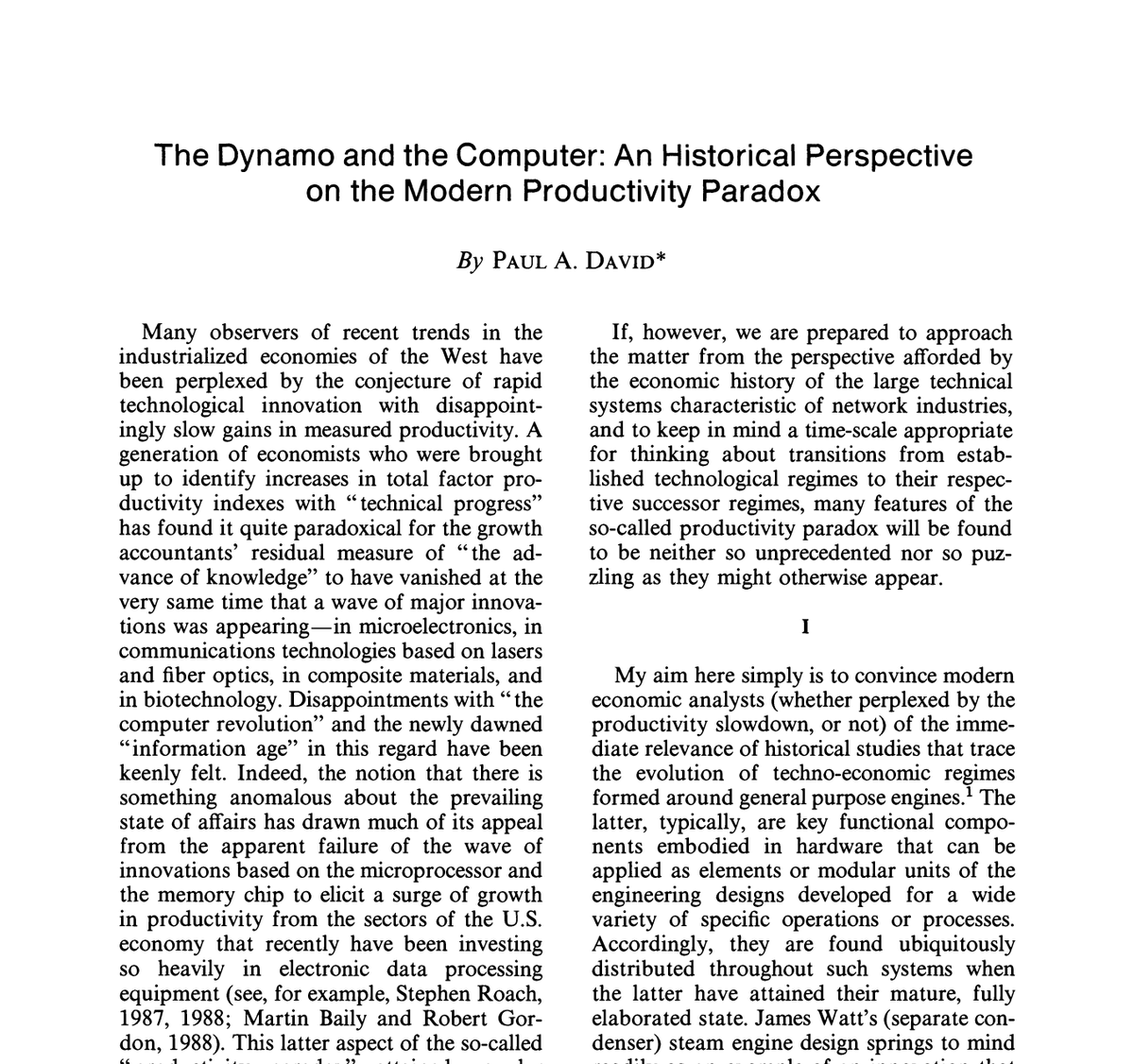
If you've adopted AI at your company but haven't seen any tangible results, read this 1990 article: "The Dynamo and the Computer" by Paul David.
When electricity first arrived, factories that "adopted" it barely got faster. They just swapped the steam engine for an electric one and ran everything else exactly as before: same machine layout, same workflow, same management. Electricity in, no real gains out.
The most common mistake with any new technology is to drop it into the old organization and then declare the transformation done.
The real leap came decades later, when each machine got its own small motor. Suddenly machines no longer had to be lined up around one central drive shaft. They could be rearranged around the actual flow of work.
The productivity gains didn't come from electricity. They came from REDESIGNING THE ENTIRE FACTORY around it.
AI is the same. Bolting it onto your existing process gets you a faster steam engine. The payoff comes when you redesign the work itself.
(link to paper in comments)
In Mere Christianity, CS Lewis has an awesome opening riff about how most people know the difference between right and wrong, but they justify acting immorally by appealing to "special exception." They know they shouldn't hit a friend, but what if that friend was being so mean? They know they shouldn't steal a seat a bus, but what if that person got up and created a moment's confusion and then the seat was up for grabs? Etc.
When I read this section, I thought a lot about contemporary politics and the way that people justify their politics, not by appealing to higher principles, but rather by appealing to "special exception" to argue that their admitted indecency is justifiable in context.
A lot of MAGA vice is justified by special exception. Trump's defenders rarely defend his crookedness directly. They don't say "it's wonderful to use trade policy to enrich the Oval Office, it's really awesome." They say: Well, look, it doesn't really matter, because the left is so dangerous, Biden maybe did something similar 3 years ago, Democrats would do the same in power, and so forth.
I heard something similar in that NYT conversation everybody's talking about. You even see it in the headline: ‘The Rich Don’t Play by the Rules. So Why Should I?’ Why, hello, special exception. When you start arguing that stealing food and French paintings is justifiable in the context of political protest in an age of prevailing distrust, you're similarly not arguing *for* any kind of a universal principle. Nobody actually wants 300 million people stealing fruit from the grocery store. Nobody actually wants every Louvre visitor trying to rip a Manet off the walls. These virtues don't scale. (Because they're not virtuous!)
Sap that I am, I want us to get to a place where politics is about fighting for what is right and decent, not about justifying what sort of indecent behavior might be somewhat understandable or technically justifiable given the other side's vice or the prevailing levels of indecency. The point is to build the kind of goodness that scales.
https://t.co/iPF65NuyeU
The core problem with Shoplifting Is Moral Under Leftism discourse, like so many discourses before it, is that our social media algorithms select for this.
We exist online in a system that is designed to find the most childish and inflammatory opinions and amplify them to millions of people.
In an earlier age, gatekeepers existed to stop morons with puerile or reprehensible views from being heard. That had upsides and downsides. But now gatekeepers don't exist and everyone, even the New York Times, is just chasing clicks any way they can.
Invite on the hot doofus to say blowing up stuff is cool and shoplifting is good but plastic cups are a moral travesty. Why not? That'll go viral, you'll probably get a bonus. Watch everyone get mad, lolz, so owned.
This is what our media is doing to us. These people are freaks, they're not normal, but they're shoved in our faces for the purpose of chasing the last three dollars left in media.
@EYakoby I totally understand seeing an exciting video and maybe hearing that it’s from a current event (and so wanting to share it), but doesn’t posting incorrect info like this hurt your overall mission? How do you check on stuff like this before posting?