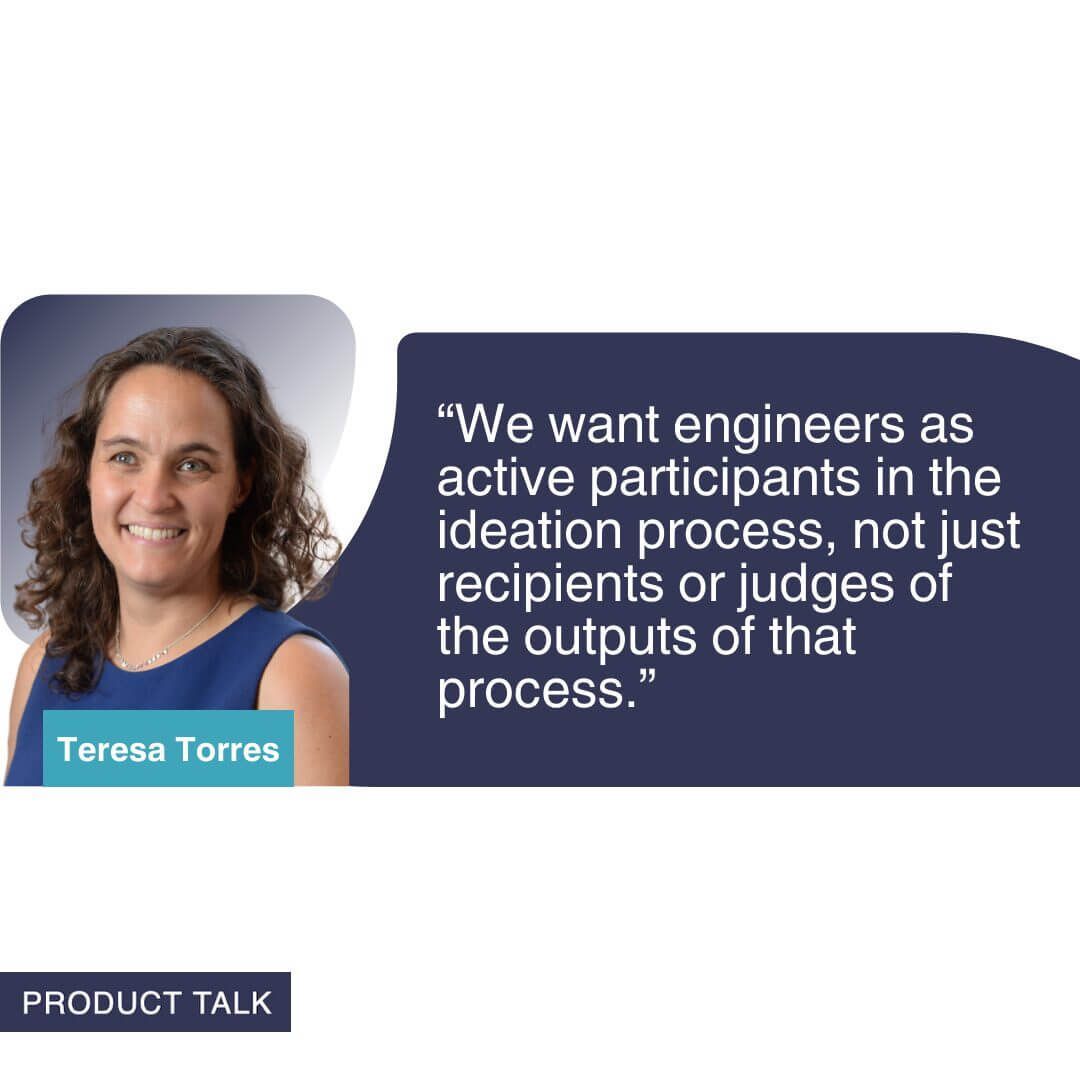
"We want engineers as active participants in the ideation process, not just recipients or judges of the outputs of that process."
https://t.co/o18s8d3L4h
#prodmgmt#ux#engineering
Nothing bothers me more than "too nice" feedback. If you know there's going to be an issue, just tell me. I'd rather context and education than catering to my "feelings"
@GoRobelix@GobiernoCholula Se murió su sitio? 🤦♂️Así o más complicado para pagar? Hay que invertirle más a la seguridad y calidad de los sistemas @Paola_Angon Si quieren mejor mandamos el pago por paloma mensajera. #predial
A: How I know I'm Agile? I need an assessment!
B: Can you change the nature and structure of what you're working on, or change the way you work, as you learn?
A: Erm, no.
B: You're not agile.
I've never worked on a piece of design-up-front software where the design didn't have to change radically based on things we learned as we developed. Death-march projects usually start with a fixed up-front design. Time spent on detailed up-front design is time wasted, IMO.
CEOs / Executives:
When you freak out about a team missing their launch date by a week or a few weeks, you should know that freaking out (or punishing this team) will not actually achieve the outcome you want.
This also applies if you appreciate a team very publicly mainly for hitting their committed date.
I know you want a culture of speed, sense of urgency, execution discipline, set an example, etc. etc. but in practice you will almost certainly get the opposite of that if you do these things.
Why?
Unintended consequences.
From now on, every team — wanting to avoid punishment & seeking your appreciation — will start padding their schedules and creating a perception of greater complexity to justify the schedules.
This in turn will slow things down a lot more, company-wide.
Plus, despite heavily padding the schedule, it’s not like these teams are going sometimes launch a project early. Because of Parkinson’s Law (“work expands to fill the time allotted for its completion”), these teams will still struggle to barely hit the padded date they committed to.
This is not intuitive to some executives. They have forgotten how first-level & mid-level managers will respond to incentives and disincentives set by the execs and the CEO.
What to do?
You must learn to see the odd missed date as an acceptable cost of setting ambitious goals and aggressive deadlines. If you want teams to move as fast as they can, you must be tolerant of the occasional missed date.
(it is a different matter if there is an external customer / partner / regulator / analyst / Wall Street commitment for a given launch date — in most companies, for most launches, this is not the case)
Amazing how quickly focus can shift from "delivering to customers" to "persuading other team to do something" as a company grows
One of the most insidious viruses that can infect a company
Leeds Festival Aftermath.
#Consumatrons were here. Existing only to consume, leaving behind a toxic Plasticene geological layer before retreating back to the false safety of their digital mind prison. Oink oink. Back to the Farm
#ecology
https://t.co/7QhubIEMlM
Call it the Great Gaslighting of the 2020s. "Climate change obsession's a mental disorder"? Meanwhile, the real world’s on fire. People are dying, and we're being told we care too much. The norm? Indifference. The message?
"Learn to live with it."
1/6
Insecure leaders strive to be the most powerful person in the room. They make others feel weak so they alone can stay strong.
Secure leaders aim to amplify the power of the room. They use their strength to make others stronger.
The best and highest use of power is to share it.
Any cycle planning methodology that requires you plan the next cycle while wrapping up the current cycle is, frankly, a broken system.
This overlap burdens ICs and managers especially. Executives usually aren't clued in as they're not the ones racing to finish up the current cycle while attending meetings and writing docs to plan the next one. They hear it's a problem from those below them, but they don't experience the full brunt of the problem. So the problem continues largely unresolved.
The solution is relatively simple:
1. Regardless of the length of your cycles (several weeks, quarters, halves) provide at least a 2-week gap between the time the current cycle ends and the next one begins, reserved for planning.
2. Establish a clear expectation for the X-week gap that products teams (all functions) are discouraged from doing cycle work during this time. Instead this should be a time for pausing, reflecting, analyzing, and planning. And personal development as time allows.
I've personally experienced both fantastic and poor examples of the above. Without question, the two solutions I've listed result in greater employee well-being, more purposeful planning, and improved overall sanity.