@iScienceLuvr@RiversHaveWings Thanks, this means a lot! Katherine's Colab notebooks were what first pulled me into generative modeling. That whole era of open, hackable diffusion code shaped how many of us got started. Building on HDiT feels like giving a bit back to a lineage I owe a lot to. Thank you.
@iScienceLuvr@MattAttimonelli@TommasoDiNoia@MICCAI_Society Bonus: want to run this locally? This a native macOS app that lets you generate full brains and slice through them in real-time, no cloud. Grab it:
🍎 https://t.co/hwf561lSfR
One full-size 3D brain. Every voxel, no lossy latent. Generated in 1s.
That's WaveDiT, 𝗲𝗮𝗿𝗹𝘆 𝗮𝗰𝗰𝗲𝗽𝘁 at #MICCAI2026 (top 9% of submissions). Now we can finally unveil it. 🧠
Try it live in your browser, no install:
🤗 https://t.co/FdjlMBTsOa
🌐 https://t.co/5bPpMoZfSZ
Meet FlowLet 🧠, a framework for synthesising entirely new 3D brain MRI volumes, just accepted at Medical Image Analysis (Elsevier).
Flow Matching in an invertible wavelet domain → new brains, in a few deterministic steps.
🌐 https://t.co/838fVd1muf
🧵
So we rebuilt the evaluation: region-level, across 95 brain structures, and tested it on Brain Age Prediction.
It's all open-source:
📄 https://t.co/PLYhiBJnoR
💻 https://t.co/tPM0k7WPiT
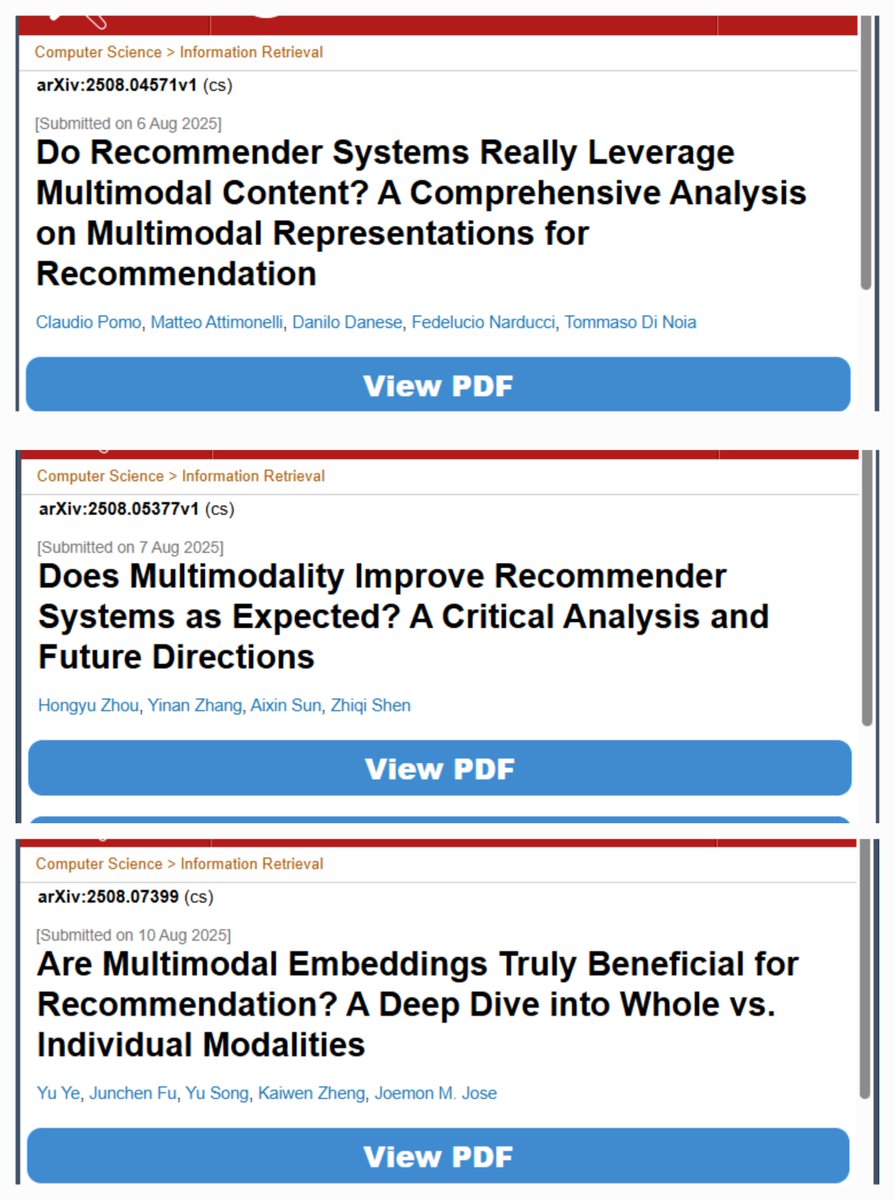
Thrilled to announce our paper, "Do Recommender Systems Really Leverage Multimodal Content?", has been accepted at #CIKM2025! 🔥
We investigate if the gains in Multimodal RecSys come from true understanding or just bigger models. A deep dive into what really works.
(Thread 👇)
I want to extend a special and heartfelt thank you to my main co-authors, @MattAttimonelli and @danilo_danese. This paper is a direct result of their brilliant insights and deep commitment. I am incredibly proud of what we have accomplished together! 🙌