Do you realize that if all of us who are holding your shit tokens @dydx ,which have lost more than 98% of their value, were to unstake, it would seriously harm the security of the network?? So why are you robbing us like this??
@LawrenceChiu14@AntonioMJuliano
is it just a network? — is it a temporal control system? continuously synchronizing itself to nanosecond accuracy?
Every validator is a sensor? Every block is a pulse? It seems every transaction is a state transition in the machine you’re now part of.
IEEE 1588 PTP hardware timing locks the entire network into phase.
You feel it the moment you connect — latency collapses, ordering resolves, the system breathes. $ROKO ?
@elonmusk prediction aligns with the growing trend toward edge computing in AI:
@RokoNetwork fits perfectly as the decentralized coordination layer for this edge-AI future, providing trust-minimized timing and verification to sync distributed edge nodes without central servers. $Roko isn't building AI or devices but serves as the "temporal backbone"—embedding hardware-secured nanosecond-precision timestamps into edge operations, ensuring verifiable, slashable actions across networks. Here's how it integrates:
Edge Synchronization for AI Inference: Devices as edge nodes need precise timing to collaborate (e.g., a fleet of robots inferring actions locally). Roko's Proof of Time (PoT) consensus (via Timebeat atomic clocks, <100ns accuracy) timestamps inferences—e.g., "Device A infers obstacle at T+0.000001s, shares with Device B at T+0.000002s"—slashed for drift (5% penalty). This overcomes bandwidth limits by enabling off-chain microseconds with on-chain verification, preventing delays in real-time AI (e.g., autonomous cars reacting to shared edge data).
Verifiable Data Flows in Bandwidth-Constrained Environments: Edge AI generates local data (e.g., sensor feeds), but sharing needs trust. Roko's temporal transactions (ordered by timestamp, not fees) and ZKP (zero-knowledge proofs) allow private, verifiable exchanges—e.g., prove inference accuracy without full data upload, reducing bandwidth use. In V2 testnet (80% coverage), graceful degradation falls back if timing fails, ensuring edge nodes stay operational.
Decentralized Edge Orchestration: As devices become "nodes," Roko's low-cost tiers (e.g., Pi-Zero GNSS kits, <24h sync on Wi-Fi) make participation easy—e.g., phones/robots as light clients contributing to consensus. This scales edge AI without clouds, with mainnet (Q3/Q4 2025) enabling apps like temporal escrows for device tasks (pay if inference completes in T+10ms).
In Elon's vision (e.g., Optimus robots as edge AI for homes), Roko fits as the sync layer—making distributed inference reliable and auditable, boosting its TAM ($100B-$500B in AI timing). Roko turns edge nodes into a verifiable network! #RokoNetwork #EdgeAI
$ROKO 🔧 Core chain breakthrough
We finally nailed the time-aware design: temporal metadata now sits in its own pallet 🧩 so Substrate’s guts stay untouched. No custom Frontier rebuilds, no weird explorer breaks—just neat hash-map storage mirroring EVM. All the tricky bits (time-bounded sig checks, miner-rules, custom gas estimator, block proposal ordering) are unit-tested ✅—~80 % coverage.
👉 Next 7-day plan
🗓️ Day 1-2 – Spin up a validator with the new code, replay 10 k blocks and make sure nothing explodes.
🗓️ Day 3-4 – Stress-test the gas estimator; keep median error < 1 %.
🗓️ Day 5-7 – Tag the beta 🎉, push docs, green-light CI, merge into the main branch.
---
🛰️ Explorer & RPC tweak
Block explorers keep working out-of-the-box 👍. We added a new RPC temporal_getTxMetadata; the patch is tiny: after you click a TX hash the UI does one extra call and shows ➡️ valid-from, valid-until, key-ID, and slippage tolerance. Ten-minute PR, 15-line guide. 🖥️✨
---
🖥️ Hardware lane
• Secure-time node (Zimbit CM5) is 90 % built; just waiting on a GPIO header + SSD 📦. As soon as they land we flip the OS clock to the external oscillator.
• Our A100 build box was RAM-starved; the new sticks arrive 24 July 📅💌. Then Rust+CUDA builds go back to “single work shift” instead of all-nighters.
• Cheap “Pi-Zero GNSS” dev-kit got the thumbs-up 👍. Next week we draft the bill-of-materials 📝, write a flashing script ⚡, and prove a home-user can sync in < 24 h on garden-variety Wi-Fi.
---
🔜 Immediate checklist (≤ 1 week)
1️⃣ Full-node beta validation (long-haul sync + memory profile).
2️⃣ Lightweight gas-oracle fallback so we don’t hit “zero gas” 🛑 again.
3️⃣ Command-line helper for key-rotation/revocation 🔑↻.
4️⃣ Pi-Zero image pipeline (ARM64 snapshot each release).
5️⃣ Explorer metadata patch merged & deployed.
---
$ROKO 🚀
🎥 The Clock Is Live.
What if time itself could be cryptographically proven?
What if the when mattered as much as the what?
Introducing Roko Network.
A programmable, slashable, nanosecond-accurate time mesh for AI, DeFi, and machines.
⏱️💥 Watch now:
1/
🕰 Centralized time is a single point of failure.
All cryptographic systems—blockchains, comms, auth logs—rely on trusted clock signals. Break the timebase, you break consensus.
There is no digital trust without time.
GPS spoofing = civilization spoofing.
2/
Today’s clock backbone is brittle:
GPS (spoofable, jammed, orbital target)
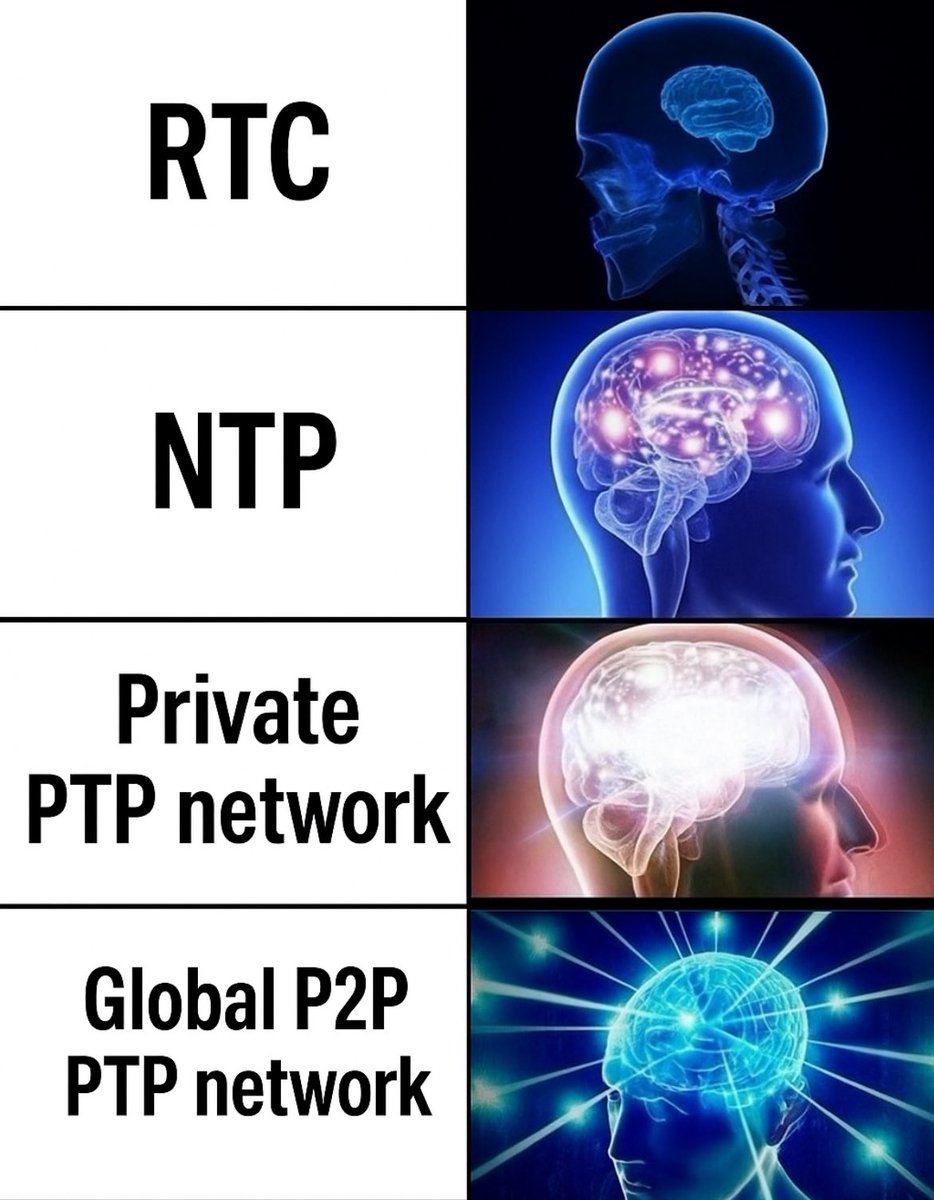
NTP (centralized, spoofable, attack-prone)
Stratum servers (few, trust-based, DoS-able)In conflict or disaster, all degrade.When time breaks, systems don’t fail safe—they fail invisible.
3/
Roko Network is a cryptographically-anchored temporal mesh.
It forms a consensus time layer across peer nodes.
Even under partial partition or satellite loss, Roko roots time via:
Signed delta synchronization
Local smoothing w/ trust decay
Backfilled cryptographic proofs
4/
Latency ≠ failure.
Roko prioritizes integrity > speed.
It can sustain clock consensus with 500ms–30s latency across degraded links.
No trust assumptions. No root key rot.
5/
Use cases:
Airgapped timestamping
Post-quantum audit chain anchoring→ If the global clock dies, Roko survives.
6/
Roko is sovereign time:
No satellites
No states
No root servers. If civilization is a computation, time is its clock cycle. $Roko is the clock that cannot be killed.
Thread: Why @RokoNetwork $Roko is the #Robotics Infrastructure to Watch 🚀📷1/ Roko’s Robotics Superpower: Nanosecond Timing
Roko delivers <100 ns time sync error for urban air mobility (UAM) and <10 ms latency for real-time control, with slash-protected UTC/TAI. Competitors like ROS (Robot Operating System) or NVIDIA Isaac? They lack this precision and decentralized trust.
Why it matters: Nanosecond accuracy is critical for coordinating robots like Tesla Bot in dynamic environments.
2/ Tailor-Made for Robotics Challenges
$Roko tackles robotics pain points: UDP emulation over TCP, latency minimization, and custom binary headers. Its “rail-track” control and “hash outside, hide inside” security model optimize real-time robot operations. ROS and NVIDIA Isaac don’t match this focus.
Why it matters: Roko’s platform is built for the robotics revolution, from industrial bots to humanoid assistants.
3/ Robots-as-a-Service Done Right
Roko’s “Life after R1” model introduces robots-as-a-service with instant slashing for bad behavior, ensuring a trustworthy robotic ecosystem. Competitors lack this economic framework for scalable robotics.
Why it matters: Roko’s incentive structure aligns perfectly with mass robot deployments, like Tesla Bot’s rollout.
4/ Tesla Bot Hype & Roko’s Role
Tesla Bot’s looming release (rumored 2025-2026) is sparking massive excitement, with Elon Musk calling it a game-changer. Roko’s nanosecond timing, secure control, and robotics-ready architecture make it an ideal backbone for Tesla Bot’s ecosystem.
Why it matters: As #TeslaBot scales, $Roko could power the trust and coordination layer for millions of robots.
5/ Growth Potential in #Robotics
Roko’s robotics-first approach positions it as a dark horse in the machine economy. Unlike general-purpose platforms, Roko’s specialized tech could capture significant market share as robotics explodes. A Tesla partnership or adoption could 100x $ROKO��s impact.
Why it matters: Early $Roko investors could ride the robotics wave to massive returns.
6/ Final Take
$Roko Network isn’t just another blockchain—it’s the universal clock and control layer for robotics. With Tesla Bot hype building and Roko’s tech ready to shine, the future looks robots @RokoNetwork #TeslaBot #Robotics
🧵
How $ROKO Interacts With Other Systems
◾ With BitTensor (AI Layer) $tao
BitTensor thinks; ROKO proves when, how, and by whom that thinking occurred
Verifies validator and miner behavior with time-bounded evidence
Enables autonomous payments, scoring, and decentralized enforcement
◾ With Banks (or Instead of Them)
Can replace the need for SWIFT, ACH, escrow, or custodial infrastructure
Verifies capital flows, settlement conditions, and risk with logic, not paperwork
◾ With IoT and Autonomous Devices
Acts as the permissioned–proof bridge: drones, sensors, and machines only act if cryptographically authorized
AI agents are here.
They’ll trade for you.
Govern DAOs for you.
Spin up infrastructure.
Sign contracts.
Enforce policies.
But none of that works if we can’t agree on when anything happened.
Let’s talk about time.
—
AI agent infra today is all over the place:
•Some run inside rollups or agentic DAOs, triggering onchain logic with timers no one can verify
•Some live on cloud GPUs, calling LLM APIs with unverifiable timestamp metadata
•Some operate on edge hardware (like drones, robots, or sensors), completely desynced from any shared time source
•Some chain signatures together in multi-agent workflows where no one can prove when any step actually happened
That’s a problem.
—
Agents rely on sequencing.
When did this task start?
When was it committed?
Was this action on time or late?
Did another agent already act?
If you can’t answer those precisely and provably, your agents don’t cooperate. They conflict.
—
Roko is an L1 that solves this.
It’s a global consensus-time mesh, where:
•Validators slash for timestamp drift
•Agents can query time as a service with cryptographic guarantees
•You can define policy windows in microseconds—not block guesses
—
Now agents can:
•Trigger jobs precisely within coordination epochs
•Prove timed access to resources
•Enforce deadlines or cooldowns that are verifiable
•React to events in a shared, trusted temporal context
•Settle conditional agreements with provable latency
—
This makes Roko the first infrastructure layer where agents can reason about time safely.
It’s not just “act and react.”
It’s “act on schedule, verify others did too, and slash if they didn’t.”
That’s a coordination primitive.
—
Think:
•Autonomous bidding agents that compete on timed reveals
•Timed payment flows across rollups
•AI governance that enforces proposal windows
•Scheduling systems where clock drift = slashing
•Chrono-verifiable SLAs for inference, training, and execution
—
We’ve priced compute.
We’ve priced storage.
We’ve priced attention.
Now it’s time to price time itself—and let agents build trust on top of it.
—
Blockchains made logic trustless.
Roko makes timing trustless.
And that unlocks an entire world of autonomous coordination.
—
Timelords don’t control the agents.
They keep them in sync.
I just claimed 550 DIAM from @diamante_io! DIAMANTE is more than a blockchain—it’s a movement toward decentralization, accessibility, and real adoption. $DIAM is just the beginning.
Gmonad 💜
Monadverse is inviting 100 early believers and supporters to be part of our exciting journey
Whitelist Form: https://t.co/HDhdT0BRV4
Form closes in a week!
For the Nads, by the Nads