🚨⏳ BACK TO THE FUTURE… BUT WHAT IF THE FUTURE OF MONEY IS CLOSER THAN WE THINK? 👀💎
The world is changing. Technology is evolving, financial systems are transforming, and blockchain is becoming part of the conversation about what comes next.
#BackToTheFuture#XRP#XRPArmy
🚨 They Planned the 2020 Lockdowns to Secretly Bail Out the Banks With $6 Trillion Without Hyperinflation
They didn’t lockdown the world because of a virus. They locked you down because the entire banking system was already on the brink of collapse.
In September 2019 the REPO market exploded. Overnight lending rates spiked. Corporate loans and derivatives were quietly failing. There was no cash left in the repo market and in the system even through banks had Treasuries as collateral.
The Federal Reserve was staring at a full-blown liquidity crisis that could have taken down major banks.
Then, just weeks later, a “once-in-a-century” virus conveniently appears.
By early 2020 the Fed starts pulling hundreds of billions out of the REPO market… right as the first cases hit U.S. soil.
They shut down the entire economy.
Why?
Because if people stop spending, stop borrowing, and stop circulating money, the system can suddenly print $6 TRILLION and dump it straight into the banks without causing immediate hyperinflation.
The lockdowns were a financial operation.
While you were terrified of a virus and watching your business die, the biggest bailout in history was being executed behind closed doors.
The timing wasn’t coincidence. The scale wasn’t accident. The narrative wasn’t organic.
They needed you scared, isolated, and offline so they could quietly rescue the system that was already breaking in 2019.
This wasn’t chaos. This was the plan.
The famous City Of London banker @LordBelgrave already warned about how central banks, IMF and BIS have been planning the new monetary order.
Oil shock? AI crisis? Cyberattacks?
They’re already preparing for the next one.
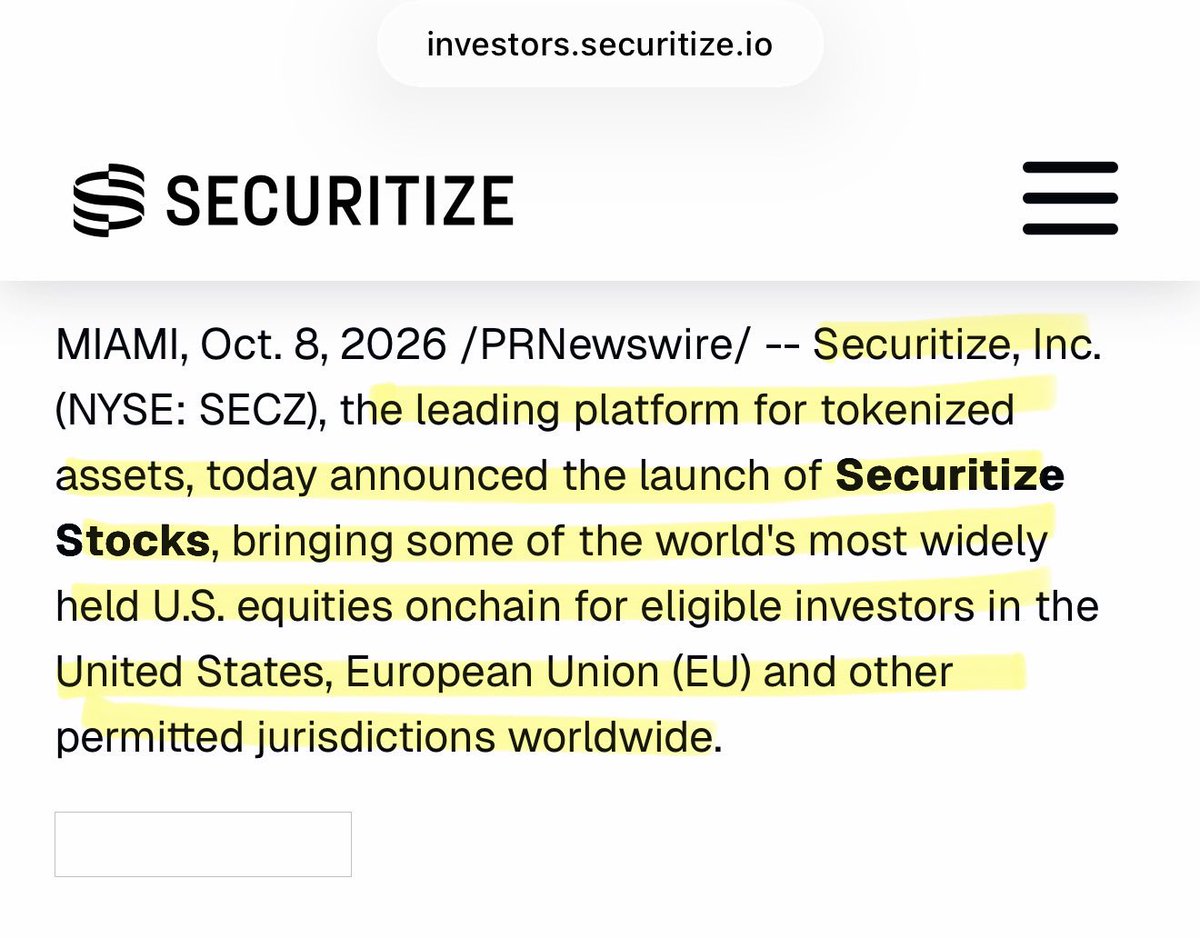
‼️OCTOBER 2026: RIPPLE PRIME WILL SUPPORT THE LAUNCH OF SECURITIZE STOCKS‼️
Securitize, the leading platform for tokenized assets, recently announced the upcoming launch of Securitize Stocks.🌐
This is an initiative to bring the world’s most widely held stocks on-chain for the first time.☝️
Ripple Prime is confirmed as a direct supporter of Securitize Stocks at LAUNCH.🔒
“Ripple Prime plans to support the launch of Securitize Stocks and explore opportunities to incorporate the assets into its broader institutional trading ecosystem.”✅
Remember:
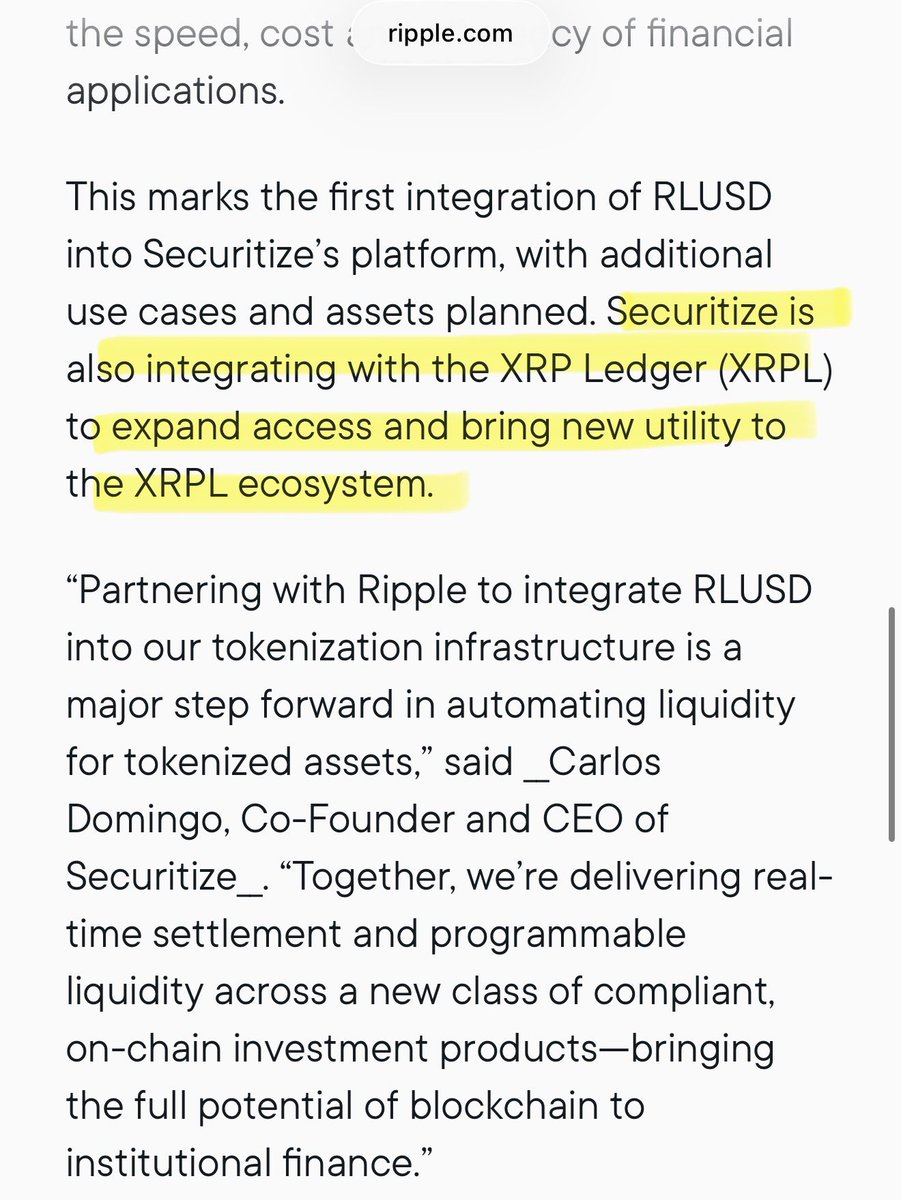
Ripple Prime and Securitize are both integrating with the XRPL.🎯
This is all documented below.📝👇
Everyone talks about selling $XRP at $5, $10, $100 or even $1,000.
What if the bigger future is earning from XRP without constantly selling the core position?
That is the part of Asheesh Birla’s Evernorth strategy I think people need to understand.
Grab a coffee. This one deserves a proper read.
Evernorth is building around a simple idea: hold a large XRP treasury, put portions of it to work, generate returns, retain those returns and try to grow the amount of XRP represented by each XRPN share.
The company entered public markets with roughly 473M XRP.
Then the pieces started moving quickly.
October 9: Evernorth completed its public-market transaction.
October 12: Hugo Jeandesboz became CIO after working at Coinbase Asset Management, HSBC and Société Générale.
October 14: Ripple, Kraken, Coinbase and BitGo were named as Evernorth’s first institutional execution partners, with initial strategies expected to begin in Q4 2026.
Now think about the difference between simply holding XRP and making the asset productive.
Take an illustrative holder with 1M XRP.
Hold it untouched for five years: 1M XRP remains 1M XRP.
If the same position hypothetically generated and retained 4% in XRP annually, it would grow to roughly 1,216,653 XRP after five years.
That is around 216,653 additional XRP without the example depending on selling the original position.
Now scale that idea to a treasury starting around 473M XRP.
The SEC filing lays out four ways Evernorth intends to pursue returns.
Institutional XRP lending.
Qualified firms borrow XRP, pay interest, and Evernorth can potentially retain those earnings.
Covered calls.
Evernorth can earn option premiums against portions of its XRP holdings and potentially recycle the net proceeds back into the treasury.
Basis trading.
Professional traders can seek returns from differences between XRP spot, futures and derivatives pricing.
Onchain lending and AMM liquidity.
XRP can eventually be supplied into lending markets or liquidity pools, earning interest, trading fees or eligible incentives.
That last part is the one I think could become huge over time.
Evernorth is preparing XRP to behave more like productive financial capital.
Banks, brokers, hedge funds, liquidity providers and asset managers already understand lending, collateral, financing, derivatives and treasury management.
Evernorth is taking those familiar financial activities and applying them around XRP.
And they even plan to measure it.
The SEC filing identifies Yield Per Token:
XRP generated by a strategy divided by XRP deployed into that strategy.
It also points to XRP generation per share and XRP reserves per share.
So eventually an XRPN investor may ask:
How much XRP was deployed?
How much additional XRP did it generate?
Did net XRP holdings rise?
Did XRP per share increase?
Those are real operating metrics, not just “did XRP price go up?”
Birla has also talked about institutional blockchain adoption needing three things:
Technology. Commercialization. Liquidity.
Ripple and developers build the rails.
Institutional firms bring access and distribution.
Evernorth brings a 473M XRP capital base that can potentially supply liquidity.
Then firms such as Ripple, Kraken, Coinbase and BitGo provide execution, custody, financing, collateral and market infrastructure around it.
Hugo Jeandesboz brings the kind of derivatives, cross-currency and institutional portfolio experience that fits this model perfectly.
Then XRPL itself is preparing native credit infrastructure.
XLS-65 — Single Asset Vaults
XRP and other supported assets can be pooled into onchain vaults.
XLS-66 — Lending Protocol
Those pools can support fixed-term credit, with borrower assessment handled offchain and loan administration recorded on XRPL.
The October 16 snapshot showed:
SingleAssetVault: 21/35 trusted validators
LendingProtocol: 19/35
29 are required for the relevant majority.
Evernorth has already announced a relationship with Doppler Finance to explore institutional XRP liquidity deployment and onchain treasury infrastructure.
Here is an easy hypothetical.
Evernorth puts 10M XRP into an institutional lending vault.
Borrowers use the capital.
A hypothetical 3% net return produces 300,000 XRP.
Evernorth retains it.
Now the treasury owns more XRP than before.
Repeat similar activity across larger allocations and longer periods and the compounding starts becoming meaningful.
At a hypothetical 4% annual net XRP growth rate, 473M XRP becomes roughly 575.5M XRP after five years.
That is approximately 102.5M additional XRP.
And the metric I would watch closest is XRP per share.
Growing the treasury matters.
Growing XRP attributable to each share matters even more.
Now look at the financial world forming around this strategy.
Brevan Howard, managing roughly $35B, expanded its relationship with Ripple Prime around clearing, prime brokerage and financing.
Standard Chartered launched custody for RLUSD on XRPL and is working with Ripple and LMAX around collateral.
DriveWealth, which serves more than 100 global brokerage partners, is working with Ripple around settlement, cross-border funding, custody and financing.
Virtu is already participating in Ripple Prime’s institutional real-world-asset derivatives offering across more than 100 reference markets.
Then come the tokenized assets that need liquidity around them.
Ondo Finance — OUSG tokenized Treasuries.
Guggenheim Treasury Services / Zeconomy — digital commercial paper.
Aviva Investors — work around tokenized traditional funds.
CSD BR and BTG Pactual — securities-record infrastructure.
Ripple and Securitize — RLUSD access around BlackRock BUIDL and VanEck VBILL.
Tokenized assets need buyers, sellers, funding, settlement and liquidity.
Evernorth wants to be one of the capital providers sitting around that activity.
And the market size is massive.
DTCC: more than $114T in assets custodied by DTC.
McKinsey: around $2T tokenized financial assets by 2030 in its base case, around $4T in an optimistic scenario.
If a $4T tokenized market eventually existed and XRPL serviced 5%, that would represent $200B of assets.
A hypothetical 2% XRP working-capital requirement around that activity would equal $4B in XRP liquidity.
At 10% XRPL participation and 3% working capital, the illustration reaches $12B.
Traditional investors also do not need to become DeFi experts overnight.
XRPN gives them a familiar public-market structure.
Evernorth manages its own XRP treasury, financial strategies and counterparties.
Capital can also enter through structures institutions already understand.
In September, NH Investment & Securities, acting as trustee for Kyobo AIM Corporate Finance General Private Investment Trust No. 3, participated in a $30M convertible senior note carrying 4% payment-in-kind interest and maturing in 2031.
Existing Evernorth backers include SBI Group, Ripple, Arrington Capital, Pantera Capital, Kraken and GSR.
My longer-term roadmap looks like this:
Q4 2026: institutional XRP yield strategies begin.
2027: XRPL lending infrastructure can open another route for productive XRP.
2027–2028: lenders, trading firms, brokers and treasury companies join.
2028–2029: tokenized assets create more demand for financing and liquidity.
2029–2030: more institutions maintain XRP for investment, liquidity and treasury operations.
Beyond 2030: XRPL competes for financial activity that historically lived across separate banking, brokerage, credit and settlement systems.
So when people ask me when I would “sell all my XRP,” I think they may be missing another possible future.
What if XRP becomes an asset institutions want to hold, lend, finance against, provide liquidity with and generate income from?
Then owning the asset can have more than one economic purpose.
The strongest future would combine:
Persistent institutional XRP accumulation.
Productive XRP holdings.
Independent demand from lenders, market makers, trading firms and treasury managers.
Evernorth now has hundreds of millions of XRP, institutional partners and a strategy built around making that treasury productive.
The next proof comes from the numbers: more XRP generated, more XRP per share and deeper institutional liquidity.
I believe we’re watching $XRP mature into productive institutional capital.
If you’re thinking about selling your $XRP during this sell-off, watch this again.
Brad Garlinghouse just explained something I think a lot of people are missing.
Evernorth is giving traditional investors a way into the XRP economy through XRPN on Nasdaq, then taking the next step by trying to make XRP productive through yield, lending, liquidity and institutional treasury strategies.
Evernorth already holds roughly 473M XRP, came public with about $300M in gross cash proceeds, and named Ripple, Kraken, Coinbase and BitGo as its first institutional execution partners. Deployment is expected to begin in Q4 2026.
The door is now open to traditional retail investors, asset managers, hedge funds, family offices, wealth managers and equity funds that are comfortable buying a Nasdaq-listed company but may not want to manage crypto wallets and custody directly.
XRPN gives them a familiar structure.
Then Evernorth can raise capital, deploy XRP, earn from the treasury and potentially reinvest those earnings into more XRP.
That is how traditional capital can eventually turn into underlying XRP demand.
And look at the names already around this.
Citigroup Global Markets served as Evernorth’s sole private placement agent and capital-markets adviser.
The investor group includes SBI Holdings, Pantera Capital, Arrington Capital, GSR, Kraken and Ripple.
Then NH Investment & Securities, acting as trustee for Kyobo AIM Corporate Finance General Private Investment Trust No. 3, participated in a $30M convertible-note financing that can support XRP acquisition and XRP ecosystem activity.
This is traditional finance starting to wrap familiar capital-market structures around an XRP treasury company.
Evernorth also hired Hugo Jeandesboz as CIO.
His background runs through Coinbase Asset Management, HSBC and Société Générale, with experience in derivatives, fixed income, cross-currency swaps and institutional portfolio management.
That tells me exactly how seriously they want to manage this treasury.
Not like a wallet.
Like professional financial capital.
Then comes the onchain part.
XRPL is developing XLS-65 Single Asset Vaults and XLS-66 Lending Protocol.
The structure is easy to understand:
Evernorth allocates XRP.
XRP enters lending infrastructure.
Approved borrowers access liquidity.
Credit managers handle underwriting.
Loans repay principal and interest.
Evernorth can retain or reinvest the proceeds.
As of October 15, SingleAssetVault had 21 of 35 supporting validator votes and LendingProtocol had 19 of 35, making activation one of the clearest next catalysts.
Evernorth is already connected to Doppler Finance, which reported more than 14,000 depositors and over $150M deposited into XRP and RLUSD vaults.
Doppler also works with Bybit, Bitget Wallet, SBI Ripple Asia and SBI Digital Finance, and partnered with OpenEden around tokenized Treasury products including TBILL and USDO.
Now XRP liquidity, yield strategies and tokenized fixed income are starting to sit inside the same ecosystem.
Then zoom out further.
Brevan Howard is working with Ripple Prime around prime brokerage, clearing and financing.
Standard Chartered, Ripple and LMAX are building around RLUSD custody and collateral.
DriveWealth is working with Ripple across settlement, funding, custody and potential equity financing.
Meritz Securities is working with Ripple on institutional custody and tokenization.
Ondo Finance is bringing OUSG tokenized Treasuries to XRPL, using assets including BlackRock’s BUIDL in its backing structure and supporting RLUSD creation and redemption.
Then comes the number I think could eventually become huge:
XRP per share.
Starting from 473M XRP:
A hypothetical 1% annual increase adds 4.73M XRP.
3% adds 14.19M XRP.
5% adds 23.65M XRP.
If Evernorth grows its XRP holdings faster than its share count, each XRPN share can represent more XRP over time.
Institutional capital → larger treasury → income strategies → retained XRP earnings → higher XRP per share → more investor interest.
And the treasury already shows how multiple capital sources can combine.
Roughly 211.32M XRP came from Arrington XRP Capital, 126.79M from Ripple, 50M from a Ripple-affiliated investor, 0.8M from others, and 84.37M XRP was purchased using about $214M in cash funding.
Now imagine the model spreads.
10 institutions allocating $50M each = $500M.
25 allocating $100M = $2.5B.
50 allocating $200M = $10B.
That is when XRP demand starts coming from many directions at once: treasury accumulation, lending, liquidity, settlement, credit markets and investment products.
Brad’s message is bigger than “institutions can buy XRP.”
He is talking about institutions being able to put XRP to work.
And I think that could completely change how Wall Street looks at $XRP.
Steve Cohen was in attendance for Freddy Peralta’s ALCS Game 2 start.
Peralta on Cohen: “I don’t even know what to say because I don’t know if he came to watch just the game or maybe me, too. What I can say is that we have a good relationship. When he traded for me, he texted me. We spoke. Also when we were in spring training, we had a really good communication. He spoke with me when I got traded back to the Rays. I think he’s awesome.”
Brad Garlinghouse at the Evernorth closing bell ceremony.
Ripple contributing XRP to Evernorth to support the community and on chain activity
"We think the XRP Ledger will be used in ways that shines and is unique"
"Leveraging the on chain (XRP Ledger) capabilities to earn yield and build out the institutional products"
Things that will happen in your life when $XRP hits just $500 per coin if you don’t have a Biblical renewing of your mind in Christ. (Sidenote: Some of these things will happen no matter what, it is what it is.
- You will lose friends. (Jealousy comes quick)
- Divorce chances increase significantly if one of you isn’t grounded in Christ.
- You will have sexual allegations against you. (Your past comes to haunt you, and it doesn’t matter if it’s a lie.)
- You will lose family. (Handouts will be expected)
- You will have to move. (You’re in danger)
- You will have to hire a financial advisor and a permanent tax specialist. (You don’t want new faces around old money)
- You have to control a fluctuating state of paranoia. (You don’t know who to trust, so you now over analyze during every conversation.
- You make bad purchasing decisions out of love for people you thought would appreciate it, but it’s never enough.
- You’re more careful with your health because you realize at some point that there are things you can’t buy. And time is a constant reminder of something we all have in common… mortality.
"THEY WON'T LET EVERYBODY GET RICH." LET'S TALK ABOUT THAT. 👇
People keep arguing $XRP can't reach $10,000 because too many people would become rich.
But you're missing a major factor:
How many people will actually still be holding XRP when it gets there?
Look at the current rich-list snapshot:
• Top 0.5% of accounts hold 79,319+ XRP.
• Top 1% hold 43,708+ XRP.
• Top 5% hold 7,288+ XRP.
• Top 10% hold 2,081+ XRP.
Now imagine XRP reaches $100.
A holder with 1,000 XRP has $100,000.
A holder with 5,000 XRP has $500,000.
A holder with 10,000 XRP has $1 million.
Do you honestly believe everyone will hold through those milestones without selling?
Some will pay off their homes.
Some will eliminate debt.
Some will sell enough to retire.
Some will take profits and never buy back in.
Others will sell at $20, $50, $100 or higher.
Every time XRP rises, holders face new incentives to sell.
If XRP ever reaches $10,000, the number of people who originally bought XRP won't tell you how many people still hold it.
The relevant question is how much XRP remains in the hands of holders who refuse to sell and how much supply is available to meet demand at that price.
Everyone is arguing about how many people would get rich at $10,000 XRP.
Hardly anyone is asking how many people will still be holding when it gets there.
That's the part of the equation they're ignoring.