I've drawn a line chart that shows an AMU's fullness through the hours of the week. I've then applied a colour gradient to the line to show the length of stay of the patients included in each fullness snapshot. The darker the line, the 'heavier' the AMU.
The reaction people are having to AIs that can find bugs in code is fascinating. Finally, we have the capacity to fix the crisis in computer security we’ve had for decades, and everyone is treating it like it’s a tragedy.
A central mistake here is that people regard this as “no one will ever be safe again” rather than “there will be a brief period when we get rid of most of the problems.”
People seem to be acting as though there will always be more security holes for these systems to find, forever, and so there can never be safety, but that’s not the way this works at all.
There are not an infinite number of computer security bugs in existence. It is only felt that way because we haven’t had the ability to carefully audit absolutely everything. There are also techniques that we could never afford to use before, like formal verification, that will let us vanquish a lot of the problems forever, but which require AI to really take advantage of because they are simply too labor-intensive for human beings.
This is not the beginning of some era of permanent insecurity where no one can ever feel safe again. It’s the end of a long period of insecurity where no one had any safety.
The problem is, certain companies are hyping this as “these tools are too dangerous to let anyone have!” Which of course means that people won’t be able to audit their own code to get rid of their bugs before they release software. Hopefully that too is also temporary. It would indeed be tragic if it wasn’t.
I’m starting to think software engineering won’t die, it will just expand in role responsibilities as coding shrinks.
You will be a software engineer + security engineer + data engineer + AI/BI engineer all rolled into a single role. That is a minimal expectation.
Doomers: now that AI can write code all the software engineers will be out of work.
Reality: more software is being written than ever before, everyone is becoming a ‘software engineer’. There are more people writing software than there ever has been.
@zuriks_ Incredible work 🤌 seeing you translate your design ideas from Figma into Swift was a real treat.
Most won’t realise the painstaking effort you put into some of those custom transitions.
Congratulations on a beautiful final product 🥳
Huge congrats Chris, so thoroughly deserved.
I remember reaching out to you for help with one of my first iOS projects back in early the bitclout days and you provided such valuable help.
It was a cold email, I was convinced you’d be too busy with other stuff but you went above and beyond to help me on my little project.
You’ve always been a positive-sum guy, so great to see you thriving.
Massive congrats 🎉
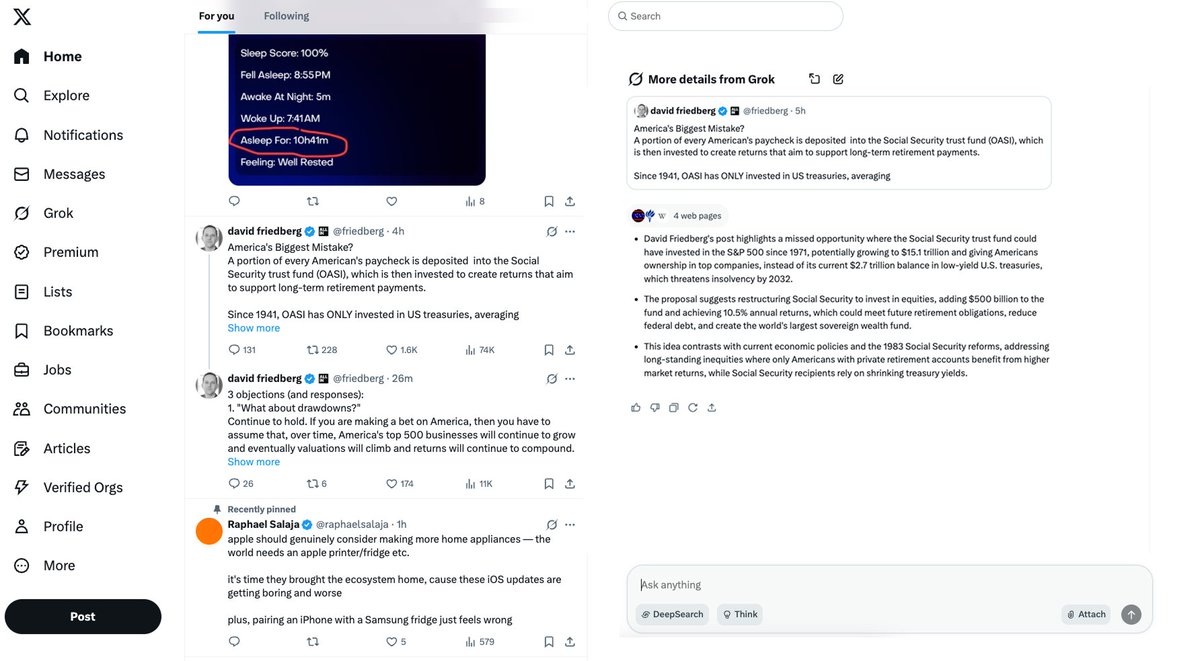
Seeing this more and more on my timeline. Small groups of people going back and forth with Grok on the same topic within the same thread.
Definitely a new social behaviour.
Here’s a reframe.
AI doesn’t take your job.
AI allows you to do any job.
So a coder can now make films.
And a filmmaker can now write code.
It allows a non-specialist to get started.
But a specialist will be needed for polish.
The xAI button acts as a way to get the post inside the chatbot interface, what if I never needed to leave my feed to do this... this is nicely done on desktop but would be epic on mobile/tablet.
Good mobile solution:
- replying to a post w @grok is by default private.
- back and forth between grok and user continues
- conversation is private, only appears in grok tab history
Maybe the open, decentralised and programmable OS we've all been craving has been staring us square in the eyes this whole time.
The browser is the operating system but tabs prevent us from realising this.