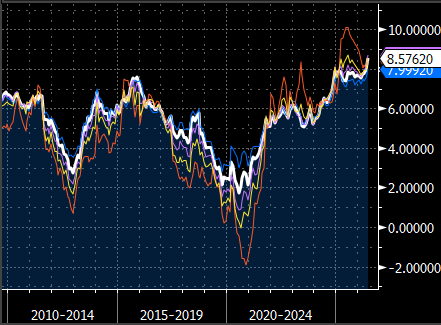
Somente em 2003 os juros reais foram tão altos para emprestar ao governo brasileiro
As NTN-Bs já superaram os níveis da era Dilma
O recado não é sobre inflação
É sobre risco fiscal
Grafico: taxa dos títulos de NTN-B
> Sancionou a Lei das Bets.
> Regulamentou as bets.
> Autorizou as bets.
> Arrecadou bilhões com as bets.
> Impôs sigilos de 100 anos nos processos que liberaram as bets.
Mas Lula diz que é contra as bets e que, se dependesse dele, proibiria tudo.
Pode confiar.
MALU GASPAR REVELA DETALHES DE NOVO CONTRATO ENCONTRADO DE DANIEL VORCARO COM ESCRITÓRIO DA ESPOSA DE MORAES:
Foi encontrado material relacionado a um contrato de R$ 50 milhões que teria sido negociado entre uma empresa do ecossistema de Vorcaro e o escritório da esposa de Alexandre de Moraes. De acordo com o relato, o contrato chegou a ser elaborado, mas não foi assinado. Vorcaro está esperando que o sistema o socorra.
A história Ambipar/Master é a maior engenharia financeira da história do Brasil
Ação da Ambipar saiu de R$ 8,80 pra R$ 76. Alta de 863%. Compras coordenadas de três fundos ligados ao Banco Master
O esquema: Tércio Borlenghi (dono da Ambipar), Nelson Tanure e Daniel Vorcaro (Master) inflaram a ação com compras cruzadas entre Texas I FIA, Esna FIP e Kyra
As ações infladas viraram garantia pra Tanure comprar a privatização da Emae por R$ 1 bilhão. A XP exigiu R$ 760 milhões em colateral. Sem inflar a Ambipar, não tinha como fechar
A CVM chamou de "troca de favores"
Resultado: Ambipar desabou 99,46%. De R$ 76 pra R$ 0,41. Em um único dia caiu 61%
Quem tomou o prejuízo? Fundos de pensão. Rioprevidência (RJ) colocou R$ 150 milhões no fundo Texas. Amprev (Amapá) colocou R$ 30 milhões 10 dias antes da ação começar a cair
Vorcaro está preso desde março. Master foi liquidado. Ambipar em recuperação judicial. Tanure perdeu a Emae
Germany didn’t lose its economic edge overnight, it was hurt by one bad policy after another.
High energy costs, endless bureaucracy, overtaxation, and anti-growth mindset have turned an industrial powerhouse into the sick man of Europe.
What needs to happen for a turnaround?
The Islamic Republic 3.0: No Restraint, No Caution—Only Facts Established Through Missiles and Drones
The events of the past 24 hours have once again demonstrated that Iran’s current leadership increasingly believes that whatever cannot be achieved through diplomacy can ultimately be achieved through the use of force.
The Houthis’ entry into the confrontation is particularly significant from Tehran’s perspective. It reflects Iran’s long-standing concept of the “Axis of Resistance” and the principle that an attack on one member of the axis requires a collective response. This logic was evident when Iran launched direct strikes against Israel following Israeli operations targeting Hezbollah strongholds in Beirut’s Dahiyeh district.
Against the backdrop of mounting threats from Tehran, it is highly doubtful that Iran will simply absorb what it views as an Israeli strike carried out with at least tacit coordination between Prime Minister Netanyahu and President Trump. From Iran’s perspective, this was not an isolated military action but part of a broader strategic alignment. As a result, the latest Israeli operation may have opened the door to a renewed cycle of escalation.
Prospects for a U.S.-Iran agreement - Iranian leaders increasingly view President Trump as unpredictable and inconsistent in his negotiating positions. At the same time, Tehran sees little chance that Israel will meet its demands for a complete cessation of military operations in Lebanon.
Notably, Israel appears to have limited its strikes to military targets rather than energy infrastructure, likely reflecting an understanding that the U.S. administration would not support attacks that could disrupt global energy markets. Even so, it is difficult to envision the Iranian regime leaving these strikes unanswered.
The most likely scenario is that the ball will soon be back in Israel’s court, as Tehran seeks to restore deterrence and demonstrate that attacks on Iranian interests will carry a price.
At this stage, escalation in the coming days appears almost inevitable. Tehran is unlikely to leave the Israeli strikes unanswered, while Israel has signaled that it is prepared to respond forcefully to any retaliation. The result is a dangerous dynamic in which both sides feel compelled to act, making further confrontation more likely than de-escalation.
My interview @cnni@BeckyCNN:
In my view, the trajectory of escalation will largely depend on President Trump's strategic decision. If he wants to preserve the possibility of a diplomatic agreement with Iran, he will likely need to pressure Israel to halt its military campaign.
Otherwise, Iran, seeking to establish a new deterrence equation in the region, will feel compelled to respond to every Israeli strike. Such a response would not necessarily come from Iran alone, but could also involve its regional partners and proxies, raising the risk of a broader regional confrontation.
#IranWar
Iran launches symbolic missile attack against Israel, which retaliates strongly
After Iran launched a symbolic attack against Israel in protest against the attacks on Beirut, hours later it was Israel's turn to retaliate, this time indeed with violence and hitting more than 10 targets in Iran, including Tehran airport and Tehran, Isfahan, Tabriz, Kermanshah, Karaj, and some other areas in western Iran.
Israel used air-launched ballistic missiles from Iranian airspace and also dared to launch cruise missiles from ships stationed in the Mediterranean. The White House said the US had no part in the attack; however, strangely, American tanker planes were seen in the air. Refueling whom? It wasn't my motorcycle.
There are two questions at this moment: One is that since the Iranian retaliation did not hit targets in Israel in a significant way, it is very likely that Iran still has a serious problem with the refurbishment and upgrade of its long-range missiles.
And the other is that perhaps the US has not only reinstated THAAD radars and others but also added more batteries brought from Asia that were positioned in advance in the corridors.
Be that as it may, the current situation forces Iran to retaliate and show that it possesses real means of inflicting damage on Israel. There will be no ceasefire in Lebanon in the way Iran desires, simply because Israel saw the quantity of missiles that Hezbollah accumulated in a short period of time and will not allow that again.
Israel has its own agenda, its own interests, and they are completely antagonistic to the peace plan that has been discussed. Trump is trying to save his political skin, but Netanyahu will impose his agenda and Trump will be dragged along by it.
But while Trump isn't dragged along, Iran seems to be wanting to settle scores with Israel, launching a new wave of missiles along with Yemen, which, by all accounts, has also decided to launch missiles against Israel. It remains to be seen what the level of these attacks will be. In the last few instances, the Houthis launched merely symbolic attacks.
Join my substack and support my work:
https://t.co/pVpY5mNsE9
**Op-Ed: Israel Seized the Moment — and the White House Was Quick to Wash Its Hands**
Iran’s emboldened leadership made a fatal mistake and handed Israel a rare window of opportunity. Israel seized that opportunity — alone, unescorted, and unapologetic. The Israeli Air Force has once again proven its dominance over Iranian skies, striking targets deep inside Iran without waiting for American permission. The operation mocks all those experts — like Prof. Robert Pape, Trita Parsi, and the other X-perts who spent the past two months on Mario Nawfal’s interviews praising Iran’s masterful “control of the Escalation Ladder” and “Escalation Dominance.”
Clearly, the IRGC walked straight into the dilemma trap I outlined more than a week ago. Iran’s entire strategy rests on never appearing weak — so it had no choice but to attack. Israel was ready, armed with abundant interceptors, and effortlessly knocked every meager Iranian salvo out of the sky.
Next, the Air Force and Military Intelligence executed the mission with precision and daring. The overnight strikes were necessary — though they are only the beginning. This is not a one-off operation to be judged in isolation; it is the start of a sustained sequence. And that sequence must continue.
As predicted, the White House was quick to announce that this is strictly an Israeli matter: Israel was attacked, Israel is responding, and the United States is not involved. That swift distancing was exactly what the “calming” X-perts on our screens had forecast — that Jerusalem would once again obey orders from the Oval Office. Their soothing certainty actually helped preserve the element of surprise.
Yesterday’s measured strike in Beirut (in response to Hezbollah firing rockets at Israeli civilians in Kiryat Shmona and Yiftach) was calibrated perfectly: firm enough to signal resolve, restrained enough not to bruise the ego of the manic-depressive in the White House. It left Tehran with two bad choices — absorb the blow and admit that Israeli deterrence works, or retaliate and invite yet another humiliating Israeli demonstration deep inside Iran, on the ground and in the air.
We have known for years what does not work against this Islamic regime: polite diplomacy or tough-sounding negotiations that evaporate overnight. A single knockout air campaign will not defeat it either. What does work — what we must do relentlessly — is exploit our decisive superiority in intelligence, technology, and air power. We must strike again and again at its military capabilities, infrastructure, and economy. Iran’s fierce insistence on linking Hezbollah to any deal only exposes its fragility both at home and abroad. That is why hitting Hezbollah hard is an integral part of this phase. The campaign will not be limited to Iran. Hezbollah must be dismantled if we want — and we do want — peace with our Lebanese neighbors.
Those who crave quiet and appeasement today will wake up tomorrow facing an Iranian nuclear bomb. There is no third option.
The window is open. The sequence has begun. The only question left is whether Israel will keep striking while the iron is hot — before the usual voices demand we close it again.
Como foi a viagem de Ciro Nogueira, patrocinada por Daniel Vorcaro, para a estação de esqui de Courchevel, nos Alpes franceses.
Por @brenopires
Leia na piauí: https://t.co/emyik8oMTu
S&P 500 earnings are now expected to increase by 25% this year. We've never seen earnings growth this high outside of post-recessionary rebounds. An unprecedented boom fueled by massive EPS gains in big tech.
Video: https://t.co/HdoFAnN6sC
Neste ano, os Correios perderam R$ 3,1 bilhões em 3 meses. Isso é mais de R$ 34 milhões de prejuízo POR DIA na gestão do PT.
Desde que Lula voltou, já são R$ 15 bilhões de rombo.
A empresa é do povo, mas Lula é o responsável pela gestão. Você manteria esse gerente no cargo?
⚠️ POLYMARKET: Taxxad decola, e já aparece com 5% de possibilidade de ser governador de São Paulo. "Ministro do governo Lula é um fenômeno de carisma e popularidade" diz leitor.