Anthropic / frontier lab investment case comes down to how you reconcile the following, or why you think one or several of these trends will change:
(1) deflation of intelligence: constant ECI price per token or task has been declining 5-10x per year
(2) hedonic price gradient of intelligence: this has also been declining: a year ago, 10 pts of ECI got you 4-9x higher price per token-per task, today it’s 3-4x
(3) 1 & 2 suggest you need 10-20 ECI pts per year to offset underlying deflation with higher intelligence
(4) scaling laws / R&D diminishing returns (this chart from @ramez) suggest the last ~20 pts of ECI costs ~$30 bn & the next will cost ~$60bn. i.e., to maintain price, R&D needs to be as much as ~$60bn in NTM and ~$120bn in the 12 mos after that, etc
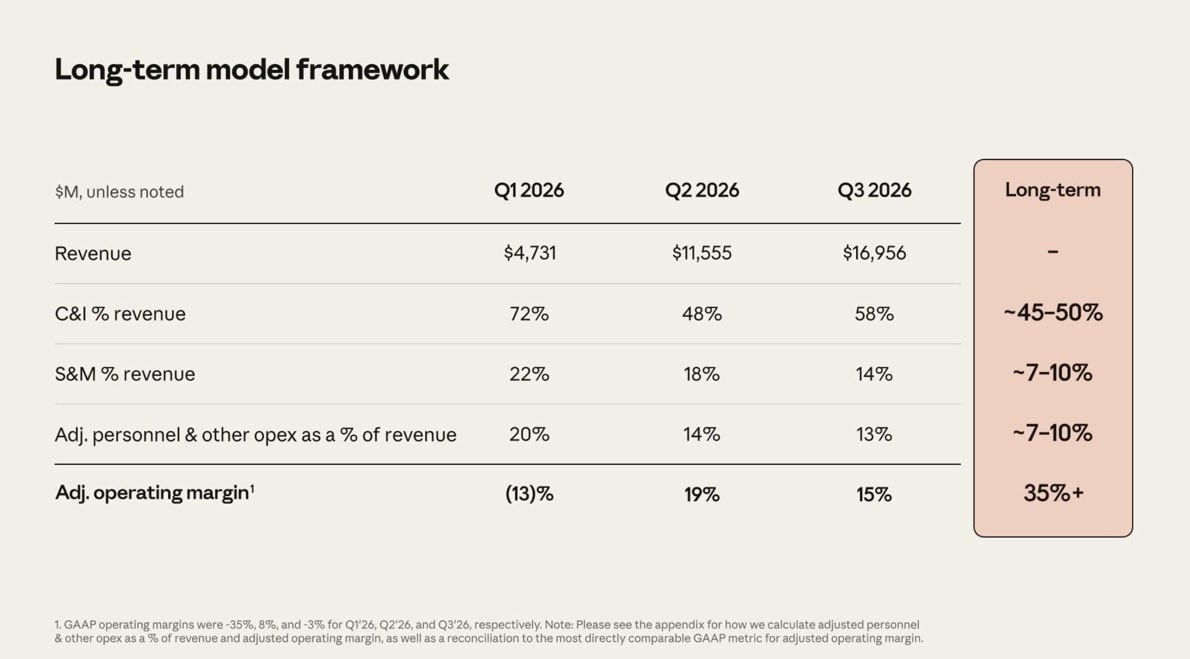
(5) meanwhile, to achieve its margin targets, Anthropic needs to decrease compute as % of sales over time, so it needs volume growth / adoption to be fast enough so the business doesn’t get caught between the jaws of the deflationary forces of (1) + (2) and the inflationary forces of (4)
these can be reconciled in ways that work out for the frontier labs (eg, regulation slows open model progress and deflation slows or hedonic gradient ramps back up; volume growth is so strong and accelerating that it more than offsets the jaws of deflationary pricing / inflationary R&D), but this is the bet imo
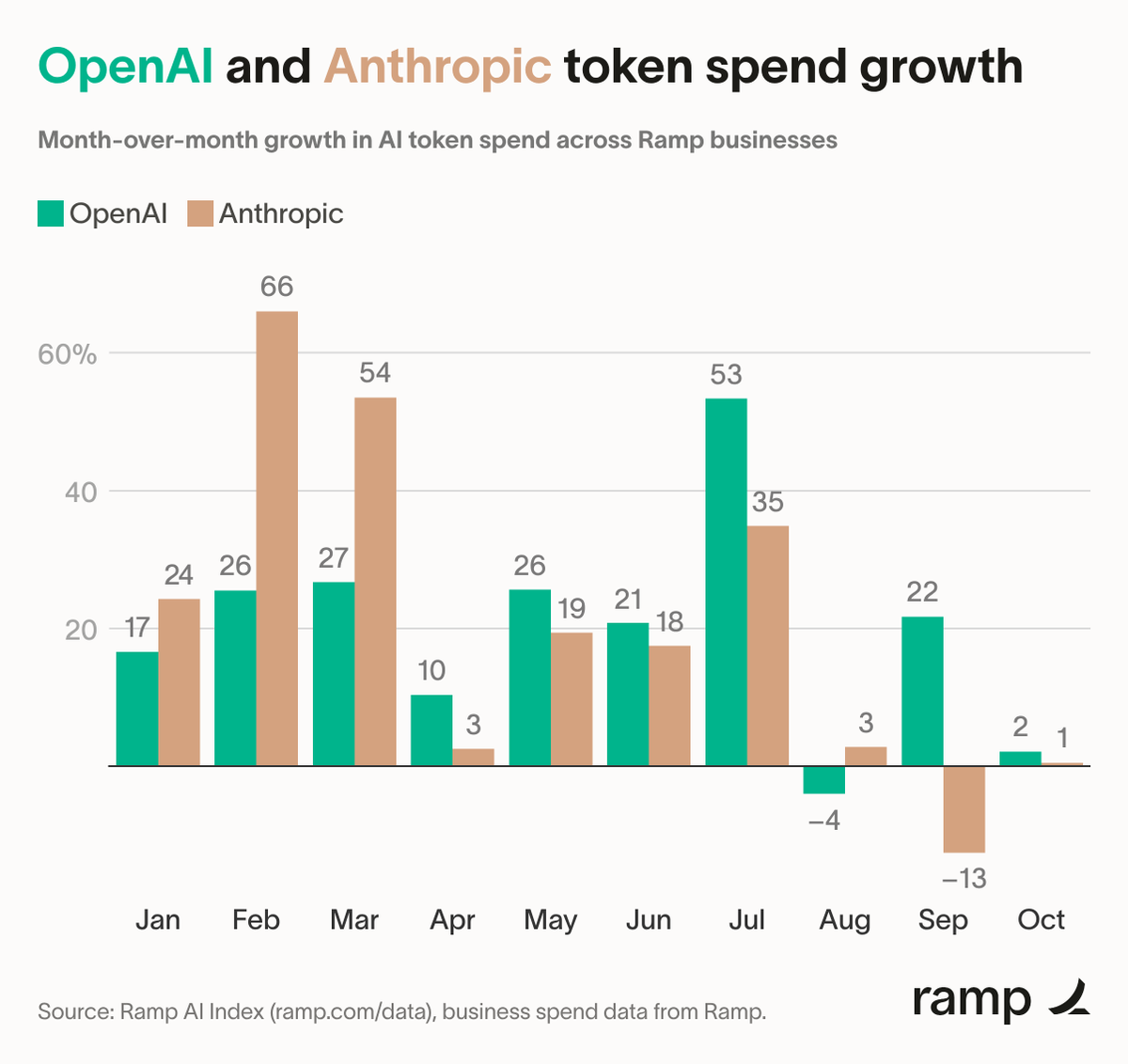
NEW Ramp AI Index: In October, AI spend rose 2%. OpenAI and Anthropic growth fell to low single-digits.
Engineering teams drove 72% of spend, followed by customer service and leadership.
Given this relatively modest growth in spend, and new competitive dynamics that may stick around, the markt should look to new fronts in the AI trade.
@jonbma thanks for the work. disagree with some implicit assumptions, and theres a lot you need to believe for non-serving compute growth to even break even.
also IMO consensus pretty bullish on this name
https://t.co/pZxOcV9Mwa
few issues
- most of margin expansion comes from non-serving compute growth slowing from 231% y/y to 8% y/y. somehow ur decoupling training and pricing even though thats your qualitative point against OS; how would 85% GMs hold if OS keeps scaling no?
-- if you held this line at 2028's 50.3% of sales then 2030 EBIT is 90bn. at ur 15x base case thats 1.36tn.
- NARR is j typed in of +1.24bn/mo every yr. why? implicitly this assumes 0 pricing pressure and 0 TAM saturation.
- opex is typed in as well (+16bn/yr), ending at 17.9% of sales. 3q26 had non-compute opex at 33.6% sales, and sales, mkting, partnership at 19.5% of H1 sales. the line looks like where the fees ant pays to cloud providers are, so should grow with sales no?
- revenue also decouples from compute. from 28-30, compute grows 19%, ARR grows, 87%, so ARR/GW growth 57%. this is while cost/GW rises flat 6%/yr (no source btw).
-- none of those make sense. right now their implied cost/gw is ~10-20% of the market price (my previous tweets). they are underpaying on compute...
theres some mechanical issues as well, with like some R&D salaries inside EBTIT (and incl the bartz settlement), GW split contradicts pnl (and also zigzags), but those are nitpicky.
the larger issues imo are the hardcoded implicit assumptions.
some of my other qualitative beliefs:
- must has show that the market clearing price for agent tokens are much lower than intelligence tokens -> pricing pressure
- incremental intelligence >> incremental demand / economic value
- some other stuff i mentioned in past posts
few issues
- most of margin expansion comes from non-serving compute growth slowing from 231% y/y to 8% y/y. somehow ur decoupling training and pricing even though thats your qualitative point against OS; how would 85% GMs hold if OS keeps scaling no?
-- if you held this line at 2028's 50.3% of sales then 2030 EBIT is 90bn. at ur 15x base case thats 1.36tn.
- NARR is j typed in of +1.24bn/mo every yr. why? implicitly this assumes 0 pricing pressure and 0 TAM saturation.
- opex is typed in as well (+16bn/yr), ending at 17.9% of sales. 3q26 had non-compute opex at 33.6% sales, and sales, mkting, partnership at 19.5% of H1 sales. the line looks like where the fees ant pays to cloud providers are, so should grow with sales no?
- revenue also decouples from compute. from 28-30, compute grows 19%, ARR grows, 87%, so ARR/GW growth 57%. this is while cost/GW rises flat 6%/yr (no source btw).
-- none of those make sense. right now their implied cost/gw is ~10-20% of the market price (my previous tweets). they are underpaying on compute...
theres some mechanical issues as well, with like some R&D salaries inside EBTIT (and incl the bartz settlement), GW split contradicts pnl (and also zigzags), but those are nitpicky.
the larger issues imo are the hardcoded implicit assumptions.
some of my other qualitative beliefs:
- must has show that the market clearing price for agent tokens are much lower than intelligence tokens -> pricing pressure
- incremental intelligence >> incremental demand / economic value
- some other stuff i mentioned in past posts
Anthropic IPO Consensus Views:
- Overvalued at $1.5T
- Revenue is flattening
- Token are commoditized due to open source
- Token prices falling faster than demand
- Anthropic shouldn't go public b/c robbing general public of upside and passing on risk.
- Anthropic is Twilio but for intelligence.
Contrarian
- Anthropic is still a 10x from here and has venture upside.
- $80B ARR reported by WSJ is just primarily coding agents and will re-accel with Fable / Mythos
- Finance, legal, life sciences, Ode are all super early ...
- Agents = still early and most businesses think of AI = ChatGPT / Claude app.
- Anthropic will zoom past $100B ARR EOY with release of Fable 5.2 / Mythos 5.2
- Retail is starving for direct exposure to frontier labs and will ape in and drive Anthropic to $3T marketcap.
- Anthropic is easily a $500B revenue business in 2030 with simple assumption Fortune 500 spent 0.1% of OPEX today ... Stripe spends 1% and not crazy Fortune 500 replace labor with tokens in 2030. 1% of OPEX would imply 10x of the $75b revenue Q3'26 so $750B revenue in 2030.
Full thesis + model coming out Wednesday
H/T @zhengjielimm
@credistick think the issue with this analogy is that frontier labs don't own the hardware no? so increased switching and the latter assumption gets squeezed.
that being said, there is more option value on the labs
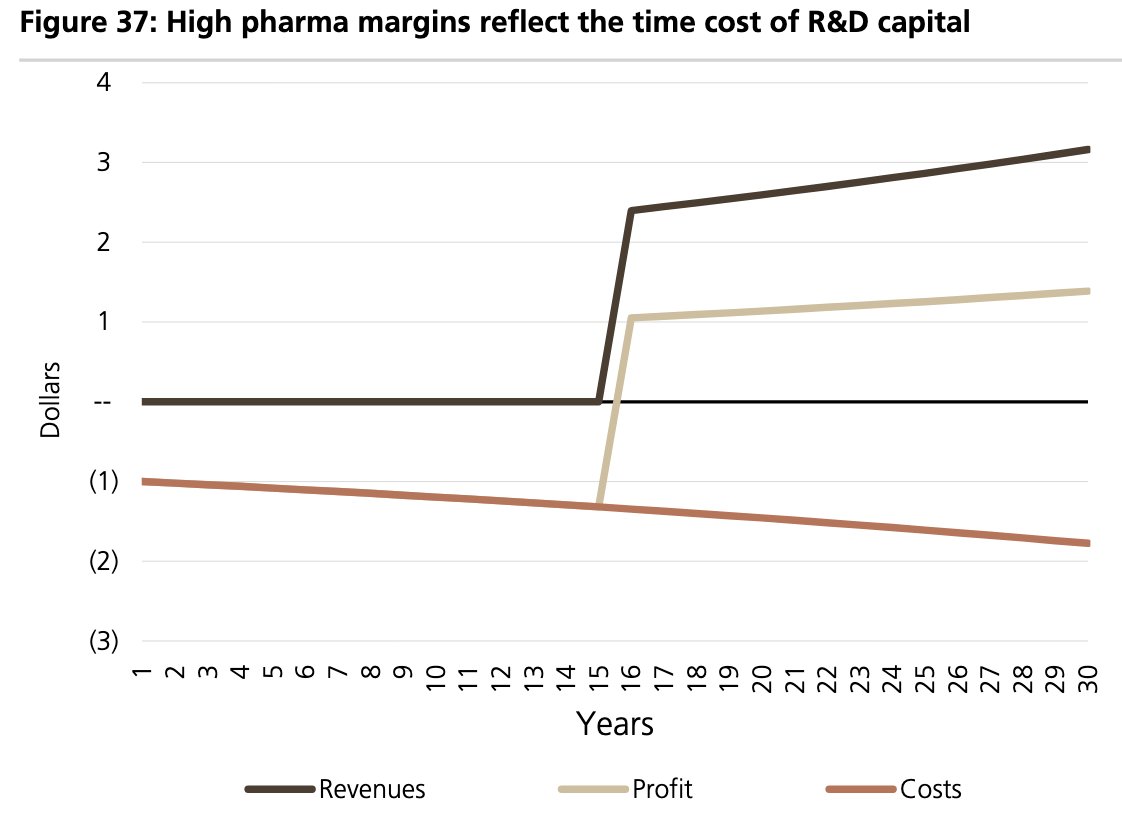
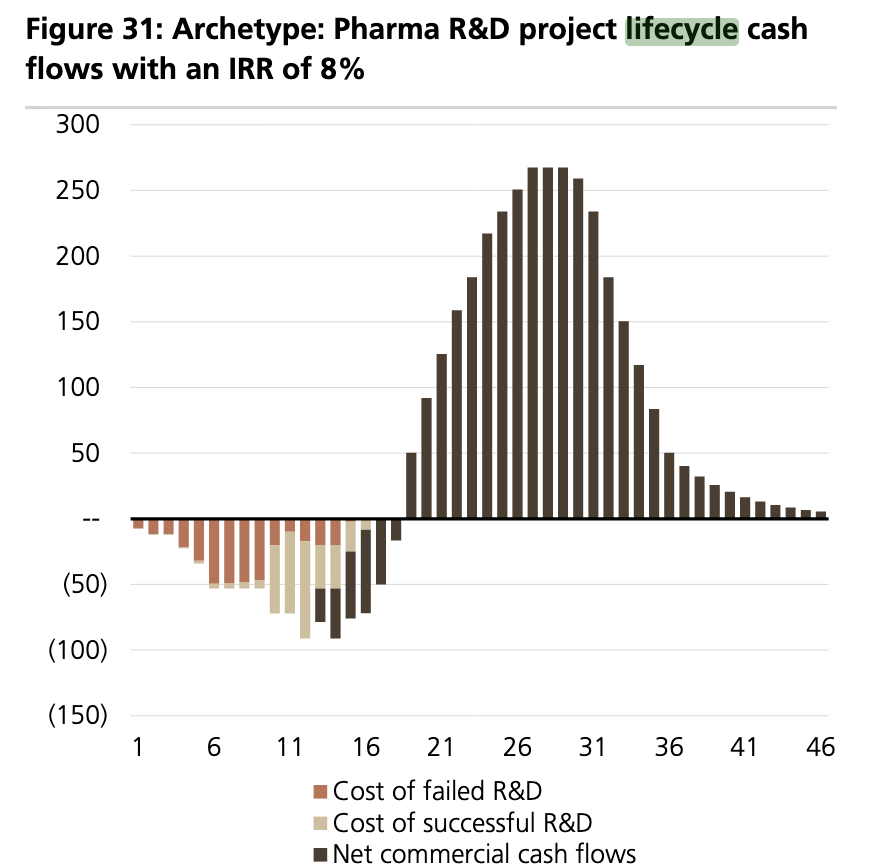
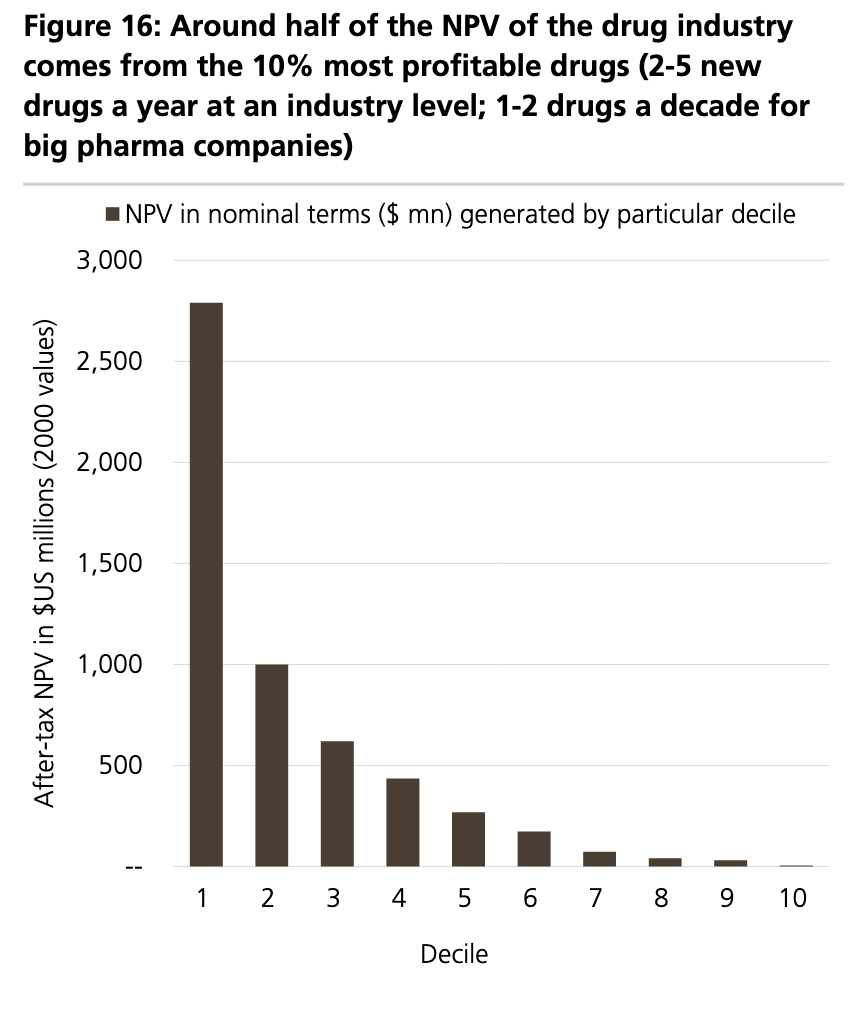
going a bit further, from a 30k ft view, ai labs seem to get the worst of both pharma and telecom.
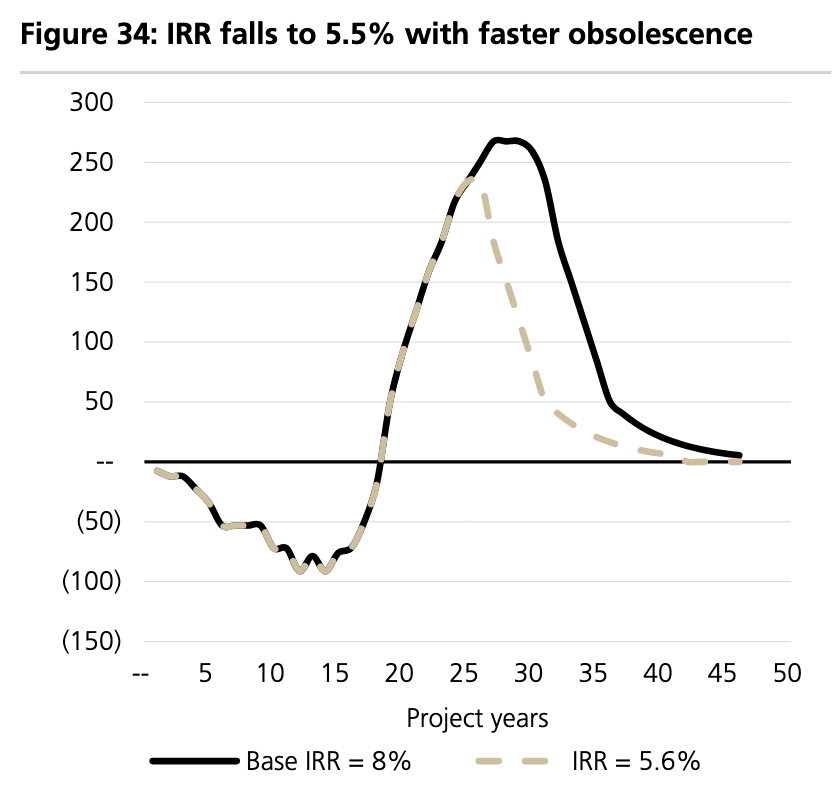
on top-line, further model lifecycles will have a mix of faster obsolescence / imitations and/or no market protection, i.e. pharma without patent protections.
on GMs, telecom-esque competition (bertrand) will bring prices ~marginal cost. this will prob be closer to cournot at the moment due to some capacity constraints, but i believe the ceiling of cost efficiency growth >> ceiling of demand -> shift to bertrand.
without regulatory protections (which is why ai labs are lobbying), labs will embark on negative NPV projects as return of time cost of R&D will be too little too late (to react). and unlike pharma, there is no such thing as a durable slugging ratio (ai lab corollary is rank / primacy, e.g. with claude code).
pics from ubs.
this is like arguing pharma is a good biz bc of high margins. ai labs are an r&d biz. obv cycles are extremely short now, but on the go forward, obsolescence is getting faster and margins will continue to fall (i est. GMs fell 3-5ppts sequentially for $ant on q2-q3 alone). GMs are only a small part of the issue here; negative roic and negative NPV investments are more important imo.
further, price cuts, while partially due to efficiency gains, are also due to competition. imo preponderance of price cuts are due to bertrand comp.
ehh. look GS on ant. dont see pos fcf til 29-30. preponderance of equity val change will come from multiple. TV thus matters. do i think its worth<1.5tn? yes. do i think its a good short? no. it's like the canonical dy wanna be right or dy wanna make money.
on the former, im happy to go into more in dms, but imo this is structural. think bulls are saying this is a one time pull fwd, but ur seeing with law firms, startups, etc. as well. the value prop of the additional intelligence vs OS (which is narrowing; i believe this narrowing will continue as i believe capabilities are plateauing) is getting worse relative to the ability to control data, finetune data (pretty easy to get frontier-lvl capabilities from such on specific areas), and control uptime, among other things (guardrails).
yes but TV is ~all of current ant and openai val. i also do note that "i believe the ceiling of cost efficiency growth >> ceiling of demand" and incr token data and wallet share is supportive of the latter.
likewise, telecom busted before it became mature as it was clear the incr margins would not be feasible to pay back capex (telecom can be thought of as one massive lifecycle project). in this case, instead of one big negative NPV project, i believe labs are going from small positive NPV projects (by which investors believe grow into big positive NPV projects) to negative NPV projects.
at a high level, i am arguing that directionally i fundamentally disagree with these bulls in the mature state. and since much of valuation hinges on the mature state, this lends to massive gap in PV.
this is like arguing pharma is a good biz bc of high margins. ai labs are an r&d biz. obv cycles are extremely short now, but on the go forward, obsolescence is getting faster and margins will continue to fall (i est. GMs fell 3-5ppts sequentially for $ant on q2-q3 alone). GMs are only a small part of the issue here; negative roic and negative NPV investments are more important imo.
further, price cuts, while partially due to efficiency gains, are also due to competition. imo preponderance of price cuts are due to bertrand comp.
more go forward thoughts
- managed care margins recovery are gonna slow. most of this yr's repair came from (i) repricing benefits, (ii) exiting bad markets / members, and (iii) releasing reserves. 2027 needs to combat accelerating cost trends (see hum call) with only pricing.
- hum prob gonna have the best 2028 in MA and aetna the worst. lowk priced in
- cor gets bent from cigna launching evernorth wholesale; evernorth is ~13% of cor sales and cor has reported lower sales to a large mail-order customers for 3qs. this prob gonna accel
- think isrg is cutting intrument rev per procedure bc of comp pressures. dont see why this wont accelerate (seems like a juicy pie).
- enov finally fixed their mgmt fuck up of getting stupid vr buy getting the robot co but enov has this deal and buyback. think its a bit risky now wrt buyback auth getting pulled. maybe dem wave saves this.
- post-covid high utilization seems structural; insurers have expected normalization but dont think this ever happening (aging, specialty drugs / glps pushing part d costs, part d redesign in 2025), etc.
- medicaid work reqs help hca vs competitors. the reqs only hit medicaid expansion states; texas and fl (hca big boys) never expanded and are huge aca mkts. so like long HCA short MOH CNC
- NVO wegovy pill is useless and only used bc cheeap, subq keytruda wont work, (this all cons tho)
- OSCR prob a short here. with competitor exits and shrinks, risk pool should converge to mkt average + price ppl never underwritten. mlr was goated but should go down and risk adj gains were ~1/3 of fy guide.
takeaways from bellwhether hc names so far:
- obesity drugs are giving up price for volume, esp for abroad (lly sales up 39% on 53% vol); nvo losing share here
- pharma shite outside obesity; much of growth is flatter by temp price (eliquis primarily net price, MRK from buying early, lly also had some one-time sales benefits)
- pharma eps depressed on IPR&D (expected bc of LOEs but was surprised on extent). -$4-5 for lly, ~-$10 for gild, etc.
- insurers are shrinking (to improve mlr). medical costs spiked and margins are recovering off depressed base. quality scores are coming headwind.
- medicaid mlr is cheeks (lags cost) but may recover 2027.
- said lost coverage shafting hospitals. volumes up but mix worse (more outpatient vs inpatient surgeries, more ER).
- ISRG cutting price per procedure to drive vols. this amid procedure volumes p healthy. BSX still a shitco.
- large joint othropedics soft industry wide though (maybe downstream effect from glps).
- testing vol strong but price/requisition down (as expexted).
- a&g demand still bad. brownfield is still most of reshoring.
implications (imo):
- smaller beats next yr if at all. profits going towards insurers from hosptial, should be decent share changes in the go fwd in medtech and obesity.
- abbv and regn seem pretty well postitioned with pipeline. bms and mrk look pretty volatile.
- LLY still has 2-3yrs before credible comp. OUS pricing prob interesting. PBMs dont get even volumes so could also be itneresting.
- 2027 eps growth for managed care will largely be margin driven.
- medicaid heavy plans (moh cnc) has pretty good upside if it reprices well.
- operators with more outpateint and ambulatory might gain share.
- BSX will be a share donor for a while.
- brownfield is still most of reshoring -> upside is on greenfield. think u could express this with like long sartorius short rgen?
- distributors still doing roll ups (rlly bullish on it). dunno why cor guide so low.
seeing lot on my feed that these mem LTAs will be honored. sirs, i point u to game theory and history - where are precedents for supercycle LTAs holding?
polysilicon in 2011, amd / globalfoundries in 2012, globalfroundries in 2023, microchip pref supply in 2024, nat gas in the 80s, mem 2017-2019, etc. -> all renogotiated / pushed out / litigated once cycle turns
design-in lock protects the mem makers as a group; but like wrt NVDA (i) every major supplier is qualified on hbm4, (ii) custom HBM is buyer's spec, (iii) product gen is much shorter than LTAs, (iv) hyperscalers have credible committments and, once cycle turns, mem suppliers dont have the bargaining power & no supplier sues its biggest customer, (v) HBM glut will follow commodity glut as they run on same wafer (shift to HBM; not independent), etc.
$eaf readthroughs for $mu
relatively worse (for $mu):
- mem has faster new capacity ramps relative to LTA lengths
- China seen as a more valid substitute
- competitors are smarter / more experienced than $eaf competitors (game theory type)
- counterparties are legal wizards
- mem prices more volatile (graphite electrodes only doubled); likely more incentive to break LTAs when capacity ramps
relatively better:
- counterparty risk is null (probably); likely no FMs
- demand-pull driven spike (more durable, but tbf can also reverse more violently)
- volumes are essentially guaranteed (unless taiwan gets bombed)
@EventDrivenEddy@TheDebtReaper ? the point of duration is trading higher vol for higher returns on the premise that u can take more vol than others can -> earn a premium. u tell me if thats working. alr bud
istg LOs and L/S funds who say duration is their advantage is so cope unless it's like ability to trade illiquity for return (like delisted cos or non tradeable cvrs that req duration); like if ur trading the same names as pods duration isnt an advantage
Lone Pine Capital co-CIO Kelly Granat on why duration is their biggest edge:
"We want to be positioned in a way to capitalize on non fundamental dislocations and lean into duration."
"When those set up dynamics are tricky or complicated and everyone's lined up one way, I want to line up the other way."
"I think we've always said that duration is our single biggest advantage, but it's never felt more prominent and powerful than it is in today's market structure."