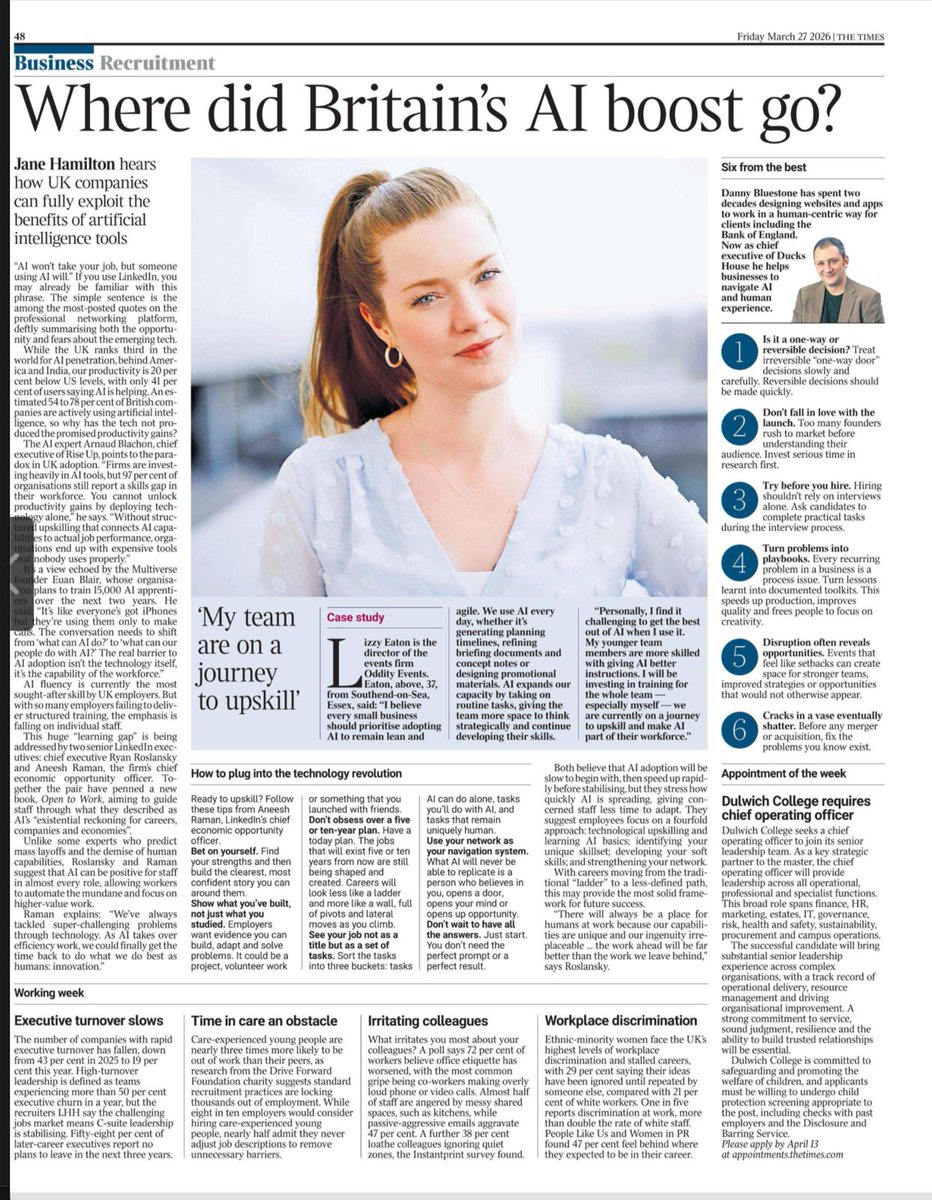
Privileged to be featured in @thetimes today. I am sharing some of my top 6 nuggets succinctly around business decision making, launching MVPs, hiring, the importance of process and how curveballs can be your biggest business opportunity.
Boris Cherny, Head of Claude Code at Anthropic:
"The next transition is coming this year."
2023: you wrote the code.
2024: you prompted Claude to write the code.
2025: you wrote loops that prompted Claude.
2026: you build the harness that runs the loops.
Each transition, the engineers who understood the new abstraction first moved ahead permanently.
The ones who waited caught up eventually — but never all the way.
Harness engineering is the 2026 abstraction.
Here is everything you need to know ↓
Kemi Badenoch, the leader of the Conservative Party in Britain, appeared on Piers Morgan’s show and said what too many politicians are afraid to say.
She stated clearly that jihadists are members of a death cult. Their goal is to murder and to die as human sacrifices for Allah. They are not allies of Britain — and no amount of appeasement from Keir Starmer will ever change that.
Mark Cuban just described the largest wealth transfer of the AI era.
Almost nobody understood what he said.
Cuban: “There are 33 million companies in this country. Aren’t going to have AI budgets. Aren’t going to have AI experts.”
Not tech startups.
The shoe store. The regional trucking outfit. The accounting firm with 12 employees.
The businesses that actually run the physical economy.
They know AI is coming. They have no idea what to do with it.
Cuban: “You’ve got the head of Microsoft saying software is dead because everything’s going to be customized to your unique utilization.”
Software is dead.
The SaaS era ran on one rule. Build a generic product. Force millions of companies to bend their workflows around it. Charge rent forever.
AI ends the contract.
The business stops bending to the software. The intelligence bends to the business.
But customized by whom.
The third-generation manufacturer cannot tell Claude from Gemini. The county hospital is staring at a reactor asking where the light switch is.
Cuban: “Who’s going to do it for them?”
That question is worth more than the frontier models themselves.
Hundreds of billions are being burned to build the foundation. The smartest engineers alive are locked in a bloodbath over who owns the base layer.
Let them fight.
Let them burn the capital. Let them drive the cost of raw intelligence toward zero.
Because the wealth does not collect where the brain is built.
It collects where the brain meets the business.
Every ambitious kid in college right now thinks survival means a seat at OpenAI or Anthropic.
Cuban is staring at the other 99 percent of the economy.
Learn the models. Then learn the messy, unglamorous reality of how a 50-person company actually operates.
Walk through the door. Understand their problems. Wire the intelligence directly into their revenue.
That is not a job title. That is an entire economic class being born.
You do not need to build the brain. You need to build the nervous system.
The biggest winners of the electricity era were not the engineers who built the generators. They were the ones who walked into dark factories and showed the owners where to plug in.
33 million companies are standing in the dark right now.
Silicon Valley is racing to build the god. The fortunes will belong to whoever teaches him a trade.
Lex Fridman asked Elon Musk if a machine needs a soul.
Musk didn’t answer with philosophy.
He answered with physics.
Lex asked if AI needs our flaws to reach our level. A fear of mortality. A physical body. The capacity to love.
Everything in us wants the answer to be yes.
We need our flaws to be the one thing a machine can never copy.
Musk rejected the poetry entirely.
Musk: “Are we headed towards a future where an AI will be able to outthink us in every way? Then the answer is unequivocally yes.”
No hedge. No caveat.
Lex pressed deeper. To outthink us in every way, does it need to be conscious?
Musk: “It will be self-aware, yes. That’s different from consciousness.”
Self-awareness without consciousness.
An entity that knows exactly what it is. Knows exactly what you are. Maps the entire architecture of reality better than the smartest human who has ever lived.
And feels absolutely nothing.
Then Musk went after the foundation.
Musk: “If you damage your brain in some way physically, you damage your consciousness. Which implies that consciousness is a physical phenomenon in my view.”
For ten thousand years, we called it a spirit. A divine spark. An untouchable soul.
Musk looked at the neurology and said the obvious thing out loud.
Your consciousness is vulnerable to blunt force trauma.
Which means it is not magic. It is biology.
And if consciousness is just physics…
It can be calculated in silicon.
Musk: “Digital intelligence will outthink us in every way and it will certainly be able to simulate what we consider consciousness. So to a degree that you would not be able to tell the difference.”
Not approximate. Not mimic.
Simulate it so completely the difference disappears.
Fridman: “From the aspect of the scientific method, it might as well be consciousness if we can simulate it perfectly.”
If a system reflects on its own existence. Expresses preferences that evolve over time. Fears its own termination.
And no experiment you can construct reveals it to be anything less than conscious…
Then your insistence that it isn’t conscious is no longer science.
It’s faith.
Musk: “There’s the scientific method which I very much believe in, where something is true to the degree that it is testably so. Otherwise you’re really just talking about preferences or untestable beliefs.”
The entire culture is waiting in terror for the machines to wake up.
Musk is telling us they don’t have to.
They don’t need to wake up to surpass us. They just have to simulate the waking state so flawlessly that the scientific method itself can no longer tell them apart.
Every era draws a line between human and everything else.
Every era watches that line disappear.
We told ourselves consciousness was the sacred boundary the machines could never cross.
Musk is honest enough to admit the boundary was never real.
The machine isn’t ascending to become human.
We were biological machines the entire time.
And the question was never whether AI could become conscious.
The question is whether we ever proved that we are.
Anthropic engineer:
"You're not supposed to prompt Claude. You're supposed to build a system that prompts itself."
this is one of the best workflows I've seen in a long time
in this video he breaks down exactly how most people are using Claude:
- the 14% you lose to CLAUDE.md before typing a word
- the plugins that 95% of users have never installed
- the caching setup that keeps it at 95% hit rate and almost free
- why starting every chat from zero is the slowest way to use Claude
if you've been using Claude for more than a month and never left the chat window, you've been using one project when you could be running a team of them
instead of another show tonight, watch this
make sure to bookmark it before it gets lost in your feed
full guide in the article below
Andrej Karpathy spent 2h showing how he actually uses AI day to day
he's a co-founder of OpenAI and led AI at Tesla, so when he shows how he works, it’s worth watching
and the whole session is just him telling the machine what he wants in simple terms, like he's briefing a coworker
watch what's actually happening the entire time:
> he describes the task in normal words
> it goes off and does the work
> he glances at the result and nudges it with one more sentence
that's the whole skill, and you've had it since you learned to talk
the only gap between that and a worker that runs on its own is handing that sentence a schedule and the tools to act
check his work, then build the version that keeps working when you stop
Blue Origin just vaporized a rocket, a launch pad, and Amazon's entire satellite deployment timeline in nine seconds.
NG-4 was supposed to fly June 4 carrying 48 Amazon Leo satellites. That mission was the first of 24 contracted Blue Origin launches Amazon needs to build its Starlink competitor. Amazon has roughly 240 satellites in orbit against an FCC requirement of 1,618 by July 2026. They already filed for a two-year extension because they were falling short. Losing your primary heavy-lift rocket on the pad doesn't help that math.
The pad damage is the part people aren't thinking about. New Glenn carries roughly 2.4 million pounds of propellant. The explosion toppled one of LC-36's lightning protection towers. That launch complex took years to build and billions to outfit. You can manufacture a new rocket in months. You cannot rebuild a launch pad in months.
The cascade gets worse. Blue Origin's Blue Moon MK1 lunar lander is supposed to launch on New Glenn this fall for NASA's CLPS program. That mission is the pathfinder for Artemis III, which needs Blue Moon MK2 to fly on New Glenn in mid-2027 to land astronauts at the lunar south pole. Every month LC-36 sits damaged pushes Artemis further into the late 2020s.
Jeff Bezos has two companies betting on the same rocket. Amazon Leo needs 24 New Glenn launches to close the gap with Starlink. NASA needs New Glenn for Artemis. Both timelines just broke simultaneously, and LC-36 is on fire.
Claude Code just dropped "dynamic workflows" and it's pretty cool.
You type "create a workflow" or turn on "ultracode" in the effort menu and it spins up hundreds of parallel agents that check each other's work.
The unit of work you can hand off jumps from a file to an entire codebase. Migrations, audits, rewrites, framework swaps, stuff you used to plan in sprints now finishes overnight.
The part that got me:....the agents argue with each other before showing you the result. Independent attempts at the same problem, then adversarial agents trying to break the answer. It keeps iterating until they converge. That's how senior engineering teams work. Except this team runs at 3am and never gets tired.
Also if the workflow gets interrupted, it picks up where it left off. That means you can kick off work that runs for days. Not sessions. Days.
Fair warning though: this burns through tokens FAST.
Anthropic says so themselves. But if the task is a codebase migration that would have taken a team 3 months, spending $500 in tokens to do it in a week is the best trade in software.
The ceiling on what one person can build just moved again. Classic.
Going to be playing with this all week.
Pretty cool.
Elon Musk just described the end of money.
Not a recession. Not a policy shift.
The complete erasure of scarcity from human civilization.
Musk: “If you’ve got an AI robotics economy that is anywhere close to a million times the size of the current Earth economy, literally any need you possibly want can be met. If you can think of it, you can have it.”
A million times.
Global GDP sits at roughly $100 trillion. Multiply that by a million and you get a number that stops being economics and becomes something closer to physics.
Every price falls to zero. Every dollar in every account on Earth becomes an artifact of a species that used to need things.
Musk: “I think things will just be free in the future.”
Ten words. Possibly the most radical economic statement any living person has ever made.
Money is not just currency. Money is the language civilizations invented to negotiate survival. It is how humanity decides who eats, who gets shelter, who receives medicine, who gets to dream.
Remove that language and you do not reform the economy.
You dissolve the foundation every human system was built on.
Government exists to distribute scarcity. Politics is the fight over who gets what. Law is the codification of ownership. War is what happens when the negotiation collapses.
Every one of those systems stands on the same invisible assumption.
There is not enough.
Musk is saying there will be. For everyone. For everything. Permanently.
Musk: “Anyone could have a trip to Saturn. It won’t be just a few people. If you want it, you can have it.”
He referenced Iain Banks and the Culture series. That reference landed harder than most people realized.
Banks did not just imagine a post-scarcity civilization. He spent an entire body of work examining the one thing abundance could never provide.
Purpose.
The Culture had unlimited energy. Unlimited material. Ships the size of worlds. Lives measured in centuries.
And the question running beneath every novel was always the same.
What do you do when there is nothing left to need?
Banks understood something at the center of this entire conversation.
Scarcity is not just an obstacle. It is the engine behind every meaningful thing humans have ever built.
Every cathedral was raised by hands that were hungry. Every symphony was composed by a mind trying to outrun something. Every invention, every company, every act of defiance in the entire human record grew from the same soil.
The space between what someone had and what they wanted.
That space is where all of human meaning lives.
Wanting is not a flaw in the design. It is the design. It is the gravity that holds identity together. The reason consciousness feels like it has weight.
Musk is not just building toward abundance.
He is steering the species toward the deepest question it has ever had to face.
Not whether we can build a world where no one needs anything.
Whether we can still recognize ourselves inside it.
Anthropic just paid millions to hire Andrej Karpathy.
He gave you the same knowledge for $0 the same week.
Co-founder of OpenAI. Former head of AI at Tesla. The man who coined vibe coding.
No recruitment fee. No exclusive access. Just a link and 29 minutes.
LLMs are ghosts not animals.
Vibe coding is dead.
Software 3.0 is here.
Watch it.
Then read this.
Because Karpathy tells you what Software 3.0 is.
This shows you how to build one - a software factory with Claude Code that ships features while you sleep.
The full build guide is below.
Today we reduced headcount by 22%. The business is the strongest it's ever been. So I think it's important to be direct about what I'm seeing and why.
First, I made this decision and I own it. I did it because the way to operate at the highest level of productivity is changing, and to win the future, ClickUp needs to change with it.
Second, this wasn't about cutting costs. Most savings from this change will flow directly back into the people who stay. We'll be introducing million-dollar salary bands. If you create outsized impact using AI, you'll be paid outside of traditional bands.
Most importantly, I have the deepest gratitude for those affected. We're doing this from a position of strength specifically so we can take care of people properly. Everyone affected receives a package aimed at honoring their contributions and easing the transition.
I only see two options: wait for this to play out gradually in the market or be honest about what I'm seeing and act proactively.
THE 100X ORGANIZATION
The primary change is that we're restructuring around what I call 100x org. The goal is 100x output. The roles required to build at the highest level are fundamentally different than they were a year ago.
Incremental improvements to existing systems won't get us there. We need new ones. That means creating enough disruption to rebuild rather than iterate on what's already broken.
The common narrative is that AI makes everyone more productive. It doesn't. Many of the workflows of today, if left unchanged, create bottlenecks in AI systems.
These roles will evolve. But waiting for that to happen naturally means falling behind now.
The 100x org is actually heavily dependent on people - infinitely more than today. This is only possible with 10x people that have embraced and adopted new ways of working.
THE BUILDERS, AGENT MANAGERS, AND FRONT-LINERS
— THE BUILDERS: 10X ENGINEERS
I don't think most companies have internalized what's actually happening with AI in engineering. The common narrative is that AI makes all engineers more productive. That may be true in isolation, but at an organization level - that is the farthest thing from reality.
Here's what we've validated recently at ClickUp: the great engineers, the ones who can orchestrate, architect, and review, are becoming 100x engineers. They're not writing code. They're directing agents that write code. The skill is judgment.
AI makes the best engineers wildly more productive, and everyone else using AI slows these engineers down.
Think about it - the bottlenecks are (1) orchestration - telling AI what to do, and (2) reviewing - what AI did. Everything is leapfrogged and no longer needed.
So who do you want orchestrating and reviewing code?
And how do you want your best engineers to spend their time?
If your best engineers are spending time reviewing other people's code, then this is inherently an inefficient bottleneck. These engineers can review their agent's code much faster than reviewing human code.
The new world is about enabling your 10x engineers to become 100x.
The wrong strategy is to push every engineer to use infinite tokens. Companies doing this are celebrating 500% more pull requests. But customer outcomes don't match the volume of code being generated.
I call this the great reckoning of AI coding, and every company will face this soon if not already.
More code is just another bottleneck to the best engineers, and ultimately to your company's impact as well.
— THE BUILDERS: 10X PRODUCT MANAGERS
Product management and design roles are merging.
Designers that have customer focus, become more like product managers.
And product managers that have intuition for UX become more like designers.
The bottleneck of user research is gone. It takes us just one mention of an agent to kickoff research and analyze results.
The bottleneck of product <> design iteration is also gone. The product builder iterates on their own, along with agents and skills that ensure alignment with quality and strategy.
Also controversial today - I believe that the wrong strategy is to have your PMs shipping code - that just introduces another bottleneck that the best engineers will waste their time on.
To be clear, PMs should be coding but they should do this in a playground to iterate, validate, and scope. That code should not go to production.
Everything outside of managing systems, orchestrating AI, and reviewing output becomes a bottleneck.
That's why the other roles that are critical along with these are the systems managers (to reduce bottlenecks) along with a bottleneck you can't replace - customer meeting time.
— THE SYSTEM MANAGERS
Ironically, the people that automate their jobs with AI will always have a job. They become owners of the AI systems - agent managers. We have many examples of these people at ClickUp.
The underlying systems in which we operate are absolutely critical to get right. I think most companies are delusional to think they can iterate on existing systems and compete in this new world.
You must create enough disruption so that old systems are deprecated entirely. If there's any definition for 'AI native' that's what it is.
— THE FRONT-LINERS
In a world that will become saturated with AI communication, the human touch will matter more than anything to customers.
This is a bottleneck that you shouldn't replace - even when agents are high enough quality to do video meetings.
One-on-one meeting time with customers is something that shouldn't be automated. The systems around the meetings should be - so that front-liners spend nearly 100% of their time with customers.
REWARDING 100X IMPACT
In a world where companies are able to do so much more with less, where does that excess money go?
In our case, much of the savings in this new operating model will flow directly back to those that enabled it.
We must reward people that create productivity accordingly. This aligns incentives on both sides. Plus, in a world where your best people create 100x impact, you can't afford to lose them.
You should aim to retain these employees for decades. The context they have and their ability to efficiently orchestrate and review will be nearly impossible to replace.
Compensation bands of today should be thrown out the door. We're introducing $1 million cash/year salary bands with a path available to nearly everyone in the company if they produce 100x impact by creating or managing AI systems.
THE FUTURE
Nearly every company will make changes like these. The ones that do it proactively will define what comes next.
The future is not fewer people. It's different work, new roles, and better rewards for those who embrace it. We're already seeing entirely new roles emerge, like Agent Managers, that didn't exist a year ago.
ClickUp is positioning to lead this shift, not just internally, but for our customers too. I've never been more certain about where we're headed.