@jasminewsun 100%, trump as a centralizing figure that smashed the overton window + very good algos e.g. reddit/twitter/twitch/tiktok to create microcosms of increasingly radical/terminally-online thought. internet/YT in the early 2010s had a very innocent, pure vibe to it vs today
Working 100 hours a week is characteristic of jobs where you “work” very little, but need to always be on call (think: investment bankers). Fields that require deep creative work or technical precision usually get 4 productive hours each day. Agents moved SWE from (2) to (1)
right monitor is 20 codex instances. left monitor has situational awareness on autoscroll. center monitor is my word doc mainfesto. two keyboards, one for both hands. left airpod is dwarkesh x eric jang, 3x speed. right airpod tchaikovsky. meta quest 3 overlays my HUD: heart rate, words per minute, blood caffeine content. one assistant hooks me to an iv of chinese peptides, cocktail. the other feeds me kimchi. my unitree robot steps in when my posture slouches. blue light beams down on me in my herman miller chair. efficiency. no wasted movement. no wasted thoughts. think you can keep up with me? good luck. this is just for my morning emails.
The US is going to lose the AI race to China because of our cultural polarization.
You imagine that because the US leads in frontier models that all the US has to do is reach AGI first, and then the exponential curve will be higher, and some Patriotic US AI-bot will materialize and smite America's enemies.
For anyone who doesn't believe in the "fast take-off doomer" scenario, it should be self-evident that this is not how it happens.
The way the AI victory is won is that AI gets progressively more powerful, and is gradually integrated into every part of society and industry, providing the real massive economic uplift that leads to global domination.
When it comes to facillitating that, China is far ahead of the US, not only in terms of energy infrastructure and hardware ecosystem, but also because its culture broadly accepts and is eager to adopt more AI into their lives. This is a critical US weakness.
This is entirely self-inflicted, and tech needs to take responsibility for it and fix it.
Most people in tech prefer to sneer and look down on the anti-AI people, like coastal elites looking down on flyover country residents, and they are making the same mistake: failing (or refusing) to see that there are real and valid grievances, and they need to be solved.
I am going to describe two big ones that the tech world needs to wake up to and solve:
1) Datacenters do cause water and electrical shortages
I was part of the crowd that sighed condescendingly about the poorly-informed "datacenters use a lot of water" criticisms. I'm a water guy (see my other work), I get it.
It's true that datacenters are not likely to cause a global freshwater shortage. It's not a planet-scale problem (vs the way fossil fuel usage is). Datacenters don't "use" that much water, in a planetary sense of the word.
But datacenters absolutely do cause regional water shortages. Water is not perfectly fungible: you need to bring it to places. So every place has a certain amount, and a certain inflow rate. Datacenters use up a lot of it, and this makes water scarce, and raises local utility prices.
Many of the areas where datacenters are sited had marginal utility infrastructure to begin with, and a sudden new consumer will drive up local utility prices. Ordinary people see this directly on their utility bills!
They are also noisy and in the instances where generators have been brought into provide immediate power, they pollute the air.
I used to be able to tell people "No, no, datacenters are among the greenest users of electricity, because they're often powered by huge solar and other renewable buildouts!" but Elon, the great electric-car / solarcity entrepreneur, made it impossible by hyperscaling his datacenter build-out with gas generators. 15-20 years ago, everyone regarded Elon as a tech climate hero (I know, hard for the young people today to believe), but that reputation is never coming back. Yeah, he built his datacenter in 100 days or whatever, record speed, but the local population pays the cost.
You can't deny these experiences! They make life harder and more expensive! And then these people tell their friends and family elsewhere, and their friends and family listen.
There are solutions available to us, but I will get to them at the end, after I outline the second problem - because in the meantime all those people look on the internet and they think "for this??"
2) AI is flooding all of our online spaces with slop
You probably think, "that's just dumb people using it, AI does a lot of amazing things!"
And you'd be right, it does. It does genuinely astounding and helpful things. But that does not solve the slop problem.
If I were served a perfectly marbled ribeye steak on a platter that also had literal shit on it, it wouldn't matter how good the steak was. That is what is happening to the internet. The Good Works of AI are being drowned out by the slop we allow to surround it, to say nothing of crowding out the quality human content we initially came for.
Social media, online forums, and discussion boards used to be fun. They were a way for people to connect with other people, in many cases people you wouldn't otherwise have ever met. Now that is impossible, because you have to wade through slop.
Ordinary people on the internet experience this! It makes every tech product less fun! It's why there is less and less enthusiasm for every new tech launch that happens.
You might think this problem will solve itself as AI gets better. I don't agree.
The slop is produced by using low-cost models. No one uses frontier models to produce their marketing slop. The spammer needs to minimize costs, so they are always going to use the cheapest possible model that can output something passable. That means every spammer is always going to use Qwen3-27B for all their spam no matter how good the frontier models get if we are lucky. And we cannot just auto-filter it out using more expensive frontier models because then spammers are asymmetrically using a cheap model to force usage of a more expensive model. The arms race cannot be won that way: slop will always be created by low-quality models.
The everyday experience of the median internet user (a millennial who grew up in the halcyon days of Facebook) is one where everything they enjoyed about the internet has been overrun by the worst possible thing - not polarized trolling or disinfo - no, those would be far preferable - but relentlessly and aggressively stupid content.
There are solutions to this that tech can implement but before I get to them, I will say that they are not hard solutions (not compared to the things we are building, like rockets to Mars and supersonic civilian jetliners), but the hurdle is an insular tech culture that refuses to acknowledge these as problems.
An industry that consistently does things that makes the lives of ordinary citizens worse and polarizes a large segment of the voting public against them will not succeed on a global level against a competitor that is supported broadly by its people. This is an American self-own that doesn't need to be happening.
====
Solutions:
1: Datacenters need to be built holistically to benefit and ameliorate the costs they impose on surrounding communities.
Neither water nor electricity need to be scarce. New water supplies can be built, and new solar (cheaper than ever) can be installed. The mad rush to do everything as quickly as possible is unnecessary. Because the water and electricity footprint of a datacenter is often so large compared to that of the surrounding community, only a small fraction of overbuilding would be necessary to generate a surplus of water and electricity. Build that fraction out first, slashing the utility costs in the surrounding region, and then build the datacenter.
The technology for emissions trapping, carbon capture and storage (CCS) for natural gas plants has existed for nearly a decade now. Natural gas generators used to power datacenters can be outfitted so that they don't end up dumping loads of pollutants into the surrounding air. This is a tech implementation problem, and the demand should be huge!
As for noise, why aren't we just constructing huge sound baffles around the datacenter? (Really, just the generators). The same arguments about "it's not that loud" cut both ways: if it's not a huge amount of noise, it can be muffled. This is a tech implementation problem!
Datacenters could be infrastructure delivery vehicles for water, electricity, and even internet. Their huge data interconnects could easily serve high-speed traffic for their local areas, providing free wifi in all public spaces. All of this is possible, and reducing all of these costs for local residents would spur economic growth the same way a tax break would. Instead, right now, we are doing the opposite: causing regional shortages, increasing ordinary peoples' cost of living, and stunting economic growth when we need it the most.
2: Control AI slop with this one weird trick
Require all AI content to be clearly labeled as such, and demand that all online platforms enforce it.
This will solve the problem.
The common objection is "that would be impossible." No, it wouldn't. Sayiung "someone would still try to do it and it'd be an arms race" is wrong. It's not untrue, it's that it doesn't cause the solution to fail.
Plenty of content is already banned or otherwise regulated, and compliance comes from enforcing the actions of large-scale actors, and pushing the implementation down to individual platforms. Once a behavior becomes the norm, most people will follow it and explicit enforcement only needs to occur at the margins. It's enough to improve the online experience for most people, which is what we want.
Once it's labeled, people and platforms can decide if they want to allow AI content or not allow it. It creates the most powerful market incentive: individual choice.
Right now, no one has the choice. This gives everyone the choice of how much AI content they see. Once users can choose, this creates the conditions that incentivize production of higher-quality content. Right now everyone is equally forced to endure everything, so no incentive to "pay more to produce better" exists. If the stuff on the other side of the slop filter eventually becomes good or desirable, we'll actually win.
Far-seeing much-maligned Sam Altman foresaw this is 2019, that the world would need a way to verify true human content from AI content. His solution was just unfortunately dystopian: an orb that scans everyone's eyeball. Something lower-tech and more socially-oriented has already been shown to work better:
China already has such AI regulations. It's the greatest irony that after all the "we mustn't regulate ourselves, China will win" justification, China ended up implementing comprehensive AI regulation - and this is the important part for Americans to understand: not because the Communist Party wanted control over AI, but because it was in the public interest to do so - with the result that AI products are being much more readily accepted and adopted across China in both society and industry.
====
These solutions have two big advantages:
1) They play to tech's strengths: build infrastructure, come up with clever solutions that make things that suck, suck less.
2) They can progress and yield benefit in piecemeal fashion: every datacenter whose plan lowers utility costs in the surrounding area and provides free digital access will be more readily accepted, and every online platform that implements an "AI labeling rule" and enforces it well will eventually trend towards increasing quality, decreasing slop, and more user success even if others don't.
US tech can start doing these things now, or it can believe that all the AI-hate is unfounded and misinformed, and not worth addressing. If it does so, go ahead and bookmark my prediction now that China wins the AI race.
1/ On How Short Life Is
A few years ago, I was walking around in a blizzard in SoHo (New York). It was late, midnight, and it was beautiful.
Some friends, about 15 blocks away, called: "come over?"
It was late, it was cold, was tired, thought "maybe not worth it" but then...
Mercor is structurally misaligned to human flourishing.
It’s condemned to an information asymmetry that blocks its network from participating in the fruits of their labor.
The highest paying agent training jobs will be in companies with equity ownership in their own compression
1/ Controversial take: hard work is more important than smart work.
It's a myth that we only have a few hours of good creative work per day. Train yourself to grind long hours first. You will surprise yourself. The work naturally become higher quality, less distracted.
given the vague post is blowing up, i want to tell you all a story from last night in nyc and where i think the world is going.
last night, i went for a long walk as i felt quite existential about my business. i stopped into a restaurant. they had one last seat at the bar. i was sat next to a new friend, also 23, that teaches chess to kids and resells vintage clothes.
he asked what i did after i peppered him with questions. i told him i just make chatgpt work for businesses. he could go into the actual chatgpt app and it would know what recent lessons he gave, how he communicated with clothing suppliers, and actually do the monotonous work for him. no setup, no management on his end.
he was fascinated and open to the idea. we sat next to each other for hours and ended up talking about the implications of ai, the fear of joblessness many of our friends experience postgrad, and the meaning crisis if everything is automated (but how good the bartender's aux was, how she nearly went to deep springs college, and nascar drivers).
i generally agree but still hold that ai is the most empowering technology ever bestowed upon humanity. the gap is only engineers and pseudo-technical people can make it truly work for them in the interfaces people are comfortable with (ChatGPT/Codex & Claude). we sand down the rough edges to make the models understand our context across imessage, notes, and disparate systems.
now, step back for a minute and put yourself in your parents' or grandparents' shoes. think about the monstrous software they must battle everyday to get their job done. the legacy ERP that takes 45 minutes to process an order (i just learned what an ERP was 2 months ago).
it is obvious to me that the labs will continue pushing models up the exponential. they will make it easier for people across the country and the world to build with ai, have the models automatically surface workflows and automations for monotonous work. however, we are a ways away from this.
you, dear reader, have the unique skill set to direct codex to solve the problem. to build the integration that "just works" then to store the proper memories so it can do it faster and knows who your dad is and how he works. this technology should "just work." it is literally intelligence in a box; ai is the most malleable technology humanity has every experienced. make it so.
i hope this causes many businesses of my shape to spawn up.
go do this for the 3 businesses you know. go do this for your parents to help them have more free time to focus on what they actually love doing (i can almost assure you it is not manually inputting data into an ERP).
i have no idea if this is a "venture sized" outcome. candidly, i do not care. the largest impact i think you and i can have is to deliver on the promise of ai. it is the most human technology we have ever created.
intelligence that understands you, your parents, and your grandparents. intelligence that never tires, that handles the monotony no human wants to do, so we can focus on what is truly human -- serving others.
🚀 DeepSeek-V4 Preview is officially live & open-sourced! Welcome to the era of cost-effective 1M context length.
🔹 DeepSeek-V4-Pro: 1.6T total / 49B active params. Performance rivaling the world's top closed-source models.
🔹 DeepSeek-V4-Flash: 284B total / 13B active params. Your fast, efficient, and economical choice.
Try it now at https://t.co/GCdiMzk1Dl via Expert Mode / Instant Mode. API is updated & available today!
📄 Tech Report: https://t.co/drlDrxkYtp
🤗 Open Weights: https://t.co/T13Y8i7SDM
1/n
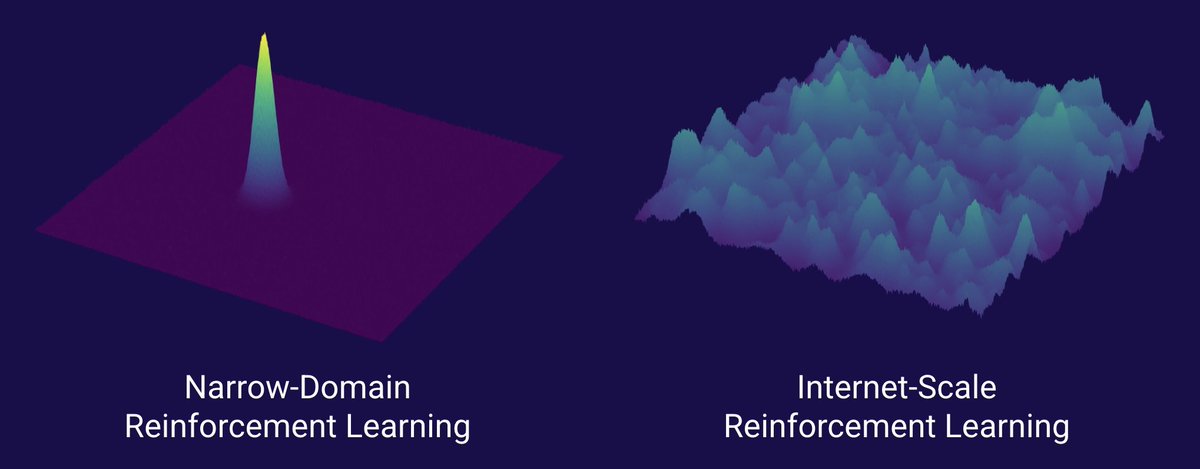
Ok. If experts are fake, then why does model progress rely on you paying Mercor, Handshake, Surge, Micro1, etc. billions of dollars to find experts to generate rubrics, define tasks, and create environments that models can learn from? If experts are fake then why do models need to extensively RL in specific domains to be useful? If experts are fake then why do models love to train on autistic tirades on r/PrintedCircuitBoard about the proper way to lay out return paths for high-speed differential pairs when they have to cross a split in the reference plan? huh, huh, huh? Broke: experts, woke: smart generalists, bespoke: expert generalists
Reddit should start a data labeling / RL environment marketplace. They have some of the most niche, high octane, taste-pilled autists on the planet on tap. Most also have a relatively low opportunity cost to expertise ratio.
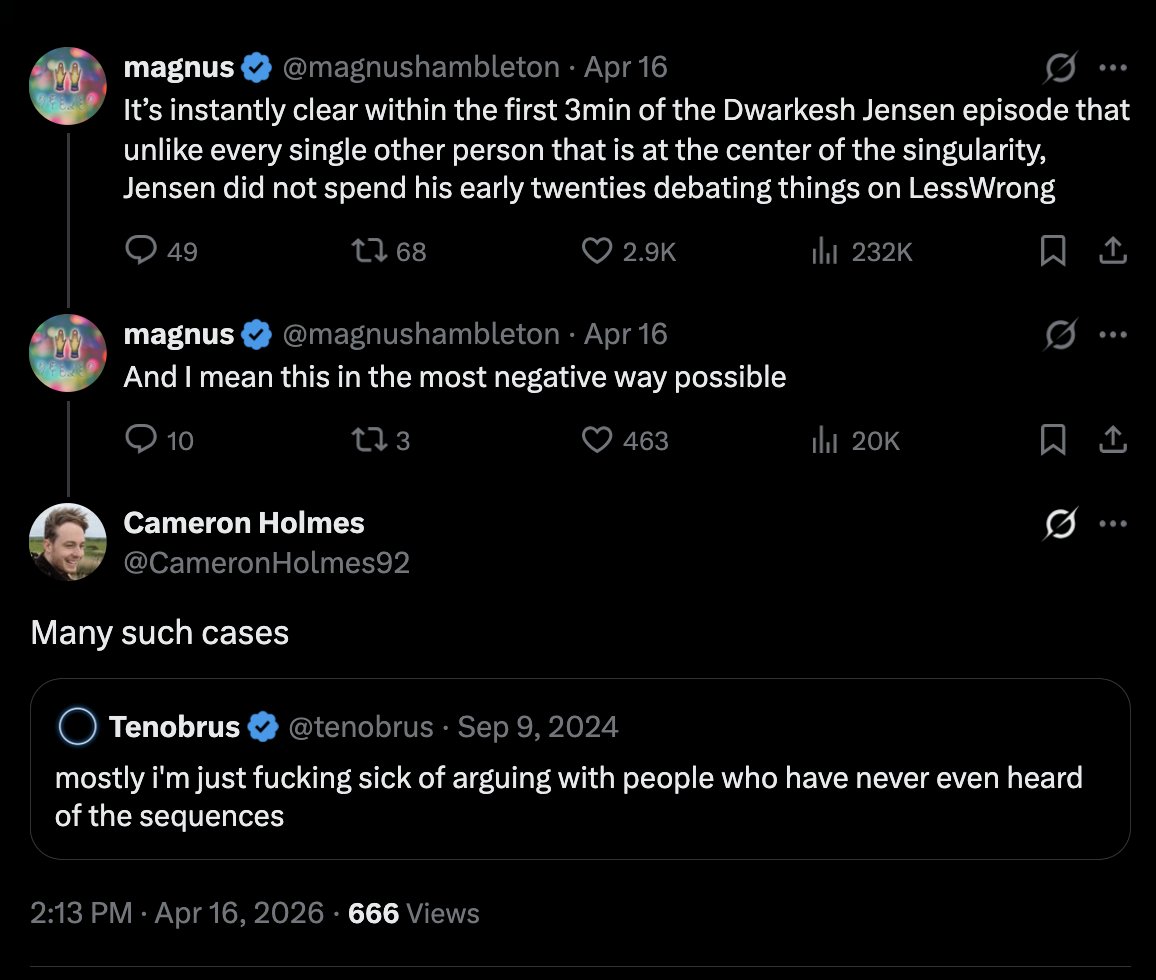
I posted this because I disliked the takes on the podcast, and I dislike some takes in response to my post, so would like to clarify my position re: Dwarkesh vs Jensen.
Dwarkesh Patel is a great podcaster, unnaturally so. Clearly he has studied his predecessors – chiefly Friedman – and engineered a methodology doing away with their frustrating defects, from the perspective of his core TA – tech-literate Americans, above-average in intelligence. Thus he provides real value to me as well. Many times has he goaded powerful men to spell out beliefs I could only conjecture they held. Is he sometimes overdoing it? No doubt. Could he do it even better in theory, helping them speak out their view of the bigger picture? For sure. But practice is scant on examples of consistently better podcasters (I'm partial to @alethios3 myself), and perhaps he'd be feared then, and extract less alpha over his career. I don't begrudge him his antics like exaggerated naivete in insisting on dumb first-principles solutions. Rationalism is a great ragebaiting tactic, if nothing else.
I don't begrudge him his sincere rationalism either. He is a creature of his era, where Teh Sequences became secular Talmud and everyone in the US with an aspiration or being technical intelligentsia or making the world a better place fr fr had to become HPMOR-literate. Hell, even I was on the edges of the same community in Russia. Sequences are a flawed and backdoored product of a sharp and criminally undercooked mind; but they had faced no comparably fit paradigm and won, and begat a great volume of often warped but excellent amateur philosophy plus OpenAI, Anthropic… and X Æ A-Xii, Exa Dark Sideræl and Techno Mechanicus. It is what it is. Scholasticism a millenium ago, Marxism a century ago, Rationalism yesterday, and it doesn't look like we're getting any better stuff so far – between Peter Thiel, Nick Fuentes and Clavicular. The schtick of at least going through the motions of updating on evidence and watching out for logical inconsistencies is vastly superior to the default, untrained culture of debate. And unfortunately, Jensen constantly demonstrates just that. Chest-thumping, rejecting the premise, refusing to entertain a hypothetical. In the venues where Dwarkesh and myself had hung out, he'd have gotten himself blocked in no time.
But. It must be understood that Jensen REALLY is Not a Loser. He's also not a Car, but indeed is the driver. Moreover, there are almost no people alive with a greater dynamic range of lived experience, who have gone from positions many would die to escape and into a position entire institutions fight to death over, and only tightened their grip since. Xi Jinping would qualify as a peer, maybe? (Musk has less range, even though he ended up in a similar place.) These individuals are fascinating outliers, and I believe that when they deign to explain their ways, however awkwardly, us mortals should sit our asses down, listen and learn.
@tailcalled has this theory that I like, published on LessWrong of course – The causal backbone conjecture. In short, it posits that the core difference between agency-driven and information-driven systems – such as humans and base LLMs, or entrepreneurs and rationalists – is that the former are oriented towards the latent substructure of reality that Makes Shit Happen; that determines how energy flows, how scarce vital resources are distributed. I've posted two cartoonishly different, archetypal bios, of a Zoomer Indian-American wordcel Dwarkesh and an X gen shape rotator Chinese-American Jensen. People find it funny, as intended, but I didn't do it to dunk on Dwarkesh, but rather to show how Jensen has basically ascended from a toilet-scrubbing immigrant runt to a demigod, from a random NPC to a Singularity Kingmaker, a whole vertebra of the Universe's backbone; and that journey informs his views, just like Dwarkesh's "be really good at Reasonably Conversing, insure your middle class stake" informs his. Jensen's journey is not about luck, he is definitely not "1 SD IQ lower". He hasn't trained himself in our exact mode of coffee salon intelligence that allows for casually cooking up consistent, defensible, lawyerly arguments about, basically, the structure of written information. So he's worse than us at it. Not because his epistemology is inferior, as in «less predictive»; it is just different, and insistence on Not Being a Loser is its functional part. He is supremely motivated to Not Lose, so he'll not make self-defeating moves. How he sorts moves into self-strengthening and self-defeating is, therefore, very important, more than verbally persuasive arguments.
Epistemology aside, I think Dwarkesh is somewhat biased towards shared assumptions and prejudices of his mileu – China Bad, AGI wunderwaffe etc. Jensen is, to put it mildly, biased by trillions of dollars on the line. But both are fundamentally good faith actors. Either is legible to his respective cohort. A healthy discourse necessitates bridging this epistemic gap – steelmanning, as rationalists would have put it (a flawed concept in its own right – you should elicidate what is actually being said, not confabulate "the strongest version" of your impression of the take, which you can still chivalrously defeat. A typical rat bait-and-switch. But I digress). Instead, they mostly roll their eyes, nitpick at seeming rhetorical contradictions, dunk and sneer. It is tedious and deserving of mockery. And I'm just about out of mockery.
So I've done a bit to steelman Jensen, today and earlier:
https://t.co/fBc3ifZNBB
https://t.co/ILbaT9wK4K
https://t.co/f4vqy3qMXB
I hope you can approach him with an open mind too.
Three of our early competitors are shutting down.
Why? Here's what I know about each 👇️
Before I get into it, I want to say that I respect each one of these companies and their founders. It's incredibly hard to start a company, and even harder to win. Being in the arena is not easy. With that, here's my perspective on each.
𝗖𝗼𝗺𝗽𝗲𝘁𝗶𝘁𝗼𝗿 𝗔
This was one of our fiercest competitors for a long time. For a year, we'd see them in almost every deal. The founders were strong, especially in GTM. They built community well, were good at appearing bigger than they were, and had an original leg up in marketing. During our Series A we were constantly asked about them, and they had a year-long headstart.
Why we won:
→ We shipped product faster. In early deals, the same story would play out again and again. The prospect would ask for a feature neither of us would have, and then we'd build it within hours. Meanwhile, it would take their team days or weeks to ship the same thing. This won us trust.
→ We nailed brand. Although they had great in-person presence, we struck lightning with LinkedIn. We started creating content and our brand presence outgrew theirs.
→ We nailed positioning before they did. In the early days we were a bit of an ambiguous product. We were originally a Slack app that sold to many members of the post-sales team. A year into the company, we decided it made the most sense to double down on customer support for the B2B segment. This is when the term "B2B support" came into existence and we created a subcategory of the support market. It also allowed us to focus in on replacing larger incumbent products like Zendesk and Intercom.
𝗖𝗼𝗺𝗽𝗲𝘁𝗶𝘁𝗼𝗿 𝗕
This competitor had been around a couple of years before us, and they had one "killer feature" that they loved to showcase. We wouldn't see them much in deals, but we were not excited about building this one thing that neither we or anyone else had, and it meant that their customers base (albiet small) was decently sticky for them.
We won for all the same reasons as competitor A, BUT we also built a superior GTM. This is one of the biggest challenges for companies founded by engineers (this includes Pylon). Sales and marketing are on the opposite side of engineering, but equally important. We embraced it and built a real GTM team while I suspect they did not.
→ 𝗖𝗼𝗺𝗽𝗲𝘁𝗶𝘁𝗼𝗿 𝗖
Possibly the least interesting of the mix. This company had been around for 3 years prior. Unlike the others, they were not SF-based but would show up occasionally in deals.
Two additional reasons we competed well against them:
→ They split their focus across IT ticketing and customer ticketing. Their core product wasn't developed enough for them to be able to make this tradeoff.
→ They were effectively bootstrapped. I don't think a bootstrapped company can afford the same level of talent and ambition when competing with a company with a grander vision that's more well-resourced.