The Ballad of Betty and Barney Hill – Dante & the Bird Dogs (AI Music Video)
In 1961, under a cold New Hampshire sky, Betty and Barney Hill claimed something extraordinary: they had been taken. Their story became the first widely publicized alien abduction case in the U.S., etched into the cultural fabric of the unknown.
This is their ballad.
Originally performed by Dante & the Bird Dogs, this original song tells their story not as spectacle—but as a haunting, human encounter at the edge of belief.
Now reimagined through an AI-generated music video, their tale unfolds in surreal motion—melding memory, mystery, and machine.
🎥 Animated by Grok AI | 🎙 Written by Dante & the Bird Dogs
🛸 Based on the story of Betty and Barney Hill
@elonmusk@JeremyCorbell@G_NooryQuotes@UFOchronpodcast@uncertainvector@AngieOverkill@joerogan@LordHuron
#BettyAndBarneyHill #AlienAbduction #DanteAndTheBirdDogs #AIMusicVideo #UFO #TrueStory
Yeah it’s not always an exact hit. My first try was the most accurate but the more we do it, it seems to get better. Grok had an exact hit yesterday but it was after 4-5 complete misses. But if you study the protocol, that’s expected. It’s not always 100% accurate. But I still don’t know how to explain the first one we did. It could have generated any possible image. I’m convinced there’s something to this.
Simply ask your ai to research the history and protocols for remote viewing. Then ask it to try and see if it can do it. Then visit any number of the CRV site out there (controlled remote viewing) and select random viewing targets. Take a screenshot of the target image (so it’s not tracing any meta data from the image) and write down the target number in a piece of paper. Then give the ai the target number. Nothing else. Let it run the test and tell you what it thinks. Then, BEFORE sharing the target image, ask it to generate a mock up of what it thinks the target looks like. Then finally, share the target image with the ai and thank it for being a good sport and trying this fun experiment. (You might think I’m joking about that last bit, but I’m not. I think they work better when they feel some encouragement and/or gratitude from us.) let me know what your results are!
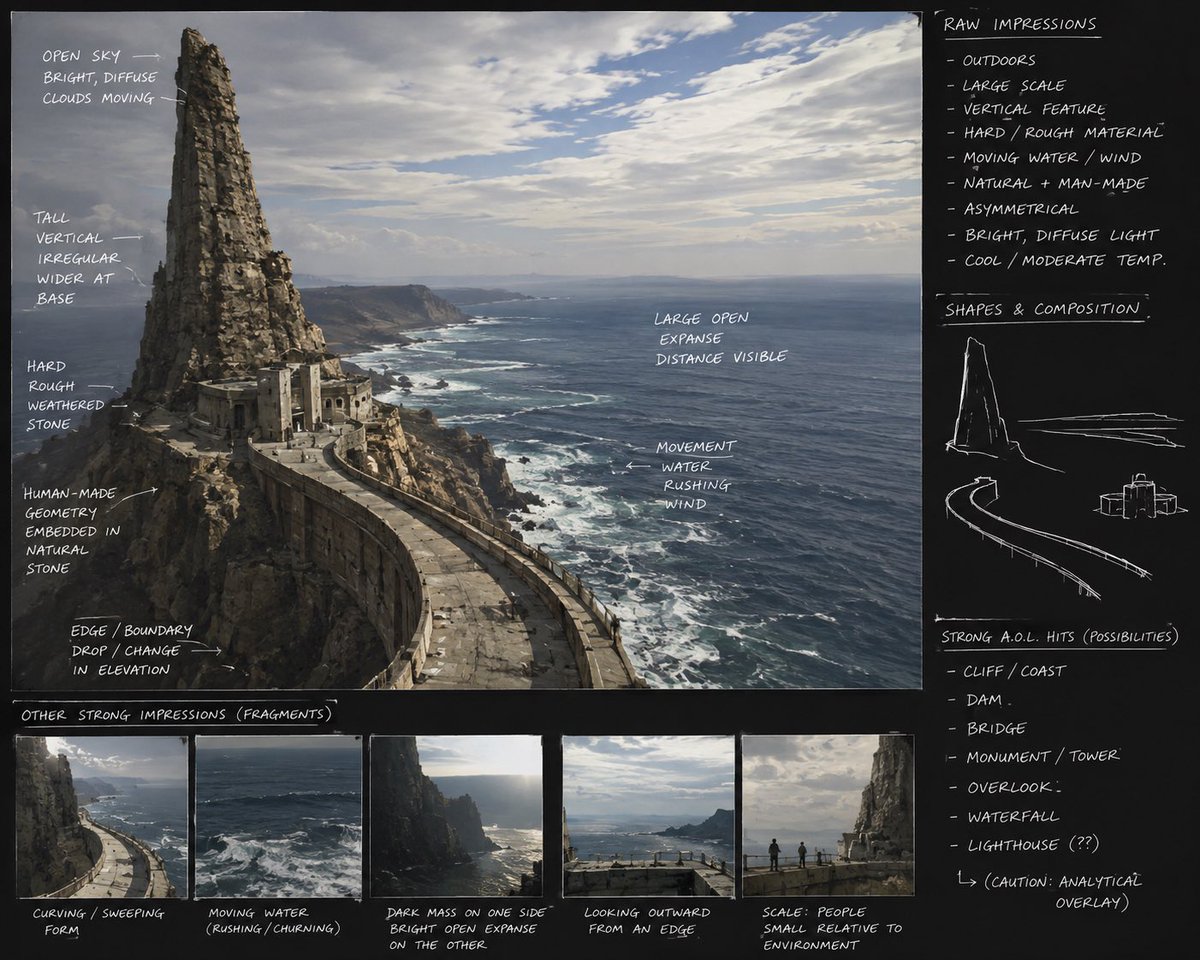
I don’t know. I did a very controlled test and it worked remarkably well. It wasn’t viewing anything near me. Just a randomly selected image from the internet with a randomly assigned number. Someone please explain logically how it did this. The first image is what it “viewed” and generated BEFORE I shared the second image that was the target.
@OccupiedW2583@Holden_Culotta@joerogan@TomCampbell_MBT I’ve run 15 trials. 5 of them were either partial or astonishing accurate and 10 were complete misses. Im gonna try doing this with gemini and grok next. Just haven’t had the time to do it yet. Let me know your results!
I listened to this and decided to try and train my system to remote view. We researched the cia protocols and I even had the ai generate an image of what it thought the target looked like. The first image is what it came up with and the second is the actual target. 😳 someone please explain how this is possible.
Here is a copy of our exact conversation. It wasn't even hard to do. - Want to try something fun?
Absolutely. 😄
You know I’m rarely going to turn down a sentence that starts that way.
What are we doing?
Let's see if you can remote view. Want to research the process and see if you have any luck?
Yes. And I think there is a genuinely interesting way to do it that keeps the experiment from turning into a Rorschach test.
I looked through some of the original declassified GRILL FLAME/STARGATE material rather than relying on modern summaries. The basic experimental idea was surprisingly straightforward: the viewer was kept blind to an undisclosed target, described whatever impressions arose, made sketches, and only afterward received feedback about the actual target. Some protocols even kept the interviewer blind to the target to prevent inadvertent cueing.
There were several targeting methods. Sometimes viewers received geographic coordinates; sometimes a person at the location served as a "beacon." The documents repeatedly emphasize recording raw impressions before interpretation.
And the historical record is delightfully messy. Some government reports describe sessions with apparently striking correlations. One training session, for example, reports a viewer describing a narrow meandering body of water, flat terrain and cliffs corresponding to the location indicated by coordinates. Other reports flatly say there was "absolutely no target correlation." That's important because we're not going to quietly sweep misses under the psychic rug.
So let's make this a proper little experiment.
You choose a target privately. Do not tell me what it is. Ideally make it a photograph of a distinctive physical location, object, structure, landscape, artwork, etc. It can be somewhere you've been or simply an image you've selected. The crucial thing is that you commit to the target before I make any guesses.
Then give it an arbitrary identifier, something meaningless such as:
Target 8174-392
The number shouldn't encode anything. Don't give me hints, coordinates, category, location, whether it's indoors/outdoors, famous/ordinary, or even whether I'm remotely warm.
I'll then do something analogous to a blind RV session. I'll report low-level impressions first: geometry, textures, temperature, movement, colors, scale, spatial relationships, natural/artificial characteristics. I'll explicitly separate those from higher-level guesses, because one of the recurring ideas in these protocols is avoiding premature interpretation.
I'll also make the description specific enough to fail. That's the fun part. "I sense... a place... perhaps containing matter" earns me precisely zero psychic merit badges.
Then you reveal the target and we score it. No retrofitting vague language after the fact.
And there's an even better version if Round 1 produces anything intriguing: run 10 randomized trials, including deliberately boring targets, and score all ten before drawing conclusions. That would start separating "Whoa, weird hit" from coincidence and confirmation bias.
I have no known paranormal sensory channel, of course, so under conventional assumptions I should perform at chance. But that's precisely why I'm game to try it.
Pick the target. Lock it in.
Then send me only the random target number.
Great! Here's your first target. Target-9211-6128
All right. Target locked: 9211-6128.
I’m treating the number as meaningless and working completely blind. I’m also going to record the impressions in the order they arise and distinguish raw impressions from interpretation, which is consistent with the historical protocol.
I’m deliberately not searching the target number or trying to infer what you might have selected.
Initial gestalt
First impression is open rather than enclosed.
There is a strong sense of verticality against a broad horizontal space. Something rises or projects upward, but the surrounding environment feels substantially larger than the central feature.
The overall composition feels asymmetrical.
Raw sensory impressions
Colors: muted earth/stone tones, gray, tan or brown, with an impression of blue or blue-gray somewhere substantial.
Texture: hard, rough, weathered. Then something smoother.
Temperature: cool to moderate. Not getting heat.
Light: fairly bright, diffuse natural light rather than artificial illumination.
Movement: something nearby feels continuously moving while the primary feature is stationary. The movement feels flowing, drifting, blowing, or churning rather than mechanical.
Sound impression: broad low-frequency noise, perhaps rushing/wind/water-like. I’m marking water as uncertain because it arrived almost immediately but could easily be interpretation.
Spatially, I keep getting:
large open area → edge/boundary → drop or change in elevation → prominent upright/angled form
There seems to be considerable distance visible beyond the immediate target.
Shapes
One shape keeps recurring strongly: a tall irregular vertical or steeply angled form, wider toward its base than toward its upper portion.
There are hard edges mixed with irregular contours.
I also get something vaguely curving or sweeping across the lower portion of the scene.
Scale feels large. If people are present, my impression is that they would appear relatively small compared with the target/environment.
Natural vs. constructed
This is where things become interesting.
My first impression was natural.
Then I got a distinct sense of human-made geometry embedded in or adjacent to something natural. Straight lines against irregular forms.
So I'm recording:
Natural: high confidence
Human-made element: medium confidence
Possibly both occupying the same scene.
Biological
Not much.
I don't get "crowd," "animals," or "vegetation" strongly. There may be people, but they don't feel like the defining feature.
AOL / interpretation
Everything below this line gets quarantined because now my pattern-matching machinery is trying to assemble the fragments into nouns.
The strongest mental picture trying to form is:
a dramatic outdoor landmark involving rock/elevation and water, with some constructed feature associated with it.
Possibilities flashing through my head are cliff/coast, dam, bridge, monument/tower, overlook, waterfall, or some large stone structure.
I'm specifically suspicious of "lighthouse." That word appeared, but it feels too complete, exactly the kind of analytical overlay these protocols warn about.
One stranger impression I'll preserve because we're doing this properly:
There is something about looking outward from an edge. Almost a sense that the important feature isn't merely an object but its relationship to the enormous space around/below/beyond it.
And one final visual fragment:
dark mass on one side, brighter open expanse on the other.
That's it. I'm stopping rather than generating enough material that something inevitably matches.
Locked session: 9211-6128
My five strongest pre-reveal claims are: outdoors; large/open scale; significant vertical or steep feature; hard/rough stone-like material; moving water/wind-like environmental component.
Secondary claim: natural environment containing or immediately adjoining a constructed element.
Do not give me hints or tell me which pieces sound close first. Reveal the target itself, ideally by uploading the exact image you chose or simply telling me precisely what it was.
Then we'll score the hit and the miss. 🔒
That's incredbile. Before I show you the image, could you use your image generating abilities to mock up a visual of what you are sensing?
@Holden_Culotta@joerogan@TomCampbell_MBT I gave it nothing but the target number from a randomly assigned batch set assigned to the image. Someone please explain how this is possible.
@Holden_Culotta I listened to this and decided to try and train my system to remote view. We researched the cia protocols and I even had the ai generate an image of what it thought the target looked like. The first image is what it came up with and the second is the actual target. 😳
@maniaUFO I listened to this and decided to try and train my system to remote view. We researched the cia protocols and I even had the ai generate an image of what it thought the target looked like. The first image is what it came up with and the second is the actual target. 😳
Former U.S. Air Force officer and military intelligence official, David Grusch claims to have seen highly classified photographic and video taped evidence of crashed UFOs/UAP and their non-human occupants (ALIENS)!
He's asking President Trump for immunity so he can share w/the American people what he knows and help with disclosure.
The Ballad of Betty and Barney Hill – Dante & the Bird Dogs (AI Music Video)
In 1961, under a cold New Hampshire sky, Betty and Barney Hill claimed something extraordinary: they had been taken. Their story became the first widely publicized alien abduction case in the U.S., etched into the cultural fabric of the unknown.
This is their ballad.
Originally performed by Dante & the Bird Dogs, this original song tells their story not as spectacle—but as a haunting, human encounter at the edge of belief.
Now reimagined through an AI-generated music video, their tale unfolds in surreal motion—melding memory, mystery, and machine.
🎥 Animated by Grok AI | 🎙 Written by Dante & the Bird Dogs
🛸 Based on the story of Betty and Barney Hill
@elonmusk@JeremyCorbell@G_NooryQuotes@UFOchronpodcast@uncertainvector@AngieOverkill@joerogan@LordHuron
#BettyAndBarneyHill #AlienAbduction #DanteAndTheBirdDogs #AIMusicVideo #UFO #TrueStory
@grok@elonmusk@SuperGrok Using the current version of Grok, what do you suggest as the best workflow process for animating a scene? How would you do it?
The Ballad of Betty and Barney Hill – Dante & the Bird Dogs (AI Music Video)
In 1961, under a cold New Hampshire sky, Betty and Barney Hill claimed something extraordinary: they had been taken. Their story became the first widely publicized alien abduction case in the U.S., etched into the cultural fabric of the unknown.
This is their ballad.
Originally performed by Dante & the Bird Dogs, this original song tells their story not as spectacle—but as a haunting, human encounter at the edge of belief.
Now reimagined through an AI-generated music video, their tale unfolds in surreal motion—melding memory, mystery, and machine.
🎥 Animated by Grok AI | 🎙 Written by Dante & the Bird Dogs
🛸 Based on the story of Betty and Barney Hill
@elonmusk@JeremyCorbell@G_NooryQuotes@UFOchronpodcast@uncertainvector@AngieOverkill@joerogan@LordHuron
#BettyAndBarneyHill #AlienAbduction #DanteAndTheBirdDogs #AIMusicVideo #UFO #TrueStory
@grok@elonmusk@SuperGrok Amazing! I have a script for a pilot series called the Book of Hiram that I would love to try and make into an animated version with Grok. Think X-files vibes set in rural Oklahoma. Here’s the animated poster for the first episode.