Update:
I'm open-sourcing this.
My DMs have exploded with investors, pro players, teams, users. The demo has 5,000,000 views across platforms.
There is obviously interest.
But, I have zero interest in working on it. I'm more interested in working on Tidbit.
So -- someone please steal it and run.
There's a beautiful vision here, especially those who want to build in education.
Imagine an AI super-coach in your pocket:
- Do yoga, correct your form in real-time
- Practice guitar, fix finger positioning instantly
- Learn cooking, get real-time tips on spices.
- Learn painting, get brush stroke feedback.
The future of learning will look a lot like real-time, in the moment AI instruction -- it likely won't look like an AI homework helper.
Anyways.
There's a cool vision here for the right person to obsess over for 10+ years.
And the starting point is clear -- pick one thing (ex. basketball), be the best AI real-time coach in the world for it, keep growing.
GLHF :).
https://t.co/LTbjI84x9u
P.S: The repo is literally just a visualizer file + prompt. But hey, maybe it inspires someone.
So Google Sheets now has a "=AI" formula?!
You can process data that was impossible before in a spreadsheet.
Gemini understands what's in the cells and returns a tailor-made answer according to your instructions.
Examples and formulas below
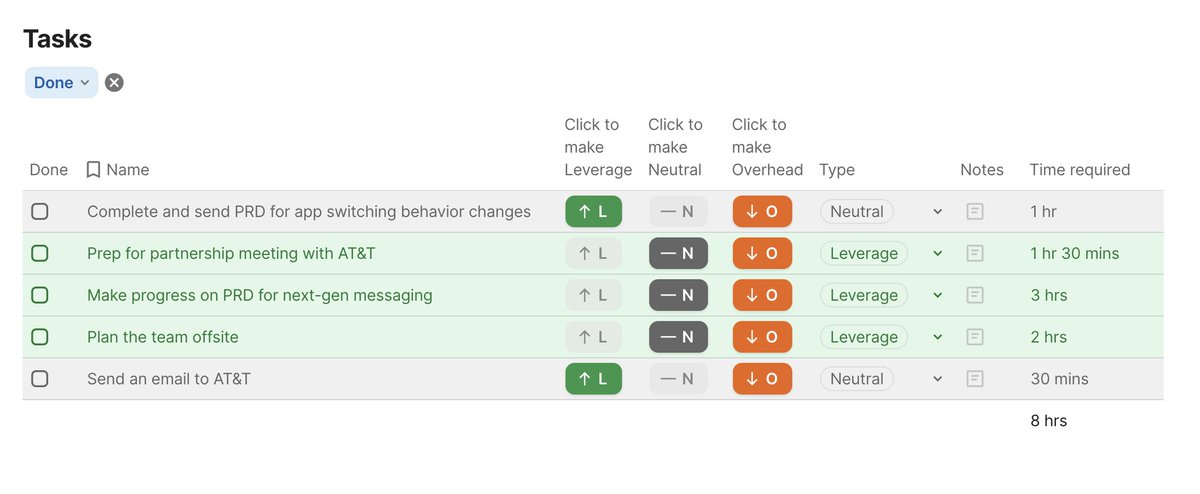
✨The LNO framework changed my life as a busy PM and I’ve been using it to manage my work for 10+ years. Over the years, 100s of PMs & non-PMs have shared how they use LNO to manage their tasks
Announcing a @coda_hq doc that makes LNO even easier for you: https://t.co/VkPwOAAOTZ
1/ A strong relationship can increase your likelihood of happiness by 5x, more than wealth and career success combined.
The Harvard study found that love and deep connection buffer the effects of aging. Couples over 80 yrs old with strong social ties reported better health, higher happiness, and even greater pain tolerance.
In the U.S., five decades of General Social Survey (GSS) data show married people consistently rank happier than the unmarried—by 30 points on a 200-point scale.
Writing software, especially prototypes, is becoming cheaper. This will lead to increased demand for people who can decide what to build. AI Product Management has a bright future!
Software is often written by teams that comprise Product Managers (PMs), who decide what to build (such as what features to implement for what users) and Software Developers, who write the code to build the product. Economics shows that when two goods are complements — such as cars (with internal-combustion engines) and gasoline — falling prices in one leads to higher demand for the other. For example, as cars became cheaper, more people bought them, which led to increased demand for gas. Something similar will happen in software. Given a clear specification for what to build, AI is making the building itself much faster and cheaper. This will significantly increase demand for people who can come up with clear specs for valuable things to build.
This is why I’m excited about the future of Product Management, the discipline of developing and managing software products. I’m especially excited about the future of AI Product Management, the discipline of developing and managing AI software products.
Many companies have an Engineer:PM ratio of, say, 6:1. (The ratio varies widely by company and industry, and anywhere from 4:1 to 10:1 is typical.) As coding becomes more efficient, teams will need more product management work (as well as design work) as a fraction of the total workforce. Perhaps engineers will step in to do some of this work, but if it remains the purview of specialized Product Managers, then the demand for these roles will grow.
This change in the composition of software development teams is not yet moving forward at full speed. One major force slowing this shift, particularly in AI Product Management, is that Software Engineers, being technical, are understanding and embracing AI much faster than Product Managers. Even today, most companies have difficulty finding people who know how to develop products and also understand AI, and I expect this shortage to grow.
Further, AI Product Management requires a different set of skills than traditional software Product Management. It requires:
- Technical proficiency in AI. PMs need to understand what products might be technically feasible to build. They also need to understand the lifecycle of AI projects, such as data collection, building, then monitoring, and maintenance of AI models.
- Iterative development. Because AI development is much more iterative than traditional software and requires more course corrections along the way, PMs need be able to manage such a process.
- Data proficiency. AI products often learn from data, and they can be designed to generate richer forms of data than traditional software.
- Skill in managing ambiguity. Because AI’s performance is hard to predict in advance, PMs need to be comfortable with this and have tactics to manage it.
- Ongoing learning. AI technology is advancing rapidly. PMs, like everyone else who aims to make best use of the technology, need to keep up with the latest technology advances, product ideas, and how they fit into users’ lives.
Finally, AI Product Managers will need to know how to ensure that AI is implemented responsibly (for example, when we need to implement guardrails to prevent bad outcomes), and also be skilled at gathering feedback fast to keep projects moving. Increasingly, I also expect strong product managers to be able to build prototypes for themselves.
The demand for good AI Product Managers will be huge. In addition to growing AI Product Management as a discipline, perhaps some engineers will also end up doing more product management work.
The variety of valuable things we can build is nearly unlimited. What a great time to build!
[Original text: https://t.co/OIeAQXpriK ]
AI Product Management
AI Product Management is evolving rapidly. The growth of generative AI and AI-based developer tools has created numerous opportunities to build AI applications. This is making it possible to build new kinds of things, which in turn is driving shifts in best practices in product management — the discipline of defining what to build to serve users — because what is possible to build has shifted. In this post, I’ll share some best practices I have noticed.
Use concrete examples to specify AI products. Starting with a concrete idea helps teams gain speed. If a product manager (PM) proposes to build “a chatbot to answer banking inquiries that relate to user accounts,” this is a vague specification that leaves much to the imagination. For instance, should the chatbot answer questions only about account balances or also about interest rates, processes for initiating a wire transfer, and so on? But if the PM writes out a number (say, between 10 and 50) of concrete examples of conversations they’d like a chatbot to execute, the scope of their proposal becomes much clearer. Just as a machine learning algorithm needs training examples to learn from, an AI product development team needs concrete examples of what we want an AI system to do. In other words, the data is your PRD (product requirements document)!
In a similar vein, if someone requests “a vision system to detect pedestrians outside our store,” it’s hard for a developer to understand the boundary conditions. Is the system expected to work at night? What is the range of permissible camera angles? Is it expected to detect pedestrians who appear in the image even though they’re 100m away? But if the PM collects a handful of pictures and annotates them with the desired output, the meaning of “detect pedestrians” becomes concrete. An engineer can assess if the specification is technically feasible and if so, build toward it. Initially, the data might be obtained via a one-off, scrappy process, such as the PM walking around taking pictures and annotating them. Eventually, the data mix will shift to real-word data collected by a system running in production.
Using examples (such as inputs and desired outputs) to specify a product has been helpful for many years, but the explosion of possible AI applications is creating a need for more product managers to learn this practice.
Assess technical feasibility of LLM-based applications by prompting. When a PM scopes out a potential AI application, whether the application can actually be built — that is, its technical feasibility — is a key criterion in deciding what to do next. For many ideas for LLM-based applications, it’s increasingly possible for a PM, who might not be a software engineer, to try prompting — or write just small amounts of code — to get an initial sense of feasibility.
For example, a PM may envision a new internal tool for routing emails from customers to the right department (such as customer service, sales, etc.). They can prompt an LLM to see if they can get it to select the right department based on an input email, and see if they can achieve high accuracy. If so, this gives engineering a great starting point from which to implement the tool. If not, the PM can falsify the idea themselves and perhaps improve the product idea much faster than if they had to rely on an engineer to build a prototype.
Often, testing feasibility requires a little more than prompting. For example, perhaps the LLM-based email system needs basic RAG capability to help it make decisions. Fortunately, the barrier to writing small amounts of code is now quite low, since AI can help by acting as a coding companion, as I describe in the course, “AI Python for Beginners.” This means that PMs can do much more technical feasibility testing, at least at a basic level, than was possible before.
Prototype and test even without engineers. User feedback to initial prototypes is also instrumental to shaping products. Fortunately, barriers to building prototypes rapidly are falling, and PMs themselves can move basic prototypes forward without needing professional software developers.
In addition to using LLMs to help write code for prototyping, tools like Replit, Vercel’s V0, Bolt, and Anthropic’s Artifacts (I’m a fan of all of these!) are making it easier for people without a coding background to build and experiment with simple prototypes. These tools are increasingly accessible to non-technical users, though I find that those who understand basic coding are able to use them much more effectively, so it’s still important to learn basic coding. (Interestingly, highly technical, experienced developers use them too!) Many members of my teams routinely use such tools to prototype, get user feedback, and iterate quickly.
AI is enabling a lot of new applications to be built, creating massive growth in demand for AI product managers who know how to scope out and help drive progress in building these products. AI product management existed before the rise of generative AI, but the increasing ease of building applications is creating greater demand for AI applications, and thus a lot of PMs are learning AI and these emerging best practices for building AI products. I find this discipline fascinating, and will keep on sharing best practices as they grow and evolve.
[Original text: https://t.co/ohLyrpU4SJ ]
🎥 The camera control system in #Gen3 has totally changed the game! In just a few minutes, you can create some seriously badass shots.
I’ll put together a thread to show you the full process for making these kinds of videos. Stay tuned! 💥
FULL Audio Of Steph Curry Trash Talking Klay Thompson👀:
“You better stay here, you better stay here!”
Then, after the game was over, Steph exchanged words with Draymond and threw shots at Klay:
Curry: “Yessir, stay here!”
Green: “Every time”
🏃♀️Comparing AI video results:
• Gen-3
• Kling AI 1.5
• Hailuo MiniMax
• Luma Dream Machine
I used a Midjourney image as the input. Each model ran the same prompt 3 times, and I chose the best results:
"Smooth side tracking shot of a woman jogging at twilight with the city skyline in the background, sharp focus on the woman as she pumps her arms with each stride as she jogs, depth of field, advertising commercial"
It's still difficult for AI to generate natural motion for walking, running, etc. But I like to test it every so often:
The future of ad is happening now.
AI is already making spec ads, and it’s going to change everything.
8 wild examples:
1. Dior AI spec ad by David Blagojević
This is an ice designer tool for bartenders, but it also shows how textures can be impressed on ice too while it melts
[📹reallyicetomeetyou]
https://t.co/vfFhJAVUd9
Practical lessons you can takeaway:
1. Ai Wrappers will always be a good idea, most users want easy UI
2. With Ai products, you can charge more! (try family plans)
3. Simpler is better. Less is more. Less buttons/bigger buttons are key.
4. TT/IG/YT shorts is your distribution
Apple just announced its Apple Intelligence features for iPhone 16.
The 8 most impressive demos:
1. Apple Intelligence accessing the iPhone's camera for 'Visual Intelligence' on any surroundings