It is hard to communicate how much programming has changed due to AI in the last 2 months: not gradually and over time in the "progress as usual" way, but specifically this last December. There are a number of asterisks but imo coding agents basically didn’t work before December and basically work since - the models have significantly higher quality, long-term coherence and tenacity and they can power through large and long tasks, well past enough that it is extremely disruptive to the default programming workflow.
Just to give an example, over the weekend I was building a local video analysis dashboard for the cameras of my home so I wrote: “Here is the local IP and username/password of my DGX Spark. Log in, set up ssh keys, set up vLLM, download and bench Qwen3-VL, set up a server endpoint to inference videos, a basic web ui dashboard, test everything, set it up with systemd, record memory notes for yourself and write up a markdown report for me”. The agent went off for ~30 minutes, ran into multiple issues, researched solutions online, resolved them one by one, wrote the code, tested it, debugged it, set up the services, and came back with the report and it was just done. I didn’t touch anything. All of this could easily have been a weekend project just 3 months ago but today it’s something you kick off and forget about for 30 minutes.
As a result, programming is becoming unrecognizable. You’re not typing computer code into an editor like the way things were since computers were invented, that era is over. You're spinning up AI agents, giving them tasks *in English* and managing and reviewing their work in parallel. The biggest prize is in figuring out how you can keep ascending the layers of abstraction to set up long-running orchestrator Claws with all of the right tools, memory and instructions that productively manage multiple parallel Code instances for you. The leverage achievable via top tier "agentic engineering" feels very high right now.
It’s not perfect, it needs high-level direction, judgement, taste, oversight, iteration and hints and ideas. It works a lot better in some scenarios than others (e.g. especially for tasks that are well-specified and where you can verify/test functionality). The key is to build intuition to decompose the task just right to hand off the parts that work and help out around the edges. But imo, this is nowhere near "business as usual" time in software.
We achieved gold medal-level performance 🥇on the 2025 International Mathematical Olympiad with a general-purpose reasoning LLM!
Our model solved world-class math problems—at the level of top human contestants. A major milestone for AI and mathematics.
ChatGPT can now access the Internet again.
This allows it to do things that weren't possible before.
Here are 8 examples of what you can do with this internet integration:
Today we're announcing #GAIA1: a 9B parameter world model, trained on 4,700 hours of driving data, able to simulate complex and diverse driving scenes from video, text and action inputs. This model is 480x larger than the preview we shared earlier this year and the results are incredible.
These videos are entirely synthetically generated by @wayve_ai's generative AI, GAIA-1. But there is more here than just generating videos, GAIA is an entire world model. A world model allows us to simulate the future, conditioned on video, text and action inputs, which can be leveraged for making informed decisions when driving.
Why is this game-changing for autonomous driving?
1. Safety. One limitation with AI systems like today's Large Language Models is that they are autoregressive, next-word prediction algorithms, but aren't necessarily aware of the implications of their decisions. A world model allows us to give our AI the capability to be aware of its decisions, by simulating the future, which is important for self-driving safety.
2. Synthetic training data. I believe synthetic training data is the future for AI, because it is safer, cheaper, and infinitely scalable. GAIA-1 unlocks unprecedented realism and diversity of synthetic data for self-driving.
3. Long-tail robustness. One of the biggest challenges for self-driving is long-tail robustness: dealing with the enormous magnitude of edge cases we see on the road. An advantage of generative AI is its incredible ability to recombine experiences in new ways. This is exciting for self-driving as it means we can learn from two edge case scenarios, and combine them to become a corner case. For example, we can experience driving in fog, and experience of jay-walking pedestrians, and GAIA can learn from these experiences to understand how to generate a fog+jay walking scenario.
Check out many more videos in our blog https://t.co/U44HQ82qeC or further technical details in our paper: https://t.co/w4nrPCy3Ph
Or come chat with our team who are at the International Conference on Computer Vision (#ICCV2023) this week in Paris in Booth 32 @Jamie_Shotton
ChatGPT can now browse the internet to provide you with current and authoritative information, complete with direct links to sources. It is no longer limited to data before September 2021.
New course with @huggingface! Building Generative AI Applications with Gradio, taught by Apolinário Passos @apolinariosteps, shows you how to quickly create demos of your machine learning applications to test and iterate/share with others. Check it out! https://t.co/HNYZa42eZE
This is insane! 😱
You can now train a 100-billion parameters LLM on Google Colab.
Explanation and code below ⤵️⤵️⤵️
--- TL;DR ---
Distributed training over the Internet has become operational with the release of the new version of the PETALS distributed training package. Join forces with people from around the world and receive immense computing power in return for your use! 🌐⚡️
--- Intro ---
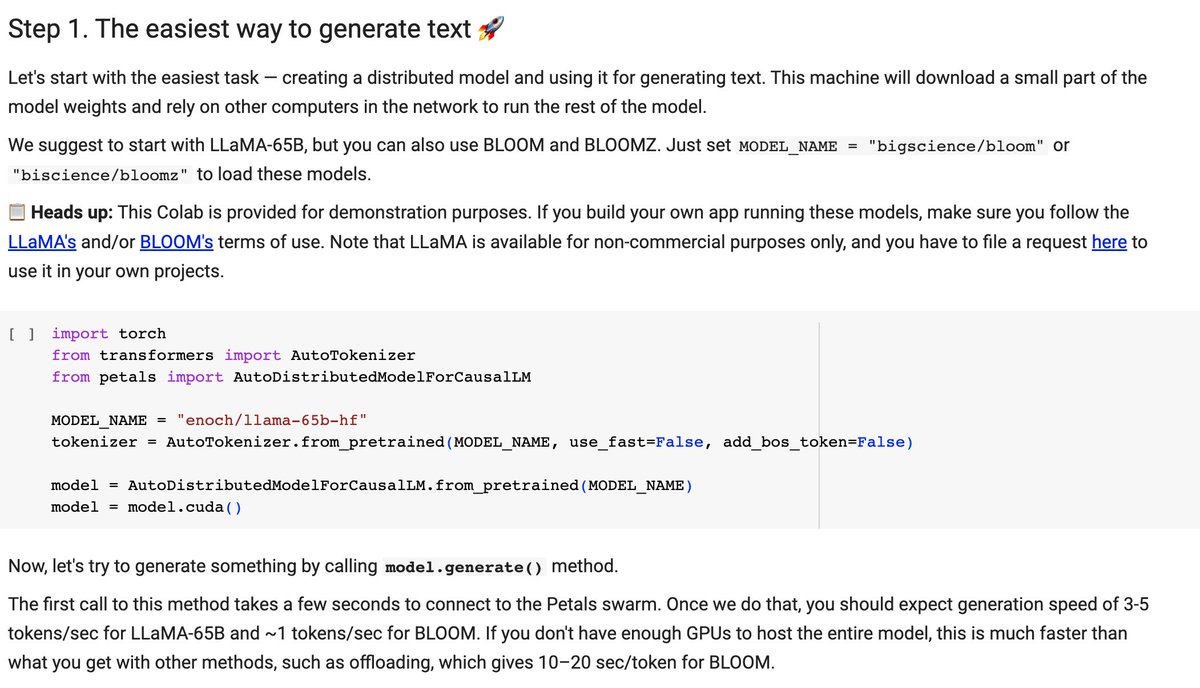
Distributed training over the internet has turned from a dream into a reality with the release of the new version of the Petals distributed training package. Upon connection, the package grants you access to immense computing power that allows you to do anything you can imagine. It doesn't even have to be your own computing power: Attaching below is a Colab notebook that trains a 65-billion-parameter model (and also supports 100 billion. Yes, models with a hundred billion parameters are accessible to you). 💻🚀
--- It surely takes years, doesn't it? ---
No. For example, with a 65-billion-parameter inference, you'll get a speed of 5 tokens per second. ⏱️⚡️
--- How does it work? ---
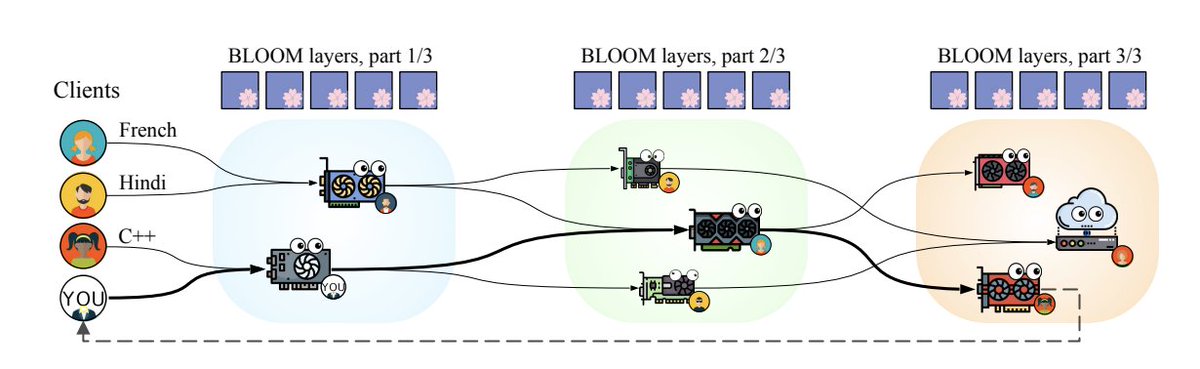
The concept is very simple. In LoRA-based training (My tweet about LoRA - https://t.co/AvSZlOot7r), the base model is the same for everyone and does not change until the end of training, so many people need it at the same time. With Petals, people load small parts of the model, and each executes their part in the computation of running the full model.
All the headache and complex software engineering required to make this madness run smoothly and quickly happens inside the package. 🤯🔧
--- How complex? ---
From your own perspective, simply run:
AutoDistributedModel.from_pretrained
--- Important! Privacy! ---
Obviously, this infrastructure sends your data outside to the world, so it's crucial to take that into account. Your code is never sent outside. 🌐🔒
--- Links ---
1. Article: Petals: Collaborative Inference and Fine-tuning of Large Models - https://t.co/kUfpyQoaDI
2. See the speed for yourself: Distributed Chatbot - https://t.co/O591uH5MiT
3. Notebook for training a 65-billion-parameter model: https://t.co/v2u6heE7h1
4. Code: https://t.co/aM9gjmqx76
5. Paper: https://t.co/mdJk1Bv1fb
6. Join the community: https://t.co/WwrtxnNldp
Free guide to MLOps, including a 15-part ✅ checklist of MLOps 🏆 best practices. Plus a comprehensive guide to designing 🔗 good processes for ML projects, from 📏scoping to 🚀deployment.
#mlops#machinelearning
ChatGPT is like FERRARI
It’s mighty & POWERFUL
BUT…
It’s not for EVERYDAY use
There are better cars for that
6 tools that are BETTER than GPT for specific use cases
Stop using ChatGPT for research.
ChatGPT’s info is outdated by 2 years.
Here are 17 mind-blowing AI tools that give you accurate research results & save $10000
Chat GPT's Code interpreter is ready to wipe out 57 BILLION DOLLAR Data analytics MARKET.
Here are 10 experiments I ran leveraging Code interpreter for a Dataset, that I used for personal learning, and the results are SPECTACULAR!
THREAD AHEAD 🧵👇
MotionGPT: Human Motion as a Foreign Language
paper page: https://t.co/rvgGnnQqMh
Though the advancement of pre-trained large language models unfolds, the exploration of building a unified model for language and other multi-modal data, such as motion, remains challenging and untouched so far. Fortunately, human motion displays a semantic coupling akin to human language, often perceived as a form of body language. By fusing language data with large-scale motion models, motion-language pre-training that can enhance the performance of motion-related tasks becomes feasible. Driven by this insight, we propose MotionGPT, a unified, versatile, and user-friendly motion-language model to handle multiple motion-relevant tasks. Specifically, we employ the discrete vector quantization for human motion and transfer 3D motion into motion tokens, similar to the generation process of word tokens. Building upon this "motion vocabulary", we perform language modeling on both motion and text in a unified manner, treating human motion as a specific language. Moreover, inspired by prompt learning, we pre-train MotionGPT with a mixture of motion-language data and fine-tune it on prompt-based question-and-answer tasks. Extensive experiments demonstrate that MotionGPT achieves state-of-the-art performances on multiple motion tasks including text-driven motion generation, motion captioning, motion prediction, and motion in-between.
Drag Your GAN: Interactive Point-based Manipulation on the Generative Image Manifold is out as a @gradio demo on @huggingface
try it out: https://t.co/MDB4TflchV
Introducing RoboCat, a new AI model designed to operate multiple robots. 🤖
It learns to solve new tasks on different robotic arms with as few as 100 demonstrations - and improves skills from self-generated training data.
Find out more: https://t.co/9YmgKxmiGE
Comparing text2video rendering tools.
The Players:
Modelscope v1 - Original A1111 local gens
Videocrafter - A1111 local gens w/ VC model
Runway v2 - Online defined length gens
Zeroscope v2 - Newly released A1111 local gens
The Prompt:
a balloon monster walking on the beach
The best way to learn about AI is to build real projects with it.
When you build, you learn what’s valuable and what’s not.
With no-code tools like Bubble, you can build a real working AI app (like a chatbot or image generation app).
Learn how: https://t.co/4cpiAOQOJc