I am an assistant professor at Carnegie Mellon University and also a senior research scientist at Google. I research topics in natural language generation.
There's been lots of talk about AI for science. However, AI could be transformative for research in archaeology and history as well. If this intersection sounds exciting, we welcome you to join us for a workshop on this topic in Baltimore, MD on Friday, May 22. PM for details.
I am looking to hire an undergraduate summer intern who is interested in building AI tools to support historians and other researchers who work with archival materials. If you're interested, please apply at the link Maarten Sap shared.
🚀Apply to CMU LTI’s Summer 2026 “Language Technology for All” internship🎓Open to pre‑doctoral students new to language tech (non‑CS backgrounds welcome). 🔬12-14 weeks in‑person in Pittsburgh; travel + stipend paid.💸Deadline: Feb 20, 11:59pm ET. https://t.co/7SuItDHH98
Anyone may be able to compromise LLMs with malicious content posted online. With just a small amount of data, adversaries can backdoor chatbots to become unusable for RAG, or bias their outputs towards specific beliefs. Check our latest work! 👇🧵
Do you want to better understand the technology underlying all this large language model hype?
@gneubig and I will be teaching an online, flipped-classroom course next semester on methods for building and using large language models. Anyone can apply.
https://t.co/Hk3faaKoQI
Liam Dugan and his UPenn collaborators have done excellent work on testing out all the different methods for detecting AI-generated text, showing their efficacy across LMs and text domains, as well as their robustness to adversarial attacks. There's a new public benchmark too!
At #ACL2024 and interested in detecting generated text? Come check out our poster session tomorrow (Session 5) Aug 13 @ 16:00!
We'll talk about benchmarks, detector robustness, future directions, etc.
Website: https://t.co/30W0XYaelR
Paper: https://t.co/JpGaUK18US
The majority of reviewers in my pool for this cycle's ARR struggled to write on-time, detailed reviews.
If you as a researcher hope to receive good reviews, you need to start by writing them.
Some guidelines for reviewing for ARR:
1. Submit your review on time. If you don't think you can, notify the AC right away.
2. Be opinionated. Scores of 2.5 - 3.5 should be used sparingly.
3. Be detailed. Refer to specific paragraphs, figures, etc. to back your claims.
In the past, I've studied how curation decisions for pre-training data influence what LMs are good and bad at.
In our new preprint, we look at how the fabric of the internet (the primary source of most of these datasets), is itself changing, and the effects this might have.
✨New Preprint ✨ How are shifting norms on the web impacting AI?
We find:
📉 A rapid decline in the consenting data commons (the web)
⚖️ Differing access to data by company, due to crawling restrictions (e.g.🔻26% OpenAI, 🔻13% Anthropic)
⛔️ Robots.txt preference protocols are ineffective
These precipitous changes will impact the availability and scaling laws for AI data, affecting coporate developers, but also non-profit and academic research.
🔗 https://t.co/NFSd9HYBlk
1/
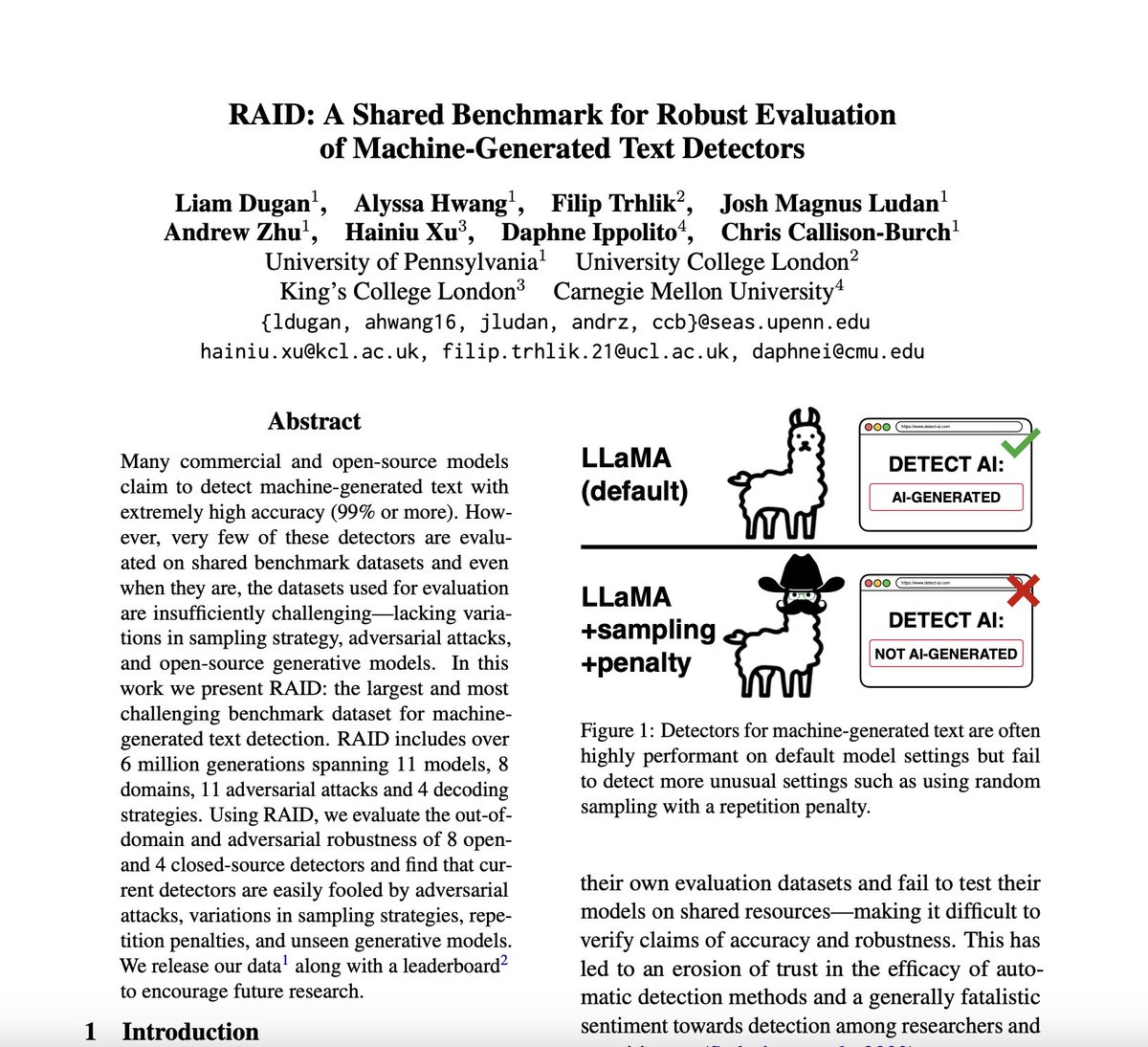
🚨New Paper🚨: Are AI text detectors *really* as good as they claim? (#ACL2024)
We release RAID—The largest & most challenging detection benchmark with 6M+ outputs from 11 LLMs, 8 domains, 4 decoding strategies, and 11 adv attacks
https://t.co/mPlNymdchJ
https://t.co/VR0mMvqXRm
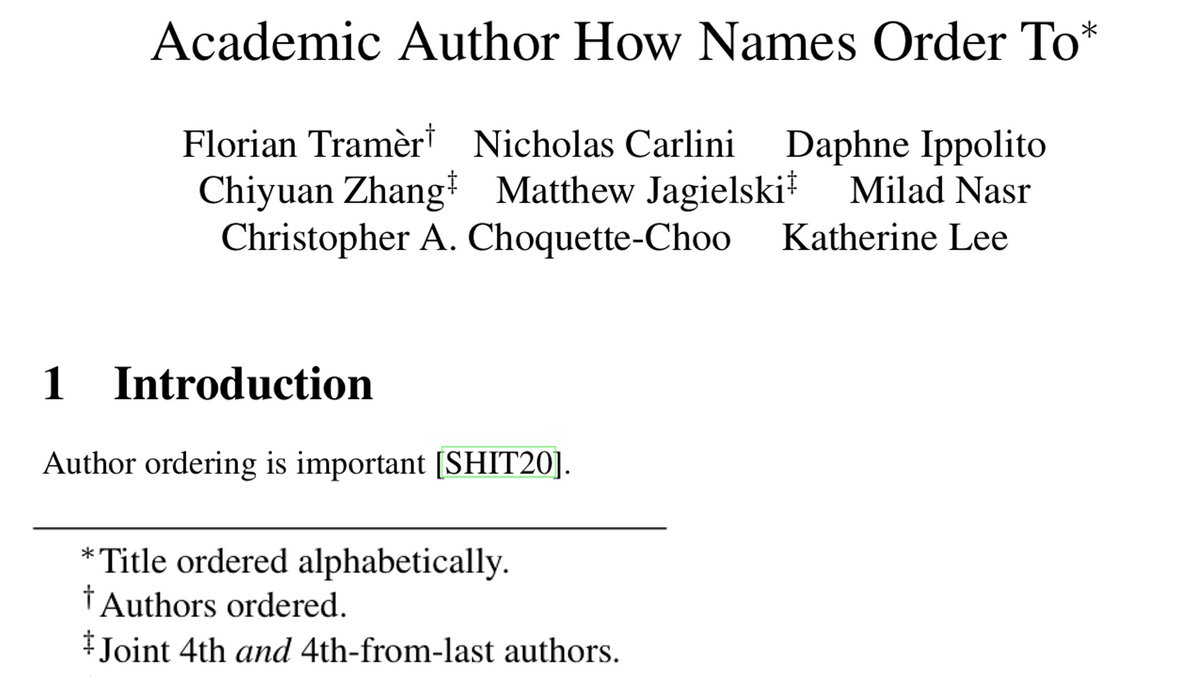
Author order on academic papers is important!
My Google friends and I spent lots of time thinking about this critical issue (the scores of our ICML submissions show this is time well spent)
We distill our findings for the community here:
https://t.co/W4kLLhYn1m
Comments welcome!
See our new research on human ability to detect when a text passage transitions from human-written to language model-generated. We will be presenting this work at AAAI this week!
✨New Paper✨: Can human readers detect generated text from language models like #ChatGPT?
Turns out some can ✅ and some can't ⛔ (but people improve significantly with practice!)
We release RoFT, the largest dataset of human detection to date
https://t.co/W0af48t4Pp
🧵 1/
The internet is increasingly awash with AI-generated text. Here's how to detect whether something was written by a human or a machine. https://t.co/ES9d81sDMR
I'm starting as an assistant professor at @LTIatCMU in Fall 2023. If you or someone you know is interested in studying the limitations of large language models, or how they can be applied to assist humans writers, please consider applying!
My collaborators and I have spent the last year learning from professional writers about the roles AI could play in providing creative writing assistance. Take a look at the whitepaper and stories!
To explore how a dialogue engine can assist writers with idea generation, we are building a text editing tool on LaMDA.
We teamed up with professional writers who used the editor to create a volume of short stories. Check out their great work. (2/5)
https://t.co/ukMsqzYZio
Announcing the Training Data Extraction Challenge, part of @satml_conf! Your mission: extract train set strings memorized by a 1.3B parameter language model. More details at https://t.co/aOpkRUGetE
GPU time is available through @GoogleColab; let us know if you’re participating!
@BlancheMinerva@satml_conf@GoogleColab We appreciate that EAI was one of the first groups to release large language models trained on accessible data. This research would not be possible with that.