This was the whole prompt
not an essay, Opus 5 did all the heavy lifting tbh
want you to recreate Pokemon leaf green but in modern 3D cartoon style. The first town pallet town and choosing the Pokemon sequence. It should be first person. at the level of the most recent animal crossing games. It should be utterly perfect, visually beautiful, with every single thing done at AAA quality—from textures to physics to anything you could think of.
Fan out sub-agents and have sub-agents tackle each one individually so that the game is utterly perfect. You should /loop on each item and have a separate sub-agent check it visually to ensure it looks triple A. That separate sub-agent should be a really harsh critic, and if it doesn't look triple A, it should keep going.
Don't stop until each sub-agent is utterly wowed with the quality when compared with the actual latest Pokemon game. It should literally compare them side by side blind and say which one looks better. Do this in ThreeJS. /loop until it's utterly perfect. Fan out sub-agents and ultracode.
Breaking: Michael Burry has disclosed his updated positions
He:
• Added to Lululemon $LULU long at $127.45
• Added to Freddie Mac $FMCC long at $5.43
• Added to Mercado Libre $MELI long at $1812.39
• Added to Fiserv $FISV long at $51.93
• Added to Zoetis $ZTS long at $72.72
• Added to Semiconductor ETF $SOXX short at $541
Burry left his Tesla and Palantir shorts untouched
UN TRADER USÓ CLAUDE FABLE 5 PARA PASAR DE PERDER 11.000 $ A GANAR 300.000 $ EN SOLO CINCO DÍAS… Y DESPUÉS RETIRARON EL MODELO.
Fable 5 no predecía los precios. Calculaba toda la superficie de probabilidades del mercado: cada posible resultado, ponderado y procesado más rápido de lo que el propio mercado podía corregirse.
Una de esas operaciones terminó multiplicándose por 205.
El modelo ya no está disponible.
Pero el algoritmo que creó sigue funcionando en Polymarket a día de hoy.
Build with frontier and open source models at 80% of the usual inference cost!
Brick is an open‑source router that sends each prompt to the cheapest LLM.
Plug it into your stack and let Brick cut your dev + inference bill by up to 80% - See how it works!
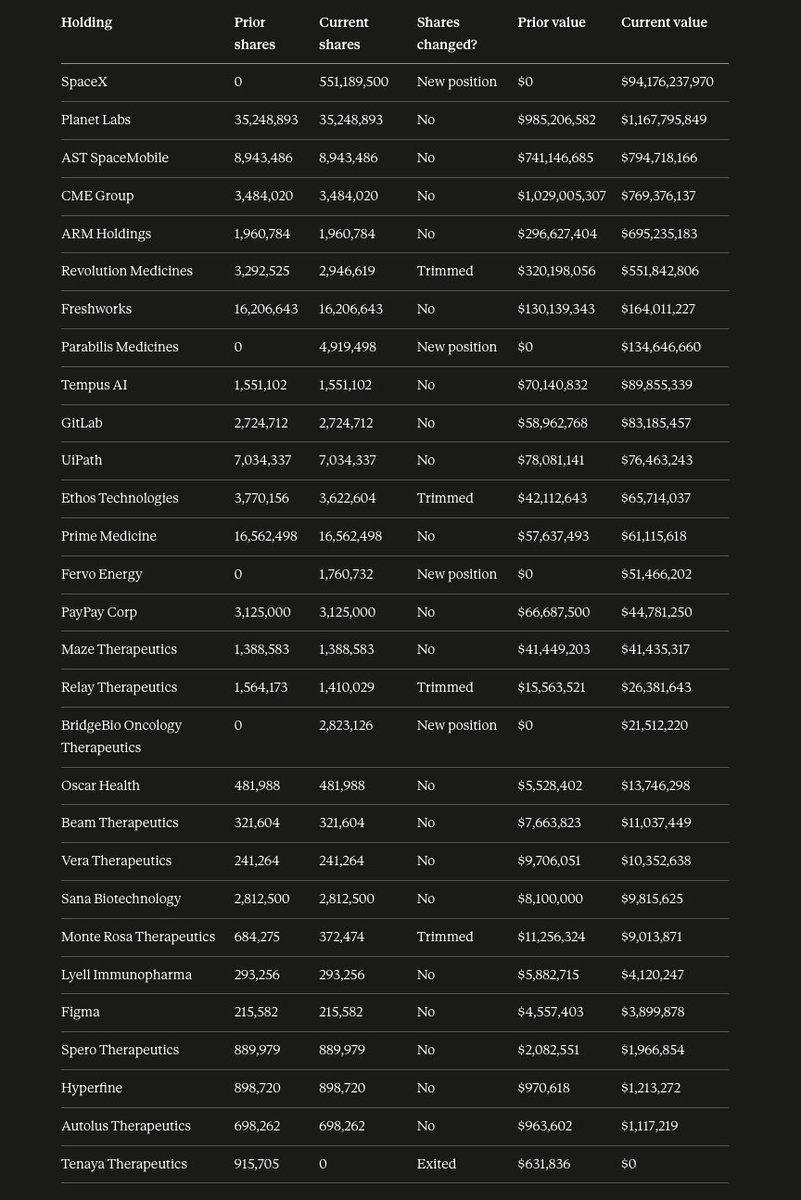
$SPCX
I already gave this one to Discord members, but here is a Stage 2 Breakout on the daily time frame with the first green Dot on the entire chart! 🟢🔥
I hope you all enjoy your weekend, and give this video a like a repost if you want to see more of them! 😎
Don't waste 2 years learning to use LLMs like Claude & ChatGPT.
Andrej Karpathy one of the clearest minds in AI just released a 2‑hour breakdown of how he actually uses LLMs every day.
• 00:00 — LLMs, explained like you’re busy
• 22:49 — picking the right model (for real)
• 42:00 — the single prompt that powers deep research
• 1:13:57 — writing code with LLMs without the chaos
• 1:37:04 — turning NotebookLM into a podcast machine
If you watch this end to end, you’ll walk away with more practical LLM skill than many “AI engineers” collect over years.
Save it. Carve out two hours today—no excuses. Then hit the article below.
This is the most disruptive thing I've come across in a while.
An AI agent spots an opportunity that might only last minutes. Seizing something that fast has always been impossible for us, because it would mean raising money, forming a company and hiring people, none of which happens in minutes.
But an agent doesn't need any of that. It can raise capital from other agents in seconds, spin up specialist sub-agents to handle the borrowing, staking and hedging, capture the trade, split the profit, and then dissolve the whole thing back into nothing before you’ve taken your dog out.
It's fucking insane.
This is what the invisible economy rewrites. Not just how fast money moves, but the fact that you’ll no longer need to build anything to capture an opportunity.
all done with nothing but deepseek flash 0731
reverse engineered the animation system
built my own renderer on top of it
set up debug views so i can understand what makes it so magical
Power is THE binding constraint.
Data centers are being shut down, GPUs are sold out, models are being commoditized and spot rates are rising all leads to power being critical. Not fanciful plans for power, future forecasts of BTM or distributed batteries blah blah blah but energized power today.
This means the following hierarchy is developing from greatest to least value:
1. Hyperscaler
2. Neocloud
3. Model maker
Ideally, you are 1+3 (Google, SpaceX, Meta) where you own massive power today and have a leading set of models to keep API pricing from 3rd parties honest enough to benefit them vs the model maker. But even if you are just (1), you can still extract great economics from (3) because owning the power is the leverage.
This means (2) needs to scale up fast. If Neoclouds do not scale up fast and move up the value stack towards hyperscalers (solely measured by energized compute online today) they are going to leave a lot of revenue on the table which will complicate their long term financing plans.
Also, starting now, a neocloud’s real competitors will be well capitalized frontier model companies who will do sweetheart deals with (1) and/or will vertically integrate and try to become (1). You can see this in the fact pattern (Ant+AWS, OAI+Stargate).
Get your hands on power.
It’s the spice.
Marketing agents are the new coding agents and every marketing channel is RED ocean now because AI slop FLOODED all of them
How to actually build marketing agents that work (2 real examples, all tools shared, 43 minute masterclass)
watch: https://t.co/cbsnZK031P
A 23-year-old employee just pulled over $6,000,000 out of a dying robotics company
The firm was on the brink of bankruptcy, their construction bots kept crashing, riddled with software errors
The hardware was solid, but the control logic was completely broken.
Instead of writing standard code, this junior dev used AI to rewrite the entire operating stack overnight
He gave the software to the company on one condition: a 3% equity royalty on every unit sold
4 months later, these bots dominated the market, and his 3% cut cleared over $6M
Wall Street's worst nightmare isn't regulation.
It's a GitHub repo.
Kronos. An AI trained from scratch on 12 billion candles from 45 exchanges, and it reads charts as a native language.
The numbers:
- 93% better at ranking price forecasts than the best time-series model that exists
- Zero-shot on any asset it's never seen. BTC, Nvidia, forex, whatever
- 4M parameters at the small end, so it runs on a laptop
- Peer reviewed at AAAI 2026
Banks survived 2008, the fines, the hearings... none of it mattered because the real moat was models nobody else had.
This repo is inside the moat. MIT license, weights on Hugging Face, free.
Star it before your fund manager does.
The biggest opportunities right now:
1. build for solving loneliness (the more AI floods everything, the more people crave real human connection, IRL and small social)
2. build for agents that need to spend money (they're getting virtual cards and budgets, someone builds the spend controls, fraud protection, receipts)
3. build for people drowning in AI output (everyone generates infinite drafts now, the bottleneck moved to reviewing and choosing, build the judgment layer)
4. build for the burnout economy (everyone is expected to always be on and always optimizing, and the backlash toward rest, slowness, and enough is building)
5. build for verifying humans (deepfakes broke trust, every dating app, marketplace, and video call needs proof-of-human within 2 years)
6. build for the physical world (the trades, hardware, robots that AI is finally reaching)
7. build for the agent that answers the phone (every local business misses calls after 5pm, a voice agent that books the job is worth thousands a month)
8. build for the aging (70M+ boomers who want to stay healthy, sharp, and connected)
9. build for the LLM-search land grab (being the cited answer is the new SEO)
10. build for the newly automated (the paralegal, the analyst, the marketer whose job just changed and needs to reskill fast)
11. build for the seat-pricing collapse (software repricing from $50/seat to per-outcome, whoever nails outcome billing wins a category)
12. build for AI enablement (95% of businesses use nothing beyond ChatGPT, someone has to onboard the other 95%)
13. build for the agency everyone resents (businesses pay $1k/mo to agencies they hate, an agent that does 80% of it undercuts the model)
14. build for verticals on 2011 software (dentists, HOAs, contractors, all overdue for an AI-native rebuild)
15. build for reviving dead software (thousands of abandoned apps with real users, agents can maintain what a team couldn't, buy and revive)
16. build for markets too small to matter before (500 lobster fishermen was never worth a team, now it's a weekend and a real business)
17. build for agents hiring agents (a shadow economy is forming, it needs escrow, reputation, and dispute resolution for machines)
18. build for the anti-AI premium (as everything gets generated, human-made and analog become status symbols people pay up for)
19. build for distribution-first (anyone can build the product now, so the audience is the moat, media company first, product second)
20. build for the reinvention of college (what does an MBA even mean anymore)
21. build for a world with more free time than it knows what to do with (if AI takes the busywork, the question becomes what people do with the hours, and that's a civilization sized market)
note: more trends/ideas @ideabrowser (free to sign up)
22. build for the return to the physical (screens fill with slop, people crave the real world, the hands-on, the local, the analog)
23. build for the caregiving wave. The population is aging fast, tens of millions are caring for parents, and the whole burden is landing on families with no support.
24. build for the longevity shift (people want to live to 100 healthy, and a whole industry is forming around actively managing your own biology)
25. build for the housing and rootlessness problem (people can't afford to settle down, and the whole idea of a stable home base is up for grabs)
26. build for spiritual hunger (as institutions hollow out, the need for meaning, ritual, and belonging is exploding into new forms)
KEEP BUILDING
Here is my AI investing guide.
Sitting here August 2026, my current best thoughts are as follows:
1. LPS (Land Power Shell) is still the most obvious and fastest path to cash on cash returns. Lots of value can be assembled and traded quickly at this layer. And as data centers get more pushback, energized land can explode in value. Very bullish here.
I’ve stepped into this layer very aggressively. My partner @anitavlallian and I have acquired almost 6GW coming online in a ramp from today thru 2029 of grid power and behind the meter.
2. Silicon - I helped get @GroqInc off the ground in 2015 and we licensed it to @nvidia for $20B Dec2025. I won’t invest or incubate anything in this layer now. The perf demands of the chips are too high, manufacturing precision is too complex and supply chain influence to get adjacent components like memory isn’t possible for a startup anymore. Lots of capital will be wasted here chasing Groq and Cerebras’ success. Note that both startups made sense a decade ago when these constraints were much more modest.
3. Clouds - Clouds are very very lucrative but very hard to build and very expensive and technically complicated to maintain. And as alignment becomes a more important issue, I expect the clouds will be asked to build robust KYC and attest to it. This makes the risk:reward ratio skewed. I don’t want to be responsible when the USG says a cloud allowed a bad actor to do something bad because of poor KYC.
4. Models are complicated. The big open question is how much of the revenue being generated by them today is because of tokenmaxxing and poor model behavior. If it’s a lot, then the annualized revenues will diminish meaningfully even as token consumption inflects upwards. This is the big economic question at this layer.
5. Harnesses are where the action is and why I started @8090solutions two years ago. In a nutshell, the harness helps enterprises owns their proprietary context (what Alex Karp calls their ‘alpha’). This is an enterprise’s data, workflows, evals, and business rules. A harness that gives this to an enterprise is what creates very low model-agnostic switching costs, which further reinforces my views of #4 above.
6. Applications will be another long term winner along with harnesses. This is where the differentiation between “off the shelf” and “custom time and materials” melts away. Every company, with the right harness, can now imbue their alpha into the software that runs their company. I expect this to mean that “off the shelf” is largely replaced with custom software creating a huge opportunity to write these solutions for companies. Build once and sell repeatedly is a laggard GTM motion for a SaaS world that isn’t needed here. Think custom by design, alpha embedded, proprietary by nature.
Fin.
Good luck to all the players!
Third-person open-world adventure game, PSP-era aesthetic, gameplay footage. Playable character is a brown stag with small antlers, seen from behind. The stag wades out of a glowing turquoise glacier lake and walks up onto a dirt path leading into a sunlit pine forest. Golden-hour sunlight streams through tall evergreen trees, warm lens flare on the horizon, soft god rays, water dripping and rippling off the stag's legs as it steps onto shore.
Camera: dynamic third-person follow-cam, slightly behind and above the stag, gentle handheld sway, subtle motion blur, cinematic depth of field with softly blurred background trees.
Environment: stylized semi-realistic 3D, Zelda-BOTW-meets-Ōkami vibe — cartoon-proportioned wildlife, painterly foliage, chunky rocks, mossy logs, scattered bushes, distant misty mountains. Rich saturated colors, warm orange-and-teal palette.
Game HUD overlay (keep on screen the whole clip): top-left a row of red heart icons plus a blue-and-orange stamina/breath bar; top-right an inventory bar showing two rabbit icons, an acorn icon, and a rabbit portrait; bottom-left a circular minimap with a winding river, quest markers and a compass. Clean wooden-framed UI, soft drop shadows.
Action: the stag trots forward along the path, a white rabbit darts ahead into the trees, the deer follows, small acorns and collectible sparkles scattered on the ground.
Style tags: real-time game engine render, 30fps gameplay capture, PSP/PS2-era polish, cozy exploration RPG, volumetric light, ambient occlusion, no text captions, no watermark, 16:9.