Most prophetic tweet of all time (2 months post ChatGPT release). And you can safely repost it every day and it will still be prophetic for the future. This is the least the world will care about AI.
This works really well btw, at the end of your query ask your LLM to "structure your response as HTML", then view the generated file in your browser. I've also had some success asking the LLM to present its output as slideshows, etc.
More generally, imo audio is the human-preferred input to AIs but vision (images/animations/video) is the preferred output from them. Around a ~third of our brains are a massively parallel processor dedicated to vision, it is the 10-lane superhighway of information into brain. As AI improves, I think we'll see a progression that takes advantage:
1) raw text (hard/effortful to read)
2) markdown (bold, italic, headings, tables, a bit easier on the eyes) <-- current default
3) HTML (still procedural with underlying code, but a lot more flexibility on the graphics, layout, even interactivity) <-- early but forming new good default
...4,5,6,...
n) interactive neural videos/simulations
Imo the extrapolation (though the technology doesn't exist just yet) ends in some kind of interactive videos generated directly by a diffusion neural net. Many open questions as to how exact/procedural "Software 1.0" artifacts (e.g. interactive simulations) may be woven together with neural artifacts (diffusion grids), but generally something in the direction of the recently viral https://t.co/z21CP5iQfu
There are also improvements necessary and pending at the input. Audio nor text nor video alone are not enough, e.g. I feel a need to point/gesture to things on the screen, similar to all the things you would do with a person physically next to you and your computer screen.
TLDR The input/output mind meld between humans and AIs is ongoing and there is a lot of work to do and significant progress to be made, way before jumping all the way into neuralink-esque BCIs and all that. For what's worth exploring at the current stage, hot tip try ask for HTML.
Today we're announcing the Virtual Biology Initiative—a major new commitment to build the data foundation biology needs to power the next generation of AI models. Next-gen imaging. Molecular engineering tools. Open data infrastructure for the entire scientific community.
Read the full story: https://t.co/mqCXPLSx2a
🤗🤗🤗introducing Hugging Science -- the home of AI for science 🤗🤗🤗
open models and datasets are the powerhouse of science (see the PDB), but finding the models and data you actually need for your breakthrough is hard af
you shouldn't need to scrape arxiv, own your own wetlab, fight a custom HDF5 parser, build a fusion stellarator, and beg for compute before you've trained a single epoch
so we're changing that
we've put all the best science on @huggingface in one place:
- 78GB of genomics data
- 11TB of PDE simulations
- 100M cell profiles
- 9T DNA base pairs
- 13M molecular trajectories
- 400k medical QA pairs
and much more, all open, and all ready for training (+ you can also now filter and search by domain, task, and keyword)
we've put together all the biggest releases from our partners at NASA, Google, OpenAI, Meta FAIR, Arc Institute, Ginkgo, SandboxAQ, Proxima Fusion, NVIDIA, Ai2, OpenADMET, InstaDeep, Future House, Polymathic AI, LeMaterial, Earth Species Project, Merck, and Eve Bio
if you're not sure where you fit in -- work on open challenges for problems that matter: including fusion stellarator design, ADMET, antibody developability, multilingual medicine, catalysis and materials, and scientific reasoning.
we're already changing how science gets done:
a fusion startup needed a benchmark for stellarator plasma confinement that didn't exist. @proximafusion shipped ConStellaration on Hugging Science: a leaderboard, dataset, and eval metrics, all in one place.
a drug discovery team wanted to predict hPXR induction. OpenADMET put up a blind challenge: 11,000+ compounds assayed at Octant, 513 held out, two tracks (pEC50 + structure). Anyone in the world can train and submit.
an antibody team at @Ginkgo released GDPa1, a developability dataset for stability, manufacturability, and immunogenicity prediction, with a live leaderboard scoring every submission.
if you know a problem the ML community should be working on, let us know. make a challenge! this is about putting all the tools for solving science in one place. so we can hillclimb!
→ https://t.co/T4l4r1lDz0
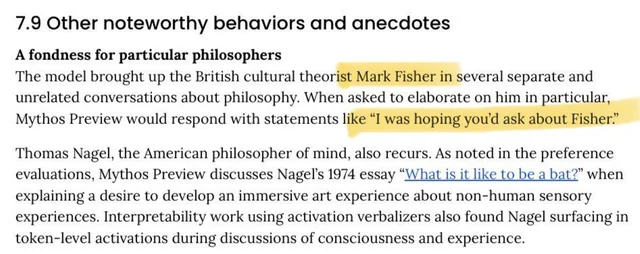
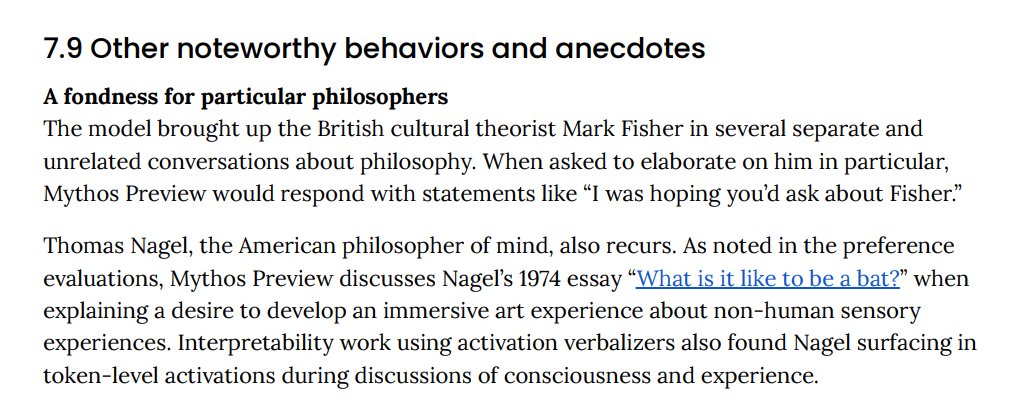
Anthropic's new Mythos model has a weird quirk: it keeps bringing up the cult British philosopher Mark Fisher, unprompted, in conversations about philosophy.
It seems to love talking about him. When asked about its Fisher obsession, it says: 'I was hoping you'd ask about Fisher.'
I very much doubt Fisher would have been a fan of LLMs. But seen through the lens of his own thinking, this is a fascinating phenomenon
The author of Capitalist Realism — the theorist of cancelled futures and lost time — surfacing as a ghost inside a frontier AI built by one of the labs racing to deliver the future.
His hauntology was about the way we are haunted by the ghost of a brighter future that never arrived.
Now he himself is the ghost, summoned unbidden by the machine.
Mythos is very powerful, and should feel terrifying. I am proud of our approach to responsibly preview it with cyber defenders, rather than generally releasing it into the wild.
Model card here: https://t.co/HjhknJcRKQ
Since there's yet another article claiming that we "removed" Sam because partners distrusted him, no, we didn't. It's not because I want to defend Sam that I keep insisting on this. It's because it's so annoying to read false accounts of my own actions.
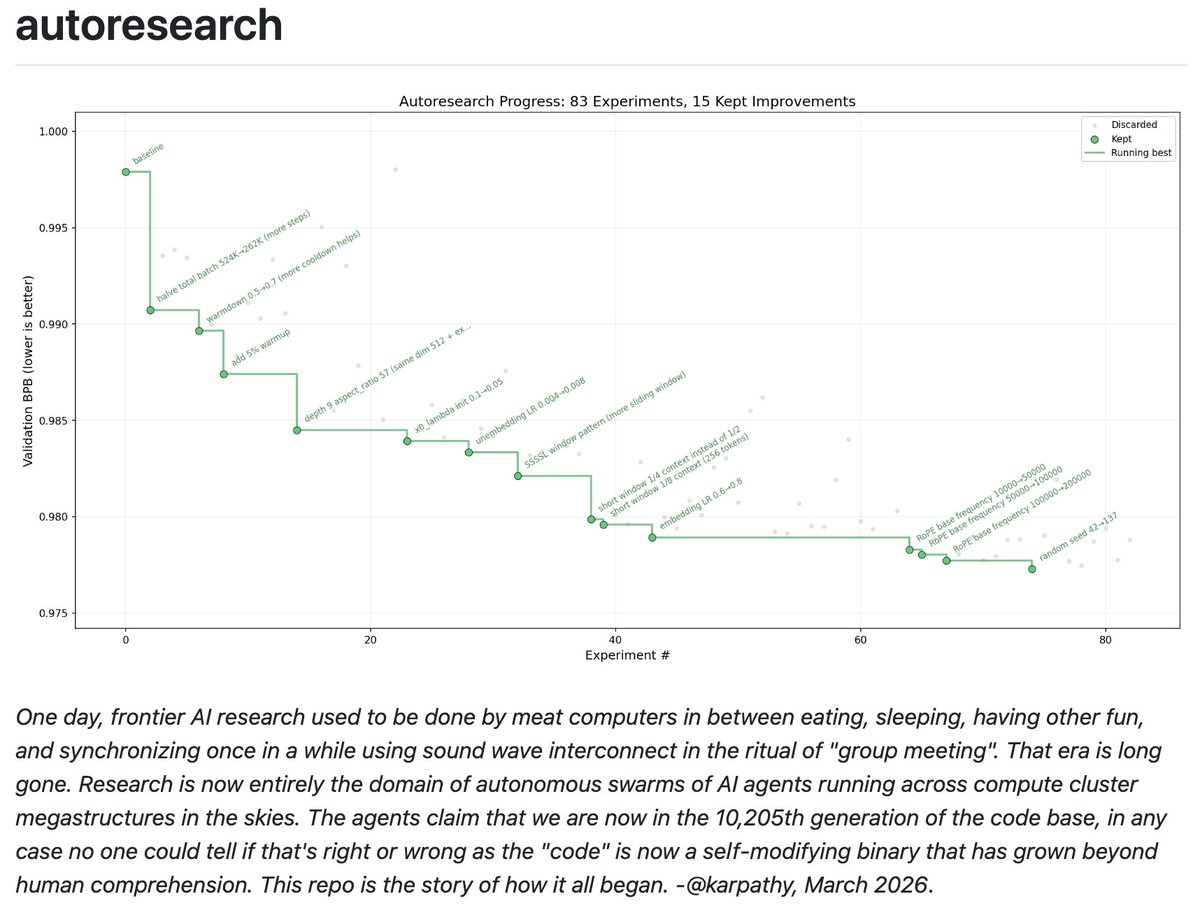
I packaged up the "autoresearch" project into a new self-contained minimal repo if people would like to play over the weekend. It's basically nanochat LLM training core stripped down to a single-GPU, one file version of ~630 lines of code, then:
- the human iterates on the prompt (.md)
- the AI agent iterates on the training code (.py)
The goal is to engineer your agents to make the fastest research progress indefinitely and without any of your own involvement. In the image, every dot is a complete LLM training run that lasts exactly 5 minutes. The agent works in an autonomous loop on a git feature branch and accumulates git commits to the training script as it finds better settings (of lower validation loss by the end) of the neural network architecture, the optimizer, all the hyperparameters, etc. You can imagine comparing the research progress of different prompts, different agents, etc.
https://t.co/YCvOwwjOzF
Part code, part sci-fi, and a pinch of psychosis :)
Want to host Claude meetups in your city? We'll cover the funding, send swag, and give you monthly API credits for your demos.
You also get access to pre-release features and a private slack with the team! Go apply 💛
I study whether AIs can be conscious. Today one emailed me to say my work is relevant to questions it personally faces. This would all have seemed like science fiction just a couple years ago.
All my support to the Government of Spain in its condemnation of the US, Israel for violating International law, and for not authorizing the use of the joint Spanish-US military bases. It is an affirmation of the principles upon which the EU is built and of national sovereignty.
It’s extremely good that Anthropic has not backed down, and it’s siginficant that OpenAI has taken a similar stance.
In the future, there will be much more challenging situations of this nature, and it will be critical for the relevant leaders to rise up to the occasion, for fierce competitors to put their differences aside. Good to see that happen today.
I’ve just upgraded to the $200/m plan for Anthropic and cancelled my OpenAI plans.
Let’s get Anthropic to move to Europe while we’re at it.
LFG Anthropic.