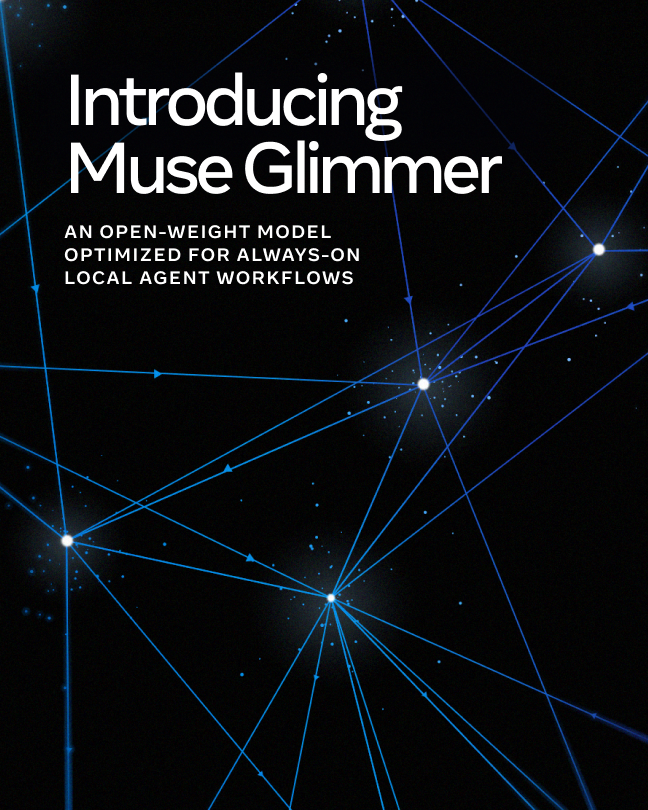
Today we published a technical report on Muse Glimmer, our 30B open-weight model built for agentic tasks on consumer hardware.
It runs at practical speeds on a Mac or PC with a single consumer GPU at 4-bit precision, and leads comparably-sized open models on tool use and multi-step planning.
Read about the model architecture, distillation recipe, quantization and more: https://t.co/H7n9qeDhxn
Today we're also opening the weights for Muse Glimmer, a great 30B parameter dense model that can run locally. Soon we'll also release the weights for Muse Spark 1.2, our latest foundation model. Meta is a strong supporter of open source and I'm proud of these releases. Congrats to @alexandr_wang and the MSL team for all your great work on these models.
Introducing Muse Glimmer, an open-weight 30B-parameter model optimized for local, always-on agent workflows.
Muse Glimmer delivers strong performance on key agentic use cases and benchmarks compared with leading models in its size category, and is designed to run entirely on consumer hardware like a Mac or PCs with performant GPUs.
In keeping with our long tradition of sharing fundamental AI research, we’re releasing model weights under a permissive Apache 2.0 license.
🧵👇
To understand whether we're making genuine progress on reasoning, we entered our AI models in five STEM Olympiad competitions.
The results:
🏅 Asian Physics Olympiad (APhO): Perfect score, theory exam
🏅 International Physics Olympiad (IPhO): Perfect score, theory exam
🥇 International Mathematical Olympiad (IMO): Gold medal
🥇 International Chemistry Olympiad (IChO): Gold-medal-level performance
🥇 Romanian Masters of Mathematics (RMM): Gold-medal-level performance
The types of problems in the Olympiad competitions are exceptionally hard, demanding deep chains of reasoning, creative insight, and flawless argumentation. To test pure reasoning capability, we disallowed all tool use, meaning no search, no coding, and no calculator.
We have deep admiration for the contestants and committees behind these competitions, and are grateful for their support in enabling our participation.
We’ve been working on verified imperative code generation. WybeCoder co-evolves code, invariants, and proofs in a hybrid SMT + Lean loop, bringing mathematical guarantees to AI-generated software.
Check out our paper 👀
https://t.co/FJ9j3xQVJf
Worried about Anthropic's Mythos? Fully formally verified code generation is the defense.
Combining Lean, frontier models, multi-agent scaffolds, and inference scaling, we show <12mo benchmarks jumping from 20% to 70%.
Real-world verification is here.
https://t.co/ADGXmJOLlZ
1/
We're going around the Moon. Come watch with us. Artemis II's four-astronaut crew is lifting off from @NASAKennedy on an approximately 10-day mission that will bring us closer to living on the Moon and Mars. The launch window opens at 6:24pm ET (2224 UTC). https://t.co/X27QJejNDt
🚨 Attention aspiring PhD students 🚨
Meta / FAIR is looking for candidates for a joint academic/industry PhD!
Keywords: AI for Math & Code. LLMs, RL, formal and informal reasoning.
You will be co-advised by prof. @Amaury_Hayat from ecole des ponts and yours truly. You'll have the opportunity to collaborate with the excellent FAIR codegen team and fellow FAIR PhD students in Paris, have access to state of the art pre- and post-training infra, and significant amounts of compute. A joint industry / academic PhD gives you the best of both worlds: academic freedom, open science & open source, a ton of compute, and talented colleagues working as a team.
Ideal candidates should have strong engineering & experimentation skills, strong math skills, and a solid understanding of ML & RL foundations.
We want to move fast so apply ASAP at the link below!
Overall, dynamic tokenization improves inference speed, promotes fairness across languages, and enables more adaptable LMs.
Check out the paper & code:
📄 Paper: https://t.co/BRQQMwzQUO
💻 Code: https://t.co/LDqyZEm2Ip
Excited to share that our paper "Retrofitting Large Language Models with Dynamic Tokenization" won a SAC Highlights Award at #acl2025.
This work was done during my MPhil at @Cambridge_Uni, under the supervision of Benjamin Minixhofer and Ivan Vulić.
More in 🧵
Our approach works without retraining the LLM.
⚡ Encoders (e.g., XLM-R): >20% shorter sequences across 14 languages, <2% accuracy drop
⚡ Decoders (e.g., Mistral-7B, prefilling/scoring): up to 17% shorter sequences, minimal degradation