We are pleased to announce that we have reached a tentative agreement with a physical gold exchange provider to facilitate pmUSD redemptions.
Subject to finalization, this arrangement is expected to enable redemptions commencing during the first week of July. In parallel, our team is actively working to accelerate the implementation timeline, with the objective of making redemption functionality available within the next 30 days.
At this stage, the identity of the counterparty will remain confidential pending the execution of definitive binding agreements and completion of all required legal, regulatory, compliance, and onboarding procedures.
Further details will be disclosed once the relevant arrangements have been formally finalized and all applicable requirements have been satisfied.
RAAC Team.
@Fo_Cryptoo@Raacfi The Pharo report is flawed. Here is something this fear monger failed to tell you. He slams IONI for being on the OTCQB. Yet they announced they are uplifting to the NASDAQ. See: https://t.co/AffgOmCj4z
I pointed this out so Pharo blocked me.
$pmUSD @Raacfi team dropped an update earlier today and it’s all green flags 🟢
✅ Redemption pathway being finalised date dropping in days.
✅ Liquidity partners injecting capital into Curve pool.
✅ Gauge voting fully active, APR incentives intact.
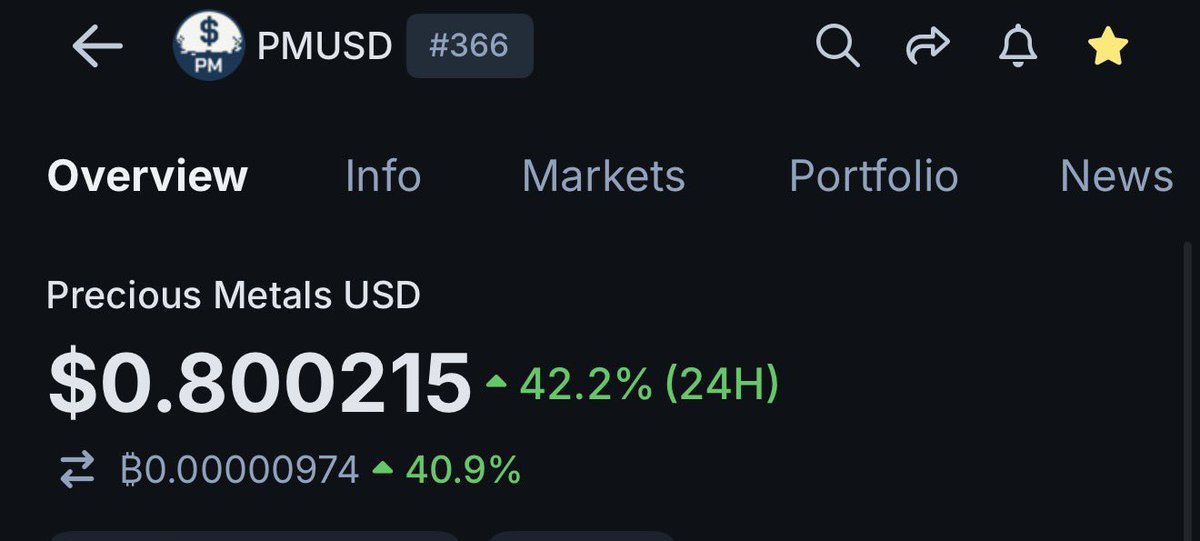
Oh and the peg? Already back to $0.80 📈
Buy at $0.80, re-peg to $1.00 = 25% gain just from the peg restore 📈
I-ON Announces Development of Structured Redemption Framework for IONau
I-ON is moving forward with the development of a structured redemption framework that takes a foundational step toward expanding the utility and liquidity profile of IONau.
This initiative is currently in development and is not yet operational. When implemented, the framework is intended to provide holders with defined pathways for converting IONau into physical gold or cash equivalents, subject to applicable terms, counterparty arrangements, jurisdictional requirements, and regulatory approvals.
We welcome the opportunity to provide additional context on both the specific claims raised and the broader diligence framework that governs every asset on our platform.
I-ON's onboarding process for gold reserves is deliberately multi-layered and does not rely on any single report or signatory. Before an asset is admitted, it passes through independent workstreams covering legal diligence, title and chain-of-custody verification, lien and encumbrance searches, confirmation of mineral, land, and water rights, third-party technical attestations, and metallurgical validation. Each layer is designed to function as an independent check, so that the integrity of the overall record does not depend on the standing of any one professional or document.
Within that framework, the underlying NI 43-101 technical reports relied on for these claims were prepared in 2013 under the oversight of an accredited Professional Geologist serving as the Qualified Person, who independently reviewed and signed the reports. The reserve data has further been supported by more than 1,000 independent metallurgical lab tests and assays, which corroborate both the composition and the volumetric estimates of the underlying material.
Regarding the disciplinary matters referenced in connection with the P.Eng: those proceedings relate to events occurring in 2021 and are completely unrelated and separate from the technical work performed on I-ON’s claims and behalf in 2013. The technical work performed on I-ON’s claims in 2013 was overseen, reviewed and signed off by a supervising Professional Geologist and Qualified Person.
Consistent with our standards and industry practice, all claims held by the Company are subject to periodic NI 43-101 renewal, with the next scheduled update for these specific claims planned for 2026-2027.
For additional context on scale: the IONau collateral supporting the pmUSD mint represents less than 1% of I-ON's total reserves, providing a substantial overcollateralization buffer within the broader DeFi structure.
We remain committed to transparency, rigorous validation, and ongoing disclosure consistent with applicable regulatory guidance, and we are happy to address any further questions.
THEY DID IT.
The SEC and CFTC just dropped a landmark document that officially classifies crypto assets.
They're actually telling us which crypto assets are securities and which ones aren't - by name!
THIS IS SOMETHING GENSLER REFUSED TO DO
(he focused on prosecuting crypto out of existence)
This rule doc gives crypto many of the benefits of the clarity bill - it lifts us out of the gray market - it gives every asset a path.
It's almost like the Clarity act just passed by way of regulator.
(of course, the actual clarity act will harden all this into legislation and make it irreversible in the event we get another Gensler, we still want it)
This rule says there's 5 categories for crypto assets:
1) Digital Commodities - assets tied to a functional, decentralized crypto system (e.g., BTC, ETH, SOL, XRP, ADA, DOGE). Not securities. (yes, they name them on page 14)
2) Digital Collectibles - NFTs, meme coins, artwork tokens, in-game items. Not securities (fractionalized collectibles may be an exception).
3) Digital Tools - membership tokens, credentials, domain names (e.g., ENS). Not securities.
4) Stablecoins - payment stablecoins under the GENIUS Act are not securities. Other stablecoins, it depends.
5) Digital Securities - tokenized versions of traditional securities. Like tokenized stocks. Always securities.
Amazing! This makes so much sense I can't believe it's coming from a regulator.
No more enforcement threats to Ethereum developers and crypto exchanges.
How about the Howey test?
More common sense! If an issuer makes specific promises of managerial efforts from which buyers expect profits, the offering is a security until those promises are fulfilled. Then it's a commodity. The asset itself was never the security, the deal around it was. (E.g. XRP was a security pre launch, became a commodity after).
How about stuff like staking and mining?
Mining? Not a securities transaction.
Staking? Also not a securities transaction, that includes custodial and liquid staking even with LSTs!
How about wrapping BTC? Not a securities transaction.
Airdrops? NOT SECURITIES. NO MORE GEO BANS PROTECTING AMERICANS from free airdrops.
Remember this is a joint doc from the SEC and CFTC, They're actually cooperating on this, no internal strife, this is binding to both.
SEC regulates $80-100 trillion assets
CFTC regulates $5-10 trillion assets
Both of the world's largest capital markets are showing us that crypto assets are here to stay and they're welcome alongside traditional assets.
Every country will follow.
This is the biggest move toward legitimacy I've seen in all my time in crypto. Maybe bigger than the genius act since is covers all crypto assets.
Well done @MichaelSelig and @SECPaulSAtkins.
And especially well done to the indefatigable @HesterPeirce. Her fingerprints are all over this, couldn't have happened without her eight years of principles-based curiosity.
I've been following @Raacfi for a while (got the early info as I hold multiple @WenLlama NFTs and picked up several of RAAC's Bot NFTs last year) and just read through the whitepaper, here's several takeaways:
-this is one of the first serious attempts by a DeFi native team to bridge TradFi RWAs into DeFi with minimal hand-waving
-the core idea: tokenize actual off-chain value (real estate, commodities) and turn it into stable, uncorrelated on-chain collateral and yield
-RAAC is built around two main pillars:
1.) RAACLend, focused on real estate. RAAC buys physical properties and issues REET NFTs that represent contractual rights to those assets. these NFTs can be traded, used as collateral to borrow crvUSD, or redeemed for the real-world title. for smaller users, there is iREET, an index token that gives fractional exposure to a diversified pool of real estate instead of forcing full property ownership
rental income isn’t just theoretical either, 80% of rent flows back into the ecosystem via secondary gauges to reward liquidity providers
2.) RWf(x), a set of legally isolated commodity “silos.”
each silo tokenizes a specific asset class (gold, farmland, oil), and risk is firewalled between them. think Silo for RWAs, or in this case f(x) for RWAs
the first live example is pmUSD, a gold-backed stablecoin issued via a partner that tokenizes precious metals
-tokenomics revolve around $RAAC, with veRAAC capturing governance + 80% of protocol fees and NFT royalties
-they also have leRAAC - a fork of clevCVX, a self-repaying wrapper that lets users pull forward future veRAAC yield without giving up governance power, a pretty DeFi-native innovation
-on the stability side, borrowing rates are anchored to the US prime rate (very TradFi-friendly), there’s a stability pool to absorb bad debt, and an explicit repair & maintenance fund for the physical assets
-the mental model is simple: RAAC is turning illiquid buildings and gold vaults into programmable on-chain collateral, while still funding the real-world upkeep behind the scenes
worth reading the full paper if you care about sustainable yield that isn’t just emissions
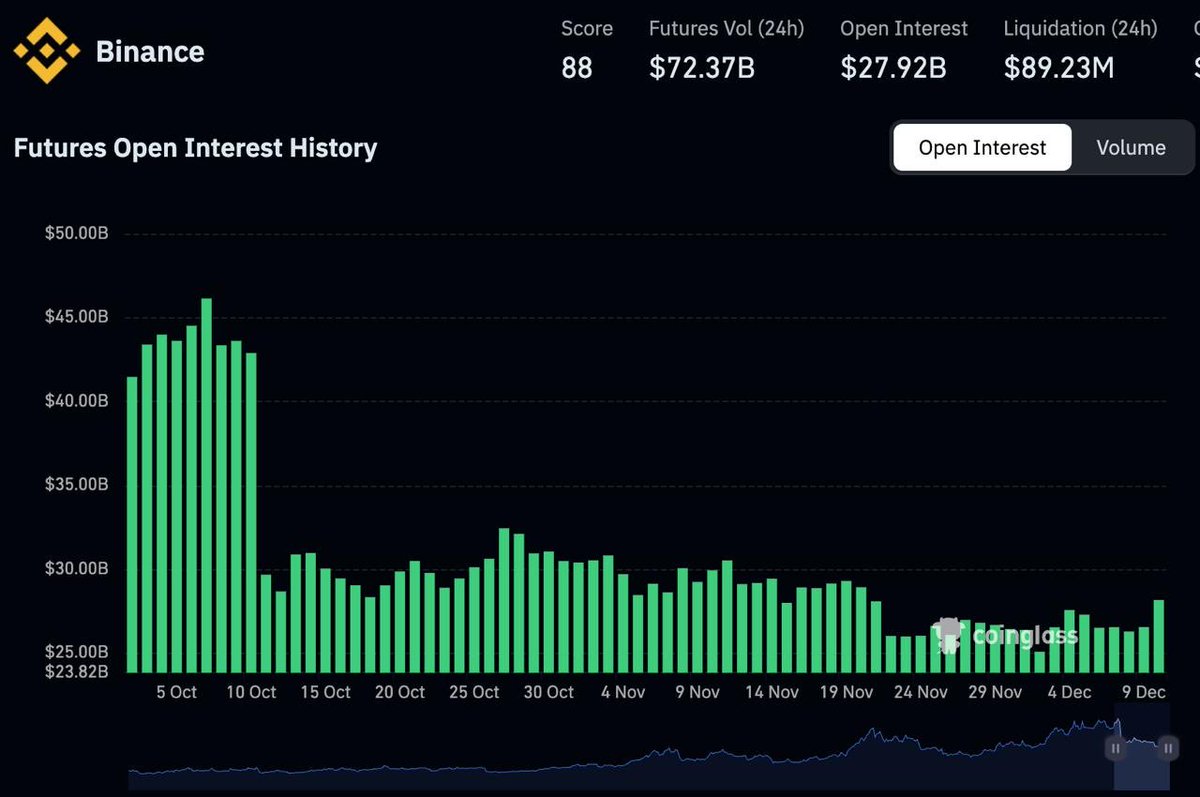
“We note that open interest post October 10, 2025 that suggests that Hyperliquid has lost nearly 50% of open interest, whereas competitors such as Lighter and even Binance have recovered to pre-event levels.”
??????
@Broly_222@Justickoolyn@HyperFND Ser you deposited into a sketch-ass protocol and devs rugged. Should have asked yourself where the yield was coming from.
Welcome to cryptology. 🤝