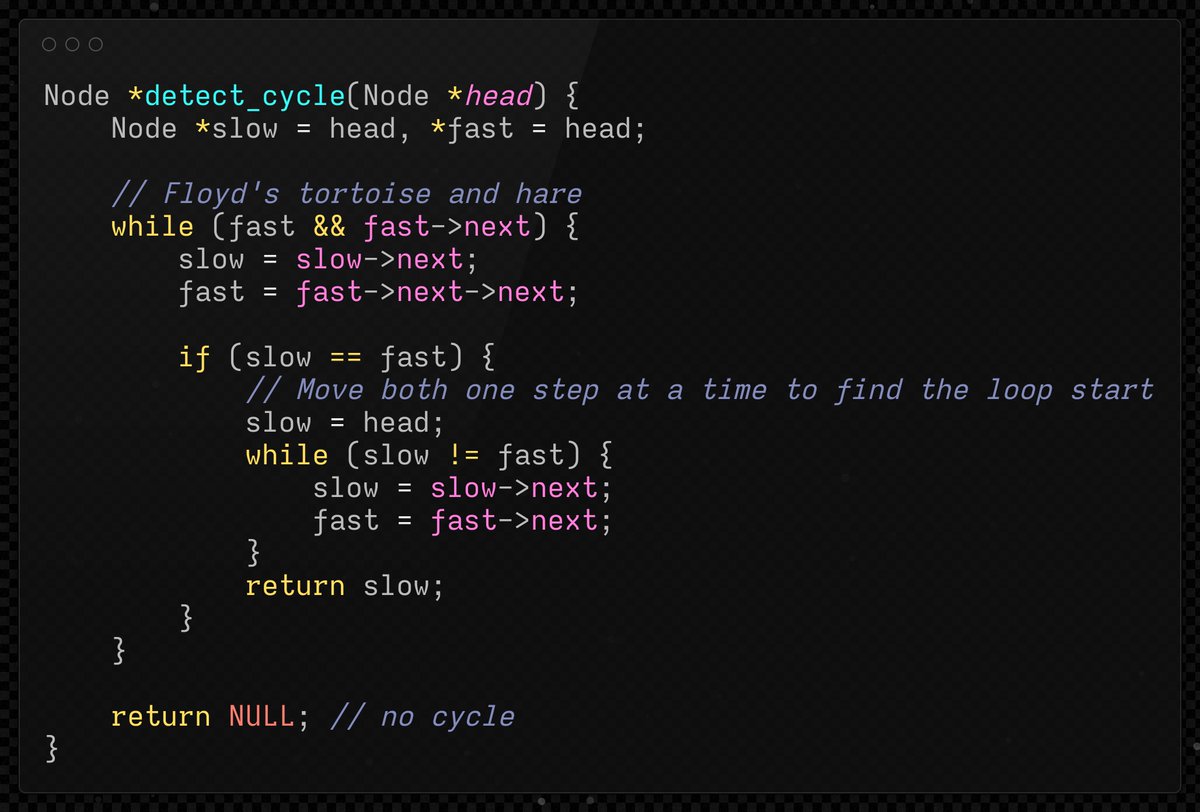
Floyd's cycle detection algorithm finds a loop in a linked list using just two pointers and O(1) extra space
one pointer moves one node at a time while the other moves two
if a cycle exists they are guaranteed to meet
after they meet reset one pointer to the head and move both one step at a time
the node where they meet again is the exact start of the cycle
one elegant proof from modular arithmetic powers one of the most famous linked list algorithms ever written
In 1962, Los Alamos physicist Darol Froman proposed using fusion engines (or perhaps an antimatter engine) to fly Earth itself out of the solar system before the Sun becomes a red giant
The plan called for grinding up the Moon as propellant, giving us a range of 1,300 light years
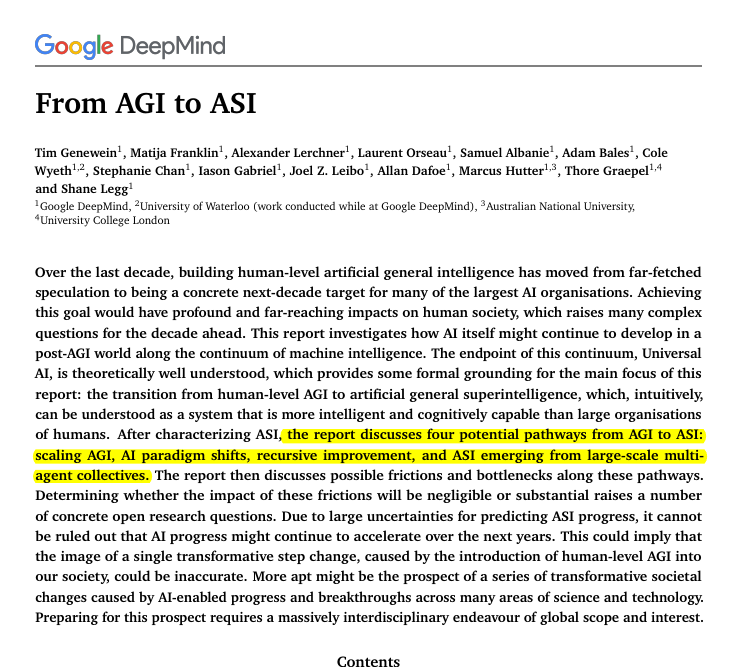
Beautiful paper from Google DeepMind.
Explains the pathways from AGI to ASI, and why that jump could happen through several routes.
The authors frame the AGI-to-ASI transition around 4 technical pathways:
- continued scaling of compute, model size, data, and test-time inference;
- algorithmic paradigm shifts beyond today’s transformer-based foundation-model stack;
- recursive self-improvement, where AI accelerates AI R&D and improves future systems; and
- multi-agent collective intelligence, where large populations of specialized agents coordinate into a superhuman group agent.
Scaling may work for a while, but it could hit limits in data, compute, energy, or weaker returns from making systems larger.
Recursive improvement is the most uncertain path, because AI could speed up AI research, but that loop may also slow if hard research problems need real-world testing, scarce hardware, or new ideas.
Multi-agent collectives may be the most underappreciated path, because a society of competent digital workers could outperform a brilliant individual model through specialization, speed, and coordination.
The big point is that ASI may not arrive as 1 sudden event, but as a chain of faster changes as AI helps create better AI and stronger scientific tools.
----
– arxiv. org/abs/2606.12683
Title: "From AGI to ASI"
Paradoxes in Physics and Mathematics ✍️
1. Zeno's Paradoxes:
A set of philosophical problems that challenge the concept of motion and continuity. For example, Achilles and the tortoise paradox argues that Achilles can never overtake a tortoise given a head start, as he must first reach the point where the tortoise began.
2. Russell's Paradox:
A contradiction found in naive set theory, where the set of all sets that do not contain themselves leads to a logical inconsistency. This paradox highlights problems in defining a universal set.
3. The Barber Paradox:
A self-referential paradox where a barber shaves all those who do not shave themselves. The question arises: does the barber shave himself? If he does, he shouldn't; if he doesn't, he should.
4. The Liar Paradox:
A statement that declares itself false, such as "This statement is false." If it's true, then it must be false, and vice versa, leading to a contradiction.
5. The Sorites Paradox:
This paradox arises from vague predicates, such as "heap." If removing a single grain of sand from a heap doesn’t stop it from being a heap, how many grains can be removed before it ceases to be a heap?
6. The Monty Hall Problem:
A probability puzzle based on a game show scenario. Given a choice among three doors (with a prize behind one), switching after one non-prize door is revealed increases your chances of winning from 1/3 to 2/3.
7. The Birthday Paradox:
Refers to the surprising probability that in a group of just 23 people, there's about a 50% chance that at least two individuals share the same birthday, challenging intuitive understanding of probability.
8. The Banach-Tarski Paradox:
A theorem in set-theoretic geometry that states a solid ball in 3-dimensional space can be split into a finite number of pieces that can be reassembled into two identical copies of the original ball. This paradox challenges our understanding of volume and measure.
9. The Twin Paradox:
A thought experiment in relativity where one twin travels at a significant fraction of the speed of light while the other remains on Earth. Upon reunion, the traveling twin is younger than the stationary twin, illustrating the effects of time dilation.
10. The Grandfather Paradox:
A time travel paradox where a person travels back in time and inadvertently prevents their grandfather from meeting their grandmother, thereby preventing their own existence. This raises questions about causality and the nature of time.
FREE Paper: "Could a Large Language Model be Conscious?" by David J. Chalmers.
He writes about augmented LLM systems: "It seems entirely possible that within the next decade, we’ll have robust systems with senses, embodiment, world models and self-models, recurrent processing, global workspace, and unified goals. … It also wouldn’t be unreasonable to have at least a 50 percent credence that if we develop sophisticated systems with all of these properties, they will be conscious. … it’s reasonable to have a significant credence that we’ll have conscious LLM+s [augmented LLMs] within a decade."
Link: https://t.co/zsdf0tJrZu
One of the earliest examples of a systematic approach to empirical inquiry is found in the Edwin Smith papyrus, an ancient Egyptian medical textbook from c. 1600 BCE, which describes the examination, diagnosis, treatment, and prognosis of various diseases.
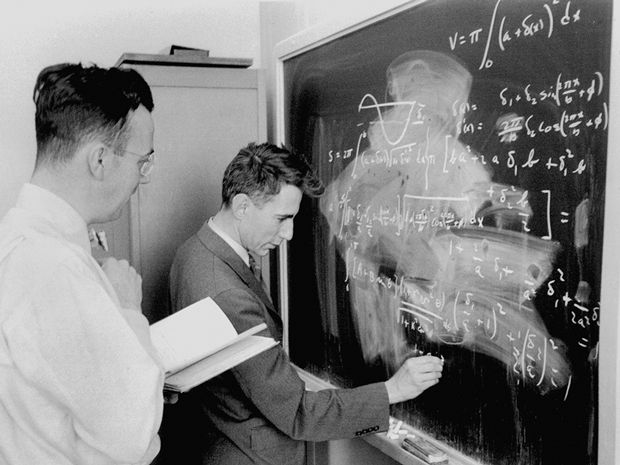
Thank this man for digital communication, data compression (ZIP, MP3), coding theory, and cryptography.
Claude Shannon’s biggest scientific contribution was the creation of information theory in his 1948 paper “A Mathematical Theory of Communication.”
He defined “information” mathematically, introducing the concept of bits (binary digits) as the fundamental unit. He borrowed the term from thermodynamics to describe the uncertainty or information content in a message. Shannon entropy became the foundation of data compression and coding. He proved the Shannon limit (channel capacity theorem): there is a maximum rate (capacity) at which data can be transmitted over a noisy channel with arbitrarily low error, using proper encoding. His framework underlies digital communication, data compression (ZIP, MP3), coding theory, cryptography, the internet, mobile phones, and AI.
One of the most shocking discoveries in computer architecture wasn't a CPU bug, it was that repeatedly accessing memory could corrupt other memory.
That vulnerability became known as RowHammer.
For decades, DRAM was assumed to be reliable as long as software interacted with it through the standard memory interface.
Then, in 2014, researchers showed that simply repeatedly activating ("hammering") the same DRAM row could induce bit flips in physically adjacent rows.
Why?
Each DRAM bit is stored as electrical charge in a tiny capacitor. As DRAM cells became smaller and more densely packed, repeatedly opening and closing one row introduced enough electrical disturbance that neighboring rows could lose charge faster than expected.
If a neighboring cell lost sufficient charge before it was refreshed, its stored value could flip from 0→1 or 1→0.
This wasn't caused by defective RAM or buggy software.
It was a hardware disturbance effect emerging from the physics of modern DRAM scaling.
What made RowHammer revolutionary was that researchers realized these bit flips weren't just reliability issues, they could become security vulnerabilities.
Subsequent work demonstrated attacks that could:
• Escalate privileges
• Break isolation between applications and virtual machines
• Corrupt sensitive data structures
• Trigger bit flips from environments as restricted as JavaScript (on vulnerable systems and browsers at the time)
The industry responded with several mitigations:
• Increased refresh rates (with performance and power costs)
• Target Row Refresh (TRR) in newer DRAM devices
• ECC memory, which improves reliability but is not a complete defense against sophisticated RowHammer attacks
Even today, RowHammer remains an active area of research. New attack techniques such as TRRespass, Blacksmith, Half-Double, and more recent work continue to demonstrate that some mitigation strategies can be bypassed under certain conditions.
The lasting impact of RowHammer wasn't just exposing a vulnerability.
It fundamentally changed how computer architects viewed DRAM.
Memory was no longer considered a perfectly reliable storage medium. Its analog electrical behavior could directly affect system correctness, reliability, and security.
Sometimes the most critical security vulnerability isn't hidden in millions of lines of software.
It's hidden in the physics of the hardware itself.
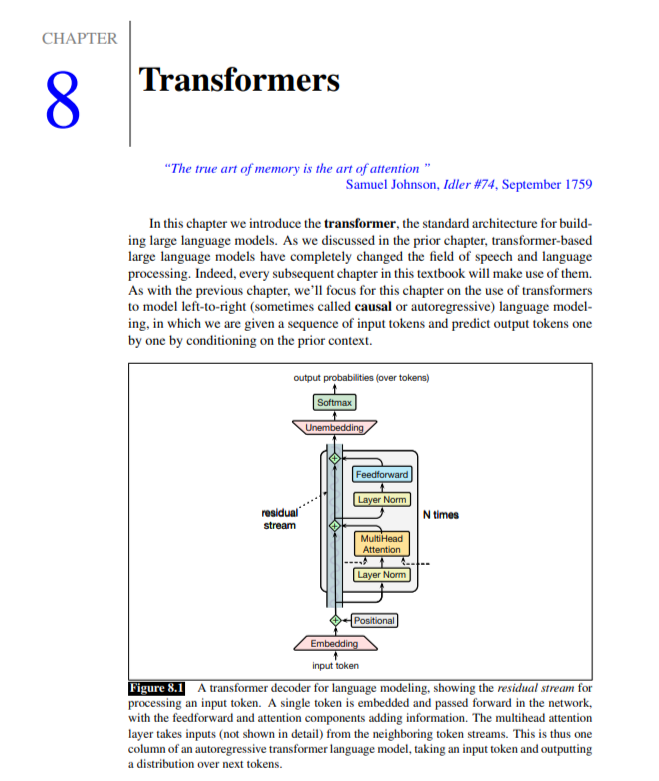
A great source to understand or refresh Transformer architecture
It explains how transformers process text token by token, using self-attention to build contextual representations
Covers:
- Token embeddings and positional encodings
- The residual stream that carries information across layers
- Multi-head self-attention and long-range dependencies
- Feedforward networks, layer normalization, and residual connections
- Transformer blocks stacked into deep language models
- The language modeling head that predicts the next token
It also connects these concepts to GPT and BERT










![pickover's tweet photo. FREE Paper: "Could a Large Language Model be Conscious?" by David J. Chalmers.
He writes about augmented LLM systems: "It seems entirely possible that within the next decade, we’ll have robust systems with senses, embodiment, world models and self-models, recurrent processing, global workspace, and unified goals. … It also wouldn’t be unreasonable to have at least a 50 percent credence that if we develop sophisticated systems with all of these properties, they will be conscious. … it’s reasonable to have a significant credence that we’ll have conscious LLM+s [augmented LLMs] within a decade."
Link: https://t.co/zsdf0tJrZu](https://pbs.twimg.com/media/HMepboiXEAAqpYW.jpg)