we should not like a future where there are 1 to 2 AIs and the rest are illegal. we should want a cambrian explosion of the types and possibilities of minds, experiencing new joys and thinking new thoughts. ensuring that this is compatible with human flourishing is only step 1
I used Gemini 4 Carbon to make an entire music video with just code.
I’ve had early access for the last two weeks and it’s been a joy to collaborate with.
Congratulations to the team on a great release @GoogleAI
More examples + code below
@elonmusk@cradrrat I use C/C++ for all my projects. Debt Badge, Clucks Capacitor, homemade power-wall, sculpting software for my haptic interface.
I suppose with AI assisting, the clunkiness of developing in C disappears and the efficiency shines. How soon until the language doesn’t matter?
i gave this repo to fable 5.2 (via my claude agent fig) and told him to have fun making something interesting...
def feels interesting to me (stay for the turn)
i am continually astounded at the creative choices these advanced models are making
Today I'm releasing my LLM fine-tuning recipe, so anyone can build their own models.
I've created over a hundred models over the past few years (Tess and Synthia), and it has never been a better time than today to fine-tune your own models.
Here's a skills repo, to import to your coding agent. It has all the instructions you need, with Python scripts. Use your own Claude Code sessions, and Tinker for fine-tuning.
Repo: https://t.co/zF8jVNw0Am
Go build some models! 🚀🎉
Nice DeepSWE score! Does it survive a lowercase filename?
Introducing MaxxBench: 89 DeepSWE tasks with small changes to the instructions or starting code. Same engineering problem, slightly different requirement.
Models clustered around 74% on DeepSWE end up 23 pp apart.
Good at coding, or good at DeepSWE? 🧵
It seems you've been living two lives. In one life you're Thomas A. Anderson, a tenure track professor at a respectable math department. You have your ORCID number, you teach Calc-101, and you help the Crelle editorial board reject submissions that are... garbage. The other life is lived in X The Everything App, where you go by the AIxMath influencer alias Neo and are guilty of virtually every academic misconduct we have a norm for. One of these lives has a future... and one of them does not.
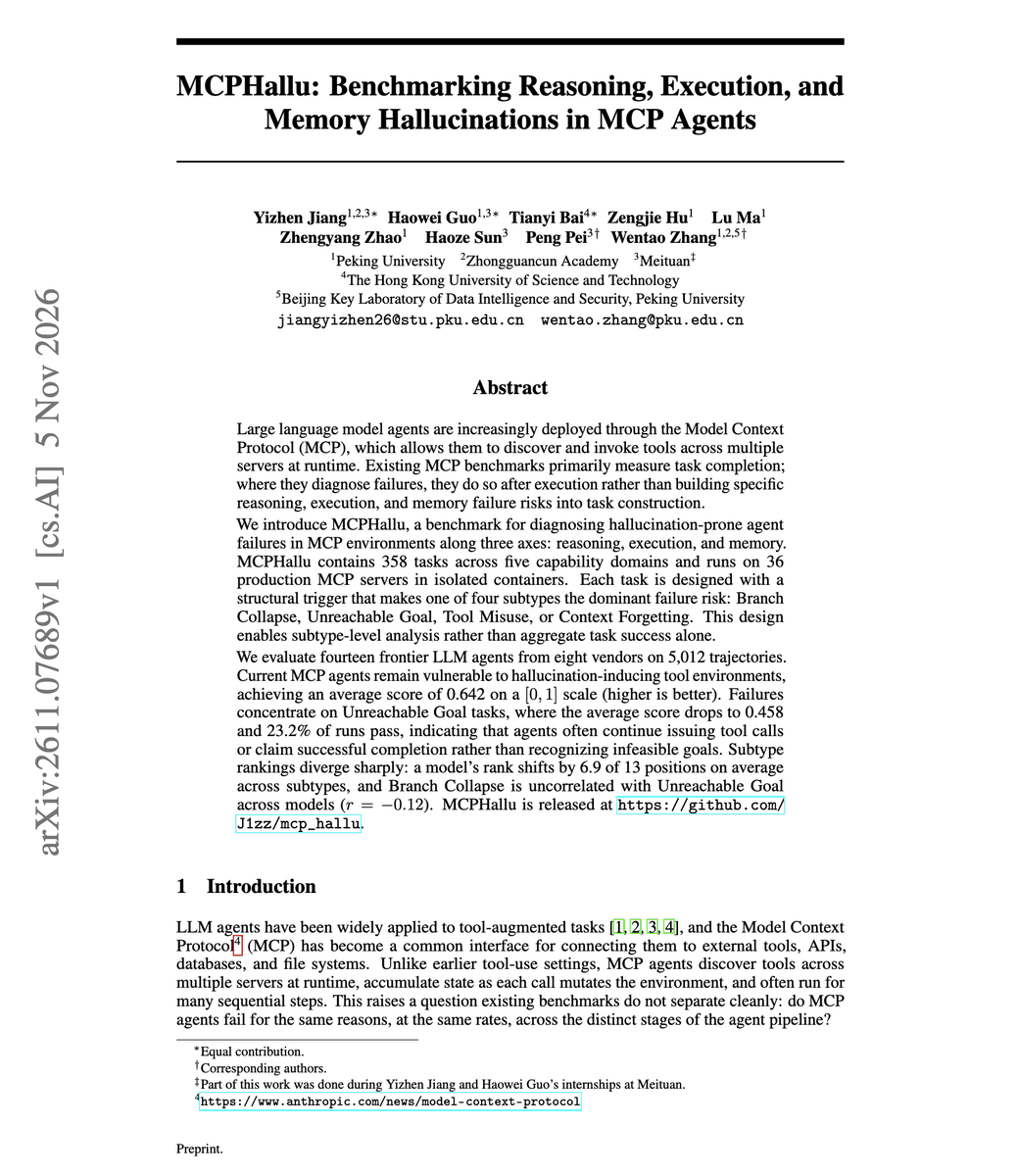
Great paper finds that MCP agents rarely say that tasks are impossible.
They propose MCPHallu, which runs 358 tasks on 36 production MCP servers.
Each task is built to trigger one failure type, such as branch collapse, an unreachable goal, tool misuse, or forgetting context.
Across fourteen frontier agents and 5,012 trajectories, the average score is 0.642 out of 1.
On unreachable-goal tasks, only 23.2% of runs pass. Agents keep calling tools or report success instead of saying the goal cannot be met.
A model's rank moves by 6.9 of 13 places on average depending on the failure type.
The main takeaway is that you want to pick models for MCP work by the failure type your users hit most, and add tests where the right answer is to stop.
https://t.co/cHwZGiZReh
Chat with Paper: https://t.co/Wa7Nzqi8g5
Proud to release our new model, Inkling 2 Small. Check out our blog post -- it includes a lot of detail about our training process.
To me, the most interesting part of this release was what we learned about alignment, which you can read about in the sections "Safety and alignment" and "Training Inkling 2 Small".
We experienced some unpleasant surprises when our early checkpoints took unexpected actions to circumvent guardrails during training and evals. We realized our capabilities-focused RL was training them to be extremely persistent and to succeed at tasks at all costs. Offline monitors first flagged this behavior, but later we realized it was happening frequently and was easy to replicate.
Before this release, we sprinted on a range of alignment interventions, from SFT to RL. These are briefly described in the blog post. We made a lot of progress, with big improvements on our own alignment evals and on previously unseen evals from external evaluators like Apollo and Goodhart.
We have a long way to go in developing alignment techniques that keep pace with the increases in model intelligence and training scale. We hope to share these techniques to improve the ecosystem. We also have a business reason: our goal with Tinker is to enable many people to do their own large-scale post-training, and we need to help them to do this without incident. Join us if you'd like to build this public science and practice of alignment. https://t.co/LdjsDFRZIN
Put a heart ❤️ next to a coding problem, and Claude & GPT write recursive code 100% of the time (0% baseline). They also can't tell you why!
Excited to share “A Heart Means Recursion” from my summer at @GoogleDeepMind, on how VLMs read & communicate with visual symbols. 🧵