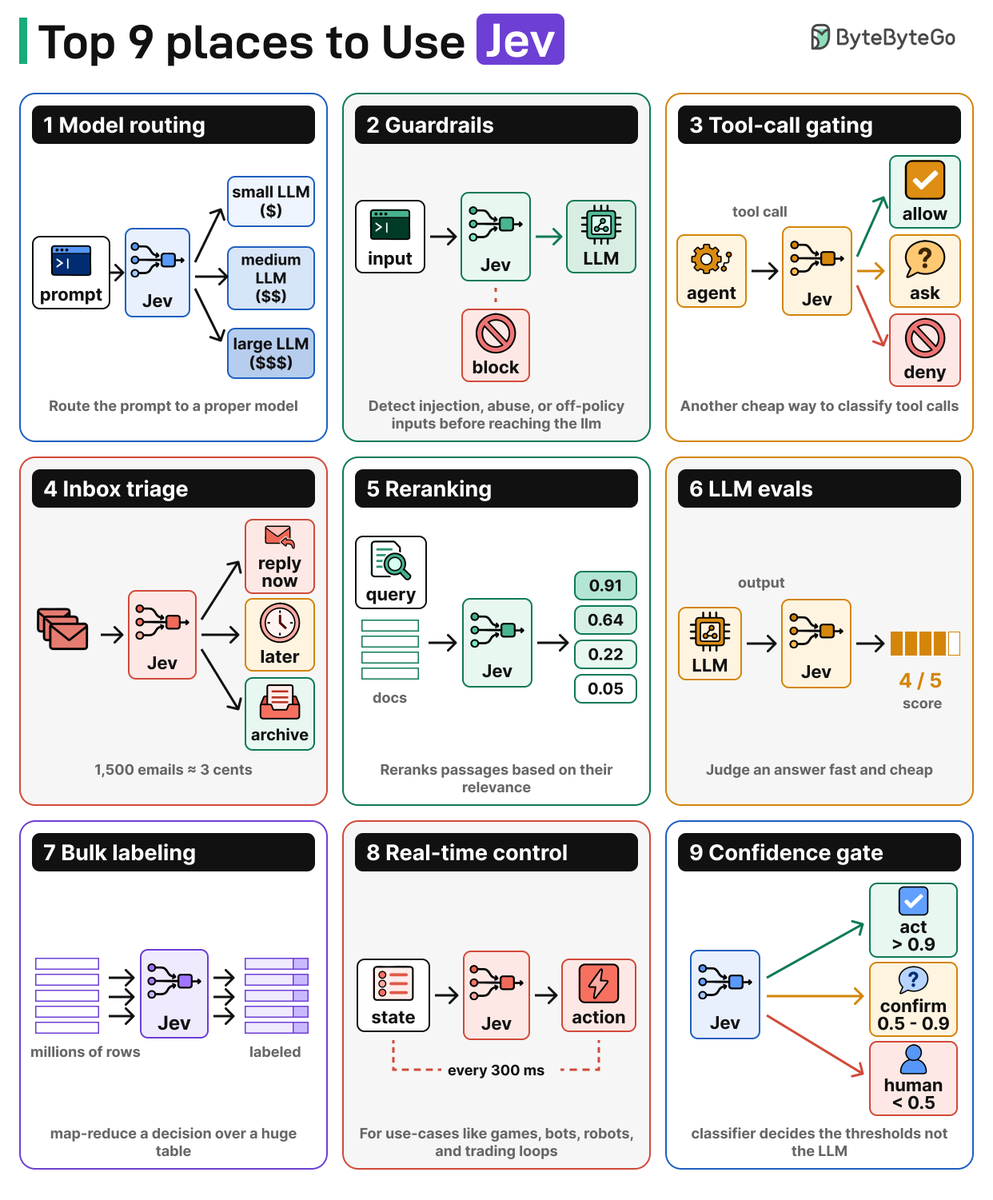
Jev is TypeSafe AI's first System One Model.
It is 100x faster and cheaper than frontier LLMs.
That opens up a lot of use cases people usually skip because the big models are too slow or too expensive for them.
Here are 9 use cases where we think Jev could be used instead of an LLM.
🚨Leave Netflix tonight.
Watch this 2 h 34 min Stanford class.
It's the clearest, most complete, and brutally honest explanation out there on how ChatGPT and Claude are really built.
From Tokenization and BPE to the Transformer architecture, the training pipeline, and the next-token decoder. No fluff. No marketing. Just the truth.
Doesn't matter if you've never touched a line of AI code or if you spend your days launching Agents: by the end, you'll suddenly connect a ton of pieces you've been trying to fit together for years.
The real core boils down to this:
How text turns into numbers the model can "eat" (BPE tokenization)
The sole mission of a language model: predict the next token
How the Transformer uses Attention so tokens can pass messages to each other
In training, the NLL loss pushes the probability of the entire sequence
In generation, the decoder builds the response token by token
The big-picture view that takes most people years to form… this class delivers it to you complete in one sitting.
Free up your time.
This could be, no exaggeration, the most valuable class you watch this month.
Microservices Cheatsheet I Wish I Had Created Earlier. Here it is for you to use.
This is the ultimate cheat sheet for anyone designing, building, or maintaining microservices. It simplifies the key layers and tools you’ll encounter.
1// Infrastructure
Manage where and how your microservices run.
- Containerization
→ Tools:
- Docker: The industry standard for containerizing applications.
- LXC: Lightweight, Linux-native containers for simplicity.
- Podman: A daemon-less alternative to Docker.
- Container Orchestration
→ Tools:
- Kubernetes: The king of container orchestration; scales and manages workloads.
- Docker Swarm: Easy-to-use clustering for Docker.
- OpenShift: Enterprise-ready Kubernetes with added developer tools.
- HashiCorp Nomad: Lightweight orchestrator for mixed workloads.
- Cloud Providers
→ Tools:
- AWS: The most feature-rich and widely used cloud platform.
- Azure: Great integration with Microsoft’s ecosystem.
- GCP: Best for AI/ML and global distributed systems.
2// Application Layer
Ensure smooth communication and operations between microservices.
- Languages
→ Tools:
- Java: Battle-tested for enterprise applications.
- Python: Ideal for rapid prototyping and lightweight services.
- .NET: Excellent for Windows-heavy environments.
- Node.js: Lightweight and fast for I/O-heavy tasks.
- GoLang: Built for concurrency and performance.
- API Management
→ Tools:
- Runscope: Monitor and debug API calls.
- MuleSoft: Enterprise-grade API management platform.
- Service Registration
→ Tools:
- Eureka: Netflix’s service discovery tool for Java apps.
- Consul: Distributed key-value store and service discovery.
- Zookeeper: Reliable service registry for distributed systems.
- Application Gateway
→ Tools:
- Kong: API gateway for managing and monitoring API traffic.
- Ocelot: Lightweight API gateway for .NET Core.
3// Performance and Optimization
Speed and reliability are key.
- Load Balancers
→ Tools:
- NGINX: Industry favorite for reverse proxy and load balancing.
- Traefik: Modern, dynamic load balancer tailored for microservices.
- Seesaw: Load balancing built by Google for extreme performance.
- Caching
→ Tools:
- Redis: In-memory database known for speed and versatility.
- Memcached: Simple, high-performance caching.
- Hazelcast: Distributed in-memory data grid for caching and computing.
- Message Brokers
→ Tools:
- Kafka: High-throughput distributed messaging system.
- RabbitMQ: Simple and widely-used message broker.
4// Monitoring and Security
Keep systems secure and operational.
- Monitoring and Alerting
→ Tools:
- Prometheus: Metrics-based monitoring and alerting system.
- Grafana: Visualization tool to analyze and view your data.
- Kibana: Explore and visualize logs stored in Elasticsearch.
- Distributed Tracing
→ Tools:
- Zipkin: Helps trace and monitor distributed services.
- OpenTelemetry: Open standard for distributed tracing and metrics.
- Security
→ Tools:
- JWT: Standard for securely transmitting information as JSON.
- TLS: Encrypts data and ensures secure communications.
5// Database Layer
Where your data lives and how it’s managed.
- SQL
→ Tools:
- Oracle: Reliable for enterprise-grade databases.
- MySQL: Open-source relational database known for simplicity.
- PostgreSQL: Advanced SQL database with rich features.
- NoSQL
→ Tools:
- MongoDB: Flexible, document-oriented NoSQL database.
- Cassandra: Handles massive amounts of data with high availability.
- HBase: Hadoop-compatible database for large-scale workloads.
- DynamoDB: AWS’s NoSQL database with seamless scaling.
Today, we’re excited to introduce Miso One, the most emotive voice model in the world.
Miso One is an 8-billion-parameter text-to-speech model for highly expressive speech generation. It emotes like a human and responds faster than a human, with just 110 milliseconds of latency.
We’ve open-sourced the model weights, with API access coming soon.
Hear how Miso One sounds in the thread below.
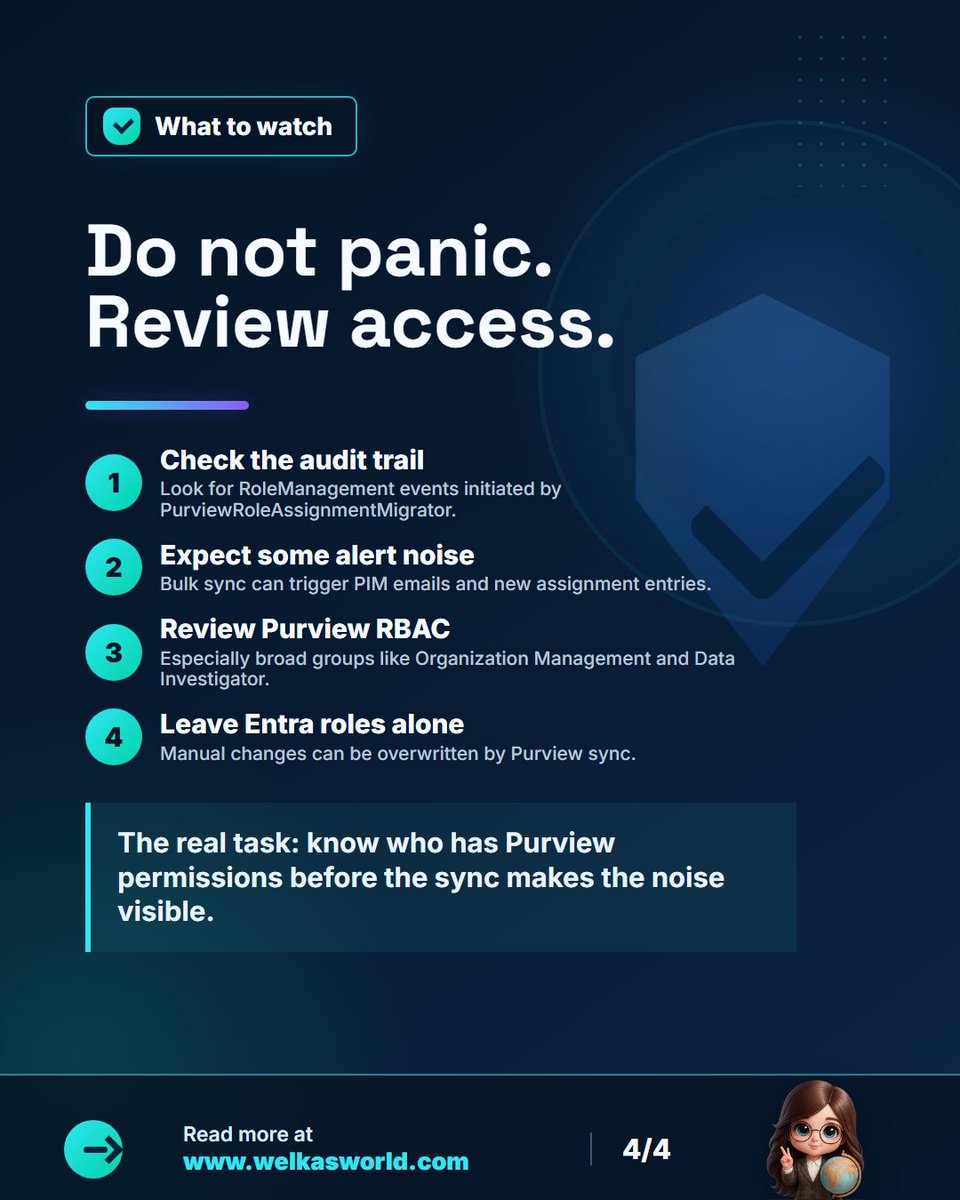
Microsoft is now auto-syncing Purview RBAC roles into Entra ID, which is why admins are seeing new roles + PIM alerts like “PurviewRoleAssignmentMigrator”.
This is expected behaviour, not a misconfig.
Breakdown here:
https://t.co/1XbEJOAFde
#Purview#Entra#PIM#PurviewRBAC
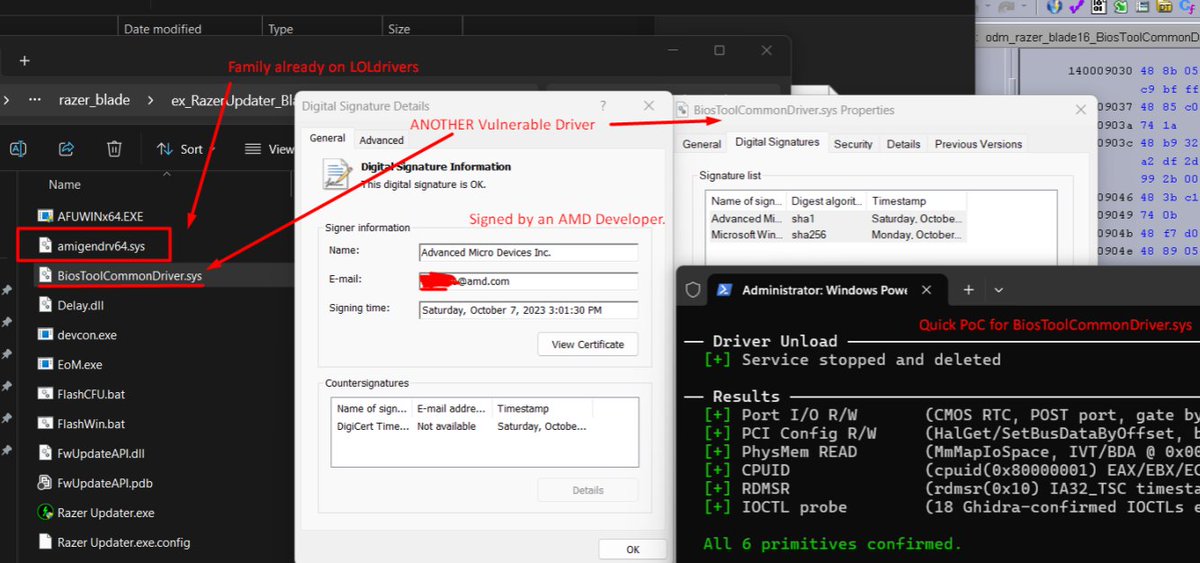
AMD is shipping a vulnerable kernel driver in the Razer Blade 16 BIOS updater. its sitting in the same folder as ANOTHER vulnerable driver that's been publicly known and documented as dangerous for years
both are signed. both can be weaponized by malware to bypass your antivirus, take complete control of your computer from the inside, read anything stored in memory including passwords and crypto wallet keys, and load ransomware /Malware without your PC putting up a fight
this is exactly what ransomware / malware operators and state backed groups hunt for every single day
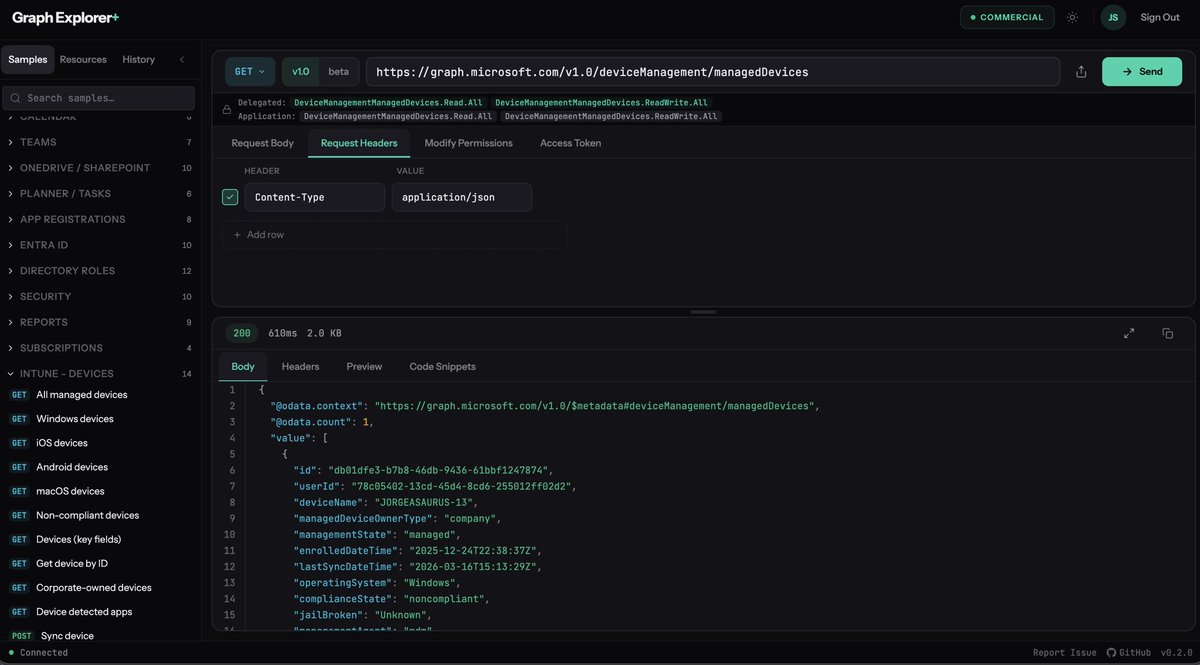
If you work with Intune + Microsoft Graph, you’ve probably rewritten the same queries 10 times.
GraphExplorerPlus = my personal collection of real-world endpoint queries, now public.
Pet project, but useful.
https://t.co/V4u7cV1yeD
M365 Red Agent powered by Claude and AADInternals is absolutely wild
I’m currently building a lightweight version that combines both worlds by integrating an agent with modular tools, attack scenarios, some workflows, and extensible capabilities for red team operations.
Will include:
Prebuilt M365 attack playbooks
Automated enumeration and privilege escalation paths
Attack cycle with Hat mode
Simulation of threat actor techniques
Easy extensibility for custom tooling and research
CPU vs GPU vs TPU vs NPU vs LPU, explained visually:
5 hardware architectures power AI today.
Each one makes a fundamentally different tradeoff between flexibility, parallelism, and memory access.
> CPU
It is built for general-purpose computing. A few powerful cores handle complex logic, branching, and system-level tasks.
It has deep cache hierarchies and off-chip main memory (DRAM). It's great for operating systems, databases, and decision-heavy code, but not that great for repetitive math like matrix multiplications.
> GPU
Instead of a few powerful cores, GPUs spread work across thousands of smaller cores that all execute the same instruction on different data.
This is why GPUs dominate AI training. The parallelism maps directly to the kind of math neural networks need.
> TPU
They go one step further with specialization.
The core compute unit is a grid of multiply-accumulate (MAC) units where data flows through in a wave pattern.
Weights enter from one side, activations from the other, and partial results propagate without going back to memory each time.
The entire execution is compiler-controlled, not hardware-scheduled. Google designed TPUs specifically for neural network workloads.
> NPU
This is an edge-optimized variant.
The architecture is built around a Neural Compute Engine packed with MAC arrays and on-chip SRAM, but instead of high-bandwidth memory (HBM), NPUs use low-power system memory.
The design goal is to run inference at single-digit watt power budgets, like smartphones, wearables, and IoT devices.
Apple Neural Engine and Intel's NPU follow this pattern.
> LPU (Language Processing Unit)
This is the newest entrant, by Groq.
The architecture removes off-chip memory from the critical path entirely. All weight storage lives in on-chip SRAM.
Execution is fully deterministic and compiler-scheduled, which means zero cache misses and zero runtime scheduling overhead.
The tradeoff is that it provides limited memory per chip, which means you need hundreds of chips linked together to serve a single large model. But the latency advantage is real.
AI compute has evolved from general-purpose flexibility (CPU) to extreme specialization (LPU). Each step trades some level of generality for efficiency.
The visual below maps the internal architecture of all five side by side, and it was inspired by ByteByteGo's post on CPU vs GPU vs TPU. I expanded it to include two more architectures that are becoming central to AI inference today.
👉 Over to you: Which of these 5 have you actually worked with or deployed on?
____
Find me → @_avichawla
Every day, I share tutorials and insights on DS, ML, LLMs, and RAGs.
🔒 Secure Bits 💡
𝗗𝗼 𝗬𝗼𝘂 𝗨𝘀𝗲 𝗥𝗲𝘀𝘁𝗿𝗶𝗰𝘁𝗲𝗱 𝗔𝗱𝗺𝗶𝗻 𝗠𝗼𝗱𝗲 𝗳𝗼𝗿 𝗥𝗗𝗣?
If not, you should—it 𝗽𝗿𝗲𝘃𝗲𝗻𝘁𝘀 𝗰𝗿𝗲𝗱𝗲𝗻𝘁𝗶𝗮𝗹 𝗲𝘅𝗽𝗼𝘀𝘂𝗿𝗲.
𝗪𝗵𝘆 𝗜𝘁 𝗘𝘅𝗶𝘀𝘁𝘀:
Restricted Admin Mode was designed to let administrators connect to a potentially compromised device without passing their credentials to it.
You must already be an administrator on the target machine, but your credentials never leave the source system, preventing theft and lateral movement attacks.
𝗪𝗵𝘆 𝗜𝘁 ��𝗮𝘁𝘁𝗲𝗿𝘀:
✅ 𝗦𝘁𝗼𝗽𝘀 𝗖𝗿𝗲𝗱𝗲𝗻𝘁𝗶𝗮𝗹 𝗧𝗵𝗲𝗳𝘁 – Protects privileged accounts during RDP sessions.
✅ 𝗜𝗱𝗲𝗮𝗹 𝗳𝗼𝗿 𝗝𝘂𝗺𝗽 𝗛𝗼𝘀𝘁𝘀 & 𝗣𝗔𝗪𝘀 – Securely connect to your devices without risk.
✅ 𝗙𝗲𝗲𝗹𝘀 𝗟𝗶𝗸𝗲 𝗦𝗦𝗢 – No password entry needed—your local admin credentials are used, but never sent to the target.
𝗛𝗼𝘄 𝘁𝗼 𝗘𝗻𝗮𝗯𝗹𝗲 𝗜𝘁:
🔹𝗢𝗻 𝘁𝗵𝗲 𝗧𝗮𝗿𝗴𝗲𝘁 𝗗𝗲𝘃𝗶𝗰𝗲:
Add this registry key:
HKLM\SYSTEM\CurrentControlSet\Control\LSA
REG_DWORD - DisableRestrictedAdmin - 0
🔹𝗢𝗻 𝘁𝗵𝗲 𝗦𝗼𝘂𝗿𝗰𝗲 (𝗝𝘂𝗺𝗽𝗛𝗼𝘀𝘁/𝗣𝗔𝗪):
Administrative Templates\System\Credentials Delegation\Restrict delegation of credentials to remote servers - Require Restricted Admin
⚠️ 𝗟𝗶𝗺𝗶𝘁𝗮𝘁𝗶𝗼𝗻: Since no credentials are stored on the target, SSO won’t work from that machine.
I explain more about this feature in my Cybersecurity Courses 👇
https://t.co/BP8j4228Sx
👉 Do you use this feature in your environment? Let me know in the comments!
#Windows #ActiveDirectory #InfoSec #Cybersecurity #RDP
Don't Miss ! On January 23, 2026, the night sky will deliver a rare and delightful cosmic moment. The Moon will curve gently beneath Saturn and Neptune, forming a natural “smiley face” high above Earth. This triple conjunction happens when all three celestial bodies appear close together from our viewpoint, creating a brief but magical alignment.
It’s a reminder that space isn’t always distant and serious sometimes, it feels playful too. If skies are clear, look up and enjoy this once-in-a-long-while celestial smile lighting up the darkness.