Calculated Collapse: Trump’s Grand Strategy as the Structural Dismantling of American Hegemony
For nearly a decade, foreign policy analysts across the political spectrum have struggled to categorize Donald Trump’s international agenda.
Neoconservatives decry it as unpredictable isolationism; liberal internationalists dismiss it as an incoherent series of tactical blunders; and critics point to seemingly contradictory moves—such as brinkmanship with Iran alongside troop withdrawals, or unconditional backing of Israel coupled with transactional dealings with Moscow—as evidence of strategic confusion.
However, viewing these actions through the orthodox lens of American grand strategy misses a far more compelling, albeit contrarian, hypothesis: What if the chaos is not an accidental byproduct, but the explicit design?
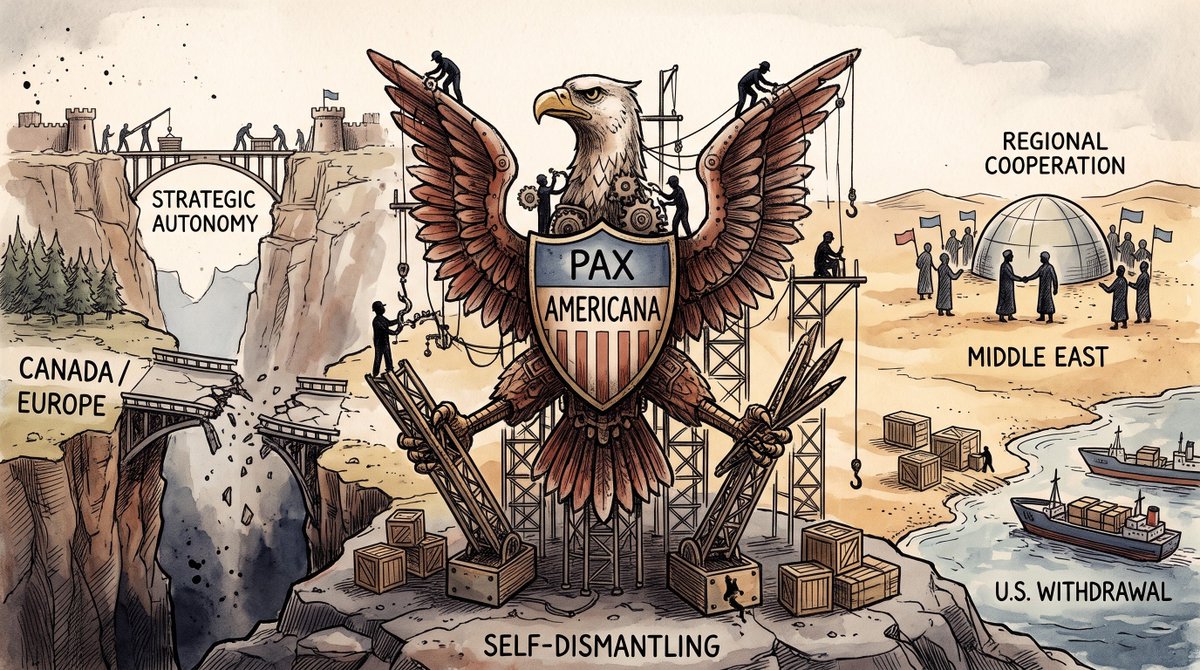
Under this thesis, Trump’s foreign policy represents a deliberate, calculated campaign of structural sabotage against America’s imperial infrastructure. Rather than attempting to manage or reform the "Pax Americana," his strategy systematically degrades the domestic institutions, regional security guarantees, and alliance structures required to sustain foreign military interventions. By pushing regional friction points to their absolute stress limits—forcing the vulnerability of forward-deployed forces, delegitimizing international norms, and eroding trust among historic allies—he is forcing a structural retreat that no subsequent administration will be able to reverse.
In the long run, this deliberate dismantling of Washington's capacity to wage endless war may represent the most radical, and structurally effective, implementation of non-interventionist doctrine in modern history.
1. The Middle East Crucible: Tactical Brinkmanship as Institutional Exhaustion
To understand this grand strategy, one must examine the operational calculus of the Middle East. Traditional foreign policy doctrines relied on the Carter Doctrine—the assumption that the U.S. military must act as the ultimate guarantor of energy flows through the Strait of Hormuz and the primary stabilizer of Gulf security.
Trump’s approach turned this paradigm upside down:
I. Exposing the Fragility of Forward Deployment: By engaging in high-stakes confrontation with Iran and encouraging localized escalation, U.S. forward-operating bases across Iraq, Syria, and the broader Gulf were rendered immediate targets. When American military infrastructure becomes a net security liability rather than a vector of power projection, the operational and financial cost of remaining becomes politically unviable.
II. Weaponizing Energy Bottlenecks: Critics argued that provoking Iran risked closing the Strait of Hormuz—a scenario previous presidents sought to avoid at all costs. Yet, exposing the vulnerability of global energy transit forces consumer nations (particularly in Europe and Asia) to take ownership of their own energy security, directly undermining the rationale for Washington to spend billions patrolling foreign waters.
III.The Demise of "Neutral Arbiter" Pretenses: By extending unconditional support to Israel and ignoring traditional diplomatic tropes regarding two-state negotiation frameworks, Trump effectively gutted the State Department's ability to act as a regional mediator. This intentional burning of diplomatic bridges renders traditional U.S. nation-building and peace-keeping operations impossible to execute.
@naval Jensen Huang should start the company directly competing to Nvidia and I am sure raising billions won't be difficult. May be probably have army of lawyers as well.
@paulg ""A habit of basing convictions upon evidence, and of giving to them only that degree of certainty which the evidence warrants, would, if it became general, cure most of the ills from which this world is suffering."
— Bertrand Russell
@KobeissiLetter Of course they can't prove it, it's like Iraq's WMD. Newspaper wrote op-eds and articles manufacturing consents. The action is taken and the truth doesn't anything mean at all.
What makes Nvidia exceptional is not merely its technology, but Jensen Huang's ability to anticipate industry developments, align Taiwan's and South Korea's semiconductor and memory supply chains, maintain strategic relationships with cloud providers, and personally cultivate relationships with major customers across the world.
He is not just running a chip company. He is orchestrating an entire ecosystem. Without his vision, industry relationships and extraordinary business development capabilities, what justifies Nvidia commanding the world's highest market valuation while sustaining profit margins exceeding 70%?
More importantly, who can guarantee that its suppliers and customers would remain equally committed and cooperative without him?
What makes Nvidia exceptional is not merely its technology, but Jensen Huang's ability to anticipate industry developments, align Taiwan's and South Korea's semiconductor and memory supply chains, maintain strategic relationships with cloud providers, and personally cultivate relationships with major customers across the world.
He is not just running a chip company. He is orchestrating an entire ecosystem. Without his vision, industry relationships and extraordinary business development capabilities, what justifies Nvidia commanding the world's highest market valuation while sustaining profit margins exceeding 70%?
More importantly, who can guarantee that its suppliers and customers would remain equally committed and cooperative without him? $NVDA is dead long term without Huang.
NVIDIA letting Jensen go is a huge mistake, for America and for humanity. It's Apple firing Steve Jobs all over again, but much bigger, given the role of AI in defining the future of our world.
I've been keeping quiet on this out of respect for Jensen's family and team, who I've met and who are amazing humans, and because I personally hate infidelity. So my heart goes out to them in this difficult personal family moment.
But I can also say that Jensen is human, and makes mistakes like all of us do. Not that I matter at all, but I've known Jensen for a long time and have gotten the chance to spend a lot of time with him, behind the scenes, away from mics and cameras. I have seen him show kindness, humility, care to everyone around him, including strangers, including from the poorest most struggling parts of society, treating all the same with the same thoughtfulness and attention, because they are fellow humans and not because he has something to gain from them. That shows rare character, to maintain humility and humanity through all of it.
Another data point is what people who know him well have said privately to me about Jensen over the years. I've never had anyone tell me anything but how awesome he is or how much they love him. Probably over a thousand people at this point. This includes hundreds of engineers, CEOs, colleagues, friends, etc.
Also, since there was some spy talk. Jensen is as proud an American as it gets. I'm in shock frankly at all of this, including the mass hysteria around it. I love America, and I think NVIDIA letting Jensen go is terrible for America.
I stand with Jensen.
Love you all ❤️
What makes Nvidia exceptional is not merely its technology, but Jensen Huang's ability to anticipate industry developments, align Taiwan's and South Korea's semiconductor and memory supply chains, maintain strategic relationships with cloud providers, and personally cultivate relationships with major customers across the world.
He is not just running a chip company. He is orchestrating an entire ecosystem. Without his vision, industry relationships and extraordinary business development capabilities, what justifies Nvidia commanding the world's highest market valuation while sustaining profit margins exceeding 70%?
More importantly, who can guarantee that its suppliers and customers would remain equally committed and cooperative without him? It's over for $NVDA in long term
Alexis de Tocqueville predicted modern Western society in 1835:
"When all conditions are equal, the slightest inequality is painful."
The safer and more comfortable a society becomes, the more intensely people obsess over minor offenses. Prosperity doesn't lower outrage; it refinishes it.
I wouldn't be surprised if $NVDA market value fall by 50% or more after Jensen Huang leaving the company. Without him, the investment thesis would look fundamentally different.
Don't be fooled by Nvidia's seemingly attractive forward P/E. That valuation metric misses the bigger picture.
Nvidia doesn't manufacture its own chips, memory or server infrastructure. At its core, it is a chip design company.
What makes Nvidia exceptional is not merely its technology, but Jensen Huang's ability to anticipate industry developments, align Taiwan's and South Korea's semiconductor and memory supply chains, maintain strategic relationships with cloud providers, and personally cultivate relationships with major customers across the world.
He is not just running a chip company. He is orchestrating an entire ecosystem. Without his vision, industry relationships and extraordinary business development capabilities, what justifies Nvidia commanding the world's highest market valuation while sustaining profit margins exceeding 70%?
More importantly, who can guarantee that its suppliers and customers would remain equally committed and cooperative without him?
When the Great Pyramid of Giza was being built, woolly mammoths were still roaming the earth on Wrangel Island. Cleopatra lived closer in time to the release of the iPhone than she did to the construction of the Great Pyramids.
We tend to compress "ancient history" into one single era, when in reality it was thousands of years apart.
Modern escapism offers us the exact same bargain as the World State in Huxley's Brave New World: trade your sharp edges, your deep sorrows, and your revolutionary anger for a smooth, frictionless, mildly sedated existence.
To resist the modern digital Soma is to embrace the friction of reality, to sit with the discomfort of our fractured world, and to realize that our anxiety is not a sickness to be numbed, but an alarm bell demanding that we wake up.
Machiavelli vs. Socrates on leadership:
Socrates: "A ruler who acts immorally destroys his own soul, rendering him unfit to lead."
Machiavelli: "A ruler who refuses to get his hands dirty will be overthrown by someone who will, destroying his people in the process."
Who is right when the stakes are survival?
UK arrested 94 year old Margaret Owen and Mike Higgins, 62 year old blind and disabled person on wheel chair because they had placard saying 'Stop the Genocide'.
The Ship of Theseus paradox applied to human beings:
Every 7 to 10 years, almost every cell in your body is replaced. You are literally not made of the same physical matter you were a decade ago.
What actually makes you "you"? Your memories, your continuity of consciousness, or something else?
The planned takeover of Nvidia by deep state by defamaing Jensen Huang should be the clear message to all non-white founders that they aren't really safe in US despite their wealth. If Huang is smart, he should move Nvidia to China as soon as possible.
When we talk about modern dystopias, George Orwell’s 1984 is usually the first reference point—a world of surveillance, pain, and totalitarian boots stamping on human faces.
But look closely at our current geopolitical and social trajectory, and it becomes clear that Aldous Huxley’s Brave New World is the far more accurate prophecy. Huxley understood that the ultimate method of control wasn't through fear and deprivation, but through manufactured pleasure, engineered inequality, and the endless distraction of consumption.
The single biggest flaw in modern democracy:
Politicians are incentivized to solve problems that take 4 years to fix, and ignore problems that take 20 years to fix.
As a result, infrastructure, education, and national debt are systematically neglected regardless of who you vote for.