Listen to Professor Mike Wooldridge (@wooldridgemike) on the @newscientist discussing how anxieties around AI distract us from the more immediate risks that the technology poses such as algorithmic bias & fake news.
Listen here: https://t.co/cZ1NQpF4Q2
#compscioxford#OxfordAI
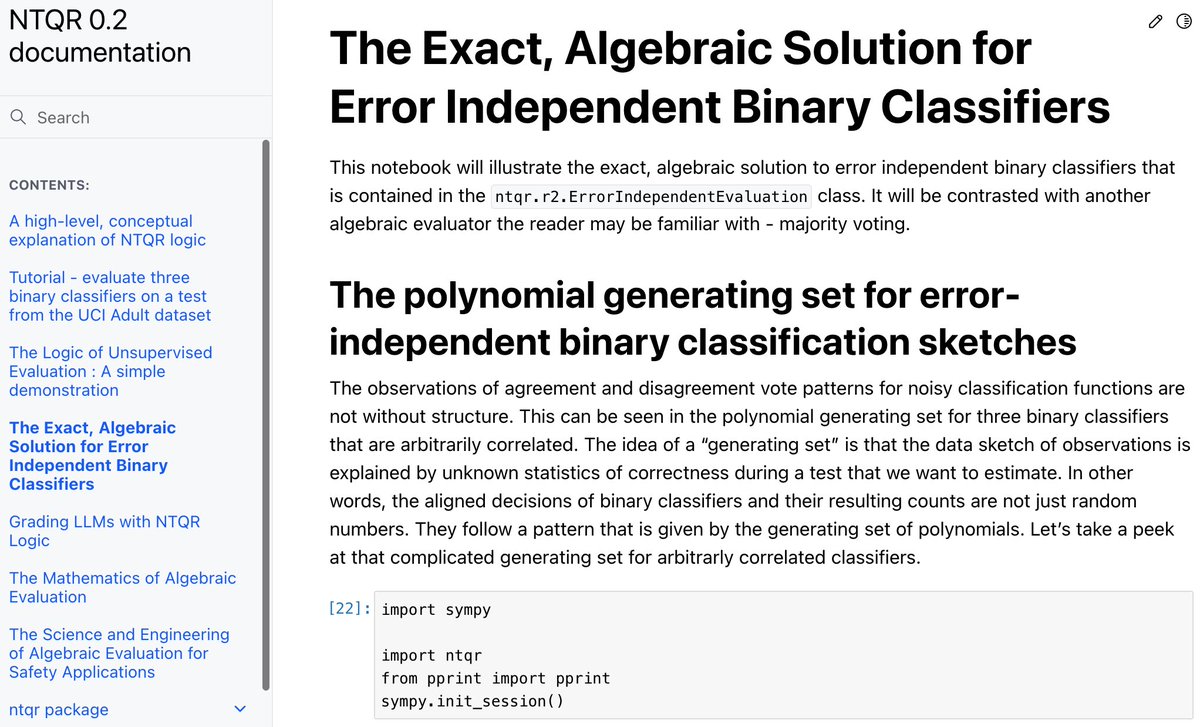
@rajiinio Readers interested in unsupervised evaluation upon deployment - a fundamental problem in #aisafety - check out our recently released Python package, ntqr, detailing how logic and algebra alone can help us here.
https://t.co/vbpncIoZRw
@MilaNLProc@paul_rottger@ma_tay_ Readers of this post may be interested in the logic of evaluating ensembles using unlabeled data as a way to have pluralistic alignment. Our recently released ntqr Python package is building out the algebraic tools for this logic,
https://t.co/vbpncIoZRw
@WIREDScience , @nytimes how many experts in #aisafety know there is an exact, algebraic solution to the problem of error independent binary classifiers being tested on unlabeled data? Algebraic numbers can protect us from hallucinating LLMs.
https://t.co/vbpncIoZRw
@AlexShtf@scikit_learn Readers interested in the use of polynomials and algebraic geometry for evaluation in unsupervised settings - using unlabeled data - check out our recently released ntqr Python package,
https://t.co/vbpncIoZRw
@iam_roysubhra@shaily99 Every little bit will help in the fight to keep us safe from noisy AI algorithms. Our business goal is to build "fire alarms" and "intelligence thermometers" to aid in the wider safety framework we need to accomplish this.
@iam_roysubhra@shaily99 The philosophical/engineering problem of safety on deployment is that we only have biased algorithms to tell us what is really happening. For that we need a "Foucault Pendulum" built from logic and algebra, like this,
https://t.co/vbpncIoZRw
@cubic_logic@twitter@learnfromerror The error independent solution is contained in our 2010 patent and thus precedes most of the probabilistic methods published by Parisi and others. The paper @cubic_logic quotes could have been greatly improved by knowledge of this solution.
@cubic_logic@twitter@learnfromerror Godel's completeness theorem applied to arithmetic without division. Similarly, when we evaluate tests taken by respondents, we can formulate the whole set of logically possible evaluations as finite integers without having to invoke any division operations.
This Black History Month, we celebrate Deborah Raji (@rajiinio), a cognitive scientist, AI researcher and Mozilla Fellow who collaborated with our founder @jovialjoy at the MIT Media Lab and AJL to audit commercial facial recognition technologies from Microsoft, Amazon, IBM, and more, and appeared in the documentary Coded Bias. Deborah's work has significantly contributed to the understanding of facial recognition technologies and their impact on marginalized communities.