People do not coordinate only through broad legal rules and prices. Hayek emphasized abstract rules that allow people to coordinate like property, contract, trade, and competition. But Lachmann also emphasized the practical secondary institutions people orient their plans around, like banks, standardized contracts, product categories, and so on.
In software, an abstraction boundary is an interface that hides complexity hiding beneath. In this 2005 paper (https://t.co/FPxYCFUSPT), Miller and Tulloh explain that you can apply this concept to markets too. Consider a post office: there's an abstract boundary that separates why the customer wants to mail something (which the postman doesn't need to know); what the shared transaction is (all the recognizable steps and commitments involved in sending mail); and how the postal system actually delivers it (complex logistics network hidden from the customer).
The middle part is what lets the user benefit from the postal system’s expertise without having to learn postal logistics. The boundary defines the shared 'what' but also separates the customer’s 'why' from the provider’s 'how'. Not only that, but reusability means the same institution can be used to satisfy many purposes (birthday invites, subpoenas etc) and polymorphism means different providers can satisfy the same need and compete (UPS, FedEx etc).
An important question in institutional theory is how societies achieve both stability and adaptation; the paper authors say that the solution is stable interfaces allow changing internals. I find this very intuitive: when companies don't evolve/change from the inside much, you get ossification and insufficient adaptation. When laws change too much and institutions are unstable, uncertainty affects market confidence.
The people who are good at redrawing abstraction boundaries are entrepreneurs, who notice when existing categories are wrong and will invent new ones to remedy faults or address demand. What has always saddened me is how poorly rewarded and incentivized political entrepreneurship is. Part of the reason why is that this is hard: market abstraction boundaries are often disciplined by exit, entry, profit/loss, customer choice, and provider competition - but these feedback loops are much weaker in the public sector.
I hope we'll see a lot more of this in the coming decade. In fact this is something that AI will hugely facilitate, since it can lower the cost of articulating and prototyping new abstraction boundaries. We've already seen minor examples through e.g. citizens creating websites/services that compete with government ones. Though usually this is to make state services more legible rather than changing the boundaries in the first place.
I think if people want the future to go well, bolstering state capacity and enabling more innovation on the governance/democracy side of things will be critical. People don't really like this because it's a slow process, but I think they're wrong (and cheems), and playing the 'urgency of AGI' card to bypass this through a de facto state of emergency will cause lasting harms, partly by weakening institutional learning, public trust, and future coordination capacity.
🎉 Arne Hole and I are delighted to share the programme for the 3rd Workshop on the Economics of #Health and #HumanCapital!
📍 Madrid, 18 June 2026
🏛️ @FundacionAreces
🎤 Keynote: @Gabri_EllaConti
Looking forward to a great day of research and discussion in Madrid!
The future of Math is mathematicians and AI agents working together.
Very pleased to introduce @GoogleDeepMind's AI co-mathematician: a multi-agent system designed to actively collaborate with human experts on open-ended research mathematics.
Mathematicians testing the agent across areas as diverse as group theory, Hamiltonian systems, and algebraic combinatorics have reported impressive results.
In autonomous mode evaluation on the rigorous FrontierMath Tier 4 problems, AI co-mathematician scored an unprecedented 48% — a new high score among all AI systems evaluated.
pleased to note a modest milestone: my GScholar profile crossed 100 citations (h-index: 5; i10-index: 3). All publications 1st authored (incl. work in A* and A-journals). Though work-research balance is skewed & Econ publishing is crazy demanding, I wish to continue #EconTwitter
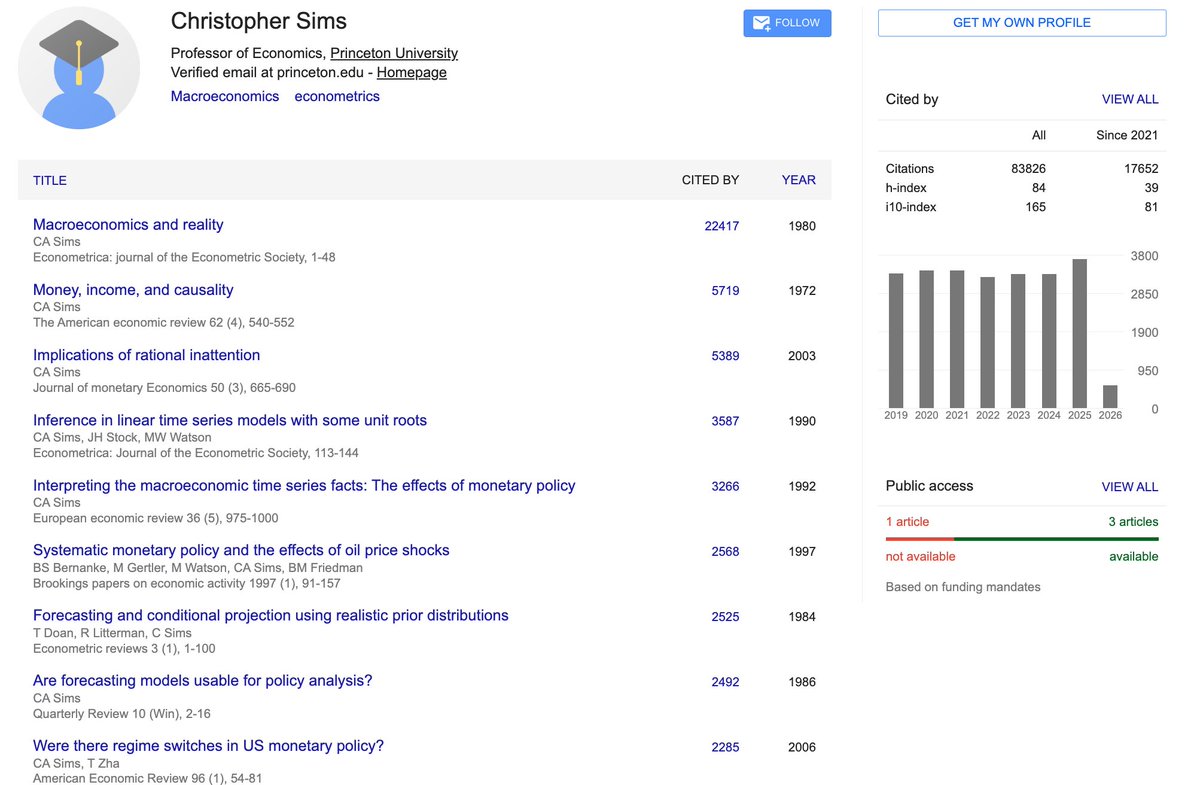
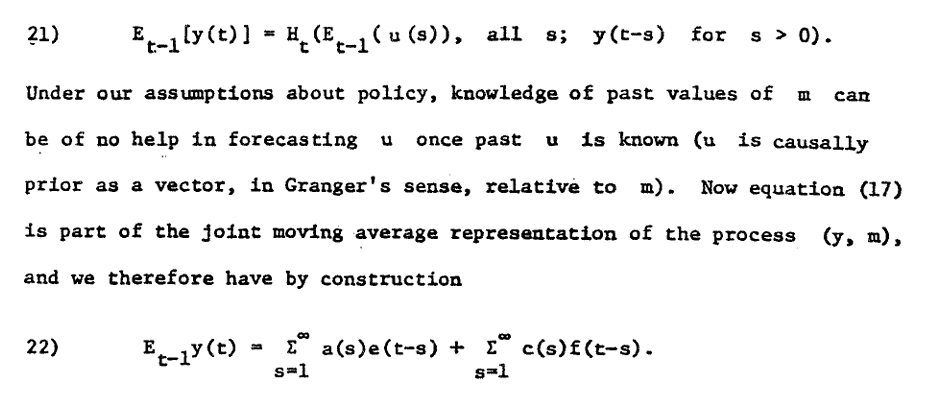
2011 Nobel Laureate Christopher Sims will be missed in new issues of @ecmaEditors & @AEAjournals. His VAR remains a legacy for Econ scholars. RIP Prof. Sims. #EconTwitter
@nberpubs@anusha_chari@PeterBlairHenry@PPicardo Nice, but not OK. Countries with more roads are also richer for institutions, geog, trade, policy, private investmnt, tech), even if control for K & H. Also, what makes authors believe that avg global elasticity=Local marginal elasticity? Major issue: MPX double counts K-effect.
Super interesting!
"Who Benefits from Capital Market Integration in a Monetary Union?" by Naomi Cohen.
"The analysis shows that who benefits from capital market integration in the euro area depends critically on both where and who you are. Capital market integration operates through two channels, diversification and reallocation, that shape welfare and adjustment asymmetrically across households and countries. In the Periphery, integration stabilizes the consumption of wealthy Savers through diversification but exposes Non-Savers to deeper labor income losses as capital outflows depress domestic activity. In the Core, by contrast, capital inflows cushion wages and benefit liquidity-constrained households, while financially integrated Savers face lower returns through their exposure to the Periphery. Taken together, these results imply that the main beneficiaries of capital market integration are asset-holding households in financially constrained regions and wage earners in capital-receiving economies, while liquidity-constrained households in debtor regions lose the most."
https://t.co/pCspBUL64k
Want to compare values across different scales or datasets? The standard score (z-score) is a simple but powerful way to do that.
It expresses how many standard deviations a value is from the mean, allowing comparisons between different variables or distributions.
Why use z-scores:
✔️ Comparability: Converts values to a common scale.
✔️ Interpretability: Helps identify how extreme a value is (e.g., +2 means two SDs above the mean).
✔️ Statistical inference: Used in many methods like hypothesis testing, regression diagnostics, and outlier detection.
✔️ Normalization: Centers data around zero with unit variance.
However, there are also some limitations to keep in mind:
❌ Assumes normality: Works best for data that are approximately normally distributed.
❌ Sensitive to outliers: Mean and standard deviation can be distorted by extreme values.
❌ Relative measure: A z-score shows deviation from the mean but not real-world importance.
❌ Not for categorical data: Only applicable to continuous numeric variables.
The visualization below shows how z-scores, T-scores, standard deviations, and cumulative percentages align in a normal distribution. Image source Wikipedia: https://t.co/JUvYkrIr5a
For more tutorials and insights on R, Python, and data science, subscribe to my newsletter.
Take a look here for more details: https://t.co/X93SeCe0rb
#Python #programming #programmer #RStats #database
@captgouda24 IP is one of the wicked public policy chutzpah. Non-economist policymakers can bring forth not only absent outcomes but also capital misallocation. You highlight tariffs as main debacles; incentives are no less culprits either. Productivity policy gets no takers as IP blinds eyes
Publication Alert: A Smoothed Instrumental Variables Quantile Qegression (SIVQR) based analysis on a novel dataset. Published in Economic Analysis and Policy. thanks to lectures of @causalinf
https://t.co/AmZOWDzUbk
#econtwitter
Thanks for response. Every public policy Q is abt constrained optimization. No CGE model available. 1st principles should be applied but rarely done. This built incentives for being sub-optimal. That's why Chainsaw Econ. Fantastic theory and number crunching up ahead #EconTwitter
Interesting dataset on Indian Economy. Services took over Agri in 1979 (right Y axis). Agri share been a secular decline.Growth shocks (left Y axis) mostly impacted trend of Industrail share (never surged). Agri went down industries in 1995. #econtwitter@IEGResearch@BIPP_ISB @
Publication alert: One in IIMB Management Review (B) other in 𝗧𝗿𝗮𝗻𝘀𝗽𝗼𝗿𝘁𝗮𝘁𝗶𝗼𝗻 𝗥𝗲𝘀𝗲𝗮𝗿𝗰𝗵 𝗣𝗮𝗿𝘁 𝗔: 𝗣𝗼𝗹𝗶𝗰𝘆 𝗮𝗻𝗱 𝗣𝗿𝗮𝗰𝘁𝗶𝗰𝗲 (A*). 1st with Prof. Atulan Guha, 2nd with Arjun Anand. #Econtwitter might be interested @mitenergy@UChiEnergy@CGMPitt