Most of us, even those working in Industrial IoT, don’t realize how much is happening behind the scenes in the wireless networking world.
We default to the established public networks we’ve relied on for years. But there’s a strong movement to step away from those networks.
I was fortunate to see Norman Fekrat, Chairman of the OnGo Alliance, at Network X Americas. OnGo is building a powerful, operator-neutral alternative using CBRS shared spectrum.
Airports and major oil & gas companies are already successfully deploying it for reliable, private connectivity that reduces dependency on traditional carriers.
This is a real game-changer for enterprise and industrial use cases. The future of wireless is becoming more open and flexible!
#NetworkX #OnGoAlliance #CBRS #PrivateNetworks #IndustrialIoT #WirelessInnovation
Good industrial IoT is:
→ Edge-first (connectivity fails in the field)
→ Physics-informed (pattern matching ≠ understanding)
→ Installed in hours, not months
→ A real-time twin, not just a dashboard
→ Deployable your way — not locked to one cloud
Most platforms nail one of these. The hard part is all five.
#IndustrialIoT #PredictiveMaintenance #EdgeComputing
Land of the free, because of the brave. Today we honor those who paid the price for our freedom. 🇺🇸
Set aside time today for those who go in harm’s way.
#MemorialDay
Just back from Network X where I caught an excellent fireside chat with Irvind Ghai (VP, Silicon Labs) on IoT Connectivity + Edge AI.
Key takeaway: Predictive maintenance is about to get much smarter. Faster, more reliable wireless networks + advanced silicon at the edge will dramatically improve prediction accuracy and value.
The future of industrial reliability is looking bright. 🔥
#NetworkX #EdgeAI #IoT #PredictiveMaintenance
🚀 Building Smarter Cities with predictive intelligence.
At Datahoist, our SOTL5 & SOTL6 IIoT solutions turn real-time infrastructure data into physics-informed ML insights — helping cities and operators prevent failures before they happen.
✅ Fewer disruptions ✅ Lower costs ✅ Longer asset life ✅ Safer urban environments
Proud of our team making city infrastructure more reliable every day.
Smart Cities pros — what’s your biggest infrastructure challenge right now? 👇 DM me or visit https://t.co/6eCME69k39
#SmartCities #IIoT #PredictiveMaintenance #SmartBuildings #UrbanTech
Tech cycles repeat: hype → lock-in → deprecation → stranded $$.
AI is the latest. We use it at Datahoist where ROI is real — but fundamentals first.
Custom predictive maintenance. You own the data. Flexible (on-prem/Azure/intermittent). Survives any platform shift.
DM to chat. #Datahoist #PredictiveMaintenance #SmartCity
🚀 Predictive maintenance that actually predicts.
At Datahoist, our SOTL5 car-top sensors + SOTL6 controller solutions turn real-time elevator & escalator data (door cycles, vibration, ride quality, run times, fault codes) into actionable insights with physics-informed ML.
Result: ✅ Fewer breakdowns ✅ Lower emergency repair costs ✅ Extended equipment life ✅ Safer, smoother rides
Brand-agnostic IIoT that works for any vertical transportation fleet.
Proud of the Datahoist team making it happen every day.
Building ops or elevator pros — let’s talk. DM me or visit https://t.co/6eCME69k39
What’s your biggest elevator/escalator headache right now? 👇
#PredictiveMaintenance #ElevatorIoT #SmartBuildings #IIoT #VerticalTransportation
Our new Principal Data Scientist, Michael Taylor Bryant, PhD, earned his PhD from Texas A&M University In the spring of 2025. His addition has significantly expanded our analytics capabilities and product offerings at DataHoist.
With six years of experience in machine learning built on a strong statistics foundation, Michael brings a unique perspective to our team. During his doctoral work at Texas A&M, he developed advanced machine learning models to predict the environmental behavior and plant uptake of contaminants such as nanoplastics, PFAS (per- and polyfluoroalkyl substances), and heavy metals in agricultural systems, with a clear emphasis on public health implications.
He now applies this expertise at @datahoist by approaching our mechanical systems through knowledge-based and physics-informed modeling. This enables the creation of more accurate, interpretable models grounded in the underlying physical mechanics of elevators, escalators, industrial equipment and related infrastructure; bridging environmental predictive analytics with industrial reliability and performance optimization.
Outside the office, Michael is enjoying his newfound freedom from the lab by spending free time landscaping and tending to his garden and yard. Perhaps channeling some of that plant science knowledge into his own backyard!
Welcome aboard, Michael! We're thrilled to have you and excited for the innovative impact you'll make.
#DataScience #MachineLearning #EnvironmentalModeling #Engineering #TeamDataHoist #Landscaping
Team spotlight: Rick Fisher, Director of Sales & Customer Support @ Datahoist! Joined last summer → instantly improved contract mgmt + comms across engineers/partners/customers. 🚀
25+ yrs enterprise sales (clients: Coca-Cola, Disney, GM + more; past: BMC, RSA, NEC). Perfect fit for our predictive IoT in elevators/escalators.
Also mentors at-risk students (Hillsboro HS, Boys & Girls Clubs, Waterfront Rescue Mission) + author/speaker empowering men.
Thanks, Rick! Let's connect on #IoT #PredictiveMaintenance #Elevators #SalesLeadership
[Link: https://t.co/YvtyL8sbO4]
Celebrating #InternationalWomensDay tomorrow by spotlighting a star: Chandani Patel Baghat! Brilliant engineer, entrepreneur, System Architect & Eng Manager. Via #Innoteer, our outsourcing went from hit-or-miss to smash hit—her team delivers because she demands success.
On this Memorial Day, we remember the heroes who never made it home. Their sacrifice ensures our freedom and inspires us all. We remember and are forever grateful.
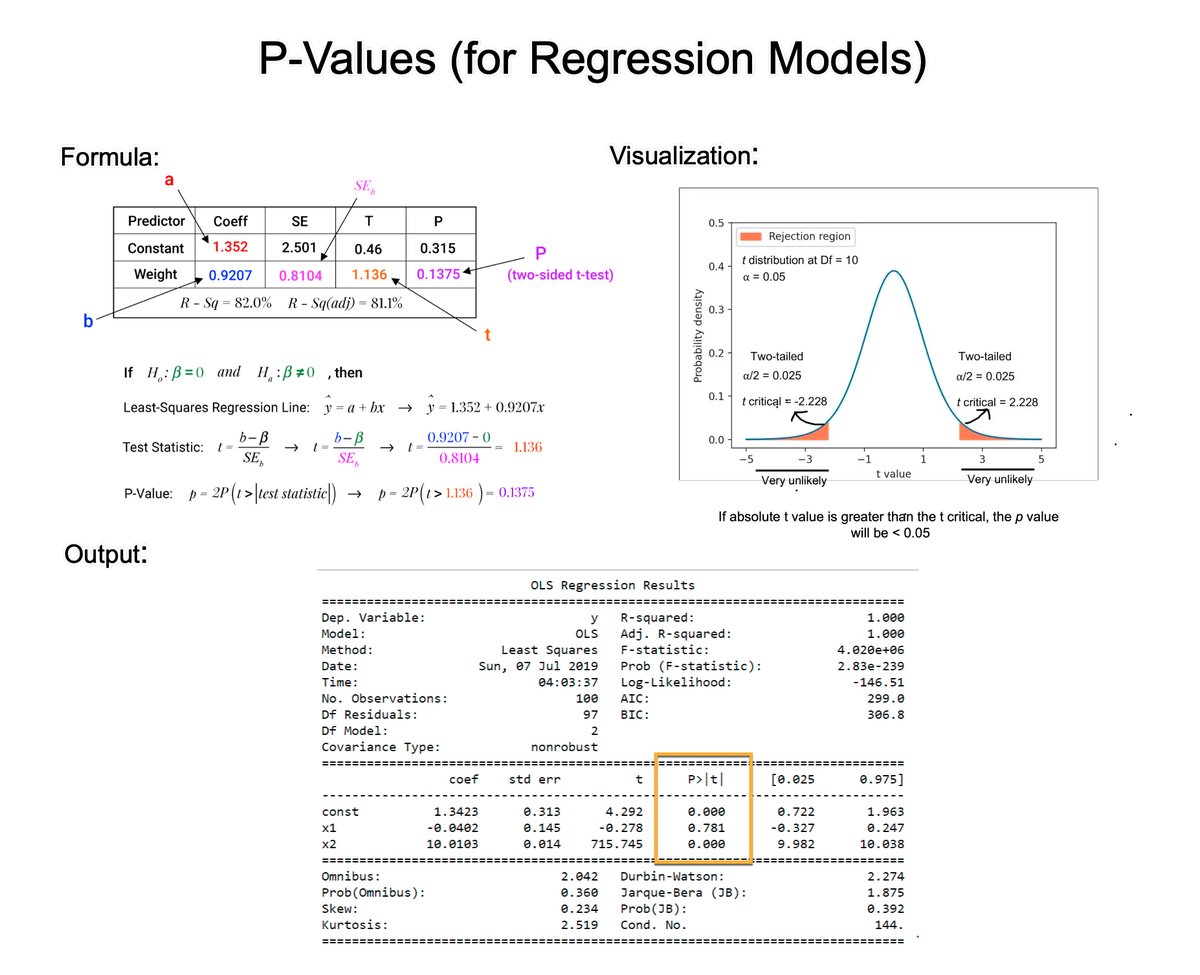
Understanding P-Values is essential for improving regression models. In 2 minutes, learn what took me 2 years to figure out.
1. The p-value: A p-value, in statistics, is a measure used to assess the strength of the evidence against a null hypothesis.
2. Null Hypothesis (H0): This is a general statement or default position that there is no relationship between two measured phenomena or no association among groups. For example, the regressor does not affect the outcome.
3. Alternative Hypothesis (H1): This is what you want to test for. It is often the opposite of the null hypothesis. For example, that the regressor does affect the outcome.
4. Calculating the p-value: The p-value for each coefficient is typically calculated using the t-test. There are several steps involved. Let's break them down.
5. Coefficient Estimate: In a regression model, you have estimates of coefficients (β) for each predictor. These coefficients represent the change in the dependent variable for a one-unit change in the predictor, holding all other predictors constant.
6. Standard Error of the Coefficient: The standard error (SE) measures the accuracy with which a sample represents a population. In regression, the SE of a coefficient estimate indicates how much variability there is in the estimate of the coefficient.
7. Test Statistic (T): The test statistic for each coefficient in a regression model is calculated by dividing the Coefficient Estimate / Standard Error of the Coefficient. This gives you a t-value.
8. Degrees of Freedom: The degrees of freedom (df) for this test are usually calculated as the number of observations minus the number of parameters being estimated (including the intercept).
9. P-Value Calculation: The p-value is then determined by comparing the calculated t-value to the t-distribution with the appropriate degrees of freedom. The area under the t-distribution curve, beyond the calculated t-value, gives the p-value.
10. Interpretation: A small p-value (usually ≤ 0.05) indicates that it is unlikely to observe such a data pattern if the null hypothesis were true, suggesting that the predictor is a significant contributor to the model.
Understanding p-values can help improve your models.
But with changes in machine learning, there's a lot more to learn.
If you'd like to grow your skills and get a data science career, I’d like to help.
I put together a free on-demand workshop that covers the 10 skills that helped me make the transition to Data Scientist: https://t.co/LR39RJ5XKB
And if you'd like to speed it up, I have a live workshop where I'll share how to use ChatGPT for Data Science: https://t.co/EaMpKrJiqX
If you like this post, please reshare ♻️ it so others can get value.
Modularity is the lost art of software engineering.
But what does it mean?
Modular means to consist of separate parts that, when combined, form a complete whole.
In our world, it refers to breaking down complex systems into smaller, independent parts - modules.
Each module encapsulates a specific functionality that can be independently:
- Developed
- Tested
- Maintained
How do you make a system Modular?
If you follow the Separation of Concerns, you end up with smaller components that implement specific functionalities.
And you can apply this on the level of a method, class, or module.
Loose coupling is another constraint that will make your system Modular.
Modules should only talk through well-defined interfaces.
What's your take on Modularity?
P.S. If you want to improve at software architecture, subscribe to my FREE weekly newsletter.
Join 26,000+ engineers -> https://t.co/M6og1UeWzm
I wonder when we should start considering New Braunfels a suburb of Austin 🤔
No, nevermind, that's not what I'm wondering. I'm wondering when our local governments will start investing properly in mobility and infrastructure for the Central Texas Metropolis