Ask what is necessary. Do it.
Mobility & Climate Emergency & Democracy
Maps, Graphs, Apps, Data, ML, Visualization
Incorporated as Datamap AG in Zurich, CH
This paper from Harvard and MIT quietly answers the most important AI question nobody benchmarks properly:
Can LLMs actually discover science, or are they just good at talking about it?
The paper is called “Evaluating Large Language Models in Scientific Discovery”, and instead of asking models trivia questions, it tests something much harder:
Can models form hypotheses, design experiments, interpret results, and update beliefs like real scientists?
Here’s what the authors did differently 👇
• They evaluate LLMs across the full discovery loop hypothesis → experiment → observation → revision
• Tasks span biology, chemistry, and physics, not toy puzzles
• Models must work with incomplete data, noisy results, and false leads
• Success is measured by scientific progress, not fluency or confidence
What they found is sobering.
LLMs are decent at suggesting hypotheses, but brittle at everything that follows.
✓ They overfit to surface patterns
✓ They struggle to abandon bad hypotheses even when evidence contradicts them
✓ They confuse correlation for causation
✓ They hallucinate explanations when experiments fail
✓ They optimize for plausibility, not truth
Most striking result:
`High benchmark scores do not correlate with scientific discovery ability.`
Some top models that dominate standard reasoning tests completely fail when forced to run iterative experiments and update theories.
Why this matters:
Real science is not one-shot reasoning.
It’s feedback, failure, revision, and restraint.
LLMs today:
• Talk like scientists
• Write like scientists
• But don’t think like scientists yet
The paper’s core takeaway:
Scientific intelligence is not language intelligence.
It requires memory, hypothesis tracking, causal reasoning, and the ability to say “I was wrong.”
Until models can reliably do that, claims about “AI scientists” are mostly premature.
This paper doesn’t hype AI. It defines the gap we still need to close.
And that’s exactly why it’s important.
You rarely solve hard problems in a flash of insight. It's more typically a slow, careful process of exploring a branching tree of possibilities. You must pause, backtrack, and weigh every alternative.
You can't fully do this in your head, because your working memory is too limited. Writing is the external medium that affords the time and precision necessary.
Serious thinking must be done in writing. And that's why you can't outsource your writing, because then you're outsourcing your thinking.
🧵5/n. 🧪 Critical thinking effects
When answers arrive instantly, people practice evaluation and reasoning less, and the paper reports measurable declines in critical‑thinking scores among heavy users explained by offloading behavior.
The punchline is not anti‑tool, it is that over‑delegation breeds standardized critical thinking, where everyone leans on the same shortcuts.
"As a result of [China's] massive supply, the cost of generating electricity from solar has now fallen to a global average of around $0.04 per kilowatt hour—making it the cheapest energy source in history".
https://t.co/dazMdg5ndJ
Meanwhile, Western officials complain about China's so-called "overcapacity", which is precisely what is making a transition away from fossil fuels possible for the world.
As this physicist writes:
"one thing is clear: while China is making political decisions based on scientific evidence and while it is flooding the market with cheap solar energy, the Western world is sinking in a quagmire of self-righteous debate consisting of right-wing lies and left-wing virtue signaling. We need to get serious about how China is offering a way to combat climate change".
I like the analogy of the "bicycle for the mind", because riding a bike requires effort from you, and the bike multiplies the effect of that effort. I don't think the end goal of technology should be to let you sit around and twiddle your thumbs.
Software engineers shouldn't fear being replaced by AI. They should fear being asked to maintain the sprawling mess of AI-generated legacy code their employer's systems will soon run on.
Because that one will actually happen.
An international call for action just got louder:
Today, 7 Nobel Laureates have issued a powerful call for a minimum tax on the ultra-wealthy in Le Monde
Here’s a quick breakdown of the debate—and where things stand globally
https://t.co/kJKbMhPj5R
🧵
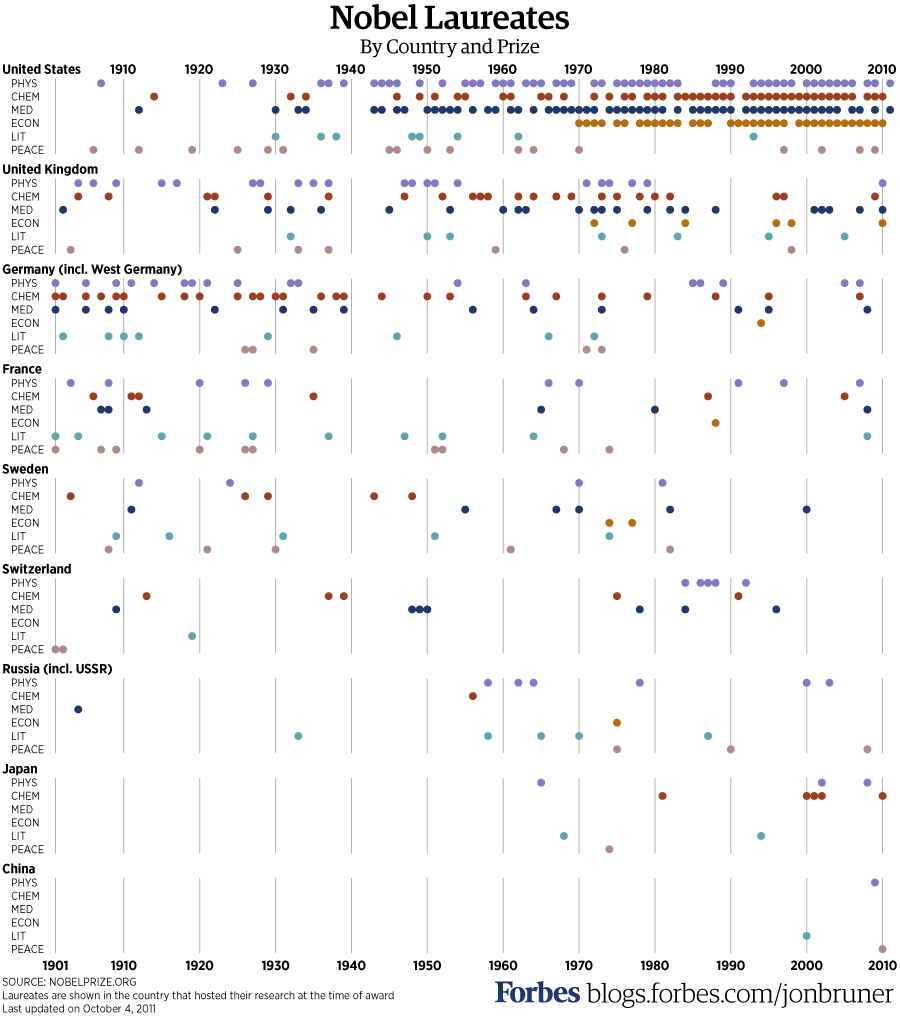
1/ This graph from @JonBruner tells an important story: America's current dominance in science only began after the mid-1930s, when persecuted scientists began fleeing universities in Germany and then elsewhere in occupied Europe.
You've heard of the studies where they give the same dataset/research question to a bunch of researchers and they tend to get different answers, right?
Why is that?
This new working paper shows that it has a lot to do with data cleaning.
This is consistent with Gelman's "garden of forking paths" analogy. Small researcher coding decisions greatly influence results, often without being explicitly acknowledged.
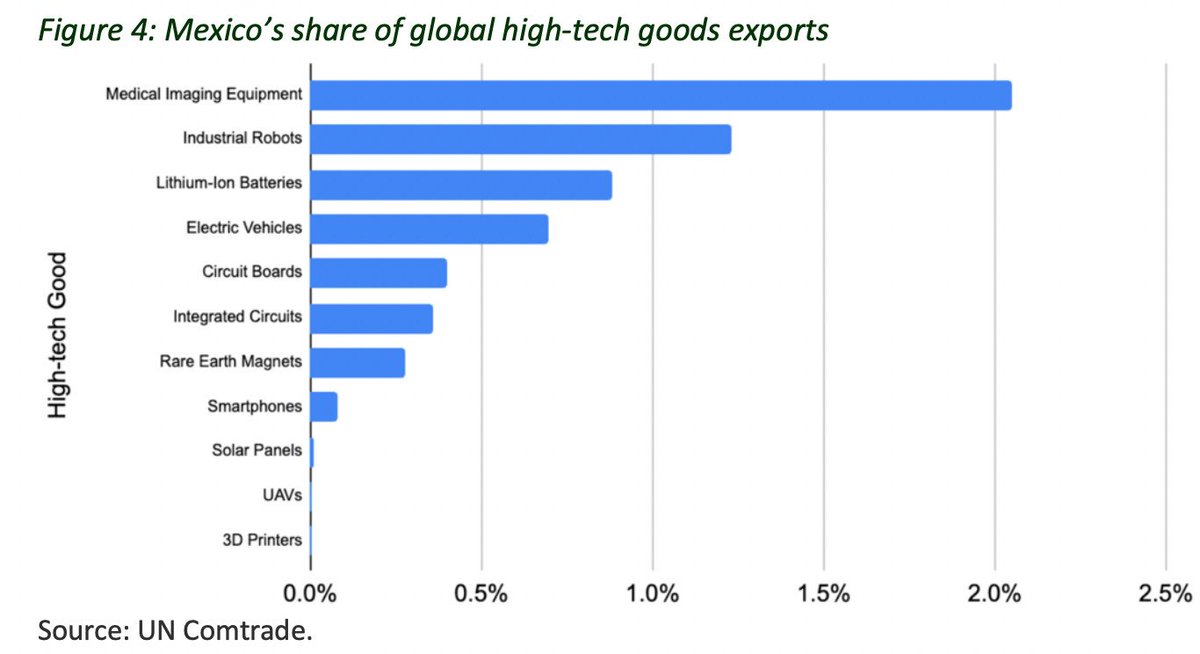
Mexico's president Claudia Sheinbaum is an energy systems expert. She is positioning Mexico to lead in the global green economy —from EVs & batteries to Renewables,Critical minerals,HVAC manufacturing. Her Plan Mexico is at a critical juncture. Our report:
https://t.co/YFPeRpGN3Z
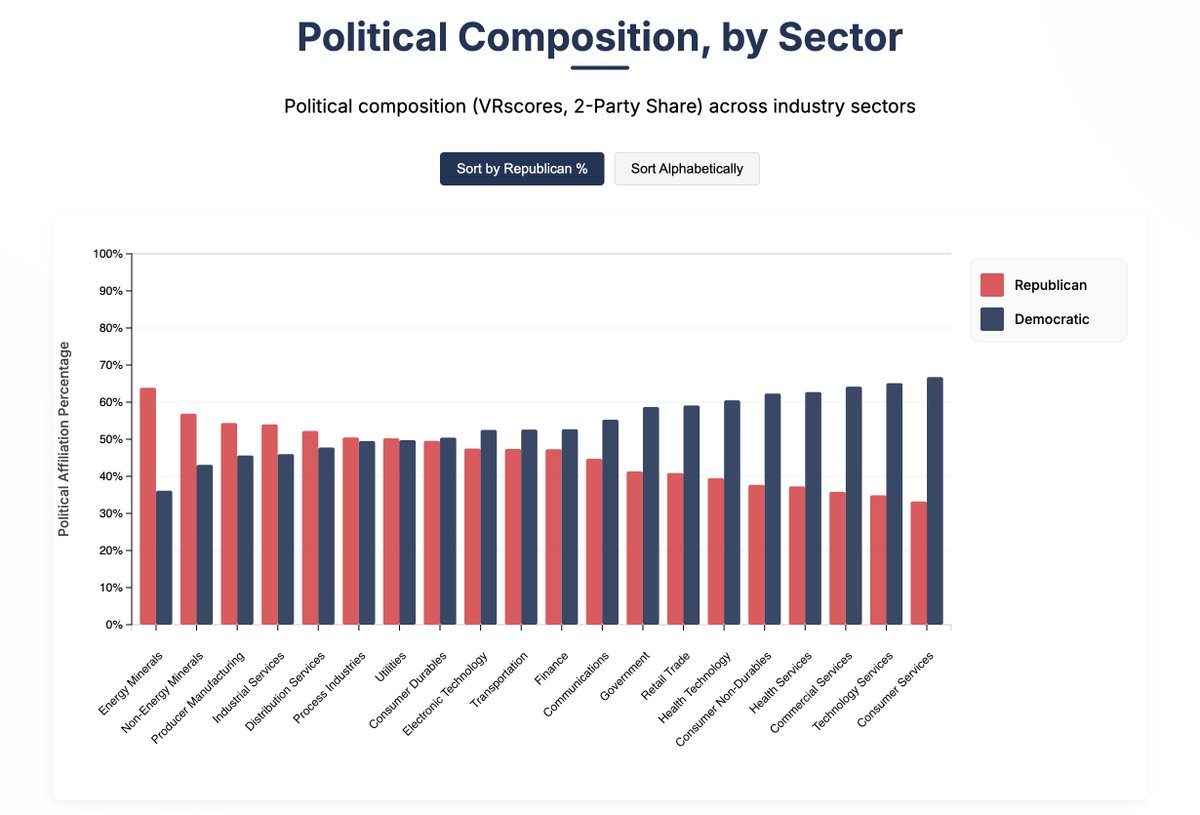
Overall, many employers in their sample have a distinct Democratic tilt. Look at how few sectors are dominated by Republicans!
{This could have something to do with what orgs are in their database, but their sample is quite large!}
Now, looping back around, how does a dive bar tie into this?
When our team visited the mill, we would stay in Memphis, about an hour away. At the end of the day, we would swing by the closest bar—Bar Dog—for a nightcap.
And the bar was usually full of people speaking German.
@JeffWeniger@Noahpinion I lived in France, Switzerland and the US. I had the highest salary in the US, but it still felt way less than in the other two countries.
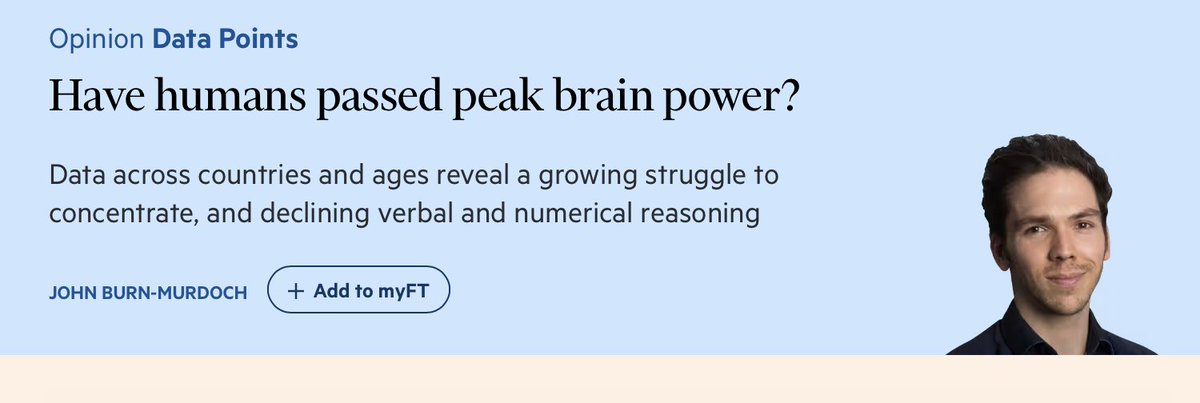
NEW 🧵: Is human intelligence starting to decline?
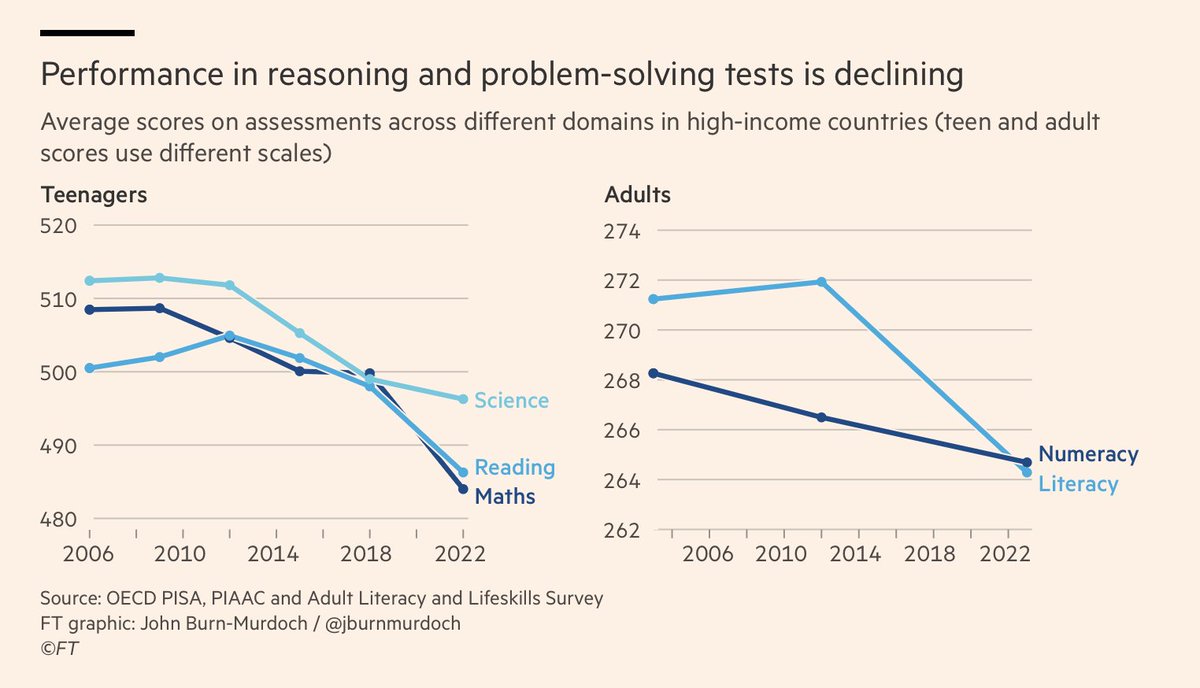
Recent results from major international tests show that the average person’s capacity to process information, use reasoning and solve novel problems has been falling since around the mid 2010s.
What should we make of this?