Hi X!
I’m Dat Tran, a researcher at Stanford working on LLM reasoning, agent systems, and decision support/recommender systems. I’ll use this account to share new papers, experiments, results, and thoughts on building reliable AI systems. Excited to connect!
There is a lot of excitement around creating complex orchestrations of multiple AI agents. But do multi-agent systems really outperform single-agent setups?
A new study shows that, given a fixed reasoning budget, in most tasks, single agents outperform mutliple agents on most tasks. The overhead of summarizing and passing messages between agents consumes extra tokens and causes information loss. In contrast, the single agent handles everything in a single, contiguous context, which makes it more efficient and accurate.
The one situation where multiple agents hold the advantage is noisy and corrupt contexts that confound a single LLM agent. In that case, the cleanup and orchestration of multiple agents improves performance.
The main takeaway is, don't jump on the multi-agent bandwagon before testing out single-agent setups thoroughly. They are simpler, easier to manage, and more efficient. When you hit the ceiling of what you can do with one agent, then consider adding more.
Very cool to see our @stanfordnlp paper on multi-agent systems get covered by @bendee983 in @VentureBeat.
More agents, better results, right? Not so fast.
Enterprises may be paying a "swarm tax" for multi-agent AI that's really just spending more compute, not reasoning better. Stanford has the receipts.
https://t.co/IEG47ad4kQ
[CL] Single-Agent LLMs Outperform Multi-Agent Systems on Multi-Hop Reasoning Under Equal Thinking Token Budgets
D Tran, D Kiela [Stanford University] (2026)
https://t.co/wIWG9B6V04
NEW paper on multi-agents from Stanford.
More agents, better results, right?
Not so fast.
This paper challenges a core assumption in the multi-agent hype by controlling for what most studies don't: total computation.
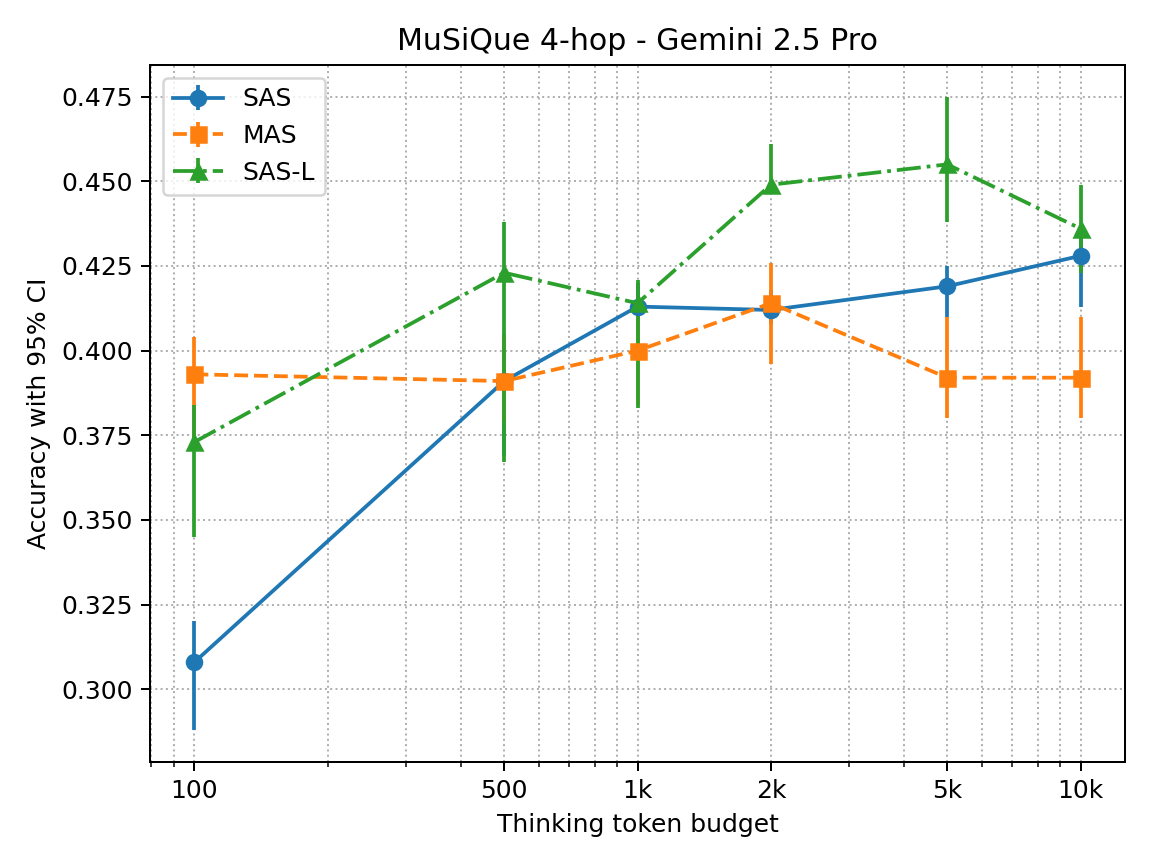
It compares single-agent and multi-agent LLM architectures on multi-hop reasoning under matched thinking-token budgets across different models.
The finding is clear:
Single-agent systems are more information-efficient when reasoning tokens are held constant. The authors also identify significant artifacts in API-based budget control that may artificially inflate multi-agent advantages.
Why does it matter?
Many reported multi-agent gains disappear once you account for unequal computation.
Before building a multi-agent system, check whether a single agent with the same token budget would do the job. This paper gives you the framework to make that call.
Paper: https://t.co/XJLFC83qm3
Learn to build effective AI agents in our academy: https://t.co/1e8RZKs4uX
We also test the theory over a Gemini models' version sweep (Gemini 2 to Gemini 3 Pro), uncover evaluation pitfalls, including API budgeting artifacts and benchmark issues that can make MAS look better than they really are.
Paper link: https://t.co/7cJ8EFEvHM
New paper: Single-Agent LLMs Outperform Multi-Agent Systems on Multi-Hop Reasoning Under Equal Thinking Token Budgets
Do multi agent LLM systems really reason better, or do they just get more computation?
In my paper with @douwekiela, we compare single agent vs multi agent systems under equal thinking token budgets and find that single agent systems consistently match or outperform multi agent architectures on multi-hop reasoning.
But MAS is not useless.
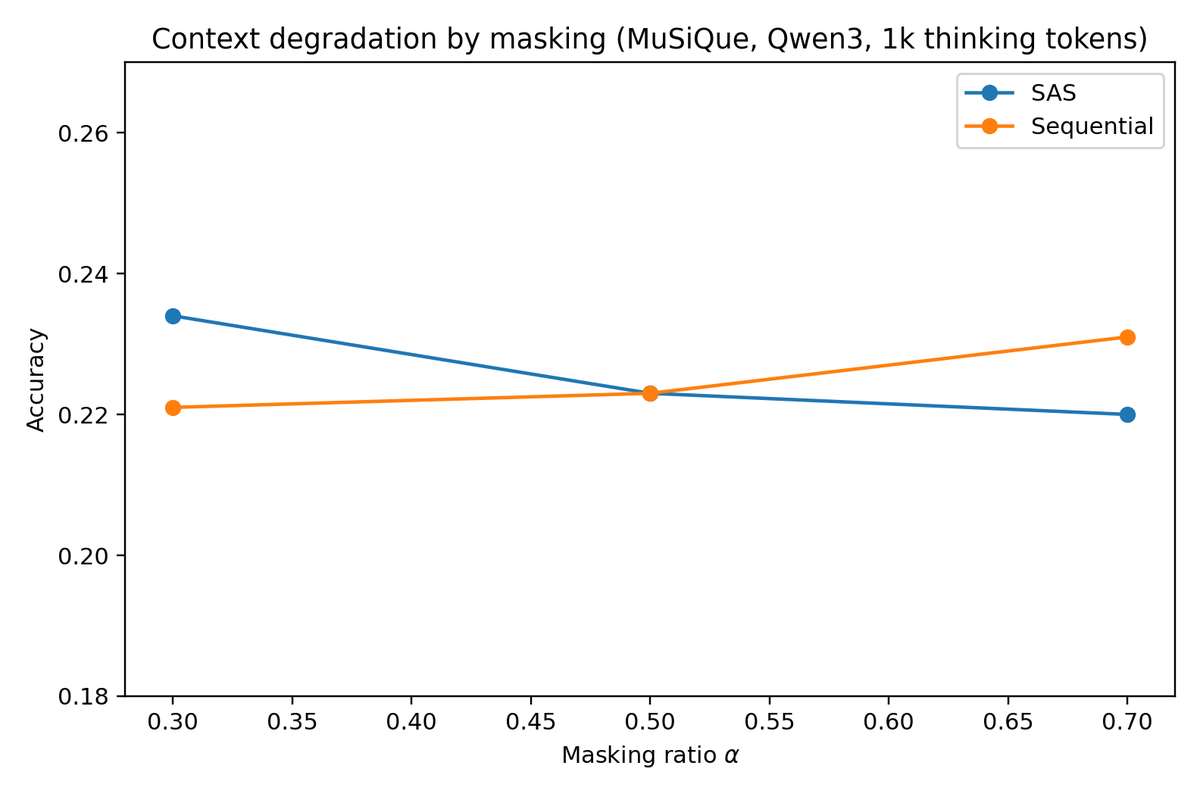
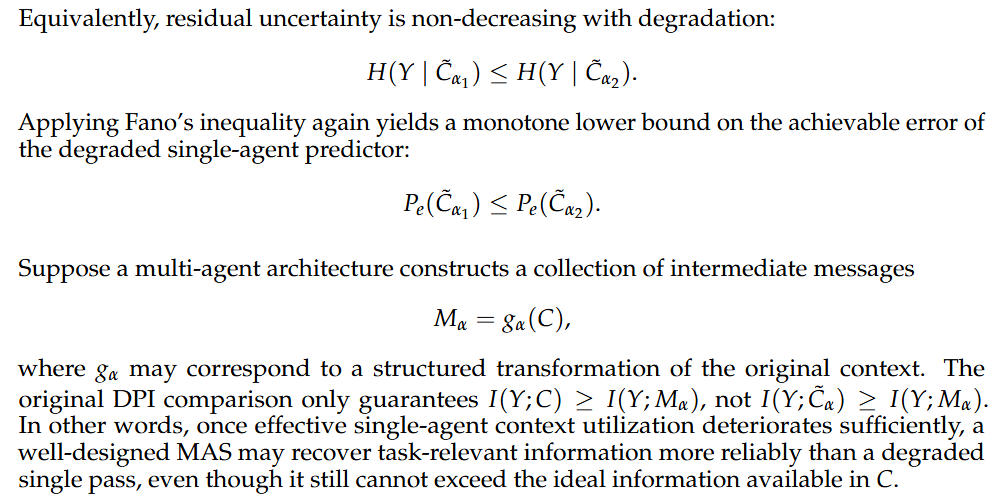
Our theory predicts - and our experiments support - that MAS can become more competitive when the single agent’s effective context utilization degrades.
That is exactly what we see in our context degradation experiments.


![fly51fly's tweet photo. [CL] Single-Agent LLMs Outperform Multi-Agent Systems on Multi-Hop Reasoning Under Equal Thinking Token Budgets
D Tran, D Kiela [Stanford University] (2026)
https://t.co/wIWG9B6V04 https://t.co/9nB2KfxtjY](https://pbs.twimg.com/media/HFQKwoQasAAOfgO.jpg)
![fly51fly's tweet photo. [CL] Single-Agent LLMs Outperform Multi-Agent Systems on Multi-Hop Reasoning Under Equal Thinking Token Budgets
D Tran, D Kiela [Stanford University] (2026)
https://t.co/wIWG9B6V04 https://t.co/9nB2KfxtjY](https://pbs.twimg.com/media/HFQKwbZa4AA-cvJ.jpg)
![fly51fly's tweet photo. [CL] Single-Agent LLMs Outperform Multi-Agent Systems on Multi-Hop Reasoning Under Equal Thinking Token Budgets
D Tran, D Kiela [Stanford University] (2026)
https://t.co/wIWG9B6V04 https://t.co/9nB2KfxtjY](https://pbs.twimg.com/media/HFQKwAEaUAAlhc1.png)







![fly51fly's tweet photo. [CL] Single-Agent LLMs Outperform Multi-Agent Systems on Multi-Hop Reasoning Under Equal Thinking Token Budgets
D Tran, D Kiela [Stanford University] (2026)
https://t.co/wIWG9B6V04 https://t.co/9nB2KfxtjY](https://pbs.twimg.com/media/HFQKw1ZbcAAZ2eQ.jpg)