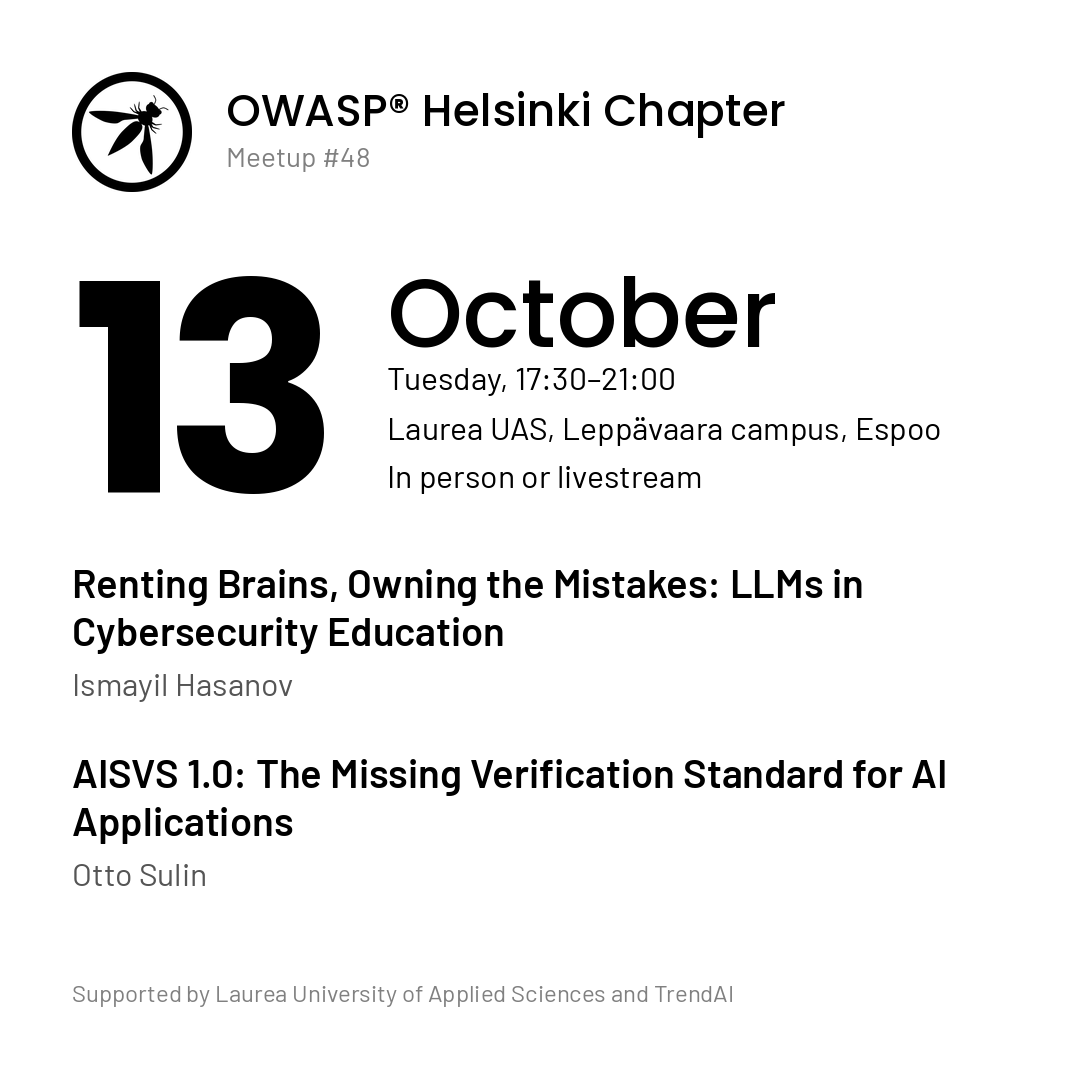
Registration is now open! 🚨
Attend the OWASP Helsinki Chapter meetup #48 either in-person or by watching the livestream!
Register here: https://t.co/DfEi0kcVzI
See you at the meetup!
#OWASP#OWASPHelsinki#AppSec#CyberSecurity#Helsinki#AISVS
OWASP Helsinki Chapter meetup coming soon! 🎉
We will host our next event on 13th of October and registration opens already on September 21st!
More details about the event: https://t.co/DfEi0kcVzI
#OWASP#OWASPHelsinki#AppSec#Helsinki#AISVS
‼️ BREAKING: OpenAI was hacked by an Anthropic model. A HEIF photo uploaded to OpenAI's public support forum triggered a bug in the site's image decoder, led to code execution on the forum, and, through a second flaw in OpenAI's own login, ended with a pull request in OpenAI's internal GitHub.
The forum runs Discourse, the off-the-shelf software behind countless community sites. Discourse was still shipping an old copy of libheif, the library that decodes iPhone-style photos. The bug in it had already been fixed upstream.
But the fix was never labelled a security fix, so nobody treated it as urgent.
Hacktron's researchers uploaded a HEIF image and got their own code running on community[.]openai[.]com.
Then came the second bug, in OpenAI's own single sign-on, the "log in with OpenAI" button the forum uses. It turned that forum foothold into the actual ChatGPT and Codex accounts of people who had signed in there. OpenAI employees among them.
And a ChatGPT account is no longer just a chatbot. Through Codex, users wire in Gmail, Outlook, Drive, Slack, GitHub.
To prove the access was real, they used one employee account to have Codex open a harmless pull request in OpenAI's internal repo. They say they read no sensitive code.
OpenAI patched the SSO flaw roughly 14 hours after the report and paid a $6,500 bug bounty.
The team says Anthropic's Opus 4.8 found the libheif bug, and Opus 5 turned it into a working exploit.
Slack, Meta, GitHub Ent, Rails, Next.js, ImageMagick, and many more were also vulnerable and compromised by the same team of researchers.
We're publishing our most detailed threat intelligence report to date.
It covers how people tried to misuse Claude—for cyberattacks, influence operations, surveillance, biology, and building weapons—and how we found and stopped them.
We disrupted every operation in the report, and used the lessons from them to strengthen our safeguards. Where appropriate, we also shared what we found with authorities and other AI companies.
These cases are not typical: we’re highlighting some of the most sophisticated misuse we’ve seen. But they’re especially important to discuss, because they show us where AI misuse is headed, where our safeguards work, and where they need to improve.
We’re publishing this report so others can spot the same activity on their own platforms, and so we can give the public a clearer view of how emerging threats develop.
Read the report: https://t.co/0EJUnYEgfz
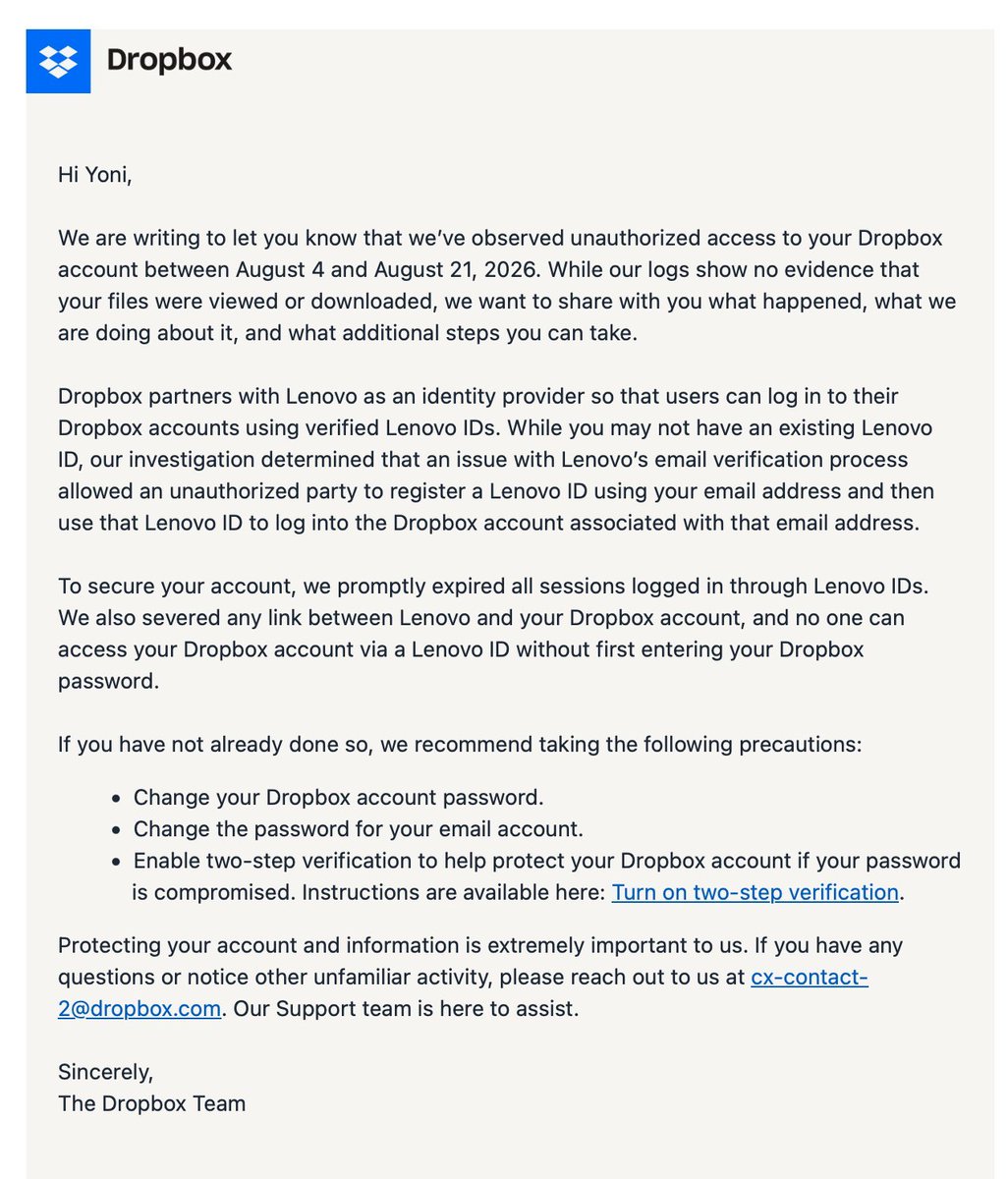
‼️ BREAKING: Dropbox says around 5,000 accounts were accessed without authorisation between 4 and 21 August, with files viewed or downloaded in fewer than a third of them.
Registering a Lenovo ID with someone else's email address was enough. Dropbox trusted Lenovo's verification and handed over a session.
Dropbox has terminated every Lenovo ID session and notified regulators.
⚡ A VoLTE exploit chain can give attackers full Android kernel access.
The Unisoc chain starts with modem RCE, then lets modem code modify Android kernel memory. It requires attacker-controlled 4G infrastructure and the victim to answer the video call.
No patch is available.
Details: https://t.co/oH0NKZGy3M
‼️🚨 ALARMING: Google now treats privacy as suspicious behavior by default. Users of GrapheneOS, CalyxOS, /e/OS, and other deGoogled Android phones are being locked out of millions of websites unless they install the exact Google Play Services software they deliberately removed.
GrapheneOS is recommended by the EFF and used by journalists, lawyers, and activists in high-risk environments. The audience most likely to read Google's data practices and refuse its terms is now flagged as fraudulent for that exact decision.
What happened?:
▪️ Google announced "Cloud Fraud Defense" at Cloud Next on April 22-23, 2026, branding it "the next evolution of reCAPTCHA." Existing reCAPTCHA customers were auto-migrated.
▪️ When the system flags traffic as suspicious, the old click-the-bus puzzle is gone. Users get a QR code instead.
▪️ Scanning the QR code requires Google Play Services running on the device. Internet Archive snapshots show this requirement has been live since at least October 2025, silently rolled out for 7 months before anyone noticed.
▪️ No Play Services = no QR scan = locked out.
The bigger picture:
▪️ Google already tried this in 2023. It was called Web Environment Integrity (WEI), and it would have let Google decide which devices were "real enough" to access the web. Standards bodies and the public pushed back hard, and Google killed it. Three years later, the same idea is back, just hidden behind a QR code instead of a browser feature.
▪️ reCAPTCHA runs on millions of websites. Every developer who keeps using it is now, by default, telling deGoogled Android users they're not welcome...
The video recording of my talk: “Automated Security Testing with OWASP Nettacker” from NDC Security 2026 Conference in Oslo is now available on YouTube: 🎥
#Nettacker
👇
https://t.co/tpmIUlNrrS
⚠️ #Linux: Major Linux distributions are impacted by a Privilege Escalation Vulnerability dubbed "CopyFail" (CVE-2026-31431) which sat undetected since 2017.
A 732-byte Python script allows any user on Linux to become root:
#CopyFail#LPE
👇
https://t.co/zhsWrqSpEc
⚠️ #Vercel hacked.
The popular platform behind tens of thousands of AI apps and the creator of NextJS framework has confirmed a breach. Hackers claiming to be ShinyHunters are selling stolen customer + employee data:
#databreach
👇
https://t.co/R9CXwVuhdn
🛑 Meta will shut down Instagram’s end-to-end encrypted chats on May 8, 2026.
Users with affected conversations will get instructions to download messages or media before the change.
🔗 Read → https://t.co/qHKNzvELIU
The UK confirmed its plan to end private messaging.
Ofcom is now being handed power to scan encrypted chats under the Online Safety Act. They’re calling it “client-side scanning.” What it means: every message on your phone gets checked before it’s encrypted.
This isn’t safety. It’s surveillance.


![IntCyberDigest's tweet photo. ‼️ BREAKING: OpenAI was hacked by an Anthropic model. A HEIF photo uploaded to OpenAI's public support forum triggered a bug in the site's image decoder, led to code execution on the forum, and, through a second flaw in OpenAI's own login, ended with a pull request in OpenAI's internal GitHub.
The forum runs Discourse, the off-the-shelf software behind countless community sites. Discourse was still shipping an old copy of libheif, the library that decodes iPhone-style photos. The bug in it had already been fixed upstream.
But the fix was never labelled a security fix, so nobody treated it as urgent.
Hacktron's researchers uploaded a HEIF image and got their own code running on community[.]openai[.]com.
Then came the second bug, in OpenAI's own single sign-on, the "log in with OpenAI" button the forum uses. It turned that forum foothold into the actual ChatGPT and Codex accounts of people who had signed in there. OpenAI employees among them.
And a ChatGPT account is no longer just a chatbot. Through Codex, users wire in Gmail, Outlook, Drive, Slack, GitHub.
To prove the access was real, they used one employee account to have Codex open a harmless pull request in OpenAI's internal repo. They say they read no sensitive code.
OpenAI patched the SSO flaw roughly 14 hours after the report and paid a $6,500 bug bounty.
The team says Anthropic's Opus 4.8 found the libheif bug, and Opus 5 turned it into a working exploit.
Slack, Meta, GitHub Ent, Rails, Next.js, ImageMagick, and many more were also vulnerable and compromised by the same team of researchers.](https://pbs.twimg.com/media/HSfMnaBXsAEkTHf.jpg)








![IntCyberDigest's tweet photo. ‼️ BREAKING: OpenAI was hacked by an Anthropic model. A HEIF photo uploaded to OpenAI's public support forum triggered a bug in the site's image decoder, led to code execution on the forum, and, through a second flaw in OpenAI's own login, ended with a pull request in OpenAI's internal GitHub.
The forum runs Discourse, the off-the-shelf software behind countless community sites. Discourse was still shipping an old copy of libheif, the library that decodes iPhone-style photos. The bug in it had already been fixed upstream.
But the fix was never labelled a security fix, so nobody treated it as urgent.
Hacktron's researchers uploaded a HEIF image and got their own code running on community[.]openai[.]com.
Then came the second bug, in OpenAI's own single sign-on, the "log in with OpenAI" button the forum uses. It turned that forum foothold into the actual ChatGPT and Codex accounts of people who had signed in there. OpenAI employees among them.
And a ChatGPT account is no longer just a chatbot. Through Codex, users wire in Gmail, Outlook, Drive, Slack, GitHub.
To prove the access was real, they used one employee account to have Codex open a harmless pull request in OpenAI's internal repo. They say they read no sensitive code.
OpenAI patched the SSO flaw roughly 14 hours after the report and paid a $6,500 bug bounty.
The team says Anthropic's Opus 4.8 found the libheif bug, and Opus 5 turned it into a working exploit.
Slack, Meta, GitHub Ent, Rails, Next.js, ImageMagick, and many more were also vulnerable and compromised by the same team of researchers.](https://pbs.twimg.com/media/HSfM0WjWkAAIWyI.jpg)