I agree that the Space theme is timely! The SpaceX IPO has brought huge attention, and $PL is indeed one of the most fundamentally solid stocks—its backlog has exceeded $900 million, its FY27 revenue guidance has been raised to $415-440 million, and it has also achieved positive adjusted EBITDA.
However, the sector as a whole was "selling the news" today, with $RKLB/$RDW both showing significant pullbacks. Your strategy of "slowly building a position near the MA" is very sound; I will wait for $PL to pull back to around $30-35 before adding to my position. I personally am most bullish on $PL.
At today’s Piper Sandler Global Exchange & Fintech Conference , $MIAX management directly addressed the very concerns that triggered the selloff in exchange stocks like $CBOE $NDAQ $ICE and largely dismantled them.
CEO Tom Gallagher first took apart the market-size argument: perpetual futures providers measure their market in notional value because the high leverage inflates the numbers and makes the market look bigger than it really is. That distorts any comparison to the 0DTE options market.
More important was his structural point: perps and options are not substitutes. With an option, your loss is capped at the premium you paid, no matter what the market does. With a leveraged perpetual future on a single stock that could open at zero or double the next day, there’s no defined exit point. Two entirely different risk profiles.
CSO Shelly Brown, herself a former market maker, added the critical liquidity problem: market makers only provide liquidity when they know they can hedge their positions. Without an established hedging market, there’s no depth, and without liquidity, no institutional volume.
Strategically, MIAX stays flexible: Gallagher said they’ll evaluate perpetual futures case-by-case rather than ruling them out entirely. Classic croupier logic, if the product gains traction, MIAX can offer it itself. if it doesn’t, nothing is lost.
Bottom line: the selloff was a headline reaction. Management confirmed firsthand today that the fundamental analysis points the other way.
CBOE: Why the Market Is Underestimating the Story
$CBOE is one of the highest-quality exchange businesses in the world. The market is focused on prediction-market competition while ignoring record earnings, raised guidance, secular growth in options trading, and one of the strongest regulatory moats in financial services.
1. Record Earnings, Record Execution
CBOE continues to produce best-in-class operating results.
Record revenue.
Strong double-digit EPS growth.
Raised guidance.
Expanding margins.
Consistent share repurchases and dividend growth.
Unlike many financial stocks, CBOE is not dependent on credit quality, loan growth, or balance-sheet risk. It earns fees from market activity.
2. Structural Growth in Options Trading
The options market continues to grow faster than the broader equity market.
Key drivers:
Retail options adoption.
Institutional hedging demand.
Growth of 0DTE trading.
Increased volatility management needs.
Systematic and quantitative trading strategies.
Every year that options become a larger part of portfolio management, CBOE benefits.
3. Monopoly-Like Assets
CBOE owns some of the most valuable financial products globally.
Notably:
VIX ecosystem.
SPX index options.
Proprietary market data.
Deep liquidity networks.
These products cannot easily be replicated by competitors.
Many investors underestimate how powerful proprietary index products become once liquidity reaches critical mass.
4. Prediction Markets Are Likely Overblown
The market narrative is that prediction markets will disrupt traditional exchanges.
The reality:
Prediction markets face significant regulatory scrutiny.
Insider trading concerns become more severe as contract types expand.
Regulators have decades of experience supervising securities and derivatives markets.
Event contracts involving material nonpublic information are likely to face increasing oversight.
As prediction markets grow, compliance burdens and surveillance requirements will likely increase rather than decrease.
The more important point: prediction markets are not replacing institutional hedging.
A pension fund managing billions is not replacing SPX options with election bets.
Prediction markets may become a niche adjacent market, but they do not replicate the risk-transfer function of listed options.
5. Volatility Is a Feature, Not a Bug
Most businesses suffer when volatility rises.
CBOE often benefits.
When markets become uncertain:
Trading volumes increase.
Hedging demand rises.
VIX products gain activity.
Options volumes expand.
Few companies have such a natural hedge against market stress.
6. Massive Operating Leverage
Exchange businesses have exceptional economics.
Once infrastructure is built:
Additional trading volume carries very high margins.
Revenue growth often outpaces expense growth.
Earnings can compound faster than revenue.
This is why the best exchange operators often trade at premium valuations.
7. Peer Comparison Suggests Upside
Compared with:
CME Group
Intercontinental Exchange
CBOE has:
Faster options growth.
Greater exposure to volatility products.
Significant international expansion opportunities.
Proprietary products that are difficult to displace.
If execution continues, valuation multiple expansion remains possible.
What Could Make the Stock Work
A plausible 3-year path:
Continued growth in SPX and VIX volumes.
Sustained 0DTE adoption.
Ongoing market-data revenue growth.
Margin expansion.
Continued buybacks.
Prediction-market fears fade as investors realize the businesses are not direct substitutes
Conclusion
The prediction markets remain a heavily regulated niche while CBOE continues doing what it has done for years: compound earnings through proprietary products, rising options activity, operating leverage, and one of the strongest regulatory moats in capital markets.
If that view is correct, the market is focusing on a speculative future threat while ignoring a company currently delivering record earnings & raising guidance.
LONG $CBOE
Why $CBOE and $CME Are Selling Off And Why It is an Overreaction.
The market is reacting to the CFTC's approval of regulated perpetual futures in the U.S., beginning with Bitcoin products. Investors immediately jumped to the conclusion that perpetual futures could eventually compete with traditional futures and options, threatening the moat of exchange operators like Cboe Global Markets and CME Group. Shares sold off sharply: CBOE ~9% and CME ~4% in a single session.
What the Market Is Pricing In?
The market appears to be assuming:
Perpetual futures become mainstream.
Retail traders migrate away from traditional futures/options.
New entrants like Kalshi and crypto-native firms take share.
Exchange fee economics compress.
CME and CBOE lose their long-term growth runway.
That's a lot of assumptions packed into a few trading days.
Why I Think the Selloff Is Overdone
1. Perps Are Not a Substitute for CME's Core Business
CME's franchise is institutional risk transfer:
Interest rate futures
Treasury futures
Energy futures
Agricultural futures
FX futures
The world's banks, hedge funds, pension funds, and corporates use CME for hedging and capital-efficient clearing.
Perpetual crypto contracts are largely speculative products. Even analysts acknowledging the threat note that perps are primarily retail-focused and poorly suited for institutional hedging.
Bitcoin perps are not replacing Eurodollar, Treasury, WTI, or SOFR futures.
2. CBOE Is Benefiting From Structural Growth, Not Just Market Cycles
Options activity continues to hit records.
Industry options volume reached new highs in Q1 2026.
Index option volume grew ~22%.
ETF option volume grew ~24%.
VIX options had one of their strongest quarters ever.
Cboe Global Markets
The retail options boom, 0DTE growth, and volatility products remain powerful secular trends.
The market suddenly decided that a new crypto product destroys that franchise. The evidence doesn't support that.
3. Exchanges Usually Adapt Faster Than Investors Expect
History:
ETFs didn't kill exchanges.
Electronic trading didn't kill exchanges.
Crypto futures didn't kill exchanges.
The incumbents usually end up listing, clearing, or facilitating the new products themselves.
If perpetual futures become a huge market, the most likely outcome isn't "CME loses."
It's:
"CME launches perps too."
4. The Moat Is Clearing, Not Matching
The market often values exchanges as trading venues.
The real moat is:
Clearing infrastructure
Regulatory approvals
Institutional relationships
Risk management systems
Liquidity networks
Those are incredibly difficult to replicate.
A startup can launch a contract.
It cannot instantly replicate decades of clearing and liquidity infrastructure.
5. Fundamentals Have Not Changed
Nothing happened this week to:
CME's interest rate franchise
CME's Treasury franchise
CBOE's index options franchise
VIX licensing revenues
Clearing revenues
Cash generation
Only sentiment changed.
The Valuation Opportunity
The market is treating this as a structural disruption event.
But if the actual impact ends up being:
modest retail competition,
limited institutional adoption,
and eventual participation by incumbents,
then today's move is multiple compression without earnings impairment.
That's exactly the kind of setup long-term investors look for.
Investment Conclusion
CME: I would rate the selloff as an overreaction unless you believe perpetual futures will fundamentally replace institutional hedging markets. The evidence today suggests they won't.
CBOE: The selloff looks even more exaggerated because its options franchise continues to benefit from record volumes, 0DTE adoption, and volatility-product growth.
My Base Case
Market is pricing a 10/10 disruption scenario.
Reality is more likely a 1–2/10 competitive threat.
Exchange moats remain intact.
Earnings power 3–5 years from now probably changes far less than the stock price suggests.
This is a great opportunity to go long $CBOE and $CME imo
So apparently $CBOE $ICE $CME and $MIAX are drawing down because the Commodity Futures Trading Commission has allowed Kalshi and Coinbase to introduce a new derivatives product - perpetual crypto futures.
"Perpetual futures, or "perps", are derivatives that lack a traditional expiration date, allowing traders to maintain positions indefinitely without the need to roll over contracts. These instruments also permit high degrees of leverage — often as much as 50-to-1 — enabling investors to amplify their exposure to market moves."
This is apparently the first time that these products have been offered in the US.
Thomson Reuters frames the sentiment/fears in the following way: "The move has sparked concerns that perpetual futures approval for other asset classes could raise competition for incumbent derivatives exchange platforms".
My immediate thoughts are:
1) The approval of a new type of derivate product is a good thing for incumbent exchange businesses. More products = more trading = more volume = more fees = more revenues = more operating income at very high margins. Offering new products for trading is part of their business model.
2) There is nothing proprietary about the contract structure itself. In other words, the incumbents can offer perps with regulatory approval. In fact, "the CFTC issued a policy statement encouraging Designated Contract Markets (DCMs) that wish to list perpetual contracts referencing asset classes not covered by the Order (e.g., agricultural products, precious metals, equity securities, narrow-based security indexes) to voluntarily submit those contracts for Commission review and approval under Regulation 40.3". [Lowenstein Sandler: https://t.co/CPAP5BghTE]
3) Incumbent revenues and earnings are mostly insulated because perps are not a substitute for their main products and services. Perps are not a substitute for options or derivatives settled with physical delivery; and data licensing segments are unaffected.
4) Competition is not fatal to exchange businesses. As Horizon Kinetics points out in their Q3'23 letter (See "The Competition Question"):
a) Exchanges usually have proprietary products - e.g., CBOE's exclusive rights to trade S&P 500 Index options through December 31, 2032;
b) Exchanges can always expand their product offerings around their main products;
c) "The very existence of a related or even identical product on a different exchange creates additional trading and arbitrage opportunities between the two, since slight momentary price differences arise, so that both exchanges experience increased volume";
d) "Trading begets more trading. Anything that lowers the barriers to transacting, like greater volume and liquidity, lower fees, faster execution, better data access and analysis, also begets more trading. The size of the pie is not fixed".
5) Nothing has impacted the incumbents' ability to compound their earnings in their existing business lines as toll booths on the overall volume of trading of securities. They continue to benefit from volatility in good times and bad. To quote HK: "As a croupier, [the securities exchange] simply collects the fees for accessing and participating in the venue it operates. It is true that if trading volumes decline, there will be earnings leverage on the downside, just as there is on the upside. But unless there will be a permanent decline in activity, it will be merely interim cyclicality".
Net assessment: Drawdown is unwarranted; presents an opportunity.
Let me know if you disagree or if I'm missing something.
Why the Kalshi and Hyperliquid Panic Is Likely an Overreaction
The recent selloff in $Cboe shares reflects growing investor concerns that emerging platforms such as Kalshi and Hyperliquid could disrupt traditional exchange operators. While these concerns are understandable, the market may be dramatically overestimating both the speed and magnitude of the threat.
Neither platform currently competes meaningfully with the core profit engines that make Cboe valuable.
Cboe's business is built around:
- Index options
- Equity options
- Volatility products
- Market data
- Institutional trading infrastructure
- Regulatory and clearing relationships
These businesses have been built over decades and benefit from enormous liquidity networks. Liquidity attracts liquidity. Institutional traders cannot simply move billions of dollars of exposure to a new venue overnight.
The economic moat is much wider than many investors appreciate.
Cboe's Biggest Products Remain Unchallenged
The crown jewel of Cboe is not crypto derivatives.
It is its options ecosystem, particularly index options and volatility products.
Many institutional investors, pension funds, asset managers, insurance companies, and hedge funds rely on these products for portfolio management and risk transfer. These users need deep liquidity, sophisticated clearing infrastructure, and regulatory certainty.
Neither Kalshi nor Hyperliquid currently offers a realistic substitute.
A "Will the S&P 500 finish above X?" contract is not a replacement for a sophisticated options strategy involving delta, gamma, volatility, and portfolio hedging.
Prediction markets may expand the overall derivatives universe, but that does not automatically mean they replace options.
Financial regulation moves slowly. Product approvals take time. New markets require legal clarity, surveillance systems, clearing arrangements, risk management frameworks, and liquidity providers.
Investors appear to be discounting a competitive threat that may not materially affect Cboe's earnings until the 2030s.
Hyperliquid Is More Threatening to Crypto Exchanges Than to Cboe
Hyperliquid's success demonstrates demand for decentralized derivatives.
But the primary losers from Hyperliquid's growth are likely to be centralized crypto exchanges, not traditional options exchanges.
Today, Hyperliquid's user base is overwhelmingly crypto-focused.
For Hyperliquid to become a direct threat to Cboe, several major developments would need to occur:
1. Tokenized securities become widely accepted.
2. Regulators allow large-scale on-chain trading of traditional assets.
3. Institutional investors migrate significant volume on-chain.
4. Liquidity reaches levels comparable to major exchanges.
That is a multi-year, potentially decade-long transition.
Cboe Continues to Benefit From Structural Growth,
While investors focus on hypothetical future disruption, Cboe continues to benefit from several powerful trends:
- Growing retail options participation
- Increased institutional demand for hedging
- Rising volatility trading activity
- Expansion of international operations
- Growth in recurring market data revenues
- Increasing use of options-based income strategies
These drivers are generating earnings today.
The market is assigning significant weight to competitive threats that remain largely theoretical while potentially overlooking the durability of Cboe's existing franchise.
Valuation Could Be Discounting Too Much Future Risk,
The market reaction suggests investors fear a future in which traditional exchanges lose relevance.
If meaningful competitive pressure from Kalshi or Hyperliquid does not emerge for five to ten years, then today's selloff may represent investors discounting distant risks as if they were immediate earnings threats.
In investing, timing matters just as much as direction.
LONG $CBOE $CME $ICE
CBOE GLOBAL MARKETS ($CBOE)
CBOE is no longer simply an exchange operator.
It is becoming the core infrastructure layer behind the global growth of derivatives trading.
The company owns some of the most valuable products in finance, including VIX and SPX options, creating a durable moat that competitors cannot easily replicate.
The secular drivers remain powerful:
• Explosive growth in options trading
• Expansion of 0DTE products
• Increasing institutional hedging activity
• Growth in retail derivatives participation
• Global demand for U.S. market exposure
• Expansion toward extended-hours and eventually near-24/5 trading
The recent SEC approval for pre-market and post-market single-stock options may represent the beginning of a major new revenue stream.
Historically, some of the largest market-moving events occurred when options markets were closed.
Beginning in July 2026, CBOE will begin monetizing portions of that previously inaccessible trading window.
The company also combines growth with profitability.
Unlike many financial-technology stories, CBOE already generates substantial earnings, strong cash flow, and industry-leading margins.
Key Reasons To Own
1. Proprietary monopoly-like assets (VIX and SPX ecosystems)
2. Direct exposure to long-term growth in options trading
3. Potential beneficiary of 24/5 market structure evolution
4. Strong earnings momentum and raised guidance
5. High-margin recurring revenue model
6. Regulatory and network-effect moat
7. Volatility often increases demand for its products
Long-Term View
If options become a larger percentage of global trading activity over the next decade and markets continue moving toward nearly continuous trading, CBOE could emerge as one of the most important financial infrastructure businesses in the world.
The market currently values CBOE as a premium exchange.
The bull case is that investors eventually value it as a premium platform company.
Today's dip is a gift.
$CBOE
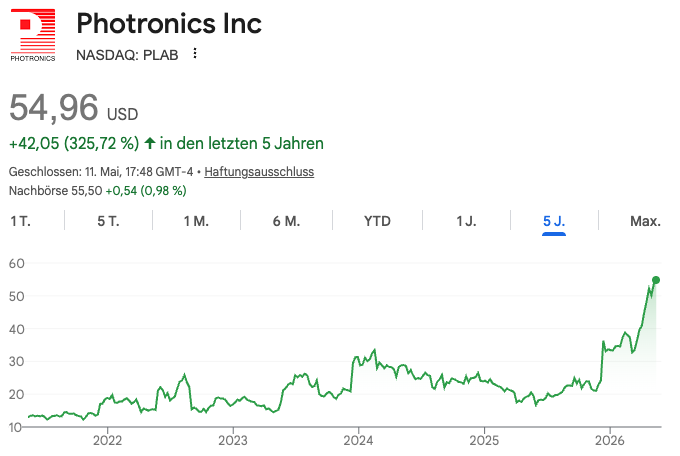
Jede Nvidia-Chip wird aus einer Schablone gedruckt. Diese Schablone heißt Photomask. Ohne sie gibt es keinen Chip, keine KI, kein Rechenzentrum. Photronics baut genau diese Schablonen seit 1969 und ist heute einer der weltweiten Marktführer in einem Nischenmarkt mit hohen Eintrittsbarrieren, den fast niemand kennt. Der Kurs hat gerade ein Allzeithoch markiert und die Umsätze für High-End-IC-Masken steigen durch den AI-Boom zweistellig. Das Schöne dabei ist dass die Aktie noch immer unter ihrem historischen Bewertungsniveau handelt.
Das gefällt mir als langfristiger Investor. Monopolartige Stellung, kaum Wettbewerb im High-End-Segment, starke Margen von 35 Prozent brutto. Das Einzige was mich leicht zwickt ist das Insider-Verkaufsvolumen der letzten Wochen. Nichts Dramatisches, aber das schaut man sich besser genauer an bevor man kauft.
$PLAB
(Keine Anlageberatung)
$vrrm is a gift here
Revenue
~$979M
Net Income
~$131M
EBITDA
~$349–358M
Operating Income
~$232–242M
Free Cash Flow
~$105M
Profit Margin
~13%
EBITDA Margin
~36%
Even after 14% revenue loss, company is solid, this is an extreme over reaction
$PLAB
Photronics ($PLAB): One of the Most Misunderstood AI Infrastructure Plays in Semiconductors
Photronics is not another speculative AI software company. It is a critical manufacturing supplier sitting directly inside the semiconductor supply chain — and nearly every advanced chip in the world depends on what it makes.
Photronics manufactures photomasks: ultra-precise templates used in semiconductor lithography. Every advanced AI GPU, memory chip, smartphone processor, and high-performance computing device requires photomasks during fabrication. As chips become more advanced, the masks become exponentially more difficult and valuable to produce.
That is the core investment thesis:
the world is moving toward more complex semiconductors, and more complex semiconductors require more advanced photomasks.
The long-term demand drivers are exceptionally strong:
- AI infrastructure expansion
- Advanced-node semiconductor growth
- EUV lithography adoption
- High-bandwidth memory scaling
- Advanced packaging
- Global semiconductor regionalization
Photronics is directly exposed to all of them.
What makes Photronics especially compelling is that it occupies a highly specialized niche with meaningful technical barriers to entry. The advanced photomask business is not easy to replicate. Multi-beam mask writers can cost tens of millions of dollars, process tolerances are extreme, and customers increasingly outsource because in-house mask operations are becoming uneconomical.
That outsourcing trend could become one of the biggest secular tailwinds for the entire company.
Photronics is also uniquely positioned geopolitically. It is one of the only publicly traded pure-play merchant photomask companies in the United States, with manufacturing operations spanning Asia, North America, and Europe. As governments push for domestic semiconductor supply chains through programs like the CHIPS Act, PLAB becomes strategically more valuable.
Financially, the company is far stronger than most investors realize.
Phitronics has:
- minimal debt
- hundreds of millions in cash and investments
- strong operating cash flow
- self-funded expansion capability
The company ended recent quarters with roughly $637 million in cash, cash equivalents, and short-term investments while continuing to aggressively invest in advanced-node capacity in Korea and the United States.
Even after the recent earnings miss, management reaffirmed that long-term demand remains strong and continues investing heavily at the high end of the market.
The recent selloff likely reflects a cyclical slowdown and overly aggressive expectations — not a broken business model.
Near-term headwinds included:
- delayed design releases
- memory supply constraints
- geopolitical uncertainty
- temporary utilization pressures
But none of those invalidate the larger secular thesis.
In fact, the market may now be offering investors an opportunity to buy a strategically important semiconductor infrastructure company after a major sentiment reset.
The most bullish part of the PLAB story is simple:
AI demand does not just require NVIDIA chips.
It requires the entire semiconductor manufacturing ecosystem behind them.
And Photronics sits directly inside that ecosystem.
As advanced-node complexity rises over the next decade, photomasks should become more critical, more technologically demanding, and more valuable. If management executes properly, PLAB could evolve from a cyclical semiconductor supplier into one of the most important “picks and shovels” businesses in the AI hardware era.
LONG $plab
$IOT Net new ARR growth accelerated for three straight quarters, and the largest customers ($1M+ ARR) are growing 56% year over year. Heavy exposure to construction and industrial verticals ties it directly to the AI data center buildout. The recent SCOTUS ruling (Montgomery v. Caribe Transport) makes brokers liable for hiring unsafe carriers, which should push freight toward larger, better documented fleets, most of which already run Samsara. Trades around 8-9x forward revenue, 50% off highs
Vertiv $VRT is one of the highest-conviction “AI infrastructure” plays in the market right now. While most investors focus on chips like GPUs, Vertiv sells the critical physical infrastructure that allows AI data centers to operate: cooling systems, power management, UPS systems, liquid cooling, racks, and integrated infrastructure.
In simple terms:
NVIDIA sells the brains.
Vertiv sells the lungs, circulatory system, and electrical grid.
Vertiv provides:
Thermal management / liquid cooling
Power distribution systems
Backup power & UPS
Modular data center infrastructure
Monitoring software
Lifecycle services
Their customers include:
Hyperscalers
AI cloud providers
Colocation operators
Telecom operators
Enterprise data centers
The key investment thesis: AI servers consume massively more power and generate massively more heat than traditional compute.
That creates a structural demand boom for:
liquid cooling
high-density power systems
advanced thermal infrastructure
This is exactly where Vertiv dominates.
Revenue growth near 40%
EPS growth above 80%
Massive order acceleration
Record backlog over $15B
AI capex remains massive
liquid cooling adoption accelerates
hyperscalers continue scaling aggressively
then VRT could remain one of the strongest infrastructure compounders in AI.
The company may evolve into:
a foundational AI infrastructure supplier
An essential “data center utility” provider.
$VRT $NVDA $MU $SNDK
$UBER gets a Quadruple BUY Signal:
🟢 Donald J. Trump: 11 buys, 4 sells
🟢 Tepper: +242% add ($455M)
🟢 Dorsey: new position initiated
🟢 Congress: Rep. Cisneros BUY Apr 14.
They don't know each other.
They all bought $UBER.
My thoughts on $UBER and WAYMO situation.
Why doesn’t $GOOGL just add Waymo into Google Maps?
Network effects are massive for Uber (that 200M+ user base doesn’t just disappear), people usually open Google Maps to check directions or plan a trip ahead, not to hail a ride right this second, and diversification is real (Delivery just grew 34% again in Q1, now over $5B). Waymo partnering with Uber in some spots proves a point, they needed the demand side.
But here’s the root of the problem I see (and I just can’t look away from):
Once robotaxis scale, the whole game flips from “who has the drivers” to “who controls the cheapest ride at the exact moment you need it.” No more paying drivers 24/7, no fatigue, just fleets running non stop. Costs drop hard. Those busy/slow times? AVs fix that way better than humans ever could.
Google already owns the map literally everyone opens when they think “I gotta get somewhere.” If they add one tap robotaxi booking right there in Maps (cheaper, safer, no surge pricing nonsense), why would people bother downloading or switching to Uber?
(Just some simple advertising is needed to show people they can do this now).
Waymo’s at ~3k cars now across 10-11 cities, gunning for 1M trips a week by year end, and expanding fast with Googles deep pockets.
This partnership feel like a bridge, not the endgame. Uber’s already starting to trash Waymo publicly while dumping $10B+ into its own robotaxi fleet (Lucid, Nuro, Rivian, etc.). Smart move, but it means Uber’s shifting from an asset light king to capex heavy competitor. Tech commoditizes, sure, but Google has the distribution moat plus the tech.
* $Uber ’s network wins today, but tomorrow it risks becoming the middleman getting squeezed on take rates.* (this is how I truly feel on this)
That’s the real tension. Uber Eats and the rest are great hedges, but if mobility (still half the business) gets margin crushed, the whole valuation story changes. Not saying Uber dies, just that the threat is bigger than people think.
——
Now, it’s not like $UBER is overvalued at all at the moment, if anything, it’s undervalued for what it is. At $75~ you’re owning the world’s largest ride sharing and delivery platform. 3.6 billion trips in a single quarter, growing 20% year over year. 50 million Uber One subscribers driving half of total bookings. 170+ million monthly active consumers across 70+ countries. $2.3 billion in quarterly free cash flow. EBITDA growing at 33% while revenue grows at 14%, operating leverage compounding in real time. A $10 billion autonomous vehicle commitment that positions Uber as the distribution layer for every AV company on earth regardless of which AV technology ultimately wins. A super app strategy adding hotels, beauty, grocery, and convenience to the core mobility and delivery aspects. And Freight returning to growth for the first time in two years.
At 17x free cash flow growing at 33%, Uber is one of the cheapest large cap technology businesses in the market.
I bought a starter at $75.
I believe fair value is closer to $110, driven not by speculation about what Uber might become but by the market simply applying an appropriate multiple to what $Uber already is.
$UBER could become one of the biggest super-apps in the future. I would be very interested in following Waymo against UBER, checking how they compete and if Uber's distribution network is essential for them...
What is great about Uber, and I was talking about it just a few days ago, is the optionality.
Management is trying to bring a lot of interesting services onto the app, and the potential is massive. The Uber One ecosystem is perfectly following the Amazon Prime strategy, and the execution is a beauty to watch.