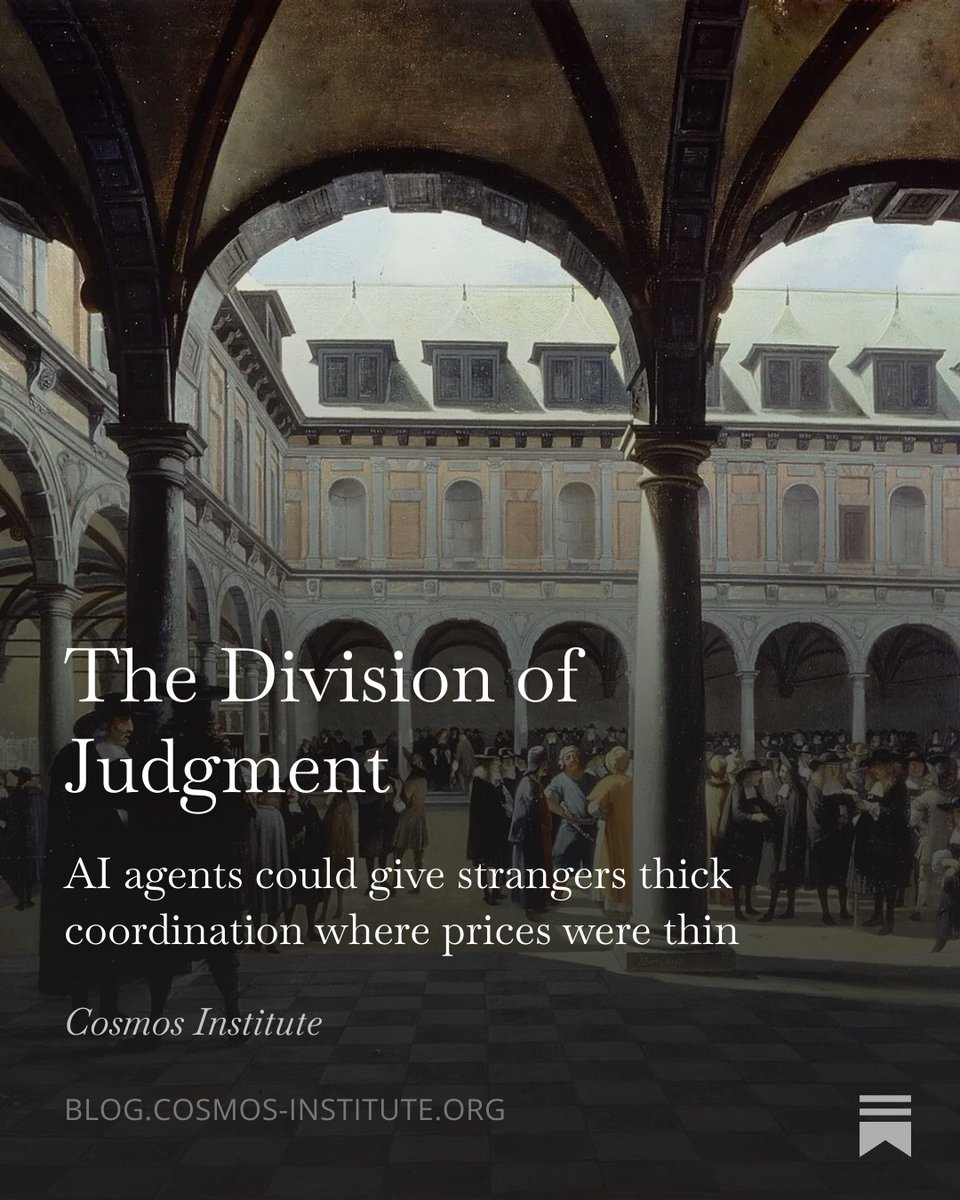
@tyler_m_john I think these strands are still undervalued among both LLMs’ creators and their leading critics. @cosmos_inst has a rich program of work on this question, e.g. see their thematic reading lists: https://t.co/doCqbvzTus
@tyler_m_john Popper on knowledge creation (starting with Conjectures & Refutations); Oakeshott vs over-confident rationalism (e.g. Rationalism in Politics); Hayek on decentralised knowledge creation and its role in sustaining the wider institutions of a free society (Constitution of Liberty)
The UK can once again be the most dynamic country in the world.
Today we launch the UK Dynamism Fund, a new philanthropic fund to support the believers and the builders of UK dynamism.
Apply now: https://t.co/6PHnd36HXO
@SamCoatesSky "What's the point and who’s it for?" We'll find out by trying it. It’s for each of us who discovers, one fare at a time, that it adds something to our lives. Citizens of a free society answer these questions through free choices: no politician can know the answers in advance.
A free society asks its citizens to tolerate dissent, accept limits on power, and live alongside disagreement. Whether new deliberative reforms build that capacity or just look like they do is still an open question. So is how to seek truth in the age of agentic AI.
IHS has opened three research funding opportunities for scholars examining deliberative democracy's actual effects, the nature of liberal civic virtue, and agentic AI's effect on news and information.
Learn more and apply:
https://t.co/UyqzELxKly
"AI, however, offers a fusion: power over what you do and power over what you think. Unlike political power, this is delivered in private, through one helpful interface, one person at a time."
@Brendan_McCord on the soft despotism that wears your face.
https://t.co/lF6Vba4EAL
Cosmos Grants are back!
If you're building AI that strengthens human autonomy or truth-seeking, we want to fund your prototype.
Inspired by @tylercowen's Emergent Ventures, we'll get a decision to you in ~4 weeks. $1k–10k+ per project. 🧵
https://t.co/3bVoeJFAiP
Today we're launching Intercept: a $500M philanthropic initiative to make respiratory infections, like the common cold and flu, a thing of the past.
We treat respiratory infections as a minor nuisance, but that’s really not the case. Most of us will spend 5% of our lives (!) sick from these viruses, they kill 1M people a year, cost $600B annually in productivity, and periodically threaten civilization through pandemics.
So, if they’re such a big problem, why haven’t we dealt with them yet? Last year we convened ~40 leading scientists, pharma R&D leaders, biotech investors, and regulatory experts to better understand that.
We heard two main reasons:
(1) First, it’s just technically very challenging: respiratory viruses represent hundreds of distinct, mutating strains across several families. Fortunately, recent breakthroughs make this newly possible.
(2) Second is a lack of funding: broad-spectrum solutions have historically been underfunded, in part because they’re not a great fit for most philanthropic or commercial funding (and while COVID generated a burst of activity around preventing and understanding respiratory infections through an influx of new funding, that hasn't been sustained).
We think that with enough focus and funding, this might be solvable. Intercept is a $500 million philanthropic initiative that will take advantage of new tools to catalyze the development and deployment of two types of products: broad-spectrum preventatives and air cleaning technologies.
This problem is undoubtedly difficult. But it’s more tractable now than it’s ever been. We think we should give it our best shot.
We’re enormously grateful to our anchor funders: @stripe, @AnthropicAI, @TheFluLab, @FoundationOAI and individuals from Jane Street.
And, I’m very excited to be building this with @incredutility and the rest of the team.
This is the way: robust cross-party scrutiny of those stoking antisemitism in our politics. Kudos to @DavidTaylor85 for the sharp application of controlled anger here.
For over twenty years, an engineer named Richard Bernstein did precisely what his doctors ordered.
He ate the diet the American Diabetes Association blessed, close to half of it carbohydrate, and chased the resulting flood of sugar with large doses of insulin. It was killing him. By his mid-thirties his body was breaking down: failing kidneys, nerve damage, the early wreckage of a Type 1 diabetic who had been told in 1946 he would be lucky to reach forty.
The treatment was textbook. The patient was dying on it.
In 1969 he got hold of a machine that blew the whole thing open. It was a blood glucose meter, a three-pound box sold only to hospitals to tell an unconscious diabetic from a drunk. Bernstein could get one at all only because his wife was a doctor and it was bought in her name.
He began measuring his own blood sugar several times a day, the first patient in the world known to do it. What the numbers showed was damning. His levels were swinging violently outside any safe range, on the exact diet the experts had sworn by.
So he ran the experiment they never bothered to run. He cut the carbohydrate hard and swapped the big insulin doses for small, precise ones. His blood sugars flattened to near normal. His complications began to reverse.
He had cracked tight control for Type 1, the type the profession insisted diet could never touch, and the very same approach worked for Type 2.
Then came the most telling part of all. When he tried to publish what had just saved his life, the journals turned him away, not on the evidence, but because he was an engineer and not a physician. So at the age of 45 he enrolled in medical school, for the sole purpose of earning the right to be heard. He qualified, opened his own practice, and spent the next several decades proving the establishment wrong one patient at a time.
The profession never really thanked him for it. It had spent years handing a high-carbohydrate diet to people whose defining problem is that they cannot handle carbohydrate, and then blaming those same people when they fell apart.
Bernstein lived with Type 1 diabetes for 78 years and died last year at 90. He outlived a great many of the experts who swore it could not be done, and a great many more of the patients who were simply given the official advice and told to trust it.
AI agents can help improve human coordination. But “Coordination can be so wholly attentive or endlessly accommodating that we cease to perform the labor of free people who live within it… A good life is not only a life that goes well. It is, and must remain, a life that each of us leads.”
"The law could be trusted because it knew nothing of you, but the AI agent is powerful because it knows you well."
@Brendan_McCord asks how AI agents can make us more prosperous without making us less free.
https://t.co/t39MDGBRPW
Returning from an inspiring weekend exploring the implications of Tocqueville's Democracy in America for human autonomy in the age of AI with 70 friends of @cosmos_inst at this incomparable salon venue, Chateau de Tocqueville
New @sci_works essay 🧵
British innovation strategy is fixated on a simple story: unis generate ideas, start-ups commercialise them, government helps them scale.
This is legible, politically attractive, & wrong.
Policy built on it will deliver neither breakthroughs nor growth.
This image is sacred to me.
This weekend we held the 2nd Cosmos Feast at the chateau of Alexis de Tocqueville. This is the Norman aristocrat who wrote in the 1830s the greatest book on democracy.
Tocqueville feared we would lose the vigorous use of our capacities and slip into passivity and dependence. A great “tutelary power” would be raised above us, keeping us in a state of permanent childhood.
This is my greatest fear for AI.
I lectured on the future of freedom in front of the hearth where Tocqueville wrote his masterwork.
And as I started to leave the room to reunite with my wife and kids at its conclusion, one of Alexis’ descendants put his hand on my arm.
He said, “Alexis was watching you.” And then pointed up to the portrait in the corner of the room. On the train back to Paris, this popped up on WhatsApp.
Between Tocqueville’s gaze, the love in Adriane’s eyes from the front row, and the presence of 70 of the most thoughtful people… people who descended on Normandy from around the world to spend a weekend communing with one of my favorite thinkers…
I’ll treasure it forever.