Start reading Metropolis by Ben Wilson (thanks twin @_alifsky for bringing it from the UK), and let’s start with this again:
City densification, walkable neighborhoods, and comprehensive public transportation network are vital in achieving environmental sustainability
AirAsia hapus rute direct Jakarta - Singapura & Jakarta - Bangkok, menjadi transit Kuala Lumpur. Alhasil perjalanan Jakarta - Singapura bisa jadi 5 jam 😢
Bagi kalian yang punya tiket AirAsia penerbangan internasional keberangkatan Juli 2026 & seterusnya segera cek notifikasi & status tiket, jangan sampai salah jadwal. Soalnya pada kena perubahan.
Indonesia was once seen as a darling of investors. But fears of corruption and policy missteps are raising concerns about the country’s economic future
https://t.co/Himk6JYfLr
Presiden SBY: kami berhasil melalui Great Financial Crisis 2008-2009 dan Taper Tantrum 2013 dengan cukup baik
Presiden Jokowi: kami berhasil melalui Trade War 2018 dan Covid Crisis 2020 dengan cukup baik
Presiden Prabowo: GW YANG BIKIN KRISISNYA AJG AWOKWOKWOKWOK
Baru beres nonton video ini di yt.
Dan saya tersadarkan kalo menjamurnya org yg jualan seblak, cilok, gorengan dan pedagang olahan tepung lainnya di jalanan bukanlah tanda kebangkitan ekonomi rakyat, tpi sinyal keputusasaan (necessity entrepreneurship) untuk menutupi status pengangguran.
Setidaknya ada 6 poin yg saya dapati :
• Jebakan low barrier to entry: Bisnis olahan tepung dipilih cuma krn modalnya murah dan gk butuh keahlian khusus.
Dampaknya, terjadi ledakan keseragaman yg memicu kanibalisme ekonomi (sesama pedagang kecil saling mematikan di radius beberapa meter saja)
• Romantisasi penderitaan oleh negara: Narasi "UMKM Pahlawan Ekonomi" dikritik sebagai alat politik agar negara bisa lepas tangan dari kewajiban menyediakan lapangan kerja formal dan jaring pengaman sosial.
• Paradoks data pengangguran: Angka pengangguran resmi terlihat turun, tpi pekerja sektor informal melonjak smpe 60%. Ini adalah fenomena pengangguran terselubung, tercatat bekerja, tapi pendapatan minim dan gk menentu.
• Perang Harga vs Hancurnya Daya Beli: Di tengah inflasi dan turunnya kasta kelas menengah, merek bukan lagi faktor penting. Pedagang terpaksa memotong margin keuntungan demi mempertahankan konsumen yg sensitif harga.
• Ironi "Negara Tepung" yg 100% Impor: Indonesia menopang jutaan pedagang kecil dari komoditas yg gak bisa tumbuh di tanah sendiri. Ketergantungan impor gandum yg mutlak membuat nasib pedagang cilok di jalanan sangat rentan terhadap konflik geopolitik dunia dan kurs Dolar.
• Model bisnis ini udah di titik jenuh. Para pedagang seperti berjalan di tempat, bekerja keras 12 jam sehari menghirup asap jalanan, tetapi posisi finansialnya gk bergeser maju sama sekali.
Source : https://t.co/YnzpIZpO3L
Our president, leader of the Republic of Indonesia, watches the poor eat their meal.
He does the watching from a lavish setting, his own plate stacked with expensive food.
Poverty as an evening's entertainment.
Global investors are rapidly losing confidence in Indonesia as the nation’s stocks tumble at the fastest pace worldwide and its currency sinks to all-time lows https://t.co/laOzvsf8t2
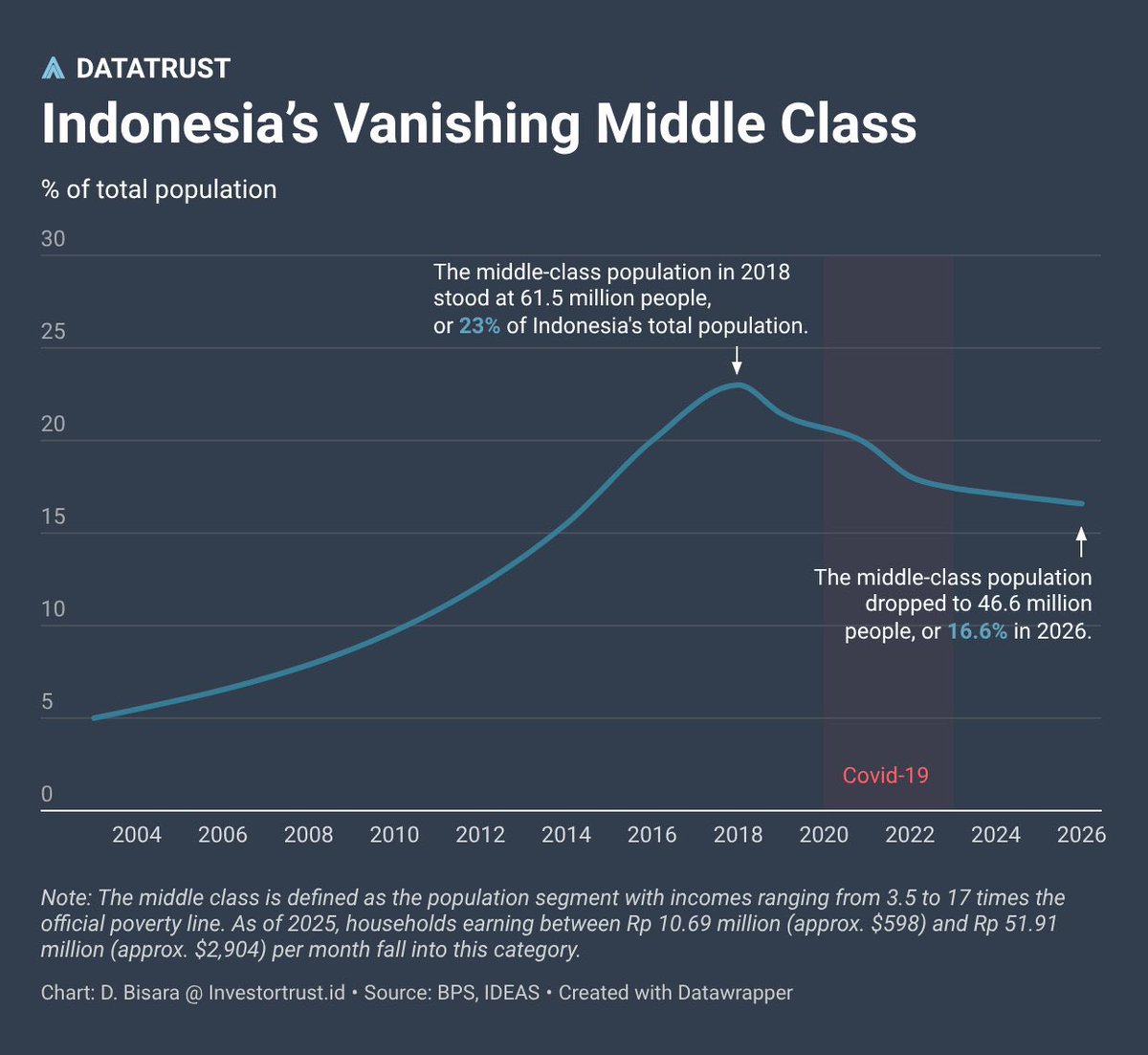
This chart should terrify policymakers. Indonesia’s middle class did not merely slow down. It went into reverse.
After two decades of expansion, the middle-class population peaked at 61.5 million people in 2018, representing 23% of the population. By 2026, that figure had fallen to just 46.6 million people, or 16.6%. That is not a cyclical slowdown. That is structural deterioration.
For years, policymakers celebrated GDP growth, infrastructure projects, commodity booms, and headline investment numbers. But the ultimate scorecard of an economy is whether ordinary people become wealthier over time. This chart suggests millions of Indonesians are moving in the opposite direction.
The middle class is the economic engine of every successful country. They buy homes, cars, insurance, consumer goods, education, travel, financial products, and healthcare. They generate tax revenue. They create small businesses. They drive domestic demand. When the middle class shrinks, the economy loses its most important customer.
The uncomfortable question is simple: where did the gains go? If GDP is growing, if conglomerates continue expanding, if commodity exports remain large, then why are fewer Indonesians qualifying as middle class than eight years ago?
More importantly, if you are born poor in Indonesia today, what ladder exactly are you supposed to climb?
If you are exceptionally good looking, perhaps you can monetize attention through social media. If you are academically gifted, perhaps you can break into an ultra-competitive institution like MBB, survive years of brutal expectations, and eventually use that platform to do something bigger. If you are entrepreneurial, maybe you build a business against overwhelming odds. If you are lucky, perhaps you benefit from family connections, inheritance, or access to opportunities unavailable to most people.
But an economy cannot rely on exceptionalism. A healthy economy creates millions of pathways upward, not a handful of lottery tickets.
The situation becomes even more concerning when you consider that well-paying white-collar jobs are becoming increasingly scarce. Many multinational companies that once established regional operations, technology centers, shared-service hubs, and professional offices in Indonesia have either downsized, relocated, or shifted future expansion elsewhere.
Those jobs were not valuable merely because of the salaries they paid. They were valuable because they transferred knowledge, management expertise, technical skills, global best practices, and professional networks into the local workforce. Over time, they helped develop intellectual capital that could later be recycled into entrepreneurship, leadership positions, startups, and domestic businesses.
When those opportunities disappear, the loss is not limited to employment. The country also loses a training ground for future managers, engineers, consultants, analysts, and business leaders. Human capital compounds just like financial capital. Once that pipeline weakens, rebuilding it can take years or even decades.
The bigger risk is that social mobility slows. When people stop believing hard work leads to a better life, trust in institutions weakens. Aspirations decline. Consumption slows. Talent leaves. The country’s most productive people increasingly look elsewhere for opportunity.
This is why Indonesia’s biggest economic challenge is no longer growth. It is upward mobility. A country cannot thrive without a growing middle class, a steady pipeline of high-quality jobs, and a clear path for ordinary people to join it. And right now, all three appear to be moving in the wrong direction.
wakil rakyat kita terlalu kaya untuk mewakili kita. Penghasilannya sekitar 14.7 kali GDP/capita, nomer dua tertinggi di dunia setelah filipina. gimana bisa connect sama rakyatnya. itupun masih minta naik terus
Kalau memang mau maling, ngerampok, dia bisa pukul kaca tsb, trus masuk.
Ini jelas cm buat meneror dan cipta kondisi kok. Biar warga sibuk dgn hal remeh temeh begini. Orang yg hidup di masa harto pahamlah yg beginian.