@blockkboyy615@tkaaaaaaaaaay they are absolutely making those connections in high school. Those prep-school alumni networks are far more powerful than those of any college.
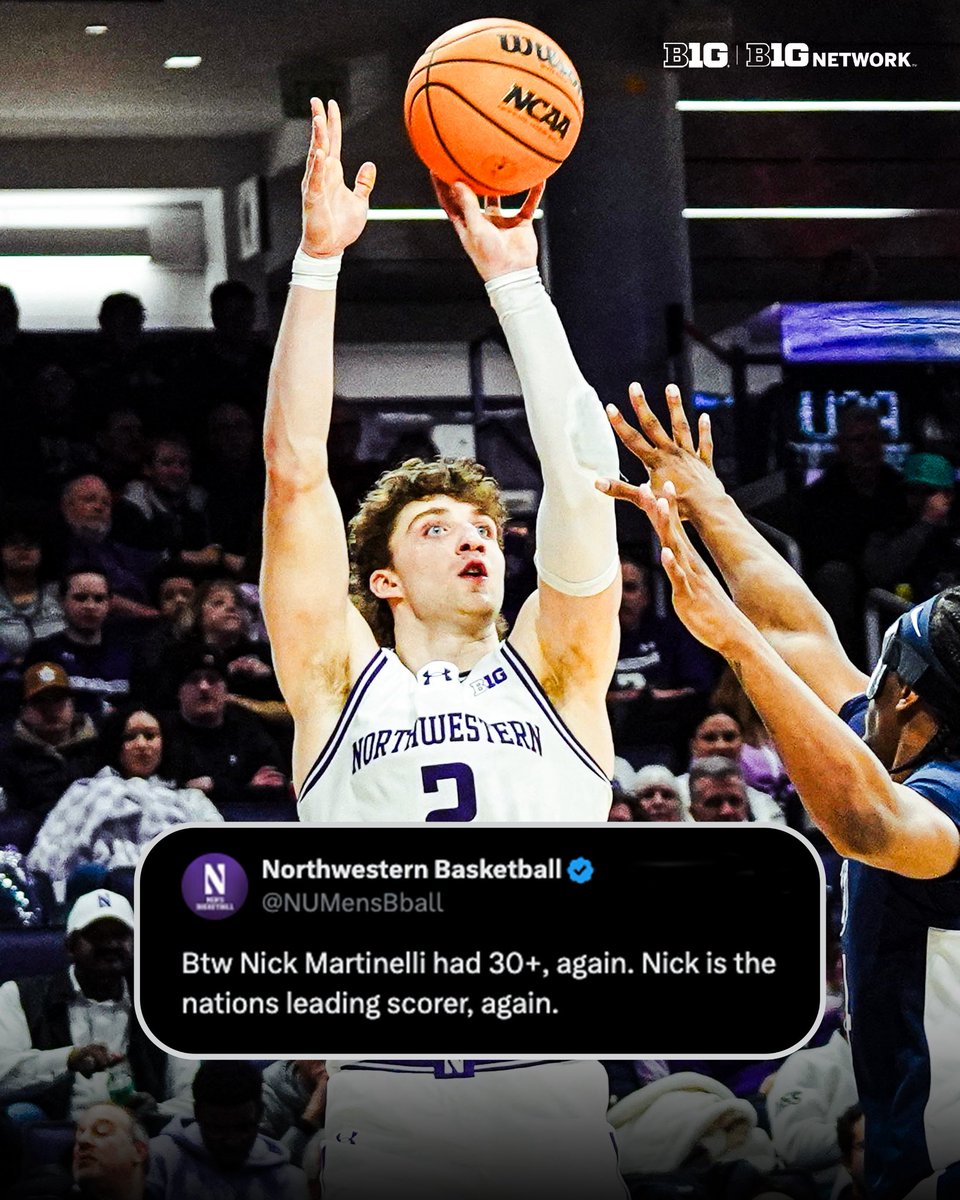
On behalf of everyone who bleeds purple, thank you Nick Martinelli for always representing our school with such class, pride, and determination. It was an absolute pleasure watching your career - we will be cheering as loudly as we can wherever your journey takes you next. Terrific player, and all time class act.
The major AI labs all (apparently) run on Slack. When they stop, it's probably a good sign that AGI is here.
I explain why here: https://t.co/Wp0KaymVVx
I love the country I live in and played for. I also really respect athletes who are mindful and thoughtful when they answer questions like this. 🇺🇸🇺🇸🇺�
I’ve been watching CES for 16 years. This week had some real announcements buried under the usual noise.
But everyone is mising the biggest one.
Google DeepMind and Boston Dynamics just partnered to put Gemini Robotics into Atlas humanoids. First deployments ship to Hyundai factories and DeepMind’s offices in months.
Here’s why this matters more than NVIDIA’s Vera Rubin, ChatGPT Health, or any other announcement.
Google owned Boston Dynamics from 2013 to 2017. Sold them to SoftBank. Hyundai bought them in 2020 for $880M.
And now Google is BACK. Through the side door.
Think about what DeepMind brings to the table. They hired Boston Dynamics’ former CTO Aaron Saunders in November. They’ve been building Gemini Robotics, a foundation model trained to generalize across different robot hardware. On-device inference without cloud dependency.
Boston Dynamics brings the physical platform everyone thought was impossible. Atlas can lift 110 pounds, has 56 degrees of freedom, 360-degree cameras, and tactile sensing in its hands.
Put them together and you get something neither could build alone.
The math is wild. Hyundai announced a $26B investment in US operations. They’re building a robotics factory capable of producing 30,000 robots per year. All 2026 Atlas deployments are already fully committed.
This isn’t a research partnership. It’s a manufacturing pipeline.
Here’s the strategic play nobody is pricing.
Google tried to build robots from scratch in the 2010s. Failed spectacularly. The lesson they learned was that hardware is brutally hard and software is their moat.
Now they get hardware access without ownership risk. DeepMind provides the brains, Boston Dynamics provides the body, Hyundai provides the factory floor and real-world training data.
Every robot deployed generates data that trains the next model.
The flywheel they’re building is identical to Tesla’s approach with autonomous driving. Except Google has been perfecting AI foundation models for a decade while Tesla’s been doing it for five years.
Why humanoids specifically? The entire industrial world was built for human bodies. Every factory floor, every warehouse, every workspace. Humanoid form factor means zero infrastructure changes required for deployment.
Compare that to Amazon’s robotic warehouses that cost hundreds of millions to retrofit.
Here’s where it gets interesting for anyone watching the AI chip market.
NVIDIA announced Vera Rubin at CES. 10x reduction in inference token cost. 4x fewer GPUs to train MoE models. Production starting H2 2026.
But robots need something different than data centers. They need on-device inference with sub-100ms latency. They need to process visual, tactile, and proprioceptive data simultaneously while making real-time motor control decisions.
DeepMind’s on-device Gemini Robotics model is purpose-built for exactly this constraint.
The market for humanoid robotics is about to get very crowded. Tesla’s Optimus is in testing. A dozen Chinese startups are racing. Figure just raised at a $2.6B valuation.
But Google just did something none of them can replicate. They got distribution.
Hyundai operates manufacturing facilities on four continents. They have relationships with suppliers, regulators, and customers that took decades to build. That’s the moat.
Software can be copied. Hardware can be reverse-engineered. Distribution takes generations.
THE BIG REGRESSION
My folks are in town visiting us for a couple months so we rented them a house nearby.
It’s new construction. No one has lived in it yet. It’s amped up with state of the art systems. The ones with touchscreens of various sizes, IoT appliances, and interfaces that try too hard.
And it’s terrible. What a regression.
The lights are powered by Control4. And require a demo to understand how to use the switches, understand which ones control what, and to be sure not to hit THAT ONE because it’ll turn off all the lights in the house when you didn’t mean to. Worse.
The TV is the latest Samsung which has a baffling UI just to watch CNN. My parents aren’t idiots, but definitely feel like they’re missing something obvious. They aren’t — TVs have simply gotten worse. You don’t turn them on anymore, you boot them up.
The Miele dishwasher is hidden flush with the counters. That part is fine, but here’s what isn’t: It wouldn’t even operate the first time without connecting it to an app. This meant another call to the house manager to have them install an app they didn’t know they needed either. An app to clean some peanut butter off a plate? For serious? Worse.
Thermostats... Nest would have been an upgrade, but these other propriety ones from some other company trying to be nest-like are baffling. Round touchscreens that take you into a dark labyrinth of options just to be sure it’s set at 68. Or is it 68 now? Or is that what we want it at, but it’s at 72? Wait... What? Which number is this? Worse.
The alarm system is essentially a 10” iPad bolted to the wall that has the fucking weather forecast on it. And it’s bright! I’m sure there’s a way to turn that off, but then the screen would be so barren that it would be filled with the news instead. Why can’t the alarm panel just be an alarm panel? Worse.
And the lag. Lag everywhere. Everything feels a beat or two behind. Everything. Lag is the giveaway that the system is working too hard for too little. Real-time must be the hardest problem.
Now look... I’m no luddite. But this experience is close to conversion therapy. Tech can make things better, but I simply can’t see in these cases. I’ve heard the pitches too — you can set up scenes and one button can change EVERYTHING. Not buying it. It actually feels primitive, like we haven’t figured out how to make things easy yet. That some breakthrough will eventually come when you can simply knock a switch up or down and it’ll all makes sense. But that's at least 20 years down the road.
It’s really the contrast that makes it alarming. We just got back from a vacation in Montana. Rented a house there. They did have a fancy TV — seems those can’t be avoided these days — but everything else was old school and clear. Physical up/down light switches in the right places. Appliances without the internet. Buttons with depth and physically-confirmed state change rather than surfaces that don’t obviously register your choice. More traditional round rotating Honeywell thermostats that are just clear and obvious. No tours, no instructions, no questions, no fearing you’re going to do something wrong, no wondering how something works. Useful and universally clear. That’s human, that’s modern.
Extra-incredibly grateful for @benthompson having me on @stratechery to talk Flighty’s evolution, app economy, my oil background, creating Weather Line, 15 years on the App Store, and more.
As a strategy nerd – he’s the GOAT. 🙏
As I wade further and further into the Youth soccer scene as a parent (which btw, is such a blast)… I see so many great things— and unfortunately, so many bad.
One disturbing trend, clubs or travel “teams” mandating young athletes have instagram pages…. What are we doing?
I don’t have enough characters to describe how detrimental that is on our youth and the type of disruptive dynamic that creates within young players, teams, and the coaches. Of course, in the best case — the kids are blissfully unaware and it is managed purely by the parents — but I see young athletes now doing something on the field and asking their parents if they got the clip or the meg, move, goal, etc.
While individual brilliance is such an important part of the game, I feel we are normalizing and prioritizing that above the “team” for fear of kids falling behind or not getting a look for the best academies, colleges, pro’s etc. I fear it’s only going to get worse, especially the more it is glorified and we start to amplify that among the younger generation. There are clear studies and research (the anxious generation) that point to social media’s influence on kids mental health that grew up with unregulated access to these apps before they have the tools to process and handle it — the same goes for sports— which is a vital part of youth development, fostering work in team environments, and ultimately learning how to compete both individually and collectively to grow, socialize, and have FUN.
As we continue to tighten the grip on youth access to these platforms— this is something we should take a look at. Kids under the age of 15 or 16 should not be “mandated” to have social accounts for any sport and if the parents choose to put some of their highlights out there— IMO they should have no access or involvement in that process. Don’t do that to your kids, please.
Let’s protect our youth and keep the sport pure and their participation FUN.