The Strait of Hormuz is not closed. It is sorted.
Iran has built a three-tier access system for the most important waterway on earth. Tier one: allies transit free. Malaysia cleared seven vessels through diplomacy at zero cost. India negotiated zero-fee passage. Pakistan secured clearance for 20 ships. Iraq transits without charge. These countries proved geopolitical alignment and the IRGC waved them through the Larak corridor without collecting a rial.
Tier two: compliant neutrals pay. At least two tankers, likely Chinese-linked, paid up to two million dollars each in yuan through Kunlun Bank intermediaries. COSCO container ships attempted the corridor, were turned back on first approach when documentation was incomplete, then succeeded days later with revised paperwork. These are the vessels that prove the system works. They submit IMO numbers, ownership chains, cargo manifests, and crew lists to the IRGC’s Hormozgan Command. They receive clearance codes. They are escorted by pilot boats through the five-nautical-mile channel between Qeshm and Larak. They pay in a currency that does not route through SWIFT. Every successful yuan transit is a live proof-of-concept for non-dollar energy settlement.
Tier three: adversaries are denied entirely. The committee plan bans American vessels, Israeli vessels, and vessels from any country participating in sanctions against Iran. These ships do not get vetting. They do not get codes. They do not get escorts. They get the AL SALMI, burning off Dubai, as illustration of what the corridor looks like without permission.
But the toll is not the real cost. War-risk insurance is. Premiums have surged from $40,000 per VLCC transit before the war to $600,000 to $1.2 million today, a 30-fold increase, now running five to ten percent of hull value. A VLCC carrying $50 million in crude oil can absorb a combined $3 million in toll and insurance as a fraction of cargo value. A container ship carrying $5 million in manufactured goods cannot. The insurance premium alone exceeds the profit margin on non-oil cargo. The strait has become an oil-only VIP lane. Crude flows selectively for those who can pay the combined cost. Everything else waits, reroutes around the Cape of Good Hope, or does not move at all.
And the US Navy is not inside the strait. The Abraham Lincoln strike group operates from standoff in the Arabian Sea. Three Littoral Combat Ships sit in the Persian Gulf. Marine expeditionary units are positioned for contingency. But zero American warships have transited the strait or escorted commercial traffic since the war began. The Navy told the shipping industry it has “no availability” for Hormuz escorts. The world’s most powerful fleet keeps respectful distance from a waterway controlled by a country whose navy is 92 percent destroyed because the mines, drones, and shore missiles that remain make close-in presence prohibitively risky.
The result is a geopolitical sorting algorithm operating at the molecular level. One hundred and eighty-one vessels transited in all of March. Pre-war traffic was 138 per day. Of those 181, roughly 70 percent were Iranian-affiliated. The remaining 30 percent were vetted allies or yuan-paying neutrals. The 20 percent of global oil that once flowed freely through this strait now flows selectively, conditionally, and in currencies chosen by Tehran.
Iran lost its air force. It lost its navy. It lost two thirds of its production capacity. It retained the only thing that matters: 39 kilometres of coastline on both sides of the narrowest point. The US Navy will not enter. Chinese tankers will. And the sorting algorithm processes another vessel, collects another yuan payment, and demonstrates once more that geography is the one military asset that cannot be degraded by precision strikes.
The strait is not closed. It is under new management.
https://t.co/dAOBBMrIOk
Everyone is covering Terafab as a chip factory.
It is not a chip factory.
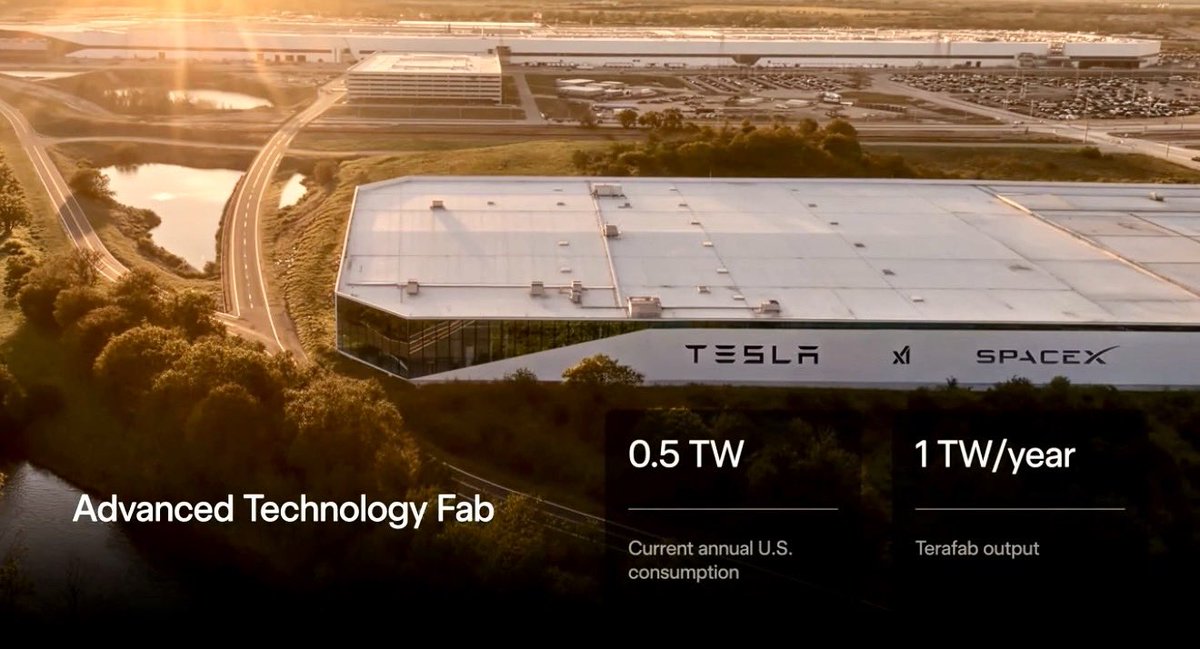
Last night in Austin, Elon unveiled a facility that makes masks, fabricates chips, and tests them inside a single building with a nine-month recursive improvement cadence. No such loop exists anywhere else on Earth. Then he told you 80% of the output goes to space. Then he showed you a 100-kilowatt AI satellite with solar panels and radiators, scaling to megawatt range. Then he said Optimus plus photovoltaics will be the first von Neumann probe, a machine capable of replicating itself from raw materials found in space.
Nobody connected the sequence.
Terafab produces 1 terawatt per year of compute. The entire United States consumes 0.5 terawatts of electricity. Musk is building a single factory whose output in AI silicon exceeds twice the power consumption of the country it sits in. And he is sending 80% of it off-planet because Earth literally cannot power what he is building.
Follow the mechanism. Terafab seeds the chips. Starship launches Optimus robots and solar arrays at 100 million tons per year. The robots mine lunar and asteroid regolith for silicon, iron, and nickel. They 3D-print more robots. They fabricate more solar panels. They assemble more AI satellites. Each satellite runs hotter-burning D3 chips designed specifically for vacuum, where free radiative cooling eliminates the thermal constraints that strangle every terrestrial data center on the planet. The nodes replicate. The replication is exponential.
This is a Dyson Swarm bootstrap hidden inside a semiconductor announcement.
The math is public. The Sun outputs 3.828 times 10 to the 26th watts. A 2022 paper in Physica Scripta calculated that 5.5 billion satellites at 290 kilograms each, robotically manufactured from Mars resources, capture enough solar energy to meet all of Earth’s power needs within 50 years. A 2025 paper in Solar Energy Materials calculated a partial swarm capturing 4% of solar output yields 15.6 yottawatts, roughly a billion times current human civilization’s total energy budget. Musk just announced the factory that builds the chips that go inside the satellites that replicate themselves forever.
92% of advanced logic chips are fabricated in Taiwan. One factory in Austin does not fix that. But one self-replicating system seeded by that factory, launched by the only company with reusable heavy-lift rockets, assembled by the only humanoid robot in mass production, and powered by the only star within reach, does not fix a supply chain. It obsoletes the concept of supply chains entirely.
The market priced this as a $20 billion capex story about semiconductor independence.
The actual announcement was the engineering blueprint for Kardashev Type II.
Humanity sits at 0.73 on the Kardashev scale. 18 terawatts. The distance between here and harnessing a star is not a technology gap. It is a recursion gap. And recursion is exactly what a single building in Austin that makes its own masks, builds its own chips, tests its own chips, and launches the output into orbit on its own rockets was designed to close.
Every civilization that makes it past this point never looks back.
“Pessimism about Iran’s fate is now baked into Chinese assessments of the Middle East,” writes Yun Sun. ��China’s disillusionment with Iran’s leaders means that Beijing is not inherently opposed to regime change.”
https://t.co/5eXQRGVenF
My information consumption is now 1/4 X, 1/4 podcast interviews of the smartest practitioners, 1/4 talking to the leading AI models, and 1/4 reading old books. The opportunity cost of anything else is far too high, and rising daily.
People get high on abstraction too early. They want the system before they’ve earned the insight.
But the good abstractions are never designed. They’re discovered. You do the stupid manual thing enough times and the real bottleneck just emerges. Your initial agency might be driven by a hunch you had in the shower, but that moment won’t get you all the way to making something people want. The right way to make anything is forced on you by reality: what are the real jobs to be done? And what sequence?
This is why “do things that don’t scale” still hits, especially now when AI makes it trivially easy to scale things that probably shouldn’t be scaled yet. PG’s point was never about suffering. It was about contact. When you’re the one manually doing the loop, you see the edge cases. The weird user behavior. The failure modes nobody designed for. The hidden dependencies that only show up at 2am when some flow or intermediate step breaks in a way you didn’t anticipate. If you automate before you have that contact, you just scale your misunderstanding faster.
When the machines can help you vibe code perfection it gives you a false sense of power. I love that feeling as much as you do. But fuck perfection. Do it live. Be the loop.
Feel every friction point. Notice what’s actually true every single time versus what just looked true because you hadn’t seen enough cases yet. Formalize that. Build the recursive version. Then keep checking that your abstraction is still attached to real humans and their needs. Because reality drifts. Your users drift. The ground truth changes under you. You may think you understand but no plan survives contact with the real users and what they want. You find those body blows in analytics and user feedback and we call them the roadmap.
Humans left with not enough data hallucinate too. But just like the LLMs with enough data you unlock real transcendence. Real utility. Prosperity for humans in real life.
The abstraction is a tool, not a destination. The moment you forget that, you’re cooked.
🚨 BREAKING: Fudan University just solved the animation problem nobody thought AI could touch.
It's called OmniLottie
The first AI that generates real vector animations from text, images, or video.
Not rasterized video. Not GIFs. Actual Lottie files, the same format used by Airbnb, Google, Uber, and every major app on the planet.
Here's why this is a big deal:
Every animation you see in modern apps, loading spinners, onboarding flows, micro-interactions, icons that move, those are Lottie files. Designers spend hours crafting them in After Effects. Companies pay $5K–$20K per animation project.
OmniLottie generates them from a text prompt.
Here's how it works:
→ You describe what you want: "a rocket launching with flame trail and stars twinkling"
→ OmniLottie converts your instruction into structured animation commands
→ A custom Lottie tokenizer compresses the JSON into compact shape + motion tokens
→ A fine-tuned VLM autoregressively generates the full animation sequence
→ Output: a production-ready .json Lottie file you can drop into any app
Three modes:
Text-to-Lottie: describe it, get it.
Image+Text-to-Lottie: give it a reference image + motion description.
Video-to-Lottie: feed it a video, get a vector animation version.
Here's the wildest part:
They tested it against GPT-5, DeepSeek, Gemini, Qwen2.5-VL, and commercial tools.
GPT-5 success rate: 12.7–68%
DeepSeek: 29.3%
Qwen2.5-VL: 0.0%
Gemini: 0.0% on Video-to-Lottie
OmniLottie: 97.3% on Text-to-Lottie. 92% on Image-to-Lottie. 90.7% on Video-to-Lottie.
It's 530× faster than optimization-based methods per successful generation.
The secret weapon: a custom Lottie Tokenizer that strips all the redundant JSON metadata and converts animations into compact command sequences. Raw Lottie JSONs waste most tokens on formatting. The tokenizer focuses the model on what actually matters — shapes, motion, and timing.
They also built MMLottie-2M a dataset of 2 million professionally designed vector animations with text, image, and video annotations. The largest vector animation dataset ever created. Publicly released.
From Fudan University, StepFun, HKU MMLab, and University of Queensland.
karpathy speaks like someone who’s running a mental compiler in real time with minimal interpretive latency & almost zero runtime garbage. he’s not verbose. he just threads complexity into compressed lossless statements.
most smart people can be dense, but they lose clarity. karpathy keeps clarity while cranking the bitrate like an llm tuned with perfect temperature control.
it’s so beautiful to listen to that i had to hear this three times already. i might add a fourth.
Transforming human knowledge, sensors and actuators from human-first and human-legible to LLM-first and LLM-legible is a beautiful space with so much potential and so much can be done...
One example I'm obsessed with recently - for every textbook pdf/epub, there is a perfect "LLMification" of it intended not for human but for an LLM (though it is a non-trivial transformation that would need human in the loop involvement).
- All of the exposition is extracted into a markdown document, including all latex, styling (bold/italic), tables, lists, etc. All of the figures are extracted as images.
- All worked problems get extracted into SFT examples. Any referenced made to previous figures/tables/etc. are parsed and included.
- All practice problems are extracted into environment examples for RL. The correct answers are located in the answer key and attached. Any additional information is added as "answer key" for a potential LLM judge.
- Synthetic data expansion. For every specific problem, you can create an infinite problem generator, which emits problems of that type. For example, if a problem is "What is the angle between the hour and minute hands at 9am?" , you can imagine generalizing that to any arbitrary time and calculating answers using Python code, and possibly generating synthetic variations of the prompt text.
- All of the data above could be nicely indexed and embedded into a RAG database for later reference, or maybe MCP servers that make it available.
Then just as a (human) student could take a high school physics course, an LLM could take it in the exact same way. This would be a significantly richer source of legible, workable information for an LLM than just something like pdf-to-text (current prevailing practice), which simply asks the LLM to predict the textbook content top to bottom token by token (umm - lame).
As just a quick and crappy example of synthetic variations of the above example, GPT-5 gave me this problem generator (see image), which can now generalize that problem template to many variations:
- When the time is 11:07 a.m., what is the degree measure of the angle between the hands? (Answer: 68)
- Determine the angle in degrees between the clock’s hands at 4:14 a.m.. (Answer: 43)
- What angle do the clock hands form when the time reads 11:47 a.m.? (Answer: 71)
- At 7:02 a.m., what angle separates the hour hand and the minute hand? (Answer: 161)
- At 4:14 a.m., calculate the angle made between the two hands. (Answer: 43)
- What angle is formed by the hands of a clock at 4:45 p.m.? (Answer: 127)
- What is the angle between the hour and minute hands at 8:37 p.m.? (Answer: 36)
(infinite practice problems can be created...)
@paimon2cool I'm starting to do some of this too. I have a script that packages all of the files of my project (which isn't a giant repo and fits just fine) uses `files-to-prompt`, then I start new conversation, copy paste, and ask a question at the end, and manually select appropriate model.
@karpathy I cancelled cursor yesterday for this reason. Constantly thinking 5 steps ahead in the wrong direction. I’m back to manually copy + pasting from chatgpt/claude/gemini for now.
I'm noticing that due to (I think?) a lot of benchmarkmaxxing on long horizon tasks, LLMs are becoming a little too agentic by default, a little beyond my average use case.
For example in coding, the models now tend to reason for a fairly long time, they have an inclination to start listing and grepping files all across the entire repo, they do repeated web searchers, they over-analyze and over-think little rare edge cases even in code that is knowingly incomplete and under active development, and often come back ~minutes later even for simple queries.
This might make sense for long-running tasks but it's less of a good fit for more "in the loop" iterated development that I still do a lot of, or if I'm just looking for a quick spot check before running a script, just in case I got some indexing wrong or made some dumb error. So I find myself quite often stopping the LLMs with variations of "Stop, you're way overthinking this. Look at only this single file. Do not use any tools. Do not over-engineer", etc.
Basically as the default starts to slowly creep into the "ultrathink" super agentic mode, I feel a need for the reverse, and more generally good ways to indicate or communicate intent / stakes, from "just have a quick look" all the way to "go off for 30 minutes, come back when absolutely certain".
There are some interesting details about how Anthropic trained their models tucked away in today's summary judgement: they bought, chopped up and scanned millions of dollars worth of books! https://t.co/QqMmhvOtRr
Wow. This is the reasoning the judge used to say that Anthropic training is fair use:
"But to make anyone pay specifically for the use of a book each time they read it, each time they recall it from memory, each time they later draw upon it when writing new things in new ways would be unthinkable."
Holy sh*t… Anthropic just released a prompt engineering bible.
It’s free. It’s insanely well written. And it covers real Claude use cases.
Every AI builder should bookmark this.
Here’s what’s inside + link:
Every AI dev should know how to implement these types of agentic systems.
All important building blocks for developing advanced agentic AI systems.
Learn it once and apply it everywhere.
Check out my new 4.5 hr course (with code examples) to learn more: