🚨 New publication alert! 🚨
1/6 🏹Using a a state-of-the-art #Bayesian#phylodynamic framework, we explore the evolution of projectile point shapes during the European Final #Palaeolithic and earliest #Mesolithic (approximately 15-11ka BP). https://t.co/Pcuaypc5A1
🚨 New publication alert! 🚨
1/6 🏹Using a a state-of-the-art #Bayesian#phylodynamic framework, we explore the evolution of projectile point shapes during the European Final #Palaeolithic and earliest #Mesolithic (approximately 15-11ka BP). https://t.co/Pcuaypc5A1
6/6✨A very special thanks to my co-authors and supervisors @rachelwarnock, @ARCHAEOfelix, and @benmarwick for their invaluable help in realizing this paper. ✨
5/6 🎓Given this innovative approach, we place considerable emphasis on systematically exploring the impact of both data and models on the results. This is achieved by incrementally introducing complexity, thereby laying a robust foundation for #futureresearch in this direction.
New broad-scale database on #lithic#technologies between ca. 15 and 11 ka in Europe @ScientificData, @ERC_CLIOARCH collaborative effort with @ARCHAEOfelix, @david_matzig and many others:
https://t.co/1aPiIcPG7i
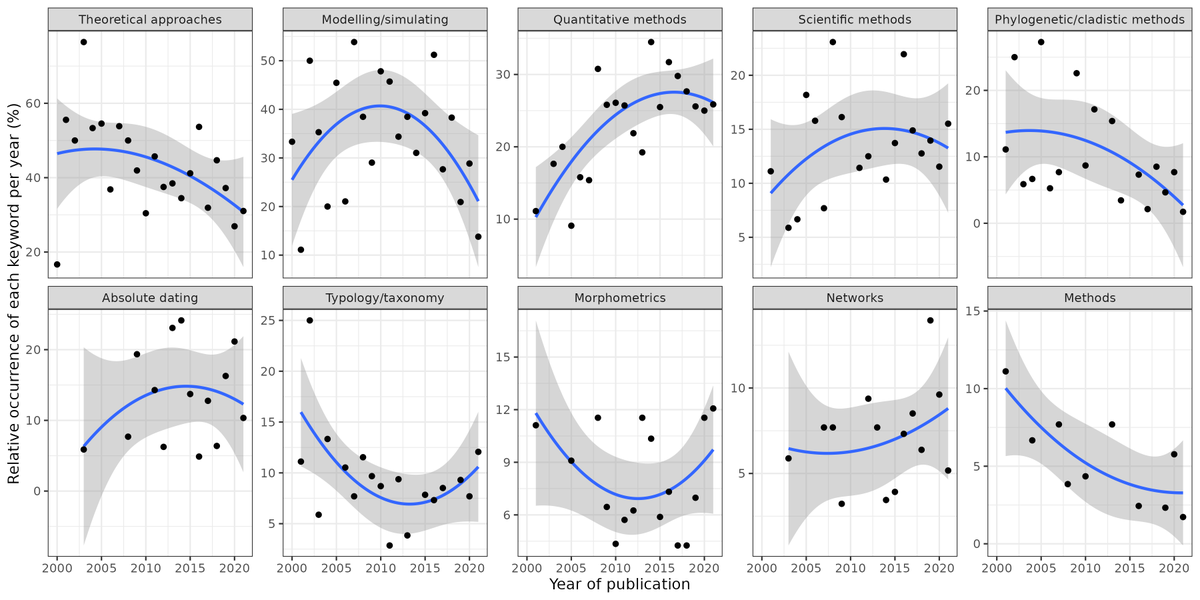
💡Recent methodological innovations allowing to integrate artefact shape data with phylogenetic applications lead us to predict a renaissance in artefact phylogenetics and appropriately #macroscale applications of cultural evolutionary theory in archaeology.
✨New paper out now!✨ @ARCHAEOfelix, @nevromeCS, and I did a #bibliometric literature review where we trace the development of #evolutionaryarchaeology over the last four decades: https://t.co/T1AZ2OBeEa
📈Importantly, our review demonstrates the centrality of computational models, but suggests a stagnation in the application of precisely that suite of methods—#phylogenetics—that is central to evolutionary archaeology’s biological counterpart #palaeontology.