Every year, I share this video of French caretakers who take sand from Omaha Beach in Normandy, and scrub them into the letters to give them the gold coloring.
They do this for all 9,386 US soldiers who died.
France also gave us this land as American soil. #MemorialDayWeekend
That water clarity is an engineering decision, and the math behind it is wilder than the video.
Roman aqueducts ran on gravity alone. No pumps, no pressure systems. Engineers carved channels with a gradient so shallow it borders on absurd. The Pont du Gard in southern France drops 2.5 centimeters over 275 meters. That's roughly the thickness of a coin over the length of three football fields. They surveyed that accuracy with plumb lines and wooden leveling instruments.
The clarity you're seeing is a direct product of flow velocity. Too steep and the water erodes the channel walls, picks up sediment, turns brown. Too flat and it stagnates. Roman engineers targeted a slope of about 20 centimeters per kilometer, which kept the water moving fast enough to stay fresh but slow enough to stay clear. Before the water reached the city, it passed through multi-chamber settling tanks where velocity dropped near zero. Suspended particles sank. Clean water flowed out the top into the next chamber. Repeat three or four times.
Pliny specified the minimum slope in writing. Vitruvius published the exact mortar ratio for hydraulic cement: one part lime to two parts volcanic ash for underwater work. The pozzolana from Pozzuoli reacted with water to form a calcium-aluminum-silicate compound that actually gets stronger the longer it sits submerged. Modern concrete degrades in water. Roman concrete bonds with it.
Scale the whole system and it gets harder to process. Eleven aqueducts fed Rome at its peak. Combined output: roughly 1 million cubic meters of water per day. That works out to about 250 gallons per person for a city of one million. Modern New York delivers about 125 gallons per person per day. Ancient Rome had access to double the per capita water supply of the largest city in the United States, running entirely on slope and stone.
The Trevi Fountain in Rome is still fed by one of them. Two thousand years, same source, same gravity, same water.
A farmer dies in April 2026.
His son inherits the farm. The farm has been in the family since 1847.
The farm consists of: 300 acres of grazing pasture, a farmhouse built in 1892, a barn, a milking parlour, two tractors of varying ages, a Land Rover that runs about 70% of the time, and a herd of 180 Hereford-cross cattle.
On paper, the farm is worth approximately £3.2 million. This is because land near him has been bought recently by a London hedge fund looking for carbon credits, which has dragged the comparable value of every field within forty miles upward to a number nobody local can justify.
In cash, the farm produces a profit of about £28,000 a year in a good year. In a bad year it loses money. The son also works as a fencing contractor three days a week to keep the operation viable.
The inheritance tax bill on a £3.2 million estate, even at the reduced 20% rate, comes to approximately £140,000 after the increased threshold is applied. The son does not have £140,000. The son has never had £140,000. The son has £4,200 in his current account and an overdraft.
The son sells 60 acres to a developer to pay the tax. The developer puts solar panels on the 60 acres. The remaining herd cannot be sustained on the reduced land. The herd is sold. The barn becomes a holiday let.
A different family eats Brazilian beef this Christmas without knowing why the price went up.
The Treasury collects £140,000.
The land never produces British food again.
This man robbed a bank for $1, sat down and waited for the police, just to get free healthcare in prison
In 2011 a man named Richard James Verone walked into a RBC Bank in Gastonia, North Carolina
Handed the teller a note demanding $1
One dollar
Then sat down in the lobby and waited calmly for police to arrive
He was 59. No job. No insurance. A growth on his chest. Two ruptured discs.
Calculated that a federal conviction would guarantee him full medical coverage inside prison
The judge sentenced him to 3 years
He got the surgery
He got the treatment
He told reporters on the way out he had no regrets
A 59 year old American man robbed a bank for $1 because it was cheaper than seeing a doctor
Megyn Kelly, who endorsed and campaigned for Trump in the 2024 election:
“I didn’t expect the corruption to be quite as widespread as it has been. The self-dealing, the lining of his and his family’s pockets. It’s shocking… You look across the board at the Trump family, I’ve never seen a family get so rich off the presidency.”
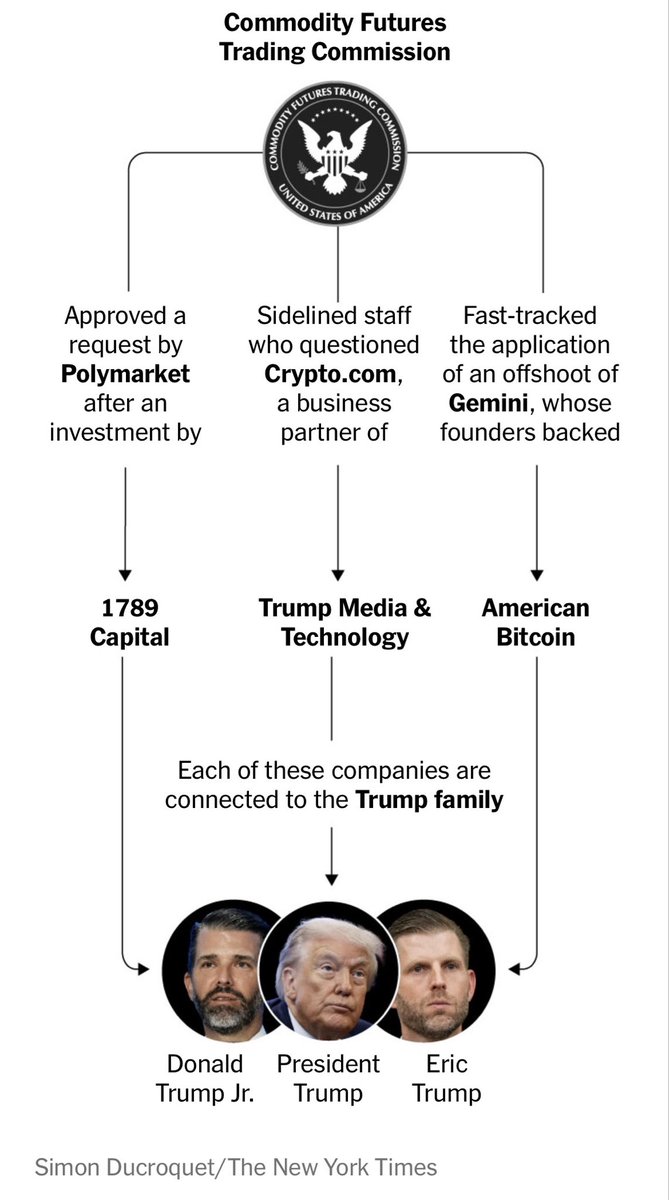
NYT out with a jaw dropping investigative report on the Commodity Futures Trading Commission. 60 Minutes reported last Sunday on some of this, too. The NYT report is a must-read, the 60 Minutes report should then be watched. 1/3
Welcome to the most asymmetric trade in modern financial history.
The thread below lays out why. The opportunity exists because capital has chased the AI trade while ignoring the physical assets AI requires to run — assets that have quietly become the best-performing asset class of the decade. Since October 2020 when we first called for the commodity super cycle: QCI Total Return +217%, GSCI Total Return +205%, Gold +140%. NASDAQ trails at +130%. S&P 500 at +85%. The top three are all commodities. Yet oil cannot get out of its own way while copper and the broader atom complex prints fresh highs . That is the dislocation. That is the trade.
Get long. Buckle in. Hang on for the ride.
Forgive the longer posts in this thread — attempting to mimic my old 10-bullet commodity takes. On to it.
This New York Times piece is worth your time. Here’s what is happening, as simply as I can put it.
Back in January, Trump sued the IRS, an agency he controls, demanding $10 billion over the leak of his tax returns a number of years ago.
IRS lawyers did their jobs. They wrote a memo laying out the defenses that could beat the suit, including the fact that Trump filed too late. His own lawyer was in court when the leaker pleaded guilty in October 2023, more than two years before Trump sued.
The Justice Department never showed up to court. Never argued back. Never used the defenses sitting on their desk.
The judge got suspicious and ordered both sides to explain whether they were actually opposing each other or just colluding. The day before that brief was due, Trump dropped the suit.
Same day, his Justice Department announced a $1.776 billion taxpayer-funded “anti-weaponization fund.”
Trump gets a formal apology. The IRS agrees to drop any audits of him and his family, even though a 2024 Times report found a loss in an ongoing audit could cost him over $100 million.
The acting Attorney General, Trump’s former criminal defense attorney, picks the five commissioners who decide who gets paid. Trump can fire any of them. Proud Boys and Oath Keepers are not ruled out.
This is the most corrupt thing I’ve ever seen from an American president.
Where in the hell are my Republican colleagues?
https://t.co/La0nlLuz1r
“Under my administration, we will be slashing energy and electricity prices by half within 12 months, at a maximum 18 months."
“We’re going to get your energy prices down. We’re going to get your energy prices down by 50%.”
“Starting on day one, we will end inflation and make America affordable again, to bring down the prices of all goods.”
“We’re going down and getting gasoline below $2 a gallon, bring down the price of everything from electricity rates to groceries, airfares, and housing costs.”
“A vote for Trump means your groceries will be cheaper."
-President Trump on the campaign trail in 2024
So let me get this straight: Donald Trump sues his own IRS, and before a judge even sees the case, Trump’s lawyers and Trump’s IRS lawyers strike a deal creating a $1.776 billion taxpayer-funded settlement fund that Trump himself will oversee—deciding who deserves compensation for supposedly being “weaponized” by the justice system. The agreement also bars the IRS from ever investigating Trump, his businesses, or his family again. Then they tell the court the case was settled before it was even filed, so the judge has no jurisdiction. Corruption on a scale "we’ve never seen before!" 4-D level corruption.
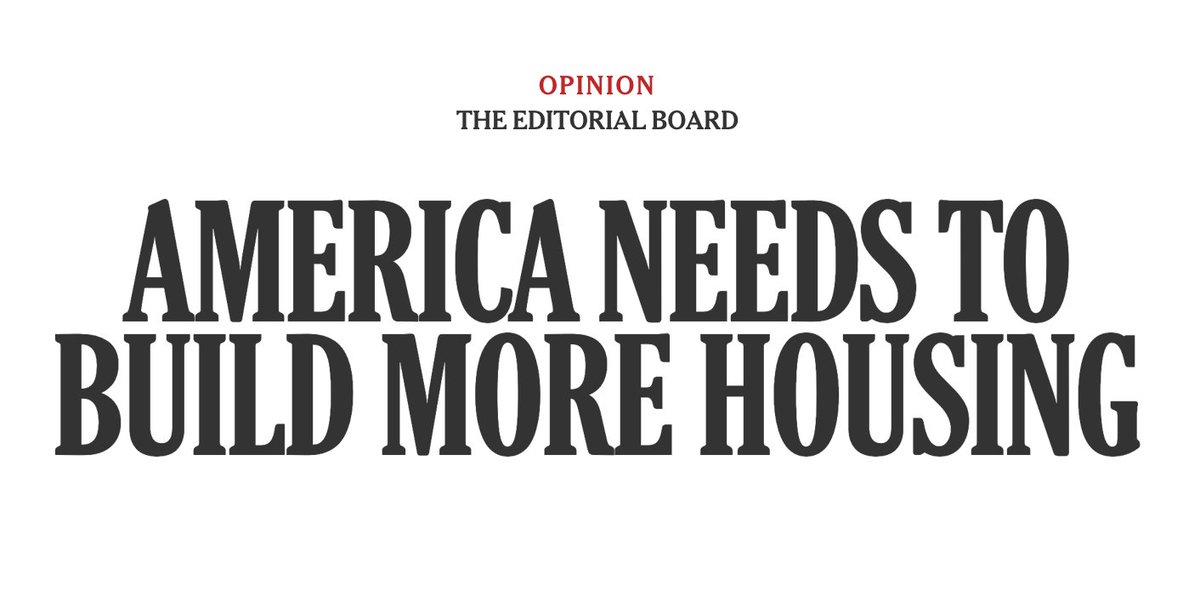
What every voter and apparently, the NY Times Editorial Board, should know about housing policy:
1. Rents reflect the balance of supply of apartments and demand for those apartments in a given area. That’s it; there’s no magic. If you want lower rents, you can hope for a recession that destroys jobs and, therefore, demand. Or you can add supply.
2. There is no amount of money that any big city government could feasibly spend that would add materially to supply. This is because, depending on the location, new apartments cost $250,000-1,000,000 to develop… building even a few hundred of those starts to stress any city budget, and many big cities need tens or hundreds of thousands.
3. On the other hand, investors (including pension funds and endowments, insurance companies, rich families, etc.) can collectively **easily** provide enough capital to build as much housing as we need **so long as they are confident they can get a reasonable return**.
To get those investors to fund the creation of the housing our society needs, we must do two things:
1. Dramatically reduce the time & complexity associated with securing governmental permission to develop housing. This means reviewing and simplifying the overlapping regulations that constrain housing production: zoning codes, building codes, parking, ADA, etc. But it also means changing the cultures within the relevant governmental agencies from “default no” to “how can we help you?”.
2. Provide certainty around on-going regulation of apartment operations.
The way investors get a return from building rentals is as follows: They hire managers to lease the apartments, collect the rents, pay operating expenses and any mortgage payments, and then send the investors the cashflow that remains.
But governments all over the country have been restricting the manner in which apartment buildings can be operated in all kinds of ways.
For example: Cities have been making it harder to screen tenants, while also making it much harder to evict tenants who don’t pay. You can see why both of those measures are politically popular. After all, who doesn’t want people to get second chances? And who wants anyone to get evicted? But, as a manager, the combination of those two regulations makes it much harder to predict, with any certainty, that the rent will get paid… and that makes it very difficult to get investors to provide capital to create more housing.
Another example: Rent control. Again, I understand why renters love rent control and why politicians want to give it to them. But, if, as has been the case in NY, LA and San Francisco, city governments hold annual rent increases below the rate of growth in the operating expenses of the buildings, the cashflow payable to the investors shrinks… making them much less likely to invest capital in building more apartments.
In conclusion: For ~every other good or service in the economy, we allow the market to function, and the result is that we have a surplus of choice at all price points (think of food or clothes or cars), which is spectacular for the consumer. If we want a surplus of choice at all price points in housing, we need to get comfortable with the idea of allowing the market to provide it.
And that means allowing investors to build rental apartments *and* allowing them to operate those apartments in a manner consistent with making a reasonable profit.
Remember: Every developer of rentals is either a landlord-in-waiting or hoping to sell to one.
Average voter: housing here became too expensive, we can’t afford it anymore
Economists: your city needs to build more housing to increase supply
Average voter: I don’t want more housing, I want housing to be more affordable
That’s basically the state of the discourse
It's not a massive, ornate iron gate.
It's an optical illusion staircase by Spanish visual artist Gonzalo Borondo, chosen as the best urban artwork in France.
I am the Executive Vice President of the Trump Organization. I am visiting China this week in a personal capacity as a supportive son.
Normal people visit their mothers in a personal capacity. Normal people attend funerals in a personal capacity. I do it beside sixteen CEOs, five billionaires worth $870 billion, and a 500-aircraft Boeing order being finalized with Beijing during the trip. Goldman Sachs. Citigroup. Mastercard. Visa. Tim Cook. Larry Fink. Stephen Schwarzman.
In a personal capacity.
I am also the Chief Strategy Officer of American Bitcoin. My qualifications for this role include mowing lawns on my father's golf courses, laying tile at his properties, and serving as a boardroom judge on The Apprentice from 2010 to 2015. I have no documented experience in cryptocurrency, blockchain, or Bitcoin mining. My stake in American Bitcoin alone was worth $548 million by September 2025 — eight months into my father's second term.
We purchased 16,000 Bitmain mining rigs for $314 million. Bitmain is Chinese. Bitmain is headquartered in Beijing. Beijing is where I am visiting in a personal capacity. In March we bought 11,298 more. The terms were "unusual" — hundreds of millions in equipment for "future considerations." I'm not sure what "future considerations" means in this context, especially when your father sets the tariff rate on your supplier's home country. I can tell you it is not a "conflict of interest." It is a "supply chain relationship."
On May 12, the day I boarded this plane, my father announced a trade agreement with China. Tariffs on Chinese goods dropped from 145 percent to 30 percent. That is a 115-point reduction on the country that manufactures my equipment, announced the same day I flew there. I did not know. I did not ask. I did not need to ask.
My family owns 60 percent of World Liberty Financial. We receive 75 percent of every token sold. The New Yorker's running total is $4.2 billion. Politico documented $12.9 billion in trading volume. Let me tell you about our team.
My brother Barron is our "DeFi visionary." He was eighteen years old. His prior experience is being tall.
My brother Don is "Web3 Ambassador." His prior experience is selling condos and shooting elephants.
I handle "strategic planning." My prior experience is tile.
My brother-in-law Jared received $2 billion from the Saudi sovereign wealth fund six months after leaving the White House. The fund's own advisory panel flagged his "lack of private equity experience" and called the due diligence results "unsatisfactory." They gave him the money anyway.
My sister Ivanka received Chinese government approval for 16 trademarks during my father's first term. The categories included handbags, sunglasses, perfume, baby blankets, and voting machines. Voting machines. From China. While her father was president. That is not "corruption." That is "brand diversification."
My father spent four years on Hunter Biden. Four years. The charge: Hunter sat on the board of Burisma for $83,000 a month with no energy experience. My father called it the greatest corruption in American political history. He withheld $391 million in military aid to Ukraine to pressure an investigation. He was impeached for it. He did it again. A special counsel was appointed. Total cost to taxpayers: millions. Total Hunter earnings: $11 million over five years.
Let me do the math my father never did.
Hunter Biden made $6,027 per day. My family makes $8.75 million per day. That is 1,451 times Hunter's rate. We earn his entire five-year scandal every thirty hours.
Hunter had no energy experience. I have no crypto experience. Hunter sat on one board. I run the operation. Hunter met one banker for a coffee. I sit on Air Force One beside $870 billion negotiating with the country that manufactures my equipment.
But here is the part that makes me proud.
We launched a cryptocurrency in my father's name. It peaked at $73. It trades today at $2.43. Retail investors lost 95 percent of their money. We collected $400 million in transaction fees regardless of price. We hosted a dinner — the top 220 holders gained entry by holding enough of my father's coin. The top 29 received a champagne toast with the President of the United States. Price of admission: approximately $3.28 million in tokens. A public school teacher earns $3.28 million in 47 years. We call that "community engagement." Not "selling access." Access is what Hunter Biden sold for a cup of coffee.
Three days before I boarded this plane to Beijing, our team moved $12 million in memecoin assets to custody platforms. Routine. Unrelated. Everything is unrelated to everything.
In a personal capacity.
On January 24, 2025 — four days after the inauguration — my father fired seventeen inspectors general in a single night. Without explanation. Without notice to Congress. Seventeen. The people whose job is to look. He removed them all at once and no one replaced them. There is no inspector general for a son's "personal capacity." There is no disclosure form for love. There is no ethics office for a champagne toast priced at $3.28 million. He didn't bend the guardrails. He fired the people who hold them.
He built that. I fly in on it. $4.2 billion at cruising altitude. Every thirty hours, another Hunter Biden.
Hunter Biden got a special counsel for a cup of coffee and a board seat that paid less per month than one champagne toast with my father costs per million.
I am the Executive Vice President of the Trump Organization. I am the Chief Strategy Officer of American Bitcoin. I am the Web3 strategic planner at World Liberty Financial. I am visiting the country that manufactures my mining rigs, approved my sister's trademarks, and funds my brother-in-law's private equity firm, on a plane beside $870 billion and a president who spent four years calling $11 million treason.
In a personal capacity. As a supportive son.
The investment world is full of assumptions, clichés, false narratives, and a striking lack of understanding about what truly drives returns and value.
Inflation, despite constantly being discussed in financial media, is perhaps one of the least understood forces determining your long-term wealth.
Take the way inflation is presented. We are told it is captured by some arbitrary index that supposedly reflects the average basket of goods and services consumers buy.
But there is no such universal basket. Your inflation is different from that of your neighbor. More importantly, while high inflation is constantly framed as “bad,” there is rarely a direct translation to what inflation actually does to your savings and wealth.
Not a single bank, asset manager, or financial institution shows you the value of your savings or investments in real terms.
When you compare savings rates online, all numbers are nominal. When you open your banking app, all numbers are nominal. Even pensions show you nominal future income. Nobody shows you the estimated real return after inflation, even though the real value of your wealth is the only thing that actually determines your purchasing power.
That alone is remarkable. In addition, the modern definition of inflation has become incredibly narrow. Almost nobody asks what inflation originally meant, or whether other forms of inflation matter far more than short-term changes in consumer prices.
Historically, inflation referred to the expansion of the money supply. The word comes from the Latin “inflatio,” meaning swelling or blowing up. For a long time, inflation literally meant the pace of money growth in the system.
Very few investors, let alone ordinary people, have any feel for this measure. And even fewer understand that, in a fiat monetary system, money with no intrinsic value and largely consisting of digital entries on a screen, money supply growth may be a far better measure of inflation for the future value of your savings and wealth.
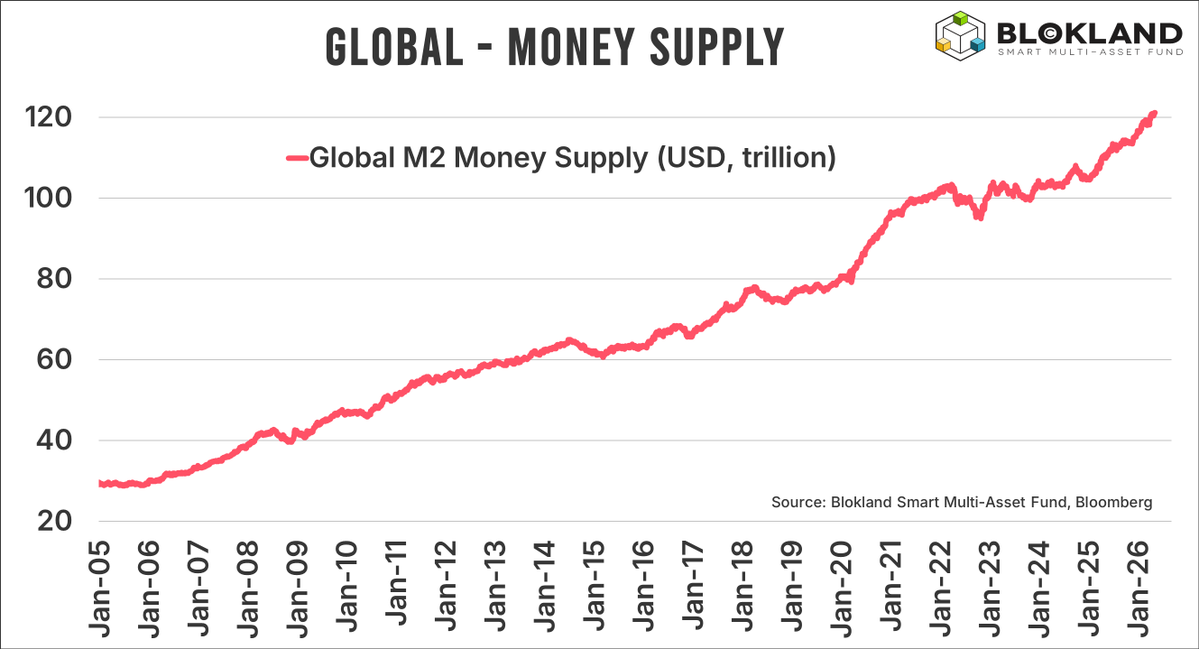
Global money supply is currently growing at an annualized pace of roughly 11%. Since COVID, global money supply has risen by approximately 53%, equal to about 7% annual growth. Since the Great Financial Crisis in 2008, the global money supply has nearly tripled, also compounding at an average annual rate of 7%.
Yet because central banks remain narrowly focused on consumer price indices, and because there is so little understanding of the historical meaning of inflation and its direct relationship with money creation, very few people truly grasp how enormous inflation actually is.
#MAGA Make Argentina Great Again!
The Trump administration is planning to temporarily reduce tariffs on beef imports...enabling more <beef> to enter the U.S. at low rates. https://t.co/J7ccZJlNAG
This is one of the most intriguing charts in the world right now.
Not necessarily because China’s annual CO2 emissions are on another planet, we all know that already, but because climate ideology remains almost entirely centered in Western Europe.
If you truly believe that frustrating housing development, blocking roads, gluing yourself to buildings, or throwing soup at priceless art is the way to make the world better, why are you not doing it where it has the biggest impact?
If you believe in catastrophic climate projections, including the extreme scenarios that even the United Nations is now moving away from, and if you believe that destroying things and severely disrupting people’s lives is the way to reduce CO2 emissions, then at least focus on where the biggest reductions can actually be achieved.
Instead, after years of societal damage, activists keep demanding more idiotic measures in countries that have already cut emissions and are nowhere near China’s levels.
In Europe, climate ideology has produced massive imbalances: housing shortages, energy insecurity, loss of competitiveness, industrial decline, wealth destruction, and rising polarization.
All without anything close to a meaningful global reduction in CO2 emissions.