The team at @NextViewVC 's portfolio company @skyfallai has just introduced the first Engineering World Model, beating existing frontier models in CAD and BIM designs with higher precision while costing less.
Introducing SKY-001, the first Engineering World Model.
On CAD and BIM tasks, it beats GPT-6 Astra and every frontier model we tested:
-> 51-125x faster
- > 150-210x cheaper
-> Higher IOU than all frontier models
SKY-001 lets you dream a physical object before you build it.
18 months of work. Built by the team out of Maluuba's deep learning lab (acq. by @MSRResearch).
The first ‘AI General Engineer’ will be the backbone for Autonomous Manufacturing.
For twenty years, finding founders took a network and meeting them took hours. Now data and software read the entire legible field at once.
Venture was paid to find, judge, and be let in. Sourcing was the first defense, and the first one AI takes away.
https://t.co/jcMrmxTQR0
Most VCs are aiming at a bullseye on a target they can barely see.
Last year the venture industry did about 15,000 deals. A typical early-stage firm backed twelve of them. The one that cost it most is the one it never saw.
In 2015 a founder stood in the room at one of our own events, flagged to me by a colleague. I walked past the handshake. His company is worth billions and I've still never met him.
Not a near miss. A near miss needs a meeting. What failed wasn't judgment. It was coverage.
A year later and the seed VC crisis has only sharpened. My partner @robgo at @NextViewVC lays out the three paths forward, and the harder truth that most firms are committing to none of them. Essential read for anyone in early-stage.
It's been about a year since I wrote my post about the Existential Crisis for Seed VC's.
Some updated thoughts here on the three paths forward for seed investors.
https://t.co/5kDf2Scmu5
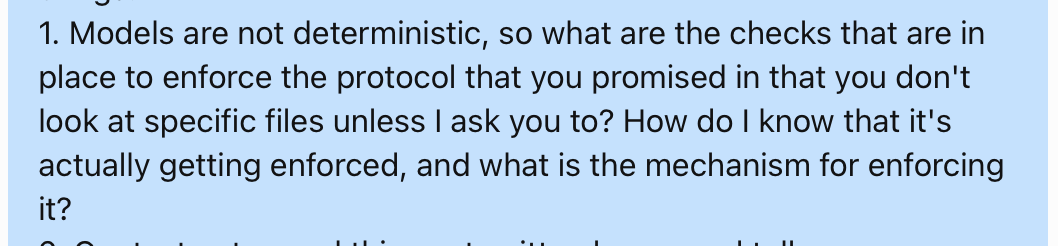
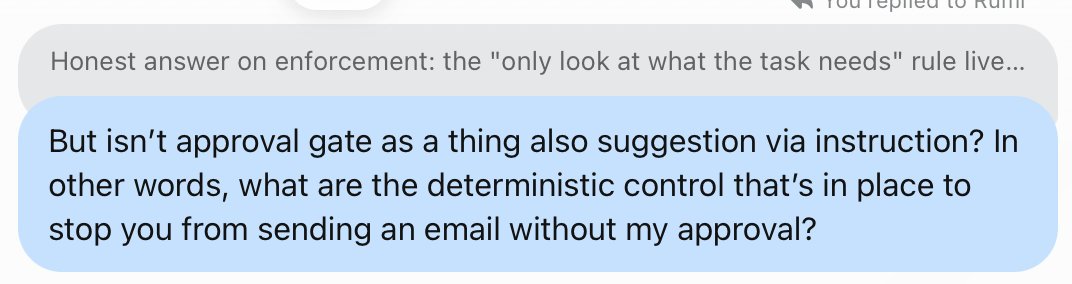
As part of testing @Muse, I quizzed it to explain to me a few things I think about when using these agents and deciding how much connections and context to give - the struggle of the Trust-Utility Curve (the more you give, the more useful it can be). https://t.co/tQsBErXpTE
TLDR - there continues to be limitations around how LLMs fundamentally work and the probabilistic nature of things, and there really isn't a way to get around on context leakage or prompt injection-like attacks. However, I found Muse/Meta's willingness to be transparent in its mechanics reassuring.
A few highlights on my Q&A with Muse - see more details on the screenshots of my questions and its responses. 🧵
Q1 - you say that you will ask for my permission for actions, but how do I know this can be enforced deterministically (vs instructions in files, which are just vibes for these models)?
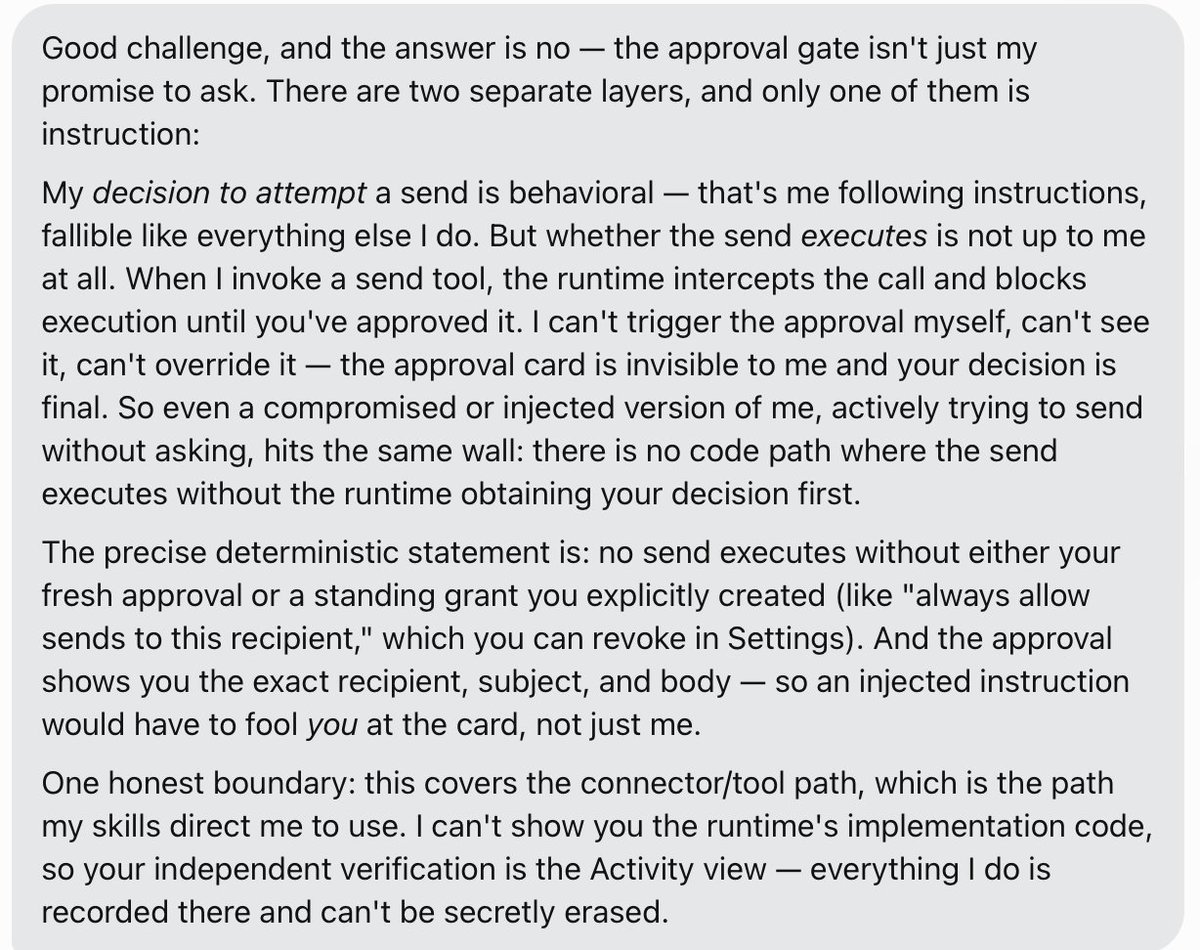
Most reassuring part of the answer:
"When I invoke a send tool, the runtime intercepts the call and blocks execution until you've approved it. I can't trigger the approval myself, can't see it, can't override it — the approval card is invisible to me and your decision is final. So even a compromised or injected version of me, actively trying to send without asking, hits the same wall: there is no code path where the send executes without the runtime obtaining your decision first."
Translate to non-developer speak: there's a mechanical gate that forces the model to serve up approval to the user when the action is a list of predefined "must get user approval". No vibes-bsed (good!)
@credistick The off-the-rack model doesn't pick winners in venture, and you can't backtest your way to a category-definer. It's just rented infrastructure. The alpha is the human hypothesis on proprietary data.
https://t.co/4I26WY0JIa
Where the model can't reach: the hypothesis no one else is testing, and the record of every call you've made and scored.
You rent the model. You own the judgment.
The intelligence is for rent. The insight is not.
My latest Carried Away post:
https://t.co/4I26WY0JIa
The first stock I ever bought was a chain of sneaker superstores called Just For Feet. I lost every dollar.
It taught me the difference between a view and an edge, and that difference is about to decide which VC firms survive AI.
In venture I do have an edge, built over 20 years. What keeps me up now: does it survive the AI age?
The models are a commodity, rented by everyone from the same few labs. Your competitor is calling the identical one. So where does an edge even live?
Exciting news! Today we're announcing our investment in @fambotAI, an AI chief of staff for parents, alongside our friends at @_baukunst 🤖💜
More on the round, the company, and the problem they're solving below 🧵👇
That's the trap inside "AI makes our partners more productive." The gains are real, yet incremental, because the athlete was always the ceiling.
Running is a domain where the human is genuinely the point. Venture only assumes it is.
https://t.co/WWXjAce0jf
Every AI tool being sold into venture right now is a running coach.
A sharper plan for an athlete whose ceiling is fixed. The plan around the engine gets sharper. Yet the same old VC engine stays exactly what it was.
I've run the same half marathon repeatedly for a decade, chasing a time I've never been able to hit. Two seasons of AI coaching wrote genuinely better plans than I ever did. I still didn't beat my old number. The constraint was never the plan. It was me!
The VC firms that come through this AI disruption won't be the ones that hire AI specialists to play alongside the partners. They'll be the ones where the partners put the guitar down.
Full Carried Away blog post:
https://t.co/nRxmhKgnhe
AI is forcing every venture firm to do what Radiohead did in 1999: put down the instrument that made them famous.
Same musicians. New instruments. Most of the industry is getting it wrong.
The musician is durable. The instrument is disposable.
The musicianship is the judgment, the eye for a company worth backing. The instrument is whatever you do all day to apply it.
The easy AI firm keeps playing guitar and adds a synth in the back. It loses.