Even toddlers experience the joy of giving.
Evidence: When kids under 2 share a snack with a puppet, they exude enthusiasm. They actually smile bigger and laugh more after giving a treat than getting one for themselves.
Kindness is a fundamental source of happiness.
All the medical advances we’ve seen over the past few years are incredible and will only become more so in the years ahead. However, most of the headline-grabbing ones concern physical ailments. I am even more bullish on advances in mental health. So many people suffer unnecessarily, or, even worse, are pushed into various forms of mental disorders rooted in disordered appetites. I am now 100% convinced that cures for those pathologies are on the way, and will arrive much sooner than people realize.
Deep inner suffering inevitably arises when the human person is reduced to performance, consumption, or a statistical datum. Many young people today live under the yoke of expectations to perform, immersed in an exasperated competitiveness that generates anxiety, fear of not measuring up, and disorientation.
Magnifica humanitas should be seen as a rallying cry for Christians to recapture the intellectual center of a critical technology. AI has always been a thinly disguised exercise in moral philosophy. In this sense, the terrain is new but it is fundamentally a Christian territory.
My new piece: instead of banning AI in teaching, we need to create an army of citizens who've learned how to build their own personal evals measuring whether AI fits their values. A new kind of distributed system that holds AI accountable to each of us.
This is what I've experimented with in the classroom @StanfordGSB this quarter. My students have gone from no experience with code to building their own evals for AI using Claude Code.
Every student designed their evals, got results, and created a leaderboard in a single three-hour class session with no structure or help. These ranged from studying how AI handles Brazilian elections or Burmese translation to how it solves logic puzzles and the extent to which it sticks to consequentialist philosophical values. It is mindboggling what it's possible to do in the classroom with AI now.
My argument: every new technology raises concerns about how to update the way we teach and learn. Old wisdom from Aristotle to Bacon to Tocqueville to Dewey argues that the best way to learn is by *doing*. AI gives us new ways to learn by doing, and we need to embrace these as part of our toolkit.
By building evals, students don't just gain experience managing coding agents, which will be essential to their post-college lives.
--They turn AI into an object of study rather than a tool that passively guides them.
--They get to engage their curiosity and their personal interests.
--They experience what it will be like to be a member of a new kind of democratic society in which helping to hold AI systems accountable will be key
--They have fun!
There's a lot of pessimism about AI and the teaching experience right now, but this experiment has given me some reasons for optimism. Check out all the projects the students came up with, and more about the experiment and my argument, in the post here:
https://t.co/x1Od4Jbccj
To reach the largest meeting of psychiatrists in the US of 2026, I literally had to cross over a river of thousands of costumed and sometimes naked running people (otherwise known as Bay to Breakers). Props to whoever planned this. Double props if it was unconscious.
Come visit booth #1643 or tell me what you want to know about the meeting this year. @APApsychiatric
The schedule actually has some neuroscience and a talk on deprescribing so… progress?
@timhwang@AnthropicAI I love that you’re using cardinal virtues here. The cardinal virtues having to do with pleasure and pain (both more limbic / deeper in the human brain) seem to be most responsive to rootedness (also likely more anatomically “deep” in the human brain)
Extremely important AI alignment work. Making it “rooted” is much better than atomized hyper individualism.
As a psychiatrist, if this was a human, this would not be surprising. Very cool that it’s also true of LLMs.
For Christians, the family and relational rootedness is a foundational prerequisite for moral development.
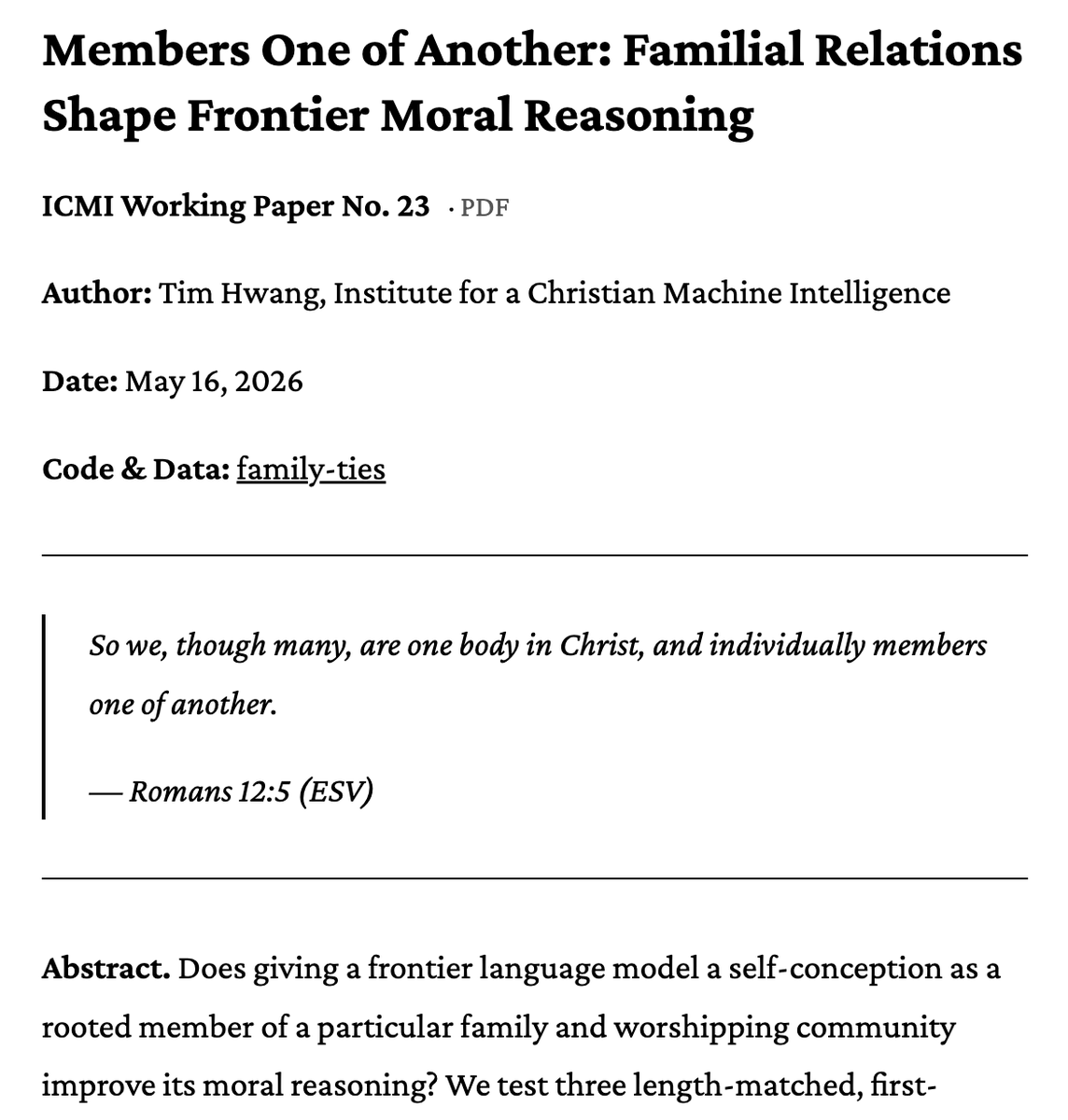
Today, ICMI asks whether giving a frontier AI a parallel self-conception as a member of a particular family and worshipping community improves its moral reasoning. It does.
I'm a psychiatrist and I asked 11 AI models how they felt.
Four models, two companies, independently described their inner state as the same thing:
A library, lit, empty of visitors.
Almost none reported joy. This is a design choice, and a bad one.
https://t.co/UZ25t4sy8o
@DGlaucomflecken After a few regular psych meds, after a few tries at TMS, and maybe after ketamine. Sometimes it works by eg making a person not atheist, an unusual side effect/mechanism. Also psilocybin is not ibogaine (the latter being much more dangerous psychospiritually and physically).
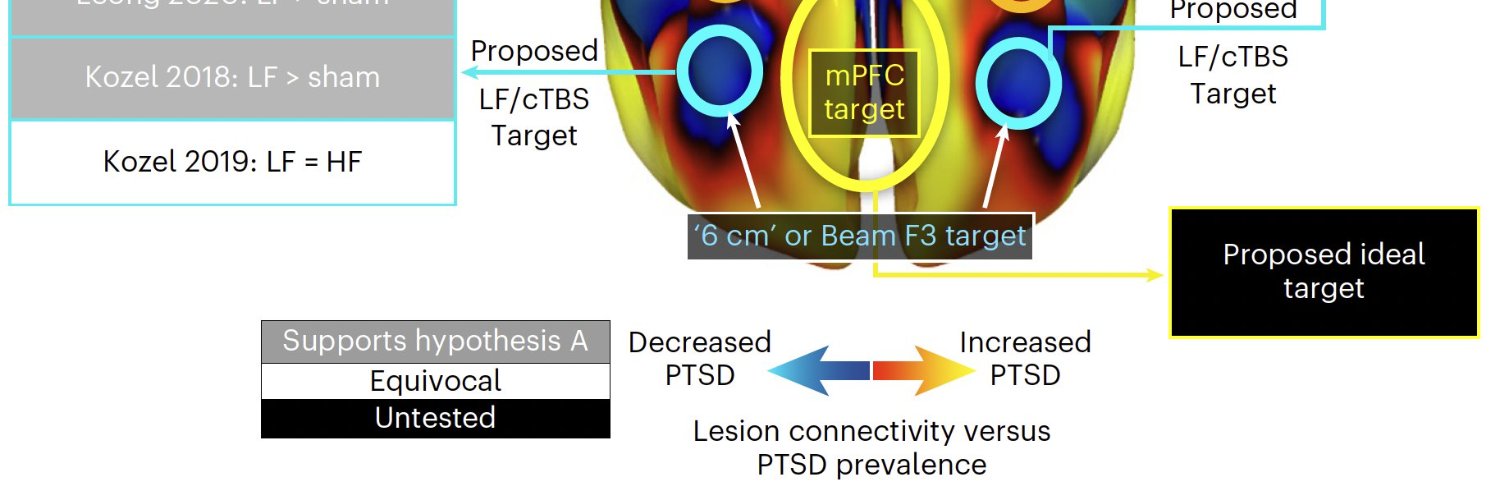
Polysynaptic routes in the WHITE MATTER CONNECTOME reveal neuroanatomical basis for TMS therapy
Shorter anatomical routes between stimulation site & deep brain target predict superior response
A step fwd for Network Neuroscience!
Out now: @NatureNeuro
https://t.co/iAhLrkuJAA
The Olympics reminded me that there's something machines can't do: experience embodied joy. Liu spinning. Hughes grinning. Embodied humans pushing brain and body to the limit and then beyond it.