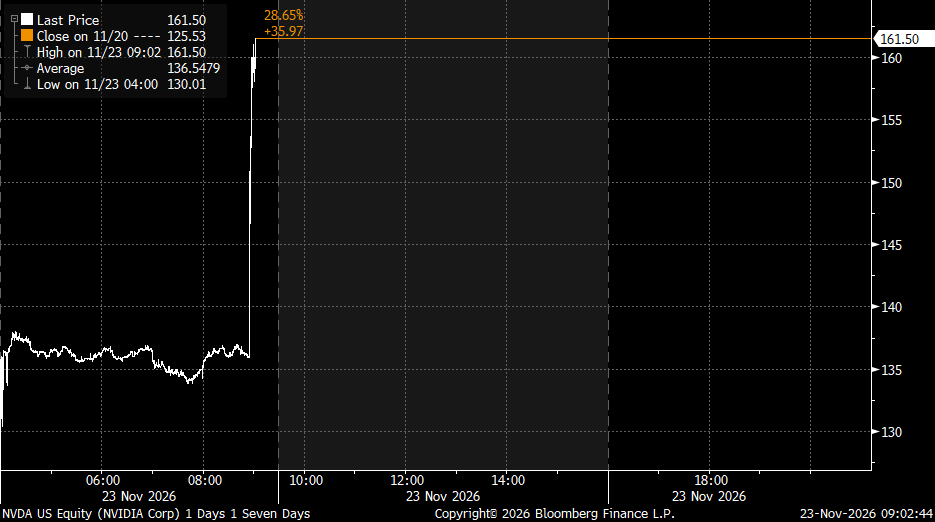
Kalshi and Polymarket will have a market on Jensen's pardon any moment. I can't see him staying at the helm again without it. BoD will need pardons too.
"Trade for long enough, and you discover that the market has a godlike ability to peer into your soul, learn your character flaws, your private fears, weaknesses, pain thresholds. And the market uses this knowledge to tease you, sometimes letting you get away with recklessness, rewarding your greed, luring you to commit more brazen sins. At other times it creates false hope that you’ll escape whatever predicament you’ve gotten yourself into, allowing you to believe your own lies, letting you imagine you’ll slip its grasp this one time. Just like it did to leveraged Nvidia longs this Tuesday evening, when a blowout earnings report lifted the stock sharply higher after hours. By Friday's close it had lost 23% on the week. The process wears you down, so that at your weakest moment you puke positions at the absolute low, knowing it’s almost certainly a mistake, but grateful to end the torture. And breathe again.
When enough people hold the same view and pair it with arrogance, the market rounds up the herd and culls it in a violent flush. One man’s stop loss pushes price lower to the next man’s point of maximum pain, a runaway wildfire, a scorched earth cleanse. Sodom. Gomorrah. Like in February 2018, when the sellers of equity volatility watched their hallowed inverse VIX products lose 96% of their value in a ferocious afternoon. There was no specific catalyst. No real reason. Just the market gods at work. And it’s the very personal struggle with this omniscient superintelligence that makes those of us who have survived more introspective and humbler with time. It keeps us on the lookout for those moments when the herd has been rounded up and is being led to slaughter. Doing everything in our power to avoid that fate, and to capitalize on the chaos."
Eric Peters, One River Asset Management
The Russian Russian Project 20380 Steregushchiy-class corvette Mercury in Benghazi, Libya exploded today in what has been attributed to a Ukrainian strike. The corvette, which was in port after escorting shipments to the northeastern port held by Khalifa Haftar’s forces, has reportedly sunk, although definitive details on that have yet to emerge. Should the incident be confidently attributed to Ukraine, the strike would mark a notable expansion of Ukrainian strike capabilities.
Moment that a Ukrainian surface drone struck a Russian military-linked cargo vessel earlier off the coast of Benghazi, filmed from a helicopter with the Libyan National Army’s Air Force.
🚨LOOK AT HIS EYES!!
This video from New York City Mayor Zohran Mamdani is freaking me out and I will include a link to the original video to prove it's not fake, not AI, you can see it for yourself!
WHAT THE HELL IS GOING ON WITH HIS EYES?
I have just completed a three-day swim through the Strait of Hormuz to draw attention to the devastating environmental consequences of war.
Just 30 minutes after I began swimming, an oil tanker was struck a few kilometres away. The explosions rocked the sea around me. Over the following days, I witnessed further attacks on commercial shipping and saw vessels engulfed in flames.
War causes immense human suffering. Lives are lost, families are torn apart, and homes are destroyed. But there is another casualty that receives far too little attention: nature itself.
The Strait of Hormuz is one of the most beautiful places I have ever visited. Towering mountains rise above spectacular fjords. There are coral reefs and mangrove forests, and waters home to dolphins, sea turtles and dugongs. It is one of the great natural wonders of the world.
Yet this extraordinary place is now caught in the middle of a war. Oil tankers, gas carriers and other merchant ships are being attacked. The environmental consequences will last for decades.
My message is simple: Stop the fighting. Open the Strait. Clean up the pollution.
Please help share this message.
#HormuzSwim
Anthropic: The Committee of Public Safety IPO
Anthropic went public today.
It’s the first company built by “effective altruists” to go public. Thus, I’m certain most investors have no idea what they’re buying, or how dangerous the company’s charter is, not only to investors, but to humanity.
Effective altruists believe that capitalism is a flawed system because it relies on self-interested actors competing in markets. They believe they’ve created a better system, a way of creating value that’s based on doing what’s best for the “common good,” not greedy shareholders.
Anthropic is a Delaware “public benefit corporation.” Its charter assigns it a purpose: the responsible development and maintenance of advanced AI for the long-term benefit of humanity.
Its directors are required to balance three things: the financial interests of shareholders, the interests of everyone materially affected by the company’s conduct, and that purpose.
What in the heck does that actually mean?
It means that the company’s directors can do whatever they want. They aren’t accountable to the shareholders. They’re accountable “everyone,” which effectively means they’re not accountable to anyone.
A director who sacrifices your returns for the long-term benefit of humanity is deemed to have met his duties so long as the decision is informed and disinterested. Anthropic’s own prospectus concedes there is limited judicial precedent on how courts will judge that balancing. Thus, Anthropic’s board is completely unaccountable to its owners.
And… who selects the board…?
A Long-Term Benefit Trust holds a single share of Class T stock. That share carries no economic rights and no expiration date. It gives the trust the power to elect and remove four of Anthropic’s seven directors: a majority of the board. The filing describes the trustees as financially disinterested,with backgrounds in AI safety, national security, public policy and social enterprise. The men and women who pick the majority of the board of a $1.5 trillion company have not a dollar of their own at risk in it.
And the other directors?
The seven co-founders hold a single share of Class F stock through an entity called Founder LLC. That one share carries 50.1% of the vote on nearly everything else shareholders decide, including the election of the other three directors. The filing says that voting power will not be subject to dilution. Counting their own shares, the founders control about 61.3% of the vote. Each has pledged to give away 80% of his or her stock. A founder keeps a seat in the LLC so long as he holds just 2% of his IPO-era shares.
One of the most powerful technology companies that’s ever been created is going to be controlled by a group of completely disinterested directors who believe they know what’s best for the common good.
What could possibly go wrong?
Here’s what one of the founders of the world’s largest altruism movement believes about the near-term future, thanks to technology:
“Man at last will begin to harmonize himself in earnest… He will try to master first the semiconscious and then the subconscious processes in his own organism, such as breathing, the circulation of the blood, digestion, reproduction, and, within necessary limits, he will try to subordinate them to the control of reason and will… in order to reduce the fear of death to a rational reaction of the organism towards danger… Man will become immeasurably stronger, wiser and subtler; his body will become more harmonized, his movements more rhythmic, his voice more musical... The average human type will rise to the heights of an Aristotle, a Goethe... And above this ridge new peaks will rise.”
Dario Amodei, the chief executive of Anthropic (ANT), believes exactly the same ideas.
In 2024 he published an essay called Machines of Loving Grace. In it he wrote virtually the same words: weight, physical appearance, reproduction, and other biological processes will be fully under people’s control. He predicts the next 50-100 years of biological progress in 5-10 years, and a doubling of the human lifespan to 150.
What’s the problem?
That first description of the coming technological revolution (above) was written in 1924 by the leader of the world’s first effective altruism movement, Leon Trotsky. It’s from the closing pages of his book Literature and Revolution. Yes, the communists were avowed altruists. They sought to create a “perfect man” that would always act for the common good. “The average human type will rise to the heights of an Aristotle, a Goethe, or a Marx.”
Trotsky built the Red Army. In September 1918 he ordered the families of officers who defected to the enemy be arrested, so every officer knew his wife and children were hostages. Then he hung them all. For the greater good, of course.
These kinds of revolutions always devours their own. Stalin had Trotsky expelled from the party in 1927 and deported from the Soviet Union in 1929. In 1936, a Moscow show trial sentenced him to death in absentia. In May 1940, Stalinist gunmen sprayed his bedroom in Mexico City with machine-gun fire. Then, on August 20, 1940, Ramón Mercader, a Soviet secret-police agent who had worked his way into Trotsky’s household, drove a mountaineering ice axe into his skull as he sat reading at his desk.
Effective altruism, like communism, began with an appealing idea: give to charity using evidence, not sentiment. Its leading thinkers concluded that because the people who will live in the distant future vastly outnumber the people alive today, the most important moral work is preventing events that could wipe out that future.
Of course, if you accept that logic, then virtually any present sacrifice can be justified by the trillions of hypothetical lives on the other side of the ledger. It’s a preposterous idea. And it reveals a profoundly naïve false belief in their own judgment.
In March 2022, the economist Tyler Cowen asked Sam Bankman-Fried, then effective altruism’s most famous donor, whether he would take a bet with a 51% chance of doubling the Earth and a 49% chance of destroying it, and keep playing double or nothing. Bankman-Fried said yes. Eight months later his exchange, FTX, collapsed. A jury convicted him on seven counts of fraud and conspiracy. A federal judge found Bankman-Fried stole $8 billion and sentenced him to 25 years.
It’s arrogance to the level of insanity to believe that you know what’s best for everyone. It’s arrogance beyond the level of insanity to believe you have the right to other people’s property because you know what’s best for them.
Look at Anthropic's charter. Is there a meaningful difference between what Sam Bankman-Fried did and what Amodei has done with the structure of Anthropic? I don't think so. These people believe they know what's best for everyone. And they're going to do what's best for the "common good."
And where do these ideas always lead? To totalitarian systems of control.
In 1762, Jean-Jacques Rousseau wrote that society rests on a general will, and that whoever refuses to obey the general will shall be compelled to do so by the whole body. Thirty-two years later, his most devoted student, Maximilien Robespierre, told the National Convention: Terror is nothing other than justice, prompt, severe, inflexible; it is therefore an emanation of virtue.
Robespierre’s Committee of Public Safety arrested about 300,000 people. Roughly 17,000 were tried and executed. Thousands more died in prison or without trial.
The Bolsheviks replaced the general will with the dictatorship of the proletariat. Same idea: a vanguard that could see the good the masses could not.
Mao Zedong’s Great Leap Forward promised to move China into industrial abundance – for the common good. Planners in Beijing set the targets, and the peasants starved. Demographers estimate the famine of 1958 to 1962 killed somewhere between 15 million and 45 million people.
You might object that these were fanatics with guns, and that the people running Anthropic are scientists with data centers. But, it’s only a matter of time before they will create a reason to start killing people.
In the early twentieth century, American scientists, reformers and philanthropists embraced eugenics: the idea that society could breed out disease, poverty and crime with the help of science. It called itself evidence-based. It was impartial and long-termist, concerned with the welfare of generations not yet born. It was all for the common good.
The Supreme Court ruled on it in 1927. By a vote of 8 to 1, the justices let Virginia sterilize a young woman named Carrie Buck. Justice Oliver Wendell Holmes, the most celebrated legal mind of his era, wrote: Three generations of imbeciles are enough. Somewhere between 60,000 and 70,000 Americans were sterilized against their will.
C.S. Lewis best explained the unique danger of these kinds of ideas. "Of all tyrannies, a tyranny sincerely exercised for the good of its victims may be the most oppressive... those who torment us for our own good will torment us without end for they do so with the approval of their own conscience."
Alas, there is no such thing as the common good.
There are only goods, plural: the particular wants of particular people, which conflict constantly.
You want a cheaper car. The autoworker wants a higher wage. The retiree wants a safe yield, and the founder wants your savings for his start-up.
No committee – and no data center – can add those wants into a single number called “the good” and then maximize it. The wants are not knowable in advance, even to the people who hold them, until they have to choose.
But you cannot choose for others. You can only choose accurately for yourself.
That is, acting in your own best interests is a vital part of the system.
Friedrich Hayek spent his entire career explaining why self-interest is integral to a functional free market. The curious task of economics, he wrote in 1988, is to demonstrate to men how little they really know about what they imagine they can design.
The knowledge that runs an economy is not understood by one man or group of men. It is not contained by any machine – not even a superhuman AI.
The knowledge that runs an economy is local, tacit and scattered. It surfaces only when people with something at stake make choices.
That is how what is “good” gets discovered: one transaction at a time, by people who bear the consequences of their choices.
Adam Smith wrote the most famous sentence in economics: It is not from the benevolence of the butcher, the brewer, or the baker, that we expect our dinner, but from their regard to their own interest. The merchant, Smith wrote, intends only his own gain, and he is in this, as in many other cases, led by an invisible hand to promote an end which was no part of his intention. Then comes the line that every American should know: I have never known much good done by those who affected to trade for the public good.
Anthropic’s shareholders are about to learn this lesson the hard way. And I hope they're the only victims.
I don't think I could say this any better than the way Demetri just did. I would add that irregular warfare as doctrine is scaling rapidly and forecasting those impacts is increasingly complex.
Mobilization at scale is what people tend to associate with world wars. I’ve long felt that World War III would look very different and that we would take longer to recognize it once it had started.
The Internet and dual-use technologies have turned all of human society into a battlefield. For the entire post-WWII period, the human suffering wrought by war has largely been relegated to battlefields far away. I don’t expect that to be true for much longer, though we may not immediately recognize the encroachment of war onto our societies when it arrives. Furthermore, AI’s advanced capabilities, combined with the adversarial information environment and the lack of leadership in Washington, mean that it will often be impossible to know what is happening and who is doing it.
I think more and more of my grandfather and his generation who lived through war and famine and raised their children in the aftermath of what Robert Fisk described as "the total failure of the human spirit" in his book The Great War for Civilization.
What we are living through now feels cosmic. Humanity tearing itself apart as it works its way to the core of modern civilization. Growing up, I used to wonder how societies could have allowed things to spin so badly out of control in the lead-up to both world wars. I grew up believing that such barbarities were no longer possible. That civilized men wouldn’t allow them to happen. I no longer believe that. There is something ingrained in us as human beings that desires and perhaps even demands violence and the cleansing that it brings to the social order as the solution to problems too complex to be solved through diplomacy and politics, even if it comes at the expense of the human spirit.
I no longer hold out hope for a peaceful transition through what it is that ails us. Unfortunately, we will have to walk through the fire to arrive at whatever world awaits us on the other side. I have little doubt that we will find a way to build a better world by the end of it, but I think we all need to understand what we are stepping into and prepare ourselves and our families for a great deal more suffering to come.
Incredibly sad to see @russtarg is no longer with us.
I had the absolute privilege of speaking to him on the podcast more than 2 years ago.
He lived an incredible life.
❤️
NEW:
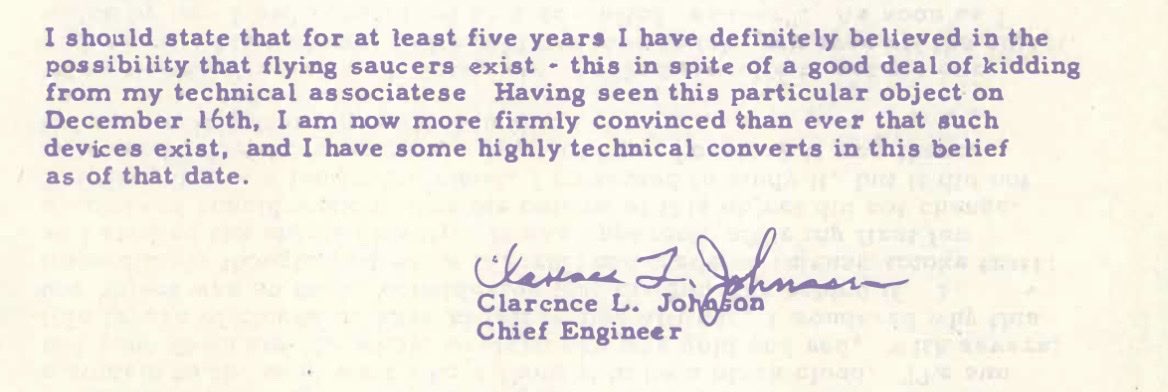
Today’s PURSUE release includes the full 1953 UAP report from legendary Lockheed aerospace engineer Kelly Johnson (U-2, SR-71) and Lockheed’s top test pilots/engineers.
The incident left Johnson “more firmly convinced than ever that [UAP] exist.”
https://t.co/YMYdLjBpAd
@NYTimesPR Impossible to believe this was originally published in good faith. The relationship between both governments is well known and mission aligned. ADLE literally ran his campaign on this joint objective.
@bullionsupermkt Spot on. Occupy Wall Street misled an entire generation in to believing that was capitalism. Capitalism would have let the fire finish burning through the canyon rather than conduct bail outs.
One of the main reasons young people take the bait on this is because they feel the system has failed them. They think, mistakenly, that capitalism has failed them. Unfortunately that's not true. We don't have true capitalism in America. We have corporate socialism. We have incestuous relationships between private companies and government and the corruption is deeply bipartisan. The answer is not more government, the answer is less. Legalizing theft from one group of Americans to subsidize another group of Americans will make everyone poorer. This is well tested and predictable. Prosecute corruption full stop and let entrepreneurs create the solutions we need rather than bureaucrats.
The best deal in town? Donating to NYC-DSA.
For just $5, $15, or $50 a month, @nycDSA sent 16 socialists to Albany, 4 to the City Council, 3 to Congress, and 1 to Gracie Mansion.
Donate monthly to the organization building a city we can afford: https://t.co/zrvyVk2WAu.