OpenAI just introduced SORA: new text2video #AI model.
While everyone is just posting mind-blowing examples, I want to talk about the consequences.
A thread 🧵🔽
Mi sono finta una ragazza interessata a lavorare come stagionale. In tutta Italia. Ho pubblicato uno stesso identico annuncio in 20 diverse località italiane, da nord a Sud, e nel giro di pochi giorni ho ricevuto più di 200 richieste di contatto da parte di imprenditori.
Il quadro che emerge, però, è veramente sconfortante.
https://t.co/Cad12yVixU
Artificial life (often abbreviated as "ALife") is a field of research that explores the creation and study of synthetic systems that exhibit behaviors and characteristics associated with living organisms. It involves the use of computer simulations and other computational techniques to model and investigate the behavior of biological systems, with the aim of understanding the principles of life and creating new forms of life-like entities.
Artificial life can encompass a wide range of activities, from simulating the behavior of individual cells to modeling entire ecosystems. Some researchers in the field focus on creating artificial organisms or robots that can learn, adapt, and evolve in response to changing environments, while others study the emergence of complex systems and patterns in nature, such as swarming behavior or the growth of cities.
Overall, the goal of artificial life research is to gain insights into the fundamental principles underlying living systems, as well as to develop new technologies and applications that draw inspiration from biological processes and systems.
The classic example of a cellular automaton and artificial life is John H. Conway's Game of Life, which consists of a grid of cells that can be in two states, "alive" or "dead." The rules dictate how cells evolve based on their neighbors, and the patterns that emerge can be surprisingly complex.
The clip shows Lenia by @BertChakovsky, a two-dimensional system with continuous space and time, where each cell's state is determined by its neighbors' states, as well as its own position and velocity.
Lenia has been praised for its ability to create complex and interesting patterns, as well as for its potential applications in fields such as physics, biology, and artificial intelligence. It has also gained a following among enthusiasts who enjoy exploring its vast and varied behavior.
Overall, Lenia is a fascinating example of how simple rules can give rise to complex and unpredictable behavior, and it has contributed to the growing interest in the field of artificial life and cellular automata.
[read more: https://t.co/ixlROfWvgU]
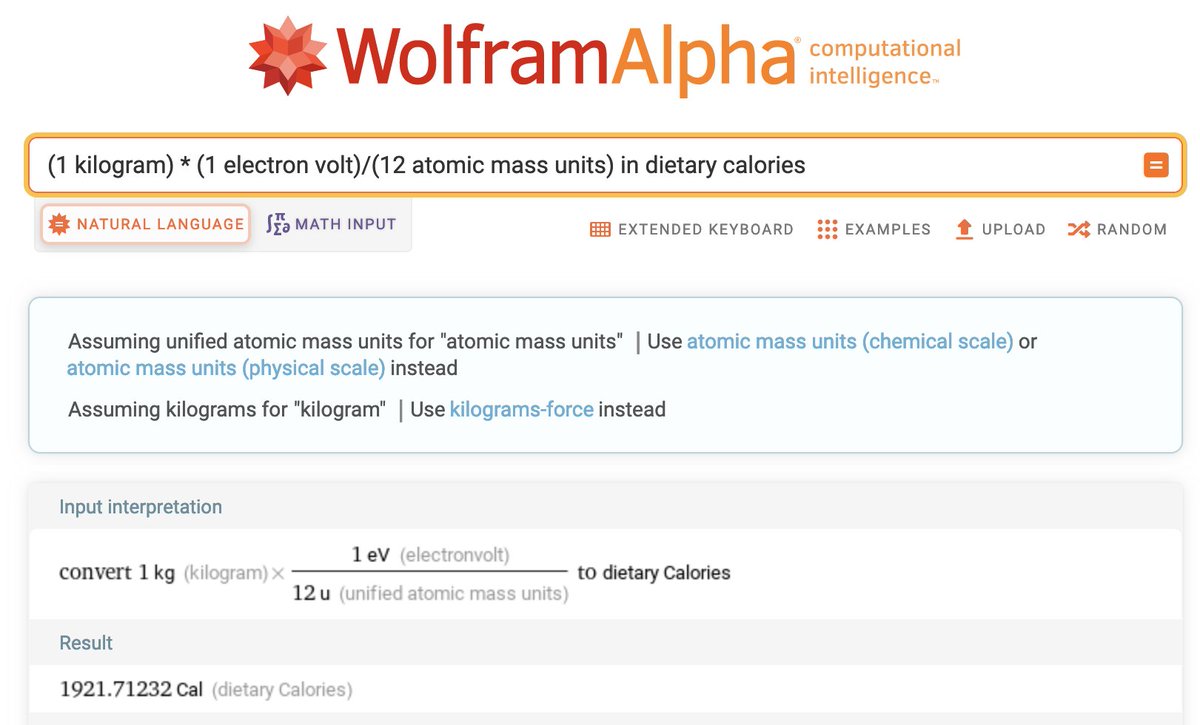
A person needs to eat about a kilogram of food per day. You can estimate this by saying that a person extracts about 1 electron volt of energy (the characteristic energy difference between atomic orbitals) per carbon atom mass consumed.
Merging art with AI. Using the new Outpainting capability,DALL-E 2 imagined how the landscape could look like between famous impressionist paintings from Van Gogh, Monet, Munch and Hokusai
[source, read more: https://t.co/boZvv4yUkn]
🌊 VIRGO: osservato un insolito segnale di onde gravitazionali che, secondo l’analisi dei dati, potrebbe nascondere un messaggio in codice.
➡️ Per saperne di più: https://t.co/GHOJWWXM1q
In 1951, Adelbert Ames created the mind-boggling ‘Ames Window’. It’s so effective that even when you know how it works you can’t break the illusion
[video from The Curiosity Show: https://t.co/DF82ASFj1a]
Does glass break faster than a bullet?
Since the vibration transmitted through the glass is much faster than the speed of sound in the atmosphere, the breaking speed of the glass is much faster than the bullet.
[📹 Slow Mo Guys: https://t.co/RW3RTn7O5k]
Top quarks have been observed to play in quartet 🤩! This marks the first observation by CMS of the simultaneous production of four top quarks, opening the door to new and exciting physics. #cern#moriond 👉 https://t.co/nWU0jN9SRH 👈