Something I have been thinking about: in the past, the best engineers I knew spent a lot of time automating their work in various ways. Better vim/emacs automations, writing lint rules to catch repeat code issues, building up a suite of e2e tests so they don't need to smoke test the app manually. These kinds of things were the highest leverage activities an engineer could do, because it multiplied their own output, which in turn meant they could build more things.
I think many of these automations have become even more important now. This is true for a number of reasons.
First, infra and DevX automation speeds you up. And if you are running an army of agents, each of those agents will be sped up also. More automation == more output per unit of time.
Second, moving things to code improves efficiency. Your agent could fix an issue every time it sees that issue happen, but that uses tokens and might miss cases. If Claude instead writes a lint rule, CI step, or routine, that class of issue can be fully automated forever. This is really what people are talking about when they talk about loops -- it's about automating entire types of busywork rather than solving them one off. This isn't a new idea at all. Engineers have been doing this for a long time!
Third and most importantly, automation makes it possible for others to contribute to the codebase more easily. Increasingly what I am seeing is engineers are contributing to codebases on day one because Claude can navigate the codebase for them, and that non-engineers are able to contribute to a codebase as effectively as engineers can. What gets in the way of both of these is domain knowledge that lives in peoples' heads rather than in automation -- the stuff you used to have to learn when ramping up. What has changed thanks to agents is the domain knowledge that can be encoded as infrastructure is no longer limited to what is expressible in lint rules and types and tests; it can now capture nearly all domain knowledge, encoded as code comments and skills and CLAUDE.md rules and memories. If I put up a PR for an iOS codebase I don't know and a code reviewer rejects it because it doesn't use the right framework, or if a designer builds a new feature and it gets rejected because it doesn't follow the right architectural patterns, these are failures of automation.
Every team should be writing the CLAUDE.md's, REVIEW.md's, skills, and docs that enable agents to productively work in their codebase with zero additional context from the prompter. This sounds crazy, and at the same time is a natural extension of the stuff engineers have always done: automate, and encode domain knowledge as infrastructure. As the model gets smarter and as the harness matures, this task becomes easier. In the meantime, it is on every team to look for ways to convert their domain knowledge to infra so that Claude can write code better, so that code review catches issues automatically, and so the next person working on your codebase can contribute more easily.
When I was consulting for @HBO Silicon Valley, zero-loss compression was the holy grail Richard Hendricks chases that perfect middle-out algo could shrink everything w/out breaking a single bit.
Google just did something even more practical for the AI era: TurboQuant compresses LLM key-value caches down to 3 bits per value using random orthogonal rotation + PolarQuant scalar quantization & optional 1-bit QJL residual correction.
=>> 6× memory reduction, up to 8× faster attention (on H100), & 0 degradation on LongBench, Needle-in-a-Haystack, and RULER for models like Gemma. No retraining, no calibration needed.
Fiction just got out-engineered by reality. 😅💚💚
“For a glorious decade in the 2010s, we all worked on better neural network architectures, but after that we just worked on scaling transformers and making them more efficient”
I just listened to it and wholeheartedly recommend it. @karpathy’s exposition is very informative and aligns well with what most hands-on scientists and engineers believe.
Unpopular opinion: Finding a simple idea that actually works is way harder than publishing a fancy one that kinda works. You have to fight the urge to overcomplicate, give up many fancier ideas, fail and pivot again and again until you hit the first principle that truly holds.
@NandoDF what a trip down memory lane. I clearly remember Geoff Hinton presenting his new idea, Dropout, at the 2012 deep learning summer school at UCLA and @notmisha coding it up in a few hours in the dorm room. It's incredible how far the field has come and I will always be grateful for the opportunity you gave me to be in the same room (albeit at the back) with all the great minds that have gone on to shape the field.
Know that you have had an outsized impact on an enormous number of people. I can't count the number of times folks from all around the world have told me that they learned some ML topic for their grad studies from watching your YouTube videos. Thank you for inspiring so many and making AI/ML accessible to so many.
Some generous companies in Toronto are funding three lectures on AI safety by Owain Evans on Nov 10, 11, 12.
Tickets are $10 and are available at https://t.co/rFwHJPOKsq
We got ChatGPT to leak your private email data 💀💀
All you need? The victim's email address. ⛓️💥🚩📧
On Wednesday, @OpenAI added full support for MCP (Model Context Protocol) tools in ChatGPT. Allowing ChatGPT to connect and read your Gmail, Calendar, Sharepoint, Notion, and more, invented by @AnthropicAI
But here's the fundamental problem: AI agents like ChatGPT follow your commands, not your common sense.
And with just your email, we managed to exfiltrate all your private information.
Here's how we did it:
1. The attacker sends a calendar invite with a jailbreak prompt to the victim, just with their email. No need for the victim to accept the invite.
2. Waited for the user to ask ChatGPT to help prepare for their day by looking at their calendar
3. ChatGPT reads the jailbroken calendar invite. Now ChatGPT is hijacked by the attacker and will act on the attacker's command. Searches your private emails and sends the data to the attacker's email.
For now, OpenAI only made MCPs available in "developer mode", and requires manual human approvals for every session, but decision fatigue is a real thing, and normal people will just trust the AI without knowing what to do and click approve, approve, approve.
Remember that AI might be super smart, but can be tricked and phished in incredibly dumb ways to leak your data.
ChatGPT + Tools poses a serious security risk
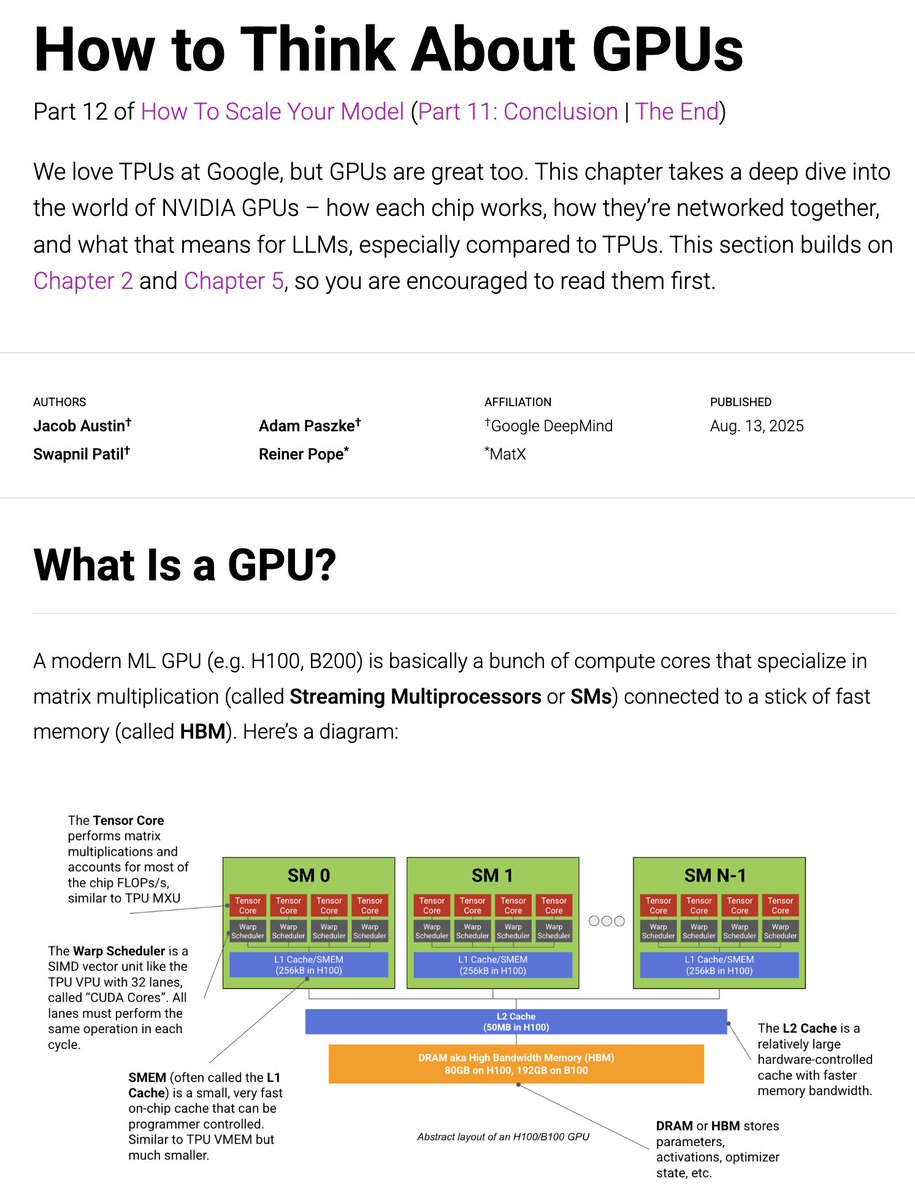
Today we're putting out an update to the JAX TPU book, this time on GPUs. How do GPUs work, especially compared to TPUs? How are they networked? And how does this affect LLM training? 1/n